

Succession planning is defined as the process of identifying and developing employees to fill critical leadership roles before a vacancy occurs. The role of succession planning in HR goes far beyond paperwork. It is a proactive function that protects business continuity, preserves enterprise value, and builds the leadership depth your organization needs to grow. Approximately 40% of CEOs leave unexpectedly within 18 months, and companies without a tested successor lose an average of 1.8% of enterprise value in the first month alone. For a $200 million business, that is $3.6 million gone before a replacement is even named.
What role does HR play in succession planning?
HR owns the design of the succession planning framework. That means building the tools, setting the process, and making sure the right conversations happen at the right time. Business leaders, however, own the talent assessments. HR and business leaders must share ownership of the process, or the program becomes a binder on a shelf that no one reads.
The core tools HR brings to succession planning include:
- 9-box grid assessments: A matrix that plots employees by current performance and future potential, giving leaders a clear visual of who is ready now and who needs development.
- Individual Development Plans (IDPs): Written plans that map specific skills, experiences, and timelines for each high-potential employee.
- Succession dashboards: Real-time tracking tools that show readiness ratings, bench depth, and gaps across critical roles.
- Talent review meetings: Structured sessions where HR facilitates honest conversations between managers and senior leaders about who is ready to step up.
HR also connects succession planning to broader talent management. That means linking it to performance reviews, learning and development programs, and employee retention strategies that keep high-potential employees engaged long enough to reach leadership roles.
Pro Tip: Schedule talent review meetings at least twice a year, not just during annual performance cycles. Readiness changes faster than most leaders expect.

Why does succession planning matter for small and mid-sized businesses?
Small and mid-sized businesses carry more key-person risk than large enterprises. When one leader exits without a ready successor, the operational disruption hits harder and faster. Between 27% and 46% of executive transitions fail or disappoint within two years. That failure rate reflects what happens when organizations react to vacancies instead of preparing for them.
The financial stakes are real and measurable. High-quality succession programs produce 2.2x higher total shareholder return over five years compared to companies with weaker programs. That compounding advantage comes from selecting leaders for future strategic capabilities, not just past performance.
Succession planning is not just a talent strategy. It is a value-protection mechanism. Boards that fail to maintain formal succession plans face rising D&O insurance premiums and potential derivative claims from shareholders. Courts have enforced board oversight obligations in this area under Caremark compliance standards, making succession planning a legal and fiduciary responsibility, not just a best practice.
Retention is another direct benefit. Organizations with clear succession pathways retain talent 2.4 times longer than those without them. Employees who see a future at your company stay. Those who do not will find a company where they can see one.
How does an effective HR succession planning process work?
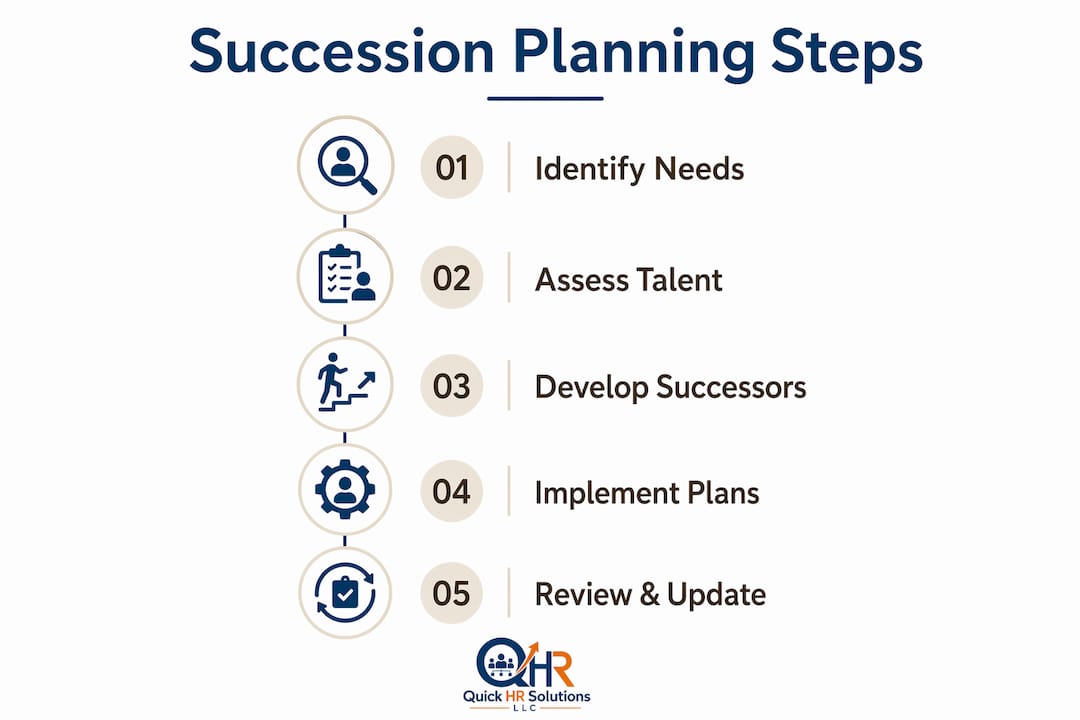
A well-run succession planning process follows four core stages. Each stage builds on the last, and skipping any one of them creates gaps that show up at the worst possible moment.
- Identify critical roles. Start by mapping which positions would cause the most operational or financial damage if left vacant. These are not always the most senior titles. A key technical role or a long-tenured client relationship manager can be just as critical as a VP.
- Assess current talent. Use objective tools like the 9-box grid, 360-degree feedback, and structured competency assessments. Data-driven assessments improve succession outcomes by removing the subjectivity that causes most leadership transition failures.
- Develop successors. Assign stretch projects, mentoring relationships, and leadership training programs. Senior role succession typically requires 12–36 months of deliberate development before a successor is truly ready. Rushing this stage is the most common mistake mid-sized companies make.
- Review and update regularly. Business strategy changes. People change. Succession plans need review every quarter or half-year to stay accurate. Annual reviews are not enough.
The comparison below shows how reactive and proactive succession approaches differ in practice:
| Factor | Reactive approach | Proactive approach |
|---|---|---|
| Trigger | Vacancy occurs | Ongoing identification |
| Candidate pool | One or two names | Multiple candidates per role |
| Readiness | Unknown | Tracked with timelines |
| Business impact | High disruption | Minimal disruption |
| Cost | High (external search) | Lower (internal development) |
Pro Tip: Involve your board or executive team in at least one succession review per year. When leadership owns the conversation, the program gets funded and followed through.
What strategies build a stronger leadership pipeline?
The most common succession planning failure is building a bench of one. Identifying multiple candidates per critical role with estimated readiness windows reduces single points of failure and gives the organization real options when a transition happens.
HR analytics make this possible at scale. When you track performance data, engagement scores, and development progress in one place, patterns emerge that intuition misses. The shift to objective talent selection methods is one of the clearest differences between organizations that execute succession well and those that scramble.
Strategies that consistently improve succession outcomes include:
- Transparency with candidates: High-potential employees who know they are being developed for leadership roles are more engaged and less likely to leave. Keeping succession plans entirely confidential often backfires.
- External advisors for gap roles: When no internal candidate is ready, an external search should start early, not after a vacancy is announced. HR should maintain relationships with search partners before they are needed.
- CEO and board accountability: Succession planning loses momentum when it lives only in HR. The CEO must champion it, and the board must review it. Without that accountability, the program stalls.
- Linking succession to HR strategy: Succession planning does not work in isolation. It connects directly to HR risk management, workforce planning, and the overall talent management cycle.
Pro Tip: Assign a readiness rating to each successor: "ready now," "ready in 1–2 years," or "ready in 3+ years." This forces honest conversations and makes gaps visible before they become crises.
A tested succession plan also improves company valuation during a sale or merger. Buyers discount businesses with key-person risk. A documented, active succession plan signals that the organization can operate and grow without any single individual.
Key Takeaways
Effective succession planning requires shared ownership between HR, business leaders, and the board, supported by objective data and continuous review.
| Point | Details |
|---|---|
| HR owns the framework | HR designs tools and processes; business leaders own talent assessment and accountability. |
| Financial risk is real | Unplanned leadership vacancies cost an average of 1.8% enterprise value in the first month. |
| Retention improves with clarity | Clear succession pathways retain employees 2.4 times longer than organizations without them. |
| Multiple candidates reduce risk | Identifying several successors per critical role prevents single points of failure. |
| Continuous review is required | Quarterly or semi-annual reviews keep succession plans accurate as business needs change. |
What I have learned from watching succession planning succeed and fail
Most succession planning failures I have seen share one trait: HR owned the process alone. The binders were thorough. The 9-box grids were color-coded. The IDPs were filed. And then a key leader left, and the organization scrambled anyway because the business leaders had never truly engaged with the plan.
The fix is not a better template. It is accountability. When the CEO treats succession as a board-level priority and reviews it with the same rigor as a financial forecast, the program works. When it is delegated entirely to HR as an annual compliance task, it does not.
The other lesson is that readiness timelines are almost always optimistic. A successor rated "ready in 12 months" often needs 24. That gap is not a failure of the individual. It is a failure of the planning process to build in enough development time and honest assessment. Organizations that build in buffer time and maintain multiple candidates per role are the ones that execute clean transitions.
Succession planning also shapes culture in ways that are hard to measure but easy to feel. When employees see that leadership development is real and not just a talking point, they invest more in the organization. That cultural signal is one of the most underrated benefits of getting this right.
— John
How Quickhrtx helps you build a succession-ready organization
Small and mid-sized businesses in the Dallas-Fort Worth area often carry significant leadership risk without the internal HR capacity to address it. Quickhrtx provides fractional HR consulting in Dallas that gives your organization expert-level succession planning support without the cost of a full-time HR department.
Quickhrtx designs succession frameworks, facilitates talent reviews, and builds the development programs that prepare your next generation of leaders. Whether you are planning for a future ownership transition, managing rapid growth, or simply want to reduce key-person risk, the team at Quickhrtx brings SHRM-certified expertise to every engagement. Book a free consultation to see what a tailored succession plan looks like for your business.
FAQ
What is the role of HR in succession planning?
HR designs the succession planning framework, facilitates talent reviews, and builds development programs. Business leaders own the talent assessments, while the board maintains oversight and accountability.
How long does succession planning take for senior roles?
Effective succession planning for senior positions typically requires 12–36 months to identify and fully prepare a successor. Starting early is the single most important factor in a successful transition.
What happens when companies skip succession planning?
Unplanned leadership vacancies cost companies an average of 1.8% of enterprise value in the first month. Between 27% and 46% of executive transitions fail within two years when organizations have not prepared successors in advance.
What is the 9-box grid in succession planning?
The 9-box grid is a talent assessment tool that plots employees by current performance and future potential. HR uses it to identify who is ready for advancement and who needs additional development before taking on a critical role.
How often should succession plans be reviewed?
Succession plans should be reviewed every quarter or at minimum every six months. Annual reviews are not frequent enough to keep pace with changes in business strategy, personnel, and market conditions.