

HR scalability is defined as the capacity of HR operations, processes, and systems to expand alongside organizational growth without requiring a proportional increase in headcount or resources. Aspen HR defines this as increasing HR output without increasing headcount at the same rate. This concept sits at the intersection of workforce planning, process design, and technology. For business owners and HR professionals in fast-growing organizations, understanding HR scalability is the difference between a people function that enables growth and one that becomes a bottleneck to it.
What does HR scalability mean for your operations?
HR scalability, sometimes called scalable HR or workforce scalability, refers to building HR functions that handle more volume and complexity without breaking down or demanding proportional staff additions. Think of it like a well-designed freeway versus a two-lane road. Both move traffic, but only one handles a surge without gridlock.
The concept covers three core dimensions. First, process scalability means your HR workflows, from onboarding to performance reviews, are standardized enough to run consistently whether you have 50 employees or 500. Second, systems scalability means your HR technology can support multi-location growth, compliance tracking, and reporting without requiring manual workarounds. Third, workforce management scalability means your HR team can absorb increased demand by reducing repetitive tasks rather than simply adding hours.
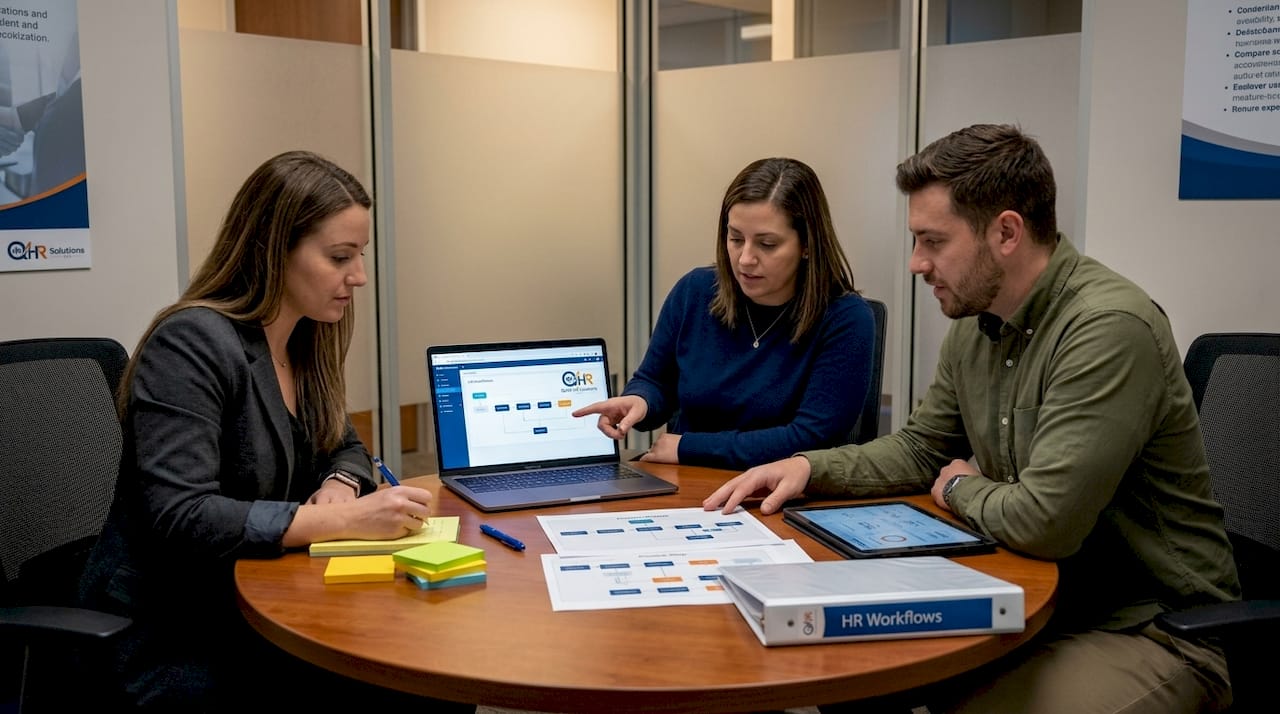
Pierpoint explains that scaling HR capacity involves standardizing decisions and reducing repetitive tasks to improve efficiency. This is a critical distinction. Scalability is not about working harder. It is about designing HR so that growth does not automatically translate into proportional HR labor costs.
Named authorities in this space, including Aspen HR, Pierpoint, and HR Cloud, consistently point to the same root principle: scalable HR is built, not hired. You design it into your processes, your technology, and your policies before the growth pressure arrives.
How does HR scalability improve business growth and efficiency?
Scalable HR directly enables business growth by removing the friction that slows down hiring, onboarding, compliance, and employee support as headcount climbs. When HR processes are designed for scale, the organization can move faster without proportional increases in HR staffing costs.
The efficiency gains are concrete:
- Reduced repetitive workload. Shifting routine questions from email to structured self-service reduces escalation volume and frees HR professionals for judgment-intensive work.
- Faster onboarding cycles. Standardized onboarding workflows mean a company hiring 10 people per month runs the same quality process as one hiring 2, without adding HR headcount.
- Improved compliance consistency. Automated reminders, centralized policy libraries, and integrated payroll systems reduce the risk of compliance gaps as the organization grows across locations.
- Better HR responsiveness. When HR is not buried in repetitive queries, response times improve and employee experience improves with them.
- AI-driven capacity gains. Gartner notes that GenAI can drive up to 30% productivity gains in HR functions by handling day-to-day tasks at scale. That frees HR professionals to focus on strategic and judgment-based work.
The importance of HR scalability becomes clearest when you look at what happens without it. HR teams get overwhelmed, response quality drops, compliance risks rise, and leadership loses confidence in the people function. Growth stalls not because of a lack of talent or capital, but because HR cannot keep pace.
Pro Tip: Map your current HR processes and mark every step that requires a human decision. Then ask which of those decisions could be handled by a policy document, a self-service portal, or an automated workflow. That gap is your scalability opportunity.
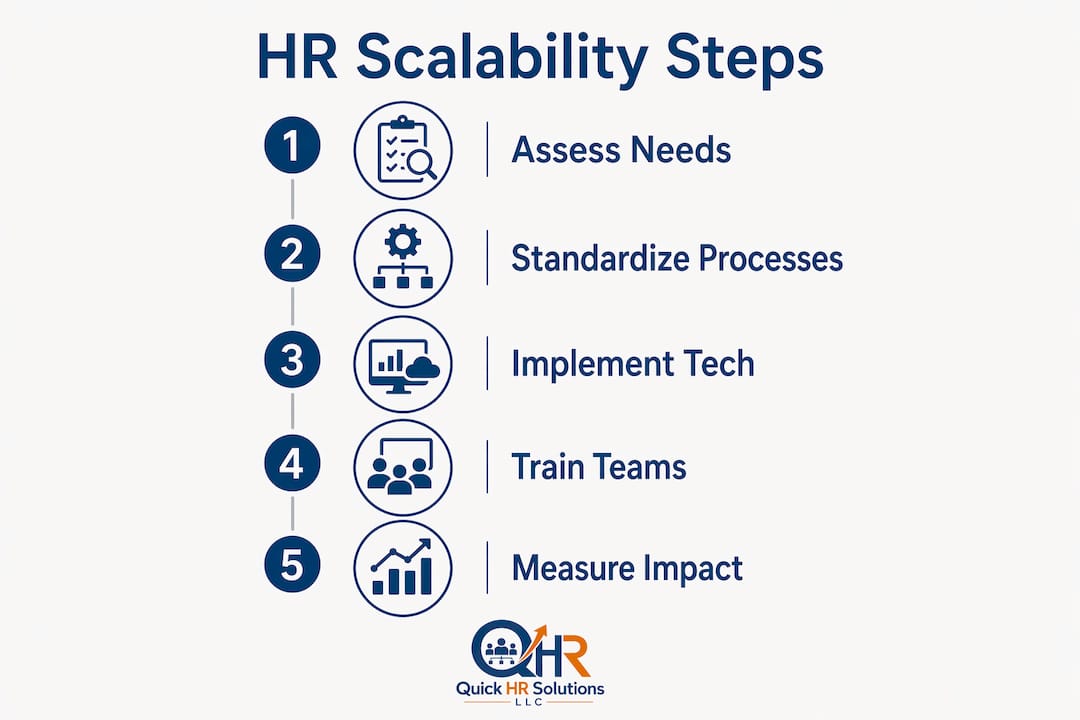
What role does technology play in achieving HR scalability?
Technology is the infrastructure layer that makes HR scalability possible at scale. Without an integrated HR tech stack, even well-designed processes collapse under the weight of manual data entry, disconnected systems, and reporting blind spots.
HR Cloud's 2026 tech stack guide highlights that integrated platforms are the foundation of scalable HR systems. The key word is integrated. A collection of disconnected tools, one for applicant tracking, another for onboarding, a separate payroll system, and a standalone performance platform, creates data silos that cost time and accuracy.
Here is how a scalable HR tech stack compares to a fragmented one:
| Capability | Fragmented tech stack | Integrated scalable stack |
|---|---|---|
| Employee data management | Manual re-entry across systems | Single source of truth, auto-synced |
| Onboarding | Separate tools, inconsistent experience | Unified workflow, consistent delivery |
| Compliance tracking | Spreadsheets, manual reminders | Automated alerts, audit trails |
| Reporting and analytics | Pulled from multiple sources manually | Real-time dashboards, single platform |
| Multi-location support | Inconsistent, location-dependent | Standardized across all sites |
Manual data re-entry and inconsistent workflows become operational risks as companies grow beyond 300 to 500 employees. That threshold is a practical signal that your current tech stack may no longer support the complexity of your workforce.
Core components of a scalable HR tech stack include an applicant tracking system (ATS) like Greenhouse or Lever, an HRIS platform like Rippling, BambooHR, or Workday, integrated payroll, and a learning management system (LMS). The goal is not to have the most tools. The goal is to have the fewest tools that cover the most ground without creating gaps.
Fragmented HR tech stacks cause operational blind spots that only become visible after metrics worsen, such as rising turnover or compliance violations. By then, the cost of fixing the problem is significantly higher than the cost of building it right the first time.
Pro Tip: Before purchasing any new HR tool, ask one question: does this integrate natively with your HRIS? If the answer is no, factor in the hidden cost of manual data management before you sign the contract. A solid HR software implementation plan prevents costly rework later.
What common challenges arise when scaling HR?
HR scalability challenges rarely announce themselves clearly. They show up as symptoms: HR response times slow down, managers start handling employee issues they should not have to, compliance deadlines get missed, and leadership starts questioning whether HR is keeping up.
The most common root cause is support delivery bottlenecks. Centralizing policies and routing routine queries to self-service improves capacity and scalability by removing the repetitive workload that consumes HR bandwidth. When every policy question, PTO request, or benefits inquiry lands in an HR inbox, the team spends its time answering the same questions instead of solving real problems.
Here is a practical sequence for diagnosing and addressing HR scalability challenges:
- Audit your HR ticket volume. Track every incoming request for two weeks. Categorize by type. You will likely find that 60 to 70 percent of requests are repetitive and answerable by a document or self-service tool.
- Centralize your policy library. A single, searchable policy hub eliminates the "I did not know where to find that" problem that drives unnecessary HR contact.
- Build self-service workflows. Tools like ServiceNow HR, Zendesk, or even a well-structured SharePoint site can handle routine queries without HR involvement.
- Measure friction, not effort. The number of hours HR works is not the right metric. The right metric is how many unnecessary touchpoints exist between an employee need and its resolution.
- Identify leadership blind spots. Operational blind spots in HR often become visible only after metrics worsen. Build reporting dashboards that surface early warning signals before they become crises.
"The shift from measuring effort to measuring friction is where most HR teams find their biggest capacity gains. If you are tracking hours worked but not escalation rates or repeat query volume, you are optimizing the wrong thing." — Pierpoint on scaling HR capacity
If you are seeing signs that your HR function is already struggling to keep pace, a review of your HR structure can surface the reporting and workflow gaps that are limiting your capacity.
How to design HR scalability for long-term workforce agility
Designing HR scalability into your organization requires deliberate choices about policy architecture, technology, and people capability. It is not a one-time project. It is an ongoing design discipline.
Start with flexible, adaptable policies. Policies written for a 50-person company often break at 200 employees because they assume manual oversight and informal communication. Scalable policies are written to work without a human in the loop for every decision. They are clear, accessible, and consistently enforced through systems rather than memory.
Human capability maps are a tool that identifies who holds critical judgment and institutional knowledge within your organization. This matters enormously as AI takes on more routine HR tasks. If the people who understand your culture, your compliance history, and your workforce dynamics are not identified and protected, scaling AI agents into HR processes creates risk rather than capacity.
Key practices for building long-term HR scalability include:
- Align workforce planning with your tech stack. Your HRIS should inform headcount planning, not just track it after the fact.
- Train HR and managers to work alongside AI tools. The goal is human oversight of automated processes, not replacement of human judgment.
- Build for distributed teams from the start. Scalable workforce infrastructure is essential for long-term growth and operational consistency in distributed models. If your HR processes only work when everyone is in the same building, they are not scalable.
- Review your HR structure annually. What worked at 100 employees will not work at 300. Build a review cadence into your HR calendar.
Pro Tip: If you are a founder or early-stage HR lead, use a startup HR responsibilities checklist to identify which HR functions need to be systematized before your next growth phase. Building scalable foundations early costs far less than retrofitting them under pressure.
Key takeaways
HR scalability requires building processes, systems, and policies that handle workforce growth without proportional increases in HR headcount or effort.
| Point | Details |
|---|---|
| Define scalability correctly | HR scalability means increasing output without increasing headcount at the same rate. |
| Technology is infrastructure | An integrated HR tech stack eliminates data silos and supports growth beyond 300 to 500 employees. |
| Friction is the real bottleneck | Measuring and reducing repetitive HR tasks unlocks more capacity than adding HR staff. |
| Human capability maps matter | Identifying knowledge holders protects institutional knowledge as AI takes on routine HR work. |
| Design before the pressure hits | Scalable HR policies and workflows must be built proactively, not retrofitted during a growth surge. |
Why most HR teams scale the wrong way
After working with growing businesses across Texas, the pattern I see most often is this: a company hits a growth phase, HR gets overwhelmed, and the instinct is to hire another HR coordinator. Sometimes that is the right call. More often, it is not.
Adding headcount without fixing the underlying process problems just means more people doing inefficient work. I have seen HR teams of four people drowning in requests that a well-built self-service portal and a centralized policy library could handle in half the time. The problem was never capacity. It was friction.
The organizations that scale HR well share one habit: they measure what is actually slowing them down. Not hours worked. Not headcount ratios. They track how many times the same question gets asked, how long it takes a new hire to become productive, and how often a compliance deadline gets missed. Those numbers tell you where to invest.
I also want to push back on the idea that technology alone solves scalability. I have seen companies buy expensive HRIS platforms and still struggle because their policies were unclear, their managers were undertrained, and their HR team had no visibility into what was actually happening at the team level. Technology amplifies your process quality. If the process is broken, the technology makes it break faster and at greater scale.
The practical path forward is to audit your friction points first, fix your policy architecture second, and then select technology that supports the process you have designed. That sequence matters. Most organizations do it in reverse.
— John
How Quickhrtx helps you build scalable HR systems
Quickhrtx provides fractional HR consulting in Dallas and across the Dallas-Fort Worth area, helping small to mid-sized businesses design HR functions that grow with them. Whether you are approaching the 50-employee threshold where informal HR breaks down, or scaling past 200 employees and hitting compliance and process limits, Quickhrtx builds the systems, policies, and workflows that remove friction and create capacity. You get SHRM-certified HR expertise without the overhead of a full internal HR department. Book a free consultation at Quickhrtx to start building an HR function that scales with your business.
FAQ
What does HR scalability mean in simple terms?
HR scalability means your HR operations can handle more employees, locations, and complexity without requiring a proportional increase in HR staff or costs. It is achieved through standardized processes, integrated technology, and reduced repetitive workload.
Why is HR scalability important for growing businesses?
Without scalable HR, growth creates bottlenecks in hiring, onboarding, compliance, and employee support that slow the entire organization down. Scalable HR keeps the people function effective as headcount and complexity increase.
What are the biggest HR scalability challenges?
The most common challenges are support delivery bottlenecks from repetitive queries, fragmented HR tech stacks that create data silos, and policies written for smaller organizations that break under growth pressure.
How does technology support HR scalability?
An integrated HR tech stack, covering HRIS, ATS, payroll, and compliance tools, eliminates manual data re-entry and provides real-time reporting that supports decision-making as the workforce grows.
When should a business start building scalable HR systems?
The right time is before the pressure arrives. Companies approaching 50 to 100 employees should begin standardizing HR workflows and evaluating their tech stack. Waiting until processes are already breaking makes the fix significantly more expensive.