

Running a small business means wearing every hat, and HR is one of the heaviest. When you decide to outsource HR for your small business, you're not just handing off paperwork. You're making a strategic call to stop fighting compliance fires and start building a business that scales. HR outsourcing helps businesses delegate hiring, payroll, and compliance to specialists, which directly improves efficiency and reduces legal exposure. This guide walks you through exactly when to make the move, which model fits your situation, and how to avoid the mistakes that cost business owners time and money.
Table of Contents
- Key Takeaways
- When your small business should consider HR outsourcing
- HR outsourcing models: which one fits your business
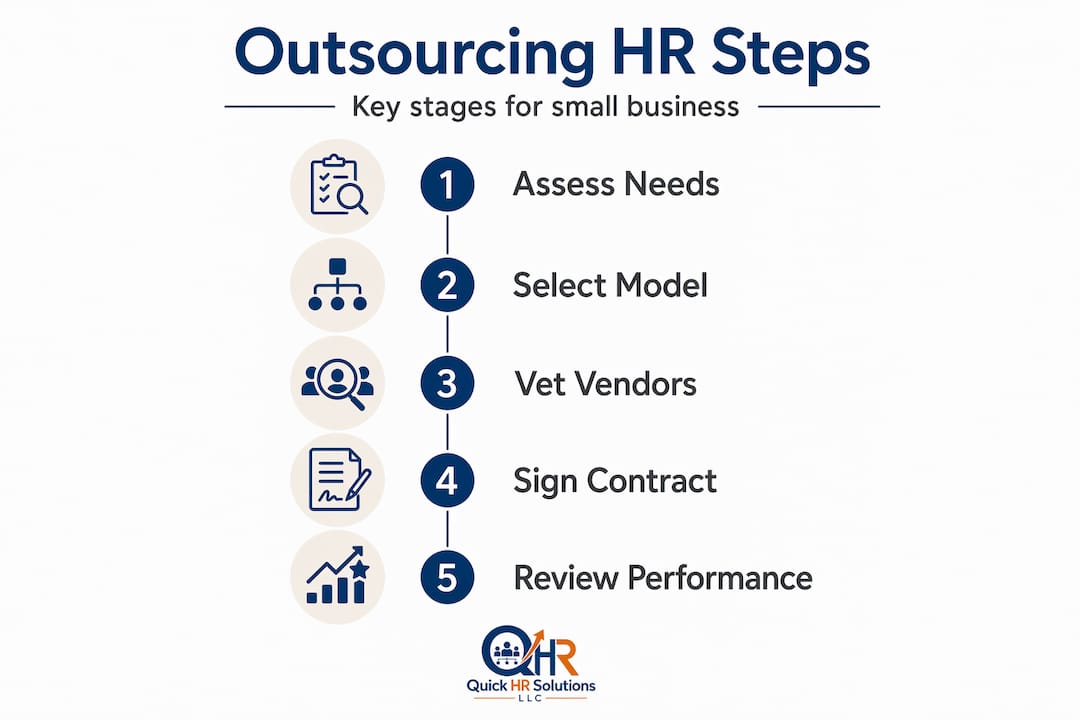
- How to outsource HR: a step-by-step approach
- Common mistakes when outsourcing HR
- What success looks like after outsourcing HR
- My take on outsourcing HR the right way
- Ready to put this into practice?
- FAQ
Key Takeaways
| Point | Details |
|---|---|
| Know when to outsource | Once you cross 10 to 15 employees, in-house HR typically becomes too complex to manage without dedicated expertise. |
| Match the model to your needs | PEOs, ASOs, HROs, and EORs each serve different situations; choosing the wrong one creates more problems than it solves. |
| Start with compliance mapping | Identify every state and country where you have employees before evaluating any outsourcing partner. |
| Contracts determine real risk | Liability allocation in your service agreement matters more than the features list on a vendor's website. |
| Measure outcomes, not activity | Track compliance incident rates, time-to-hire, and employee satisfaction to know if your partner is actually delivering. |
When your small business should consider HR outsourcing
Most small business owners don't wake up one day and decide to outsource HR. It happens because something breaks. A misclassified contractor triggers a state audit. A termination goes sideways because no one documented a performance issue. A new hire shows up with no onboarding plan because the person who usually handles it is out sick.
These are not random bad days. They're signals. Recognizing them early is what separates owners who get ahead of HR complexity from those who react to it after a lawsuit.
Here are the most common signs your business has outgrown in-house HR management:
- Headcount is climbing past 10 to 15 employees. Businesses with 10 to 250 employees typically benefit most from outsourcing because the compliance burden grows faster than the team's capacity to handle it.
- You or your managers are doing HR work. If you're the one processing payroll, writing offer letters, or handling employee complaints, that time is being pulled directly away from revenue-generating work.
- You've expanded into a second state. Multi-state employment means multiple wage and hour laws, different leave requirements, and separate tax registrations. The complexity multiplies fast.
- Compliance feels reactive rather than planned. If you're learning about new regulations after they take effect, that's a risk you're carrying unnecessarily.
- Hiring and onboarding are inconsistent. Inconsistent processes create legal exposure and hurt the employee experience, which affects retention.
Pro Tip: Don't wait for a compliance incident to trigger action. A single EEOC charge costs far more in time and legal fees than a year of outsourced HR support. The EEOC reported 88,531 charges in FY2024, a 9% increase year over year, with nearly $700 million in recoveries.
Growth events like a new contract requiring multi-state hiring, a private equity investment, or a merger are natural inflection points to evaluate your HR outsourcing options for small companies.
HR outsourcing models: which one fits your business
The term "HR outsourcing" covers a wide range of arrangements. Using the wrong model for your situation is one of the most common and costly mistakes small business owners make. Here's how the main models break down.
| Model | What They Handle | Co-Employment | Best For |
|---|---|---|---|
| Payroll Provider | Payroll processing, tax filings | No | Businesses needing payroll only |
| ASO (Administrative Service Organization) | HR admin, benefits, payroll | No | Businesses wanting full admin support without co-employment |
| HRO (Human Resources Outsourcer) | Selective HR functions | No | Businesses outsourcing specific HR tasks |
| PEO (Professional Employer Organization) | Full HR suite, benefits, compliance | Yes | Small businesses wanting Fortune 500-level benefits and shared compliance |
| EOR (Employer of Record) | Legal employment, compliance for remote/international staff | Yes | Businesses hiring across borders without local entities |
The most important distinction on that table is the co-employment column. PEOs share employer responsibilities with your business while you retain operational control. That means the PEO appears on tax filings and benefit plans alongside your company. This is powerful for accessing pooled benefits and compliance infrastructure, but it also means you need to understand exactly where your liability ends and theirs begins.

EOR services have become increasingly relevant for startups and small companies hiring remote or international talent. EOR platforms let SMBs hire globally without setting up local legal entities, with pricing that typically starts around $199 per employee per month. That's a fraction of the cost of opening a foreign subsidiary.
Pro Tip: If you're a startup planning to hire across state lines within the next 12 months, evaluate partners based on where you expect to be in two years, not just where you are today. Scalable outsourcing requires evaluating partner capacity for future growth and multi-state complexity.
For most small businesses with 15 to 75 employees, a PEO or ASO typically provides the best value. But if you only need payroll and basic compliance, starting with a narrower solution keeps costs down while you assess broader needs.
How to outsource HR: a step-by-step approach
Moving from in-house HR chaos to a functional outsourced arrangement takes more than signing a contract. Here's how to do it in a way that actually works.
-
Map your compliance footprint. List every state and country where you have employees or plan to hire within 18 months. Note the specific obligations in each: wage and hour laws, paid leave requirements, workers' compensation, and benefits mandates. This is your compliance map. Start with jurisdictional coverage before you evaluate any vendor.
-
Define your outsourcing scope. Decide which HR functions you're keeping in-house and which you're delegating. Common combinations include outsourcing payroll, benefits administration, and compliance while keeping culture and performance management internal.
-
Evaluate partners against your compliance map. Don't evaluate vendors on price or software interface first. Evaluate whether they have operational expertise in your specific jurisdictions. A vendor with a slick dashboard but no coverage in California or New York is a liability, not an asset.
-
Review contracts for liability allocation. This is where most small business owners skip too fast. The DOL's joint employer framework considers hiring decisions, supervision, pay setting, and record keeping when assigning employer liability. Your contract should explicitly define which party controls each of those functions.
-
Plan the transition and communicate it internally. Employees notice when HR processes change. A clear communication plan explaining what's changing, who to contact, and what stays the same reduces confusion and prevents the early friction that derails otherwise good outsourcing arrangements.
-
Set performance expectations upfront. Define what success looks like before you sign. Metrics like time-to-hire, payroll error rates, compliance audit results, and employee satisfaction scores should be part of your vendor accountability framework from day one.
Pro Tip: When reviewing an HR vendor's contract, look specifically for indemnification clauses. You want to confirm that compliance failures in their domain are their liability, not yours. If the contract is vague on this, negotiate before you sign.
You can also reference resources like this guide on HR compliance to understand your baseline obligations as a Texas employer before entering any outsourcing conversation.
Common mistakes when outsourcing HR
Even business owners who research outsourcing carefully run into problems. Most of these mistakes are preventable if you know what to watch for.
-
Treating outsourcing as full risk transfer. This is the single most dangerous misconception. Outsourcing HR should be approached as a compliance preparedness strategy, not an administrative handoff. You remain legally exposed for many obligations regardless of who processes the paperwork.
-
Ignoring multi-jurisdiction complexity. A vendor that handles Texas requirements well may have zero expertise in Massachusetts or Washington state. If you hire across state lines and your vendor doesn't follow you, you're carrying unmanaged compliance risk in those states.
-
Misaligning contracts and day-to-day practices. The DOL joint employer proposal requires meticulous alignment of contractual and operational practices. What your contract says about who controls hiring decisions needs to match what actually happens in practice. Auditors and plaintiff attorneys look at both.
-
Underestimating onboarding complexity. Moving payroll, benefits, and HR records to a new vendor involves data migration, system integration, and employee re-enrollment. Budget at least 60 to 90 days for a proper transition. Rushing this phase creates payroll errors and compliance gaps.
-
Leaving internal stakeholders out of the loop. Your managers, finance team, and employees all interact with HR systems. If they don't know what's changing and why, you'll spend weeks managing confusion that could have been avoided with a 30-minute all-hands call.
Thinking about how to build a hiring process that integrates with your new outsourced model is also worth doing early in the transition, before your first outsourced recruitment cycle begins.
What success looks like after outsourcing HR
Once the transition is complete and your outsourcing arrangement is running, you need a clear picture of whether it's actually working. Activity doesn't equal results.
The indicators that matter most include:
- Fewer compliance incidents. If you were getting notices, audits, or employee complaints related to policy violations before outsourcing, those should decrease materially within the first two quarters.
- Faster, more consistent hiring. Outsourced recruitment support and standardized onboarding should reduce time-to-fill and improve new hire experience scores.
- Cleaner payroll. Payroll error rates should approach zero. Even small errors erode employee trust fast.
- Proactive communication from your partner. A quality outsourcing partner doesn't wait for you to ask about new regulations. They send alerts when legislation in your jurisdictions changes and update your policies accordingly.
- Employees know where to go for HR support. One of the simplest tests. If your employees can quickly reach their HR resource and get answers, your outsourcing arrangement is functioning as intended.
Pro Tip: Schedule a formal quarterly review with your HR outsourcing partner. Use it to review compliance updates, discuss upcoming business changes like new hires or location expansions, and assess whether the service scope still matches your needs. Most business owners who set this rhythm catch problems before they become expensive.
Run periodic internal audits as well. Review a sample of employee files, payroll records, and policy acknowledgments at least once a year. Operational documentation is critical for defending your position in audits or disputes, even when you're working with an outsourcing partner.
My take on outsourcing HR the right way
I've worked with dozens of small business owners who came to outsourcing with the same hope: hand this off and move on. That mindset isn't wrong. But it almost always leads to a painful lesson somewhere in year one.
What I've learned is that the business owners who get the most from outsourced HR are the ones who stay involved at the strategic level. They're not processing payroll or writing employee handbook sections. But they know their compliance footprint, they've read their vendor contracts, and they ask their partners hard questions about jurisdiction coverage before signing.
The companies that struggle are the ones who treat a signed PEO contract like a compliance insurance policy. It isn't. Choosing a partner based on compliance exposure rather than price or interface quality is what determines long-term outcomes. I've seen well-priced vendors cost clients three times their annual fee in one regulatory misstep because the vendor lacked expertise in a state the client expanded into.
My advice is this: go into outsourcing with a clear compliance map, a contract you've actually read, and a vendor you've vetted for where your business is going, not just where it is today. When those three things are in place, outsourcing stops being a burden transfer and becomes a genuine competitive advantage. You get access to HR expertise that most small businesses simply can't afford to hire full-time. That changes how you recruit, how you retain people, and how confidently you grow.
— John
Ready to put this into practice?
If this guide has you thinking seriously about making a change, Quickhrtx is built specifically for this moment in your business. As a SHRM-certified fractional HR consulting practice based in Dallas, Quickhrtx works with small and mid-sized Texas businesses that need real HR expertise without the cost of a full internal department. From compliance reviews and policy development to recruitment support and employee relations, the team provides the hands-on guidance that actually moves the needle. Whether you're trying to untangle a compliance issue or build HR infrastructure from scratch, you can book a free consultation and see exactly what a partnership looks like before committing to anything.
FAQ
When should a small business outsource HR?
Most businesses benefit from outsourcing once they reach 10 to 15 employees, when HR complexity outpaces what owners or office managers can handle alongside other responsibilities. Multi-state expansion and rapid hiring are also strong triggers.
What is the difference between a PEO and an HRO?
A PEO enters a co-employment relationship with your business, sharing employer responsibilities on tax filings and benefits plans. An HRO acts as a service provider handling specific HR functions without co-employment status, which means different liability implications for your company.
How much does it cost to outsource HR for a small business?
Costs vary by model. Payroll-only providers typically charge per employee per pay run, PEOs often charge 2% to 12% of payroll, and EOR platforms for international hires generally start around $199 per employee per month. Scope and jurisdiction coverage drive most of the price variation.
Does outsourcing HR remove my compliance liability?
No. Outsourcing HR functions does not transfer all legal liability to the vendor. You remain responsible for many obligations, and joint employer rules mean contracts must align with actual day-to-day practices to protect your business in an audit or dispute.
What HR functions can small businesses outsource?
Small businesses commonly outsource payroll processing, benefits administration, compliance management, recruitment, onboarding, and employee relations. Many keep culture-building and performance management internal while delegating the administratively heavy and legally complex functions to a qualified partner.