

Employee retention strategies for mid-sized companies are defined as intentional, structured methods to keep skilled employees engaged and committed long enough to deliver measurable business value. Replacing a single employee costs between 50% and 200% of their annual salary, making turnover one of the most expensive problems a growing company can ignore. Mid-sized firms face a specific challenge: they lack the budget flexibility of enterprise organizations but carry far more complexity than small businesses. The most effective approach combines structured onboarding, manager development, continuous engagement programs, and fair compensation into one coherent system. Gallup, ADP, and SurveyMonkey each offer data that makes the path forward clear.
1. Build a structured 30-60-90 day onboarding program
Structured onboarding is the single fastest way to reduce early turnover and accelerate new hire productivity. A 30-60-90 day framework divides the first three months into three distinct phases, each with a specific purpose.
Days 1–30: Orientation and role clarity. The first month focuses on helping new employees understand their role, their team, and the company's expectations. This means completing compliance training, meeting key stakeholders, and receiving a clear written description of 30-day success metrics.

Days 31–60: Relationship building and foundational training. The second month shifts toward building working relationships and developing the skills required for the role. Managers should schedule weekly one-on-ones and introduce the new hire to cross-functional partners.
Days 61–90: Task ownership and goal-setting. By the third month, the employee should own at least one meaningful project and receive formal feedback tied to their performance review cycle. This connection between onboarding and performance management is where most mid-sized companies fall short.
Poor onboarding leads to replacement costs, extended ramp time, reduced team morale, and real damage to your employer brand. Those costs compound fast when you are hiring at scale.
Pro Tip: Customize the 30-60-90 plan by role, not just by department. A sales hire and a finance hire have completely different ramp requirements. Generic onboarding programs produce generic results.
2. Invest in manager development before anything else
Manager behavior accounts for 70% of team engagement variance, according to Gallup. That single statistic reframes the entire retention conversation. You can spend heavily on perks, office upgrades, and culture events, and still lose your best people if their direct manager is unclear, disconnected, or unavailable.
Effective manager development for retention focuses on three engagement drivers:
- Clarity: Managers must communicate expectations, priorities, and performance standards consistently. Employees who do not know what success looks like disengage within months.
- Connection: Regular one-on-ones, recognition, and genuine interest in employee growth create the psychological safety that keeps people committed.
- Development: Managers who actively discuss career paths and skill-building retain employees far longer than those who only manage tasks.
Mid-sized firms improve retention most by instrumenting manager behavior through the cadence and quality of coaching and recognition, rather than only tracking broad engagement scores. Measure how often managers hold structured one-on-ones. Track whether development conversations are happening. These behaviors predict retention better than annual survey scores.
Pro Tip: Run a 90-day manager coaching cohort twice a year. Pair each manager with a specific retention metric they own, such as 90-day new hire retention or voluntary turnover rate on their team. Accountability at the manager level produces results that company-wide programs rarely achieve.
3. Run continuous employee engagement programs
Engagement programs work as continuous systems, not one-time surveys. SurveyMonkey's engagement roadmap outlines a practical four-step approach that mid-sized HR teams can run without a large dedicated staff.
The core structure looks like this:
- Establish a baseline survey in the first 90 days to measure current engagement levels across key dimensions: role clarity, manager relationship, growth opportunities, and belonging.
- Run quarterly pulse checks of 5–10 questions to detect early warning signs before they become resignation letters.
- Assign clear owners to every feedback theme. If communication scores drop, a specific manager or HR lead owns the fix with a defined timeline.
- Close the loop publicly. Tell employees what you heard and what changed. Silence after a survey destroys trust faster than a bad score does.
The Eagle Hill Consulting Employee Retention Index shows Millennials up 1.2 points in Q2 2026 retention likelihood. That trend signals that engagement programs designed for this generation are beginning to work. Continuous feedback is a core reason why.
For a deeper look at building engagement measurement systems that produce real retention outcomes, Quickhrtx has a dedicated guide worth reviewing.
4. Prioritize pay fairness, not just pay levels
27% of workers report that perceived pay unfairness directly threatens their decision to stay, according to ADP research. That number matters because most mid-sized companies focus on whether their salaries are competitive, but not on whether employees feel they are paid fairly relative to their peers.
Pay fairness perceptions often outweigh the actual pay level in retention decisions. An employee earning $75,000 who believes a peer doing similar work earns $85,000 is a flight risk regardless of market benchmarks.
| Compensation factor | Retention impact |
|---|---|
| Regular salary reviews (annual or biannual) | Reduces attrition by catching pay drift before it becomes a grievance |
| Transparent pay bands | Builds trust and reduces internal equity complaints |
| Flexible vacation and parental leave | Valued over raises by a significant share of employees |
| Mental health and well-being benefits | Increases commitment, especially among younger workers |
ADP data confirms that employees frequently prioritize extended parental leave, flexible vacation, and health benefits over simple salary increases. This means your benefits package is a retention tool, not just a recruiting tool. Review it annually with the same rigor you apply to compensation benchmarking.
5. Embed sustainable HRM and well-being into your HR processes
Sustainable HRM, known in HR research as S-HRM, is defined as the practice of designing HR systems that support long-term employee health, development, and organizational resilience rather than optimizing only for short-term performance. A 2026 study found that S-HRM practices predict employee retention with a standardized coefficient of β = 0.31, while employee well-being adds an additional β = 0.28. Together, these two factors explain 56% of the variance in retention outcomes.
That finding carries a direct implication: well-being embedded in HR processes produces stronger retention than well-being offered as a standalone perk. A gym reimbursement program does not move the needle. A manager trained to recognize burnout, a workload review process, and a clear policy on after-hours communication do.
"Embedding employee well-being deeply into HR processes rather than offering it as a standalone perk creates a mediating pathway to retention and organizational resilience." — Sustainable HRM and Employee Well-Being, 2026
For mid-sized companies in Texas, this means reviewing your HR reporting structures to confirm that well-being accountability sits with a specific role, not with no one in particular.
6. Align retention strategy with your HR infrastructure
The best retention tactics fail when the HR infrastructure underneath them is misaligned. Mid-sized companies often reach a headcount where informal HR practices no longer scale. At that point, retention problems are frequently symptoms of structural gaps: no formal performance review cycle, no compensation philosophy, no defined career ladders.
HR department restructuring is not a distraction from retention work. It is a prerequisite for it. When employees do not see a clear path forward, they create their own path out the door.
Practical steps to align your infrastructure with retention goals include formalizing job levels and pay bands, defining promotion criteria in writing, and connecting manager coaching programs to performance management cycles. These are not bureaucratic exercises. They are the structural signals that tell employees the company is worth staying in.
Key takeaways
The most effective employee retention strategies for mid-sized companies combine structured onboarding, manager development, continuous engagement, and fair compensation into one integrated system rather than treating each as a standalone initiative.
| Point | Details |
|---|---|
| Onboarding drives early retention | A 30-60-90 day plan tied to performance reviews reduces early turnover and accelerates productivity. |
| Managers control engagement | Gallup data shows managers account for 70% of team engagement variance, making coaching the highest-ROI retention investment. |
| Continuous feedback catches risk early | Quarterly pulse checks with assigned owners convert survey data into real retention improvements. |
| Pay fairness matters more than pay level | ADP research shows 27% of workers cite pay unfairness as a direct retention threat, separate from compensation benchmarks. |
| S-HRM embeds well-being structurally | A 2026 study shows S-HRM and well-being together explain 56% of retention variance when built into HR processes. |
What I've learned about retention after years of working with mid-sized firms
Most retention conversations I have with business leaders start in the wrong place. They want to know what perks to add or what the market salary is for a given role. Those are valid questions, but they are not the first questions.
The first question is always: how good are your managers? In my experience working with mid-sized companies across Texas, the firms with the lowest voluntary turnover share one trait. Their managers hold regular one-on-ones, give direct feedback, and actively discuss career development. That is not a coincidence.
The second thing I have learned is that onboarding is where retention is won or lost, and most companies treat it as an administrative process rather than a strategic one. Connecting the 30-60-90 plan directly to the first formal performance review changes everything. It signals to the new hire that the company is paying attention and that their growth is tracked from day one.
I am also watching the S-HRM research closely. The idea that well-being embedded in HR processes predicts 56% of retention variance is not a soft finding. It is a structural argument for redesigning how HR operates, not just what benefits you offer. Mid-sized firms that get ahead of this now will have a real workforce stability advantage in the next three to five years.
If you are an HR leader or business owner trying to figure out where to start, my honest recommendation is this: fix your manager development program first, then build your onboarding framework, then layer in continuous engagement. Everything else follows from those three.
— John
How Quickhrtx helps mid-sized companies build retention systems that work
Mid-sized companies in the Dallas-Fort Worth area often need retention expertise without the overhead of a full internal HR department. Quickhrtx delivers exactly that through fractional HR consulting designed for companies at your stage of growth.
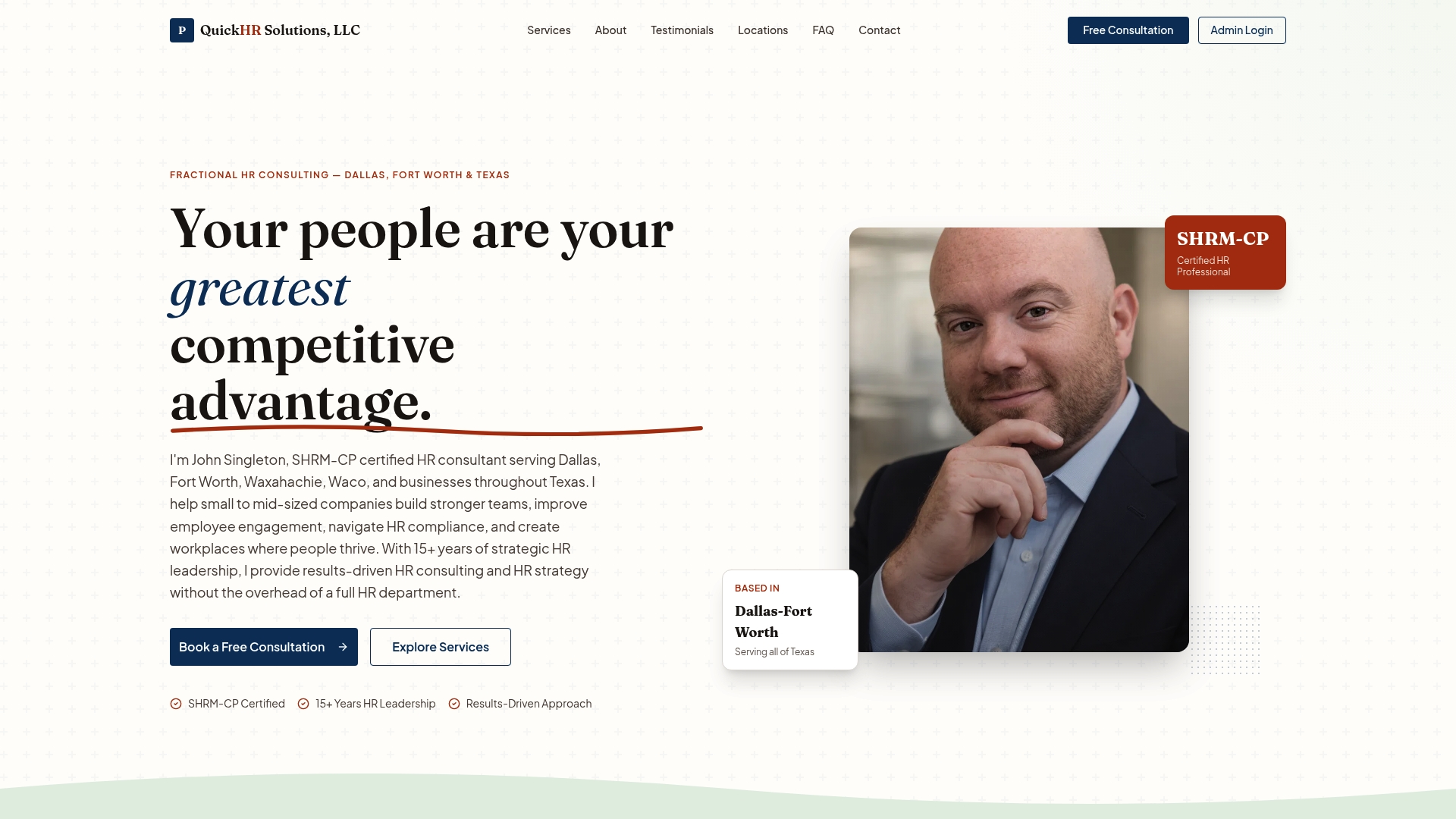
Quickhrtx builds structured onboarding programs, manager coaching frameworks, and continuous engagement systems tailored to your headcount and industry. The team holds SHRM-CP and SHRM-SCP certifications and brings direct experience with the retention challenges mid-sized Texas firms face. Whether you need a one-time retention audit or ongoing HR support, fractional HR services in Dallas give you senior-level strategy without the full-time cost. Book a free consultation to see where your retention gaps are and what it would take to close them.
FAQ
What are the most effective employee retention strategies for mid-sized companies?
The most effective strategies combine structured 30-60-90 day onboarding, manager development programs, continuous engagement surveys, and regular compensation reviews. Gallup data shows manager development alone accounts for 70% of team engagement variance.
How much does employee turnover cost a mid-sized company?
Replacing one employee costs between 50% and 200% of their annual salary when you factor in recruiting, lost productivity, and onboarding time. That cost makes retention investment far cheaper than repeated replacement.
Why do employees leave mid-sized companies?
The most common drivers are unclear career paths, weak manager relationships, and perceived pay unfairness. ADP research shows 27% of workers cite pay fairness as a direct retention threat, independent of whether their salary is market-competitive.
How often should mid-sized companies run employee engagement surveys?
Run a full baseline survey once a year and quarterly pulse checks of 5–10 questions in between. SurveyMonkey's engagement framework shows that continuous feedback systems catch retention risks far earlier than annual surveys alone.
What is sustainable HRM and why does it matter for retention?
Sustainable HRM (S-HRM) is the practice of designing HR systems that support long-term employee health and development rather than short-term output. A 2026 study found S-HRM and well-being together explain 56% of employee retention variance, making it one of the strongest structural predictors available.