

HR risk management strategies for businesses have never mattered more. Employment law complexity has grown sharply, workforce expectations have shifted, and a single compliance misstep can trigger federal investigations, lawsuits, or reputational damage that takes years to repair. This article covers the core strategies that HR professionals and business leaders can act on now: building a governance framework, running meaningful risk assessments, training with documentation that holds up in court, and creating the monitoring systems that catch problems before they escalate into crises.
Table of Contents
- Key takeaways
- 1. Establish a governance framework for HR risk management strategies businesses need
- 2. Conduct a structured HR risk assessment
- 3. Build training programs with legal-grade documentation
- 4. Implement proactive employee relations and incident management
- 5. Minimize wage and hour risk with classification reviews
- 6. Monitor with Key Risk Indicators and improve continuously
- My take on proactive HR risk management
- How Quickhrtx can help you build a stronger HR risk program
- FAQ
Key takeaways
| Point | Details |
|---|---|
| Build governance first | A written HR risk policy with defined roles prevents accountability gaps that quietly accumulate into compliance failures. |
| Prioritize by exposure | Use a likelihood-impact matrix to focus time and budget on high-exposure risks like wage-hour violations and harassment claims. |
| Train and document | OSHA and EEOC treat training records as primary evidence during audits, so documentation is your legal defense. |
| Detect problems early | Structured escalation protocols catch employee relations issues before they become formal disputes or litigation. |
| Monitor continuously | Key Risk Indicators tied to HR functions give leadership early warning when compliance performance is slipping. |
1. Establish a governance framework for HR risk management strategies businesses need
Every effective HR risk program starts with a written policy. Without one, accountability is informal, reviews are inconsistent, and nobody owns the problem when something goes wrong. A well-structured risk policy includes six core sections: purpose and scope, risk appetite, roles and responsibilities, assessment methodology, reporting and escalation procedures, and a defined review cycle.

The roles section deserves particular attention. Many companies treat HR risk as HR's problem alone, which creates dangerous blind spots. Legal, IT, and senior leadership all carry specific risk accountabilities that HR cannot fulfill on its own. A RACI matrix, which stands for Responsible, Accountable, Consulted, and Informed, makes these accountabilities explicit across every function. Cross-functional governance reduces organizational silos and enables faster response when new risks emerge, including cybersecurity threats connected to HR data and AI tools used in hiring.
Governance also requires a living review process. Policies that sit unchanged for three years while employment law evolves are not governance. They are theater. Schedule trigger-based reviews after any regulatory change, litigation event, or significant workforce restructuring, and pair those with annual standing audits.
Pro Tip: Anchor your HR risk policy to your organization's documented risk appetite. If your leadership team is risk-averse, that stance should translate directly into staffing decisions, policy thresholds, and escalation triggers, not just exist as a philosophical statement.
2. Conduct a structured HR risk assessment
HR risk assessment is the formal process of identifying, analyzing, and prioritizing threats specific to your workforce. The term used in enterprise risk management is a risk register, and every HR function should maintain one. Start by collecting data across three areas: your workforce composition and classification status, your current policy inventory and compliance gap analysis, and your recent incident and complaint history.
Once you have the data, map each identified risk on a likelihood-impact matrix. High likelihood and high impact risks, such as worker misclassification or harassment claims without a reporting mechanism, belong at the top of your response list. Lower-likelihood risks can be monitored rather than actively mitigated. This tiered approach makes resource allocation defensible to leadership and keeps HR from treating every possible risk as equally urgent.
The most common HR risks worth prioritizing in 2026 include:
- Wage and hour violations: The DOL recovered over $259M in back wages in fiscal year 2025, with an average recovery of $1,465 per affected worker.
- Employee misclassification: Independent contractor versus employee determinations continue to generate federal and state enforcement actions.
- Harassment without documentation: Claims unsupported by investigation records create maximum legal exposure.
- Policy inconsistency across locations: Multi-site businesses face compounding risk when managers apply policies differently.
- Incomplete I-9 and eligibility records: A single audit can surface systemic errors if onboarding documentation lacks oversight.
Pro Tip: Document both inherent risk (the risk before you have controls in place) and residual risk (what remains after controls). Showing regulators and leadership that you know your residual risk level signals maturity and intentionality in your HR program.
3. Build training programs with legal-grade documentation
Training is your primary control for a wide range of HR compliance risks. But only training that is documented, delivered consistently, and tailored to role-specific responsibilities actually reduces your legal exposure. The agencies that enforce employment law treat training records as key audit evidence. Saying you conduct harassment training means nothing if you cannot produce completion records, training content, and delivery dates.
The categories of training every employer should treat as non-negotiable include:
- Harassment prevention: Supervisor-specific training is legally required in California and increasingly expected as a standard of care everywhere else.
- Wage and hour compliance: Managers who do not understand overtime rules, meal break requirements, or off-the-clock work are a liability waiting to materialize.
- Anti-discrimination: Covers hiring decisions, performance management, and termination to reduce EEOC exposure.
- Workplace safety: OSHA mandates specific training for covered industries, and documentation standards must match the training plan.
- Supervisor-specific modules: First-line managers make most of the decisions that generate HR risk. Targeted training for them delivers disproportionate return.
The Faragher-Ellerth defense is worth understanding here. This legal framework allows employers to avoid or limit liability in supervisor harassment cases if they can demonstrate two things: they took reasonable care to prevent and correct harassment, and the employee unreasonably failed to use the complaint process. Documented, effective training is a cornerstone of that defense.
Pro Tip: Maintain a training matrix that maps each role to required training topics, delivery dates, completion status, and next scheduled date. Auditors and plaintiffs' attorneys ask for this document first. If you cannot produce it within 24 hours, your program has a documentation problem.
4. Implement proactive employee relations and incident management
Most HR crises do not start as crises. They start as a complaint that got passed along informally, a performance issue that went undocumented, or a pattern of behavior that nobody escalated because the process for doing so was unclear. Quiet compliance risks in growing companies often trace back to unclear ownership and inconsistent escalation protocols.
Structured employee relations management changes that pattern. The components that make the biggest practical difference include:
- Centralized incident logging: Every complaint, concern, or informal report gets captured in a single system, regardless of how it was raised. This eliminates the problem of issues living in a manager's email inbox or memory.
- Defined escalation tiers: Not every issue needs to go to legal. But every issue needs a documented decision about whether it goes further, who owns next steps, and what timeline applies.
- Manager training on early detection: Managers who know what behavioral patterns precede formal complaints can flag issues before they escalate. This requires explicit training, not assumption.
- Integration with HR case management tools: Workflow automation in case management creates consistency across locations and prevents the process from varying by manager personality.
Centralizing employee data also gives HR visibility into trends that individual case reviews miss. If a specific department has three accommodation requests and two complaints in six months, that pattern is a signal. Without centralized data, you never see it.
5. Minimize wage and hour risk with classification reviews
Wage and hour compliance deserves its own focused strategy because the exposure is direct and quantifiable. The DOL's 2025 recovery figures are not abstract. They represent real businesses that miscalculated overtime, misclassified workers, or failed to maintain accurate timekeeping records.
Regular standing calendar reviews of employee classification are the most reliable prevention mechanism. Schedule quarterly reviews of any workers classified as exempt under FLSA salary and duties tests, and conduct annual reviews of independent contractor relationships. Pair those reviews with manager training that covers the practical implications of classification decisions, not just the legal definitions.
Timekeeping system integrity is equally important. If your system allows managers to edit employee time entries without an audit trail, you have a wage-hour liability regardless of your intent. Accurate records protect both the employee and the company. A structured hiring process that captures classification decisions at onboarding reduces the risk of errors that compound over time.
6. Monitor with Key Risk Indicators and improve continuously
You cannot manage what you do not measure. Key Risk Indicators, or KRIs, are metrics that give you advance warning when a risk is trending in the wrong direction. In HR, the most useful KRIs include turnover rate by department, complaint volume by category, training completion rates, open investigation age, and policy exception frequency.
Here is how a reporting and monitoring cadence typically maps to organizational level:
| Stakeholder | Frequency | KRI examples |
|---|---|---|
| HR team | Weekly | Open cases, overdue training completions |
| Department managers | Monthly | Turnover, accommodation requests, complaint trends |
| Senior leadership | Quarterly | Regulatory findings, litigation risk exposure |
| Board or ownership | Annually | Overall risk posture, audit findings, policy review status |
Pro Tip: When KRIs move in the wrong direction, treat that as a trigger for a focused mini-audit of the affected area before it becomes a formal finding. A two-hour internal review costs almost nothing compared to a regulatory investigation.
Audit findings and incident learnings should feed directly back into your risk policy and training content. A compliance program that does not update based on what it learns is not a program. It is a set of static documents that will eventually fail a serious test.
My take on proactive HR risk management
I have worked with enough organizations to see a clear pattern. The ones that treat HR risk as a compliance checkbox function always end up in reactive mode, scrambling after a complaint surfaces or a DOL inquiry arrives. The ones that build proactive monitoring into their operating rhythm rarely get caught off guard.
What I have learned is that the highest-leverage shift any organization can make is moving from reactive complaint handling to proactive monitoring of early warning signals. That shift requires two things most organizations resist: assigning real ownership to specific individuals, and investing in the data infrastructure to see patterns before they become incidents.
The cross-functional piece trips people up more than anything else. HR professionals sometimes feel territorial about risk ownership, and legal teams sometimes treat HR as a downstream implementer. In my experience, integrating legal and IT functions with defined roles creates something neither function can build alone: organizational resilience that responds to new threats faster than those threats can cause damage. The businesses that crack this operate with a confidence that is immediately visible in how their managers handle difficult situations.
— John
How Quickhrtx can help you build a stronger HR risk program
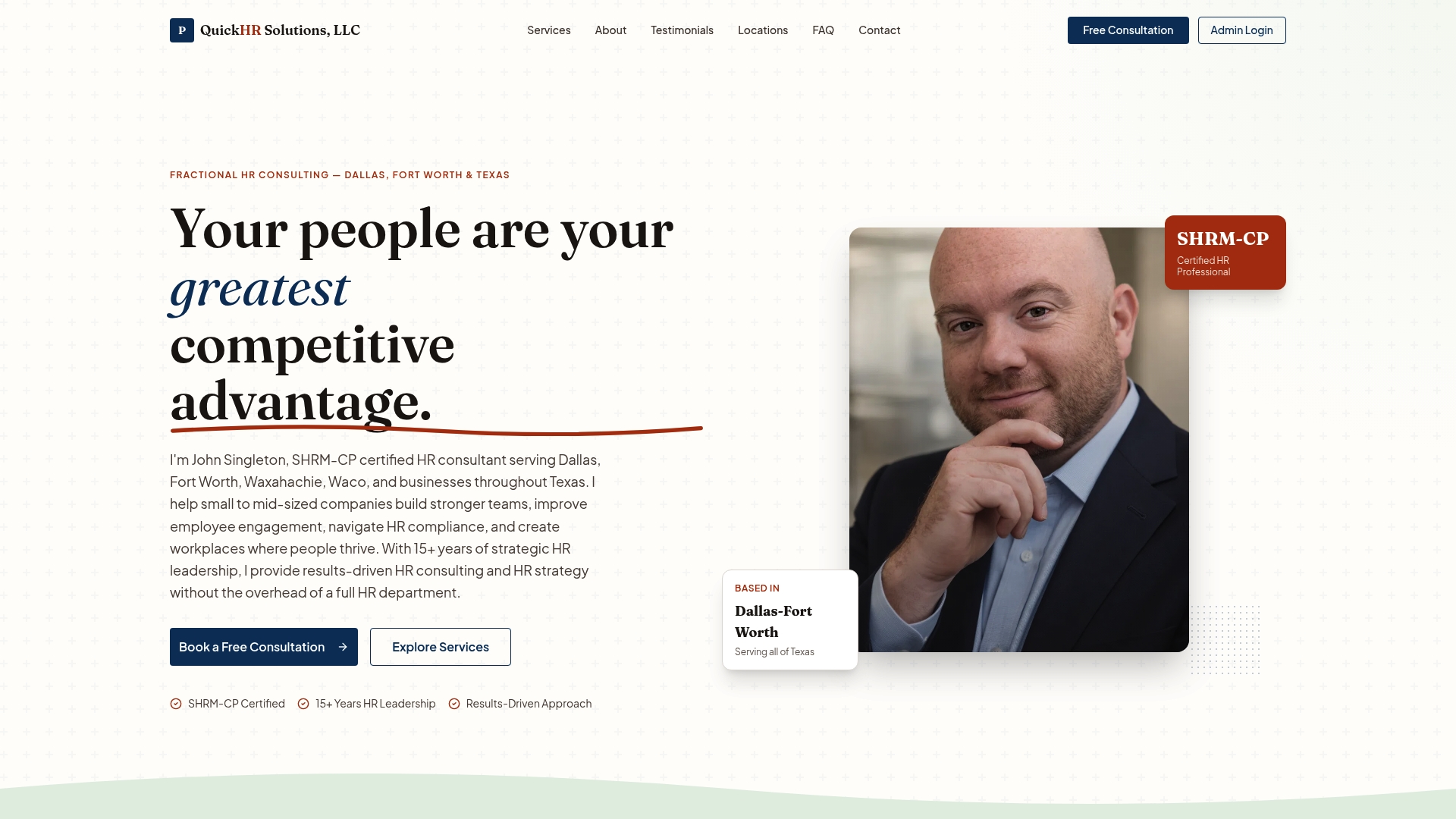
Managing HR risk at the level this article describes takes expertise, time, and systems that most small and mid-sized businesses do not have sitting on the shelf. That is exactly where Quickhrtx operates. As a fractional HR consulting firm serving Dallas-Fort Worth and surrounding Texas markets, Quickhrtx delivers the kind of hands-on HR risk management support that protects your business without the cost of a full internal HR department.
The work spans policy development, HR compliance audits, training program design, employee relations support, and ongoing compliance monitoring. Whether you need a foundational risk assessment or want a partner to help you build out governance from the ground up, the team at Quickhrtx fractional HR services can scope a engagement that fits your organization's size, industry, and risk profile. Book a free consultation to see what a difference focused HR expertise makes.
FAQ
What are the most common HR compliance risks for businesses?
The most common HR compliance risks include wage and hour violations, worker misclassification, harassment without documentation, inconsistent policy application, and incomplete onboarding records. The DOL recovered over $259M in back wages in fiscal year 2025 alone, making wage and hour compliance among the highest-exposure areas for most employers.
How do you conduct an HR risk assessment?
An HR risk assessment involves collecting workforce data, reviewing policy gaps, and mapping identified risks on a likelihood-impact matrix. Document both inherent and residual risks in a formal risk register, then prioritize your mitigation efforts around the highest-exposure areas.
Why does training documentation matter for HR risk?
OSHA and EEOC use training records as primary evidence during audits and enforcement actions. The Faragher-Ellerth defense in harassment cases depends on proving that effective, documented training existed and that a complaint process was accessible to employees.
What are Key Risk Indicators in HR?
Key Risk Indicators are measurable metrics that signal when an HR risk is trending toward an unacceptable level. Examples include open investigation age, training completion rates, complaint volume by category, and turnover rate by department. Tracking KRIs regularly allows HR teams to intervene before a trend becomes a formal compliance failure.
How can a small business manage HR risk without a full HR department?
Small businesses can manage HR risk through fractional HR consulting, which provides access to certified HR expertise on a flexible basis. This covers policy development, compliance audits, training design, and employee relations support without the overhead of a full-time hire. Texas-based businesses can explore options like Quickhrtx HR consulting to get started.