

HR's role in fundraising stages is to recruit, onboard, retain, and structure fundraising talent in direct alignment with campaign goals and regulatory requirements. Most organizations treat HR as a back-office function during fundraising drives. That is a costly mistake. Fundraiser turnover concentrates heavily in the first 24 months, making early HR involvement the single biggest factor in whether a campaign succeeds or stalls. The Association of Fundraising Professionals (AFP) 2026 standards reinforce this, placing onboarding quality and portfolio handover practices at the center of fundraising team stability. HR professionals who understand this shift from administrative support to strategic partner give their organizations a measurable advantage.
What is the role of HR in fundraising stages?
HR's involvement in fundraising is best described as workforce lifecycle management applied to philanthropic revenue goals. The industry term for this practice is mission-driven human resource management, and it covers every phase from pre-campaign hiring through post-campaign retention reviews.
The stakes are high. When a Major Gifts Officer leaves within the first year, the organization loses not just a salary investment but an entire donor portfolio built on personal relationships. That portfolio rarely transfers cleanly to a successor without a documented handover process, which is an HR responsibility, not a development team assumption.
HR functions in fundraising span four core areas: recruitment aligned to campaign stage, structured onboarding that reduces early attrition, compliance management tied to nonprofit regulations, and organizational design that matches team structure to campaign complexity. Each of these areas requires deliberate planning before a campaign launches, not reactive hiring after a gap appears.
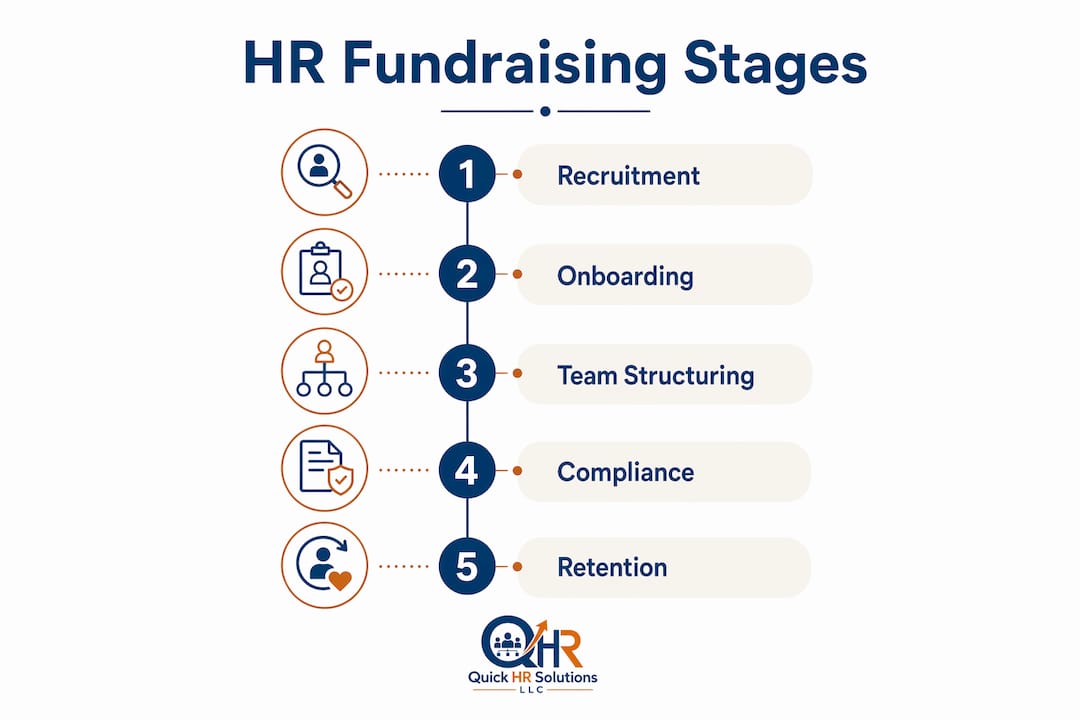
The importance of HR in donations and fundraising outcomes becomes clearest when you look at what breaks down without it. Campaigns stall when roles are undefined, staff burn out when workloads are not scaled to headcount, and donor trust erodes when compliance records are incomplete. HR prevents all three.
How does HR support recruitment and onboarding across fundraising stages?
Recruitment for fundraising teams requires role specificity that generic hiring processes miss. A Major Gifts Officer, a Campaign Associate, and a Planned Giving Coordinator each require different competencies, different interview formats, and different onboarding timelines.
Evidence-based interviews that include case study walkthroughs and solicitation role-playing predict fundraising success far better than standard behavioral questions. This approach targets actual portfolio management skills rather than generic qualifiers like "passion for the mission." HR professionals who design these interviews reduce premature attrition and improve the quality of hires from the first round.
Inclusive hiring practices also matter for long-term portfolio health. When HR builds diverse candidate pools and removes bias from screening, the resulting teams show stronger retention and broader donor relationship coverage. This is not a values exercise. It is a portfolio risk management decision.
Onboarding is where most organizations lose the gains made in recruitment. A structured 30-60-90 day plan with named internal sponsors and explicit compensation review timelines gives new fundraising hires a clear path forward. Structured onboarding plans with internal sponsors result in significantly reduced turnover rates. That reduction directly protects donor relationships and campaign continuity.
Key onboarding elements HR should build into every fundraising hire:
- Documented portfolio handover from the previous role holder, including donor history and relationship notes
- Named internal sponsor who meets with the new hire weekly during the first 90 days
- Compensation review timeline communicated at hire, not left ambiguous
- Compliance training covering donor-restriction rules and grant reporting obligations
- 30-60-90 day milestones tied to specific fundraising outcomes, not just orientation tasks
Pro Tip: Build the portfolio handover document into the offboarding checklist for every departing fundraiser. This single practice protects donor relationships regardless of who fills the role next.
For organizations that want to go deeper on reducing fundraiser turnover, structured onboarding is the highest-leverage starting point.
What organizational structures does HR establish for different fundraising campaigns?
Campaign complexity determines team structure, and HR is responsible for designing that structure before the campaign begins. A standard annual fund campaign can run with existing development staff. A capital campaign exceeding 1.5 times baseline fundraising requires dedicated campaign hires.

AFP 2026 standards specify that campaigns of this scale need at least one dedicated campaign hire, starting with a Campaign Associate who manages data and logistics before a Campaign Director is added. This sequencing matters. Hiring a senior Campaign Director without operational support underneath them is one of the most common and expensive HR mistakes in nonprofit fundraising.
HR must also differentiate clearly between executive fundraising roles. A Chief Development Officer (CDO) is a strategic revenue partner who works at the board and major donor level. A Director of Development focuses on operational execution, managing the day-to-day campaign machinery. Mislabeling these roles in job postings causes mismatched hires and accelerates turnover.
| Role | Standard campaign | Capital campaign |
|---|---|---|
| Chief Development Officer | Strategic leadership, board relations | Strategic leadership, campaign vision |
| Director of Development | Operational execution, team management | Operational execution, campaign coordination |
| Campaign Associate | Not typically required | Data management, logistics, donor tracking |
| Campaign Director | Not typically required | Senior campaign oversight, major gift solicitation |
| Major Gifts Officer | Core fundraising staff | Core fundraising staff, elevated portfolio |
Fractional senior hires are another common pitfall. Bringing in a part-time CDO during a capital campaign creates accountability gaps and confuses both staff and donors about who holds the relationship. HR should push for full-time, clearly scoped roles during high-intensity campaign phases.
Pro Tip: When building a capital campaign team, hire the Campaign Associate first. Operational infrastructure must exist before senior campaign leadership can function effectively.
HR department restructuring to support campaign-specific teams is a documented practice for mid-sized organizations scaling their fundraising capacity.
How does HR ensure compliance during fundraising operations?
Compliance is not a one-time audit preparation task. It is a continuous HR function that runs parallel to every fundraising phase. Nonprofits must meet IRS Form 990 disclosure requirements, maintain grant reporting schedules, and keep donor-restriction records that satisfy both legal obligations and donor expectations.
HR ensures adherence to these requirements by building compliance checkpoints into the fundraising calendar. When a new grant is received, HR coordinates with finance and development to confirm that staff roles, time tracking, and reporting responsibilities are clearly assigned. When a campaign closes, HR ensures that donor-restriction documentation is archived correctly.
The compliance responsibilities HR owns during fundraising include:
- IRS Form 990 preparation support, including accurate compensation disclosures for development staff
- Grant reporting coordination, ensuring staff time is tracked against grant-funded activities
- Donor-restriction record-keeping, maintaining documentation that restricted gifts are used as designated
- Internal controls review, confirming that no single staff member controls both solicitation and gift processing
- Compliance training for fundraising staff, covering gift acceptance policies and conflict-of-interest rules
Audit readiness is the practical outcome of these practices. Organizations that maintain continuous compliance documentation move through audits faster and with fewer findings. That credibility directly supports donor trust and future grant eligibility.
HR's compliance role also scales with organizational growth. As fundraising revenue increases, the complexity of reporting requirements grows. HR must anticipate that growth and build systems before the volume exceeds the team's capacity to manage it manually.
How can HR build a mission-driven culture that retains fundraising staff?
Retention in fundraising depends on leadership integration and cultural alignment far more than compensation packages or HR programs alone. Fundraisers leave primarily because they feel disconnected from organizational strategy, not because they found a higher salary elsewhere. HR's job is to close that gap before it becomes a resignation.
Mission-driven HRM gives nonprofits a framework for motivating staff and volunteers when financial incentives are limited. The approach centers on psychological engagement: giving fundraisers meaningful involvement in decisions that affect their work, recognizing their contributions publicly, and connecting daily tasks to the organization's broader impact. This is especially relevant for volunteer-dependent organizations where monetary motivation is not an option.
Practical HR strategies for building fundraising staff engagement:
- Include fundraising staff in campaign planning meetings, not just execution briefings
- Create formal recognition programs tied to donor relationship milestones, not just dollar totals
- Conduct stay interviews at the six-month and twelve-month marks to surface concerns before they become exit interviews
- Build psychological contracts by documenting growth paths and promotion criteria at hire
- Involve fundraisers in mission storytelling, giving them a visible role in communicating organizational impact
Tracking turnover metrics by role and tenure gives HR the data to identify where cultural disconnects are occurring before they become patterns.
Pro Tip: Run a stay interview at the 90-day mark for every new fundraising hire. Ask directly what would make them leave. The answers are almost always fixable, and the conversation itself signals that leadership is paying attention.
Key Takeaways
HR's role in fundraising stages is most effective when it operates as a strategic function from campaign planning through post-campaign retention, not as a reactive support service.
| Point | Details |
|---|---|
| Onboarding drives retention | Structured 30-60-90 day plans with internal sponsors reduce early fundraiser attrition. |
| Role clarity prevents turnover | Distinguishing CDO from Director of Development prevents mismatched hires and costly exits. |
| Capital campaigns need dedicated hires | Campaigns exceeding 1.5x baseline require a Campaign Associate before adding senior leadership. |
| Compliance is a continuous HR function | IRS Form 990, grant reporting, and donor-restriction records require ongoing HR coordination. |
| Culture retains fundraisers | Strategic inclusion and mission alignment matter more than compensation in keeping fundraising staff. |
What I've learned about HR's real impact on fundraising success
Most leadership teams I work with underestimate how much fundraising performance is an HR problem in disguise. They see a campaign falling short and look at donor strategy, messaging, or market conditions. The actual issue is usually a staffing gap that opened six months earlier and was never properly filled.
The onboarding piece surprises people most. Organizations spend months recruiting a Major Gifts Officer, then hand them a laptop and a donor list on day one. No sponsor. No documented portfolio. No milestone check-ins. Then they wonder why the hire leaves before the 18-month mark.
The role differentiation issue is equally underappreciated. I have seen organizations post a "Director of Development" job when they actually need a CDO, then wonder why the person they hired keeps asking for operational guidance instead of driving board-level strategy. That mismatch is an HR design failure, not a performance failure.
The organizations that get this right treat HR as a campaign planning partner, not a paperwork processor. They bring HR into the room when campaign goals are set, not after the team structure is already decided. That shift in timing changes everything about how well the team performs under pressure.
If you want fundraising campaigns that hold together through the full cycle, start with the HR infrastructure. The donor strategy matters, but it only works if the people executing it are well-hired, well-onboarded, and genuinely connected to the mission.
— John
How Quickhrtx supports HR strategy for fundraising teams
Building the HR infrastructure that fundraising campaigns require takes expertise most organizations do not have in-house.
Quickhrtx provides fractional HR consulting for small to mid-sized organizations in Dallas-Fort Worth and across Texas. The service covers recruitment design, onboarding program development, compliance coordination, and organizational structuring for fundraising and campaign-specific teams. You get SHRM-certified HR expertise without the cost of a full internal department. Organizations that need expert HR support aligned to their fundraising goals can book a free consultation to discuss where HR strategy can have the most immediate impact on their campaign outcomes.
FAQ
What is HR's primary role during a fundraising campaign?
HR's primary role is to recruit, onboard, and retain fundraising staff aligned to campaign goals while maintaining compliance with nonprofit regulations. Without structured HR involvement, fundraiser turnover and compliance gaps directly undermine campaign performance.
When should HR get involved in fundraising planning?
HR should be involved before the campaign launches, not after staffing gaps appear. Role design, compensation benchmarking, and onboarding plans must be in place before the first hire is made.
Why does fundraiser turnover concentrate in the first 24 months?
Fundraiser turnover peaks in the first 24 months because onboarding quality in the first 90 days is the strongest predictor of long-term retention. Poor portfolio handovers and lack of internal sponsors accelerate early exits.
What HR roles are specific to capital campaigns?
Capital campaigns exceeding 1.5 times baseline fundraising require dedicated roles including a Campaign Associate for data and logistics and a Campaign Director for senior oversight. These roles are distinct from permanent development staff and must be scoped and hired by HR before the campaign enters its active phase.
How does mission-driven HRM differ from standard HR practice?
Mission-driven HRM prioritizes psychological engagement and strategic inclusion over monetary incentives, which is critical in nonprofits where compensation budgets are limited. It motivates fundraising staff and volunteers by connecting their daily work to measurable organizational impact.