

HR is the strategic architect of culture change, responsible for aligning people systems, leadership behaviors, and organizational processes to produce lasting behavioral shifts. Culture change is the formal term for what many leaders call "shifting the way we work," and HR owns the design of every system that makes that shift stick or fail. Less than 50% of CHROs believe their current culture effectively drives performance, and 43% of employees and HR teams report misalignment between culture and systems. That gap is precisely where HR's role in culture change begins.
What are the key areas where HR influences culture change?
HR's impact on culture runs through six organizational levers. Addressing all six together is not optional. Multi-lever culture change programs are 5 times more likely to succeed than communication-only campaigns. That statistic reframes the entire conversation: culture change is a systems problem, not a messaging problem.
The six levers HR manages are:
- Leadership behavior modeling. Leaders must visibly demonstrate the target culture. HR designs leadership development programs, 360-degree feedback tools, and coaching structures that hold leaders accountable for the behaviors they model daily.
- People systems: hiring, onboarding, and development. Every hire is a culture decision. HR builds interview frameworks, onboarding experiences, and learning paths that reinforce the values the organization is trying to embed.
- Organizational structure and governance. Reporting lines, decision-making authority, and team design all send cultural signals. HR advises on restructuring when structure contradicts stated values. A guide on HR department restructuring shows how this plays out in mid-sized companies specifically.
- Communication practices. Communication reinforces culture but does not create it. HR designs communication rhythms that keep culture visible without relying on campaigns as the primary change mechanism.
- Work environment and psychological safety. HR builds policies and manager training that create conditions where employees can speak up, take risks, and hold each other accountable without fear.
- Rewards and incentives alignment. Compensation, recognition, and promotion criteria must reflect the target culture. When they do not, employees follow the incentives, not the values.
| Lever | Common misalignment | HR's corrective action |
|---|---|---|
| Hiring | Selecting for skills only | Add culture-fit criteria to scorecards |
| Compensation | Rewarding outcomes that contradict values | Redesign bonus criteria to include behavior |
| Leadership | Leaders model old culture | Embed culture metrics in leadership reviews |
| Communication | Campaigns replace systems | Shift investment from campaigns to process design |
Pro Tip: Audit your promotion decisions from the last 12 months. If the people promoted do not visibly model the target culture, your incentive system is actively working against your culture goals.
How does HR diagnose and measure culture before and during change?
Culture change without a baseline measurement is guesswork. Validated diagnostic tools like the Organizational Culture Inventory (OCI) and the Denison Culture Survey give HR quantitative data on current culture norms, leadership climate, and behavioral patterns. Qualitative feedback from focus groups and exit interviews adds texture but cannot replace structured measurement.

The OCI, developed by Human Synergistics, maps culture across 12 behavioral styles grouped into constructive, passive/defensive, and aggressive/defensive clusters. The Denison Culture Survey measures four culture traits: involvement, consistency, adaptability, and mission. Both tools produce benchmarkable scores that HR can track over time.
| Diagnostic tool | What it measures | Best used for |
|---|---|---|
| OCI (Human Synergistics) | Behavioral norms across 12 styles | Baseline and progress tracking |
| Denison Culture Survey | Four culture traits with benchmarks | Linking culture to business performance |
| Employee engagement surveys | Sentiment and experience | Supplementary pulse checks |
| 360-degree feedback | Leadership behavior alignment | Individual leader accountability |
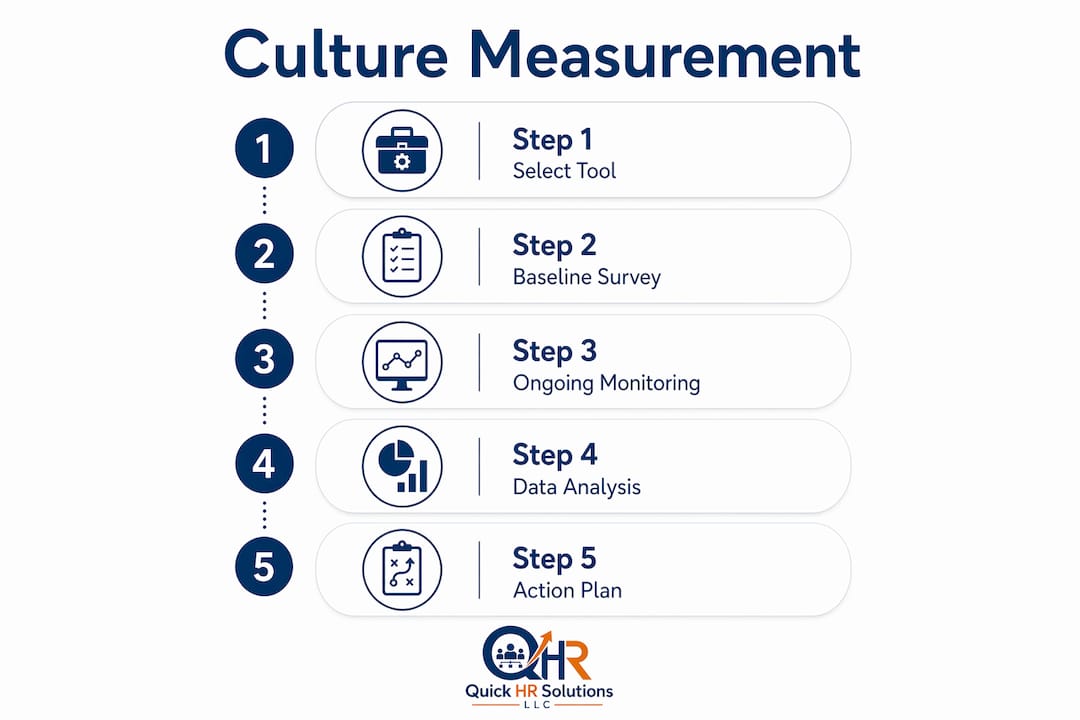
Sustainable culture transformation requires a multi-year timeline. Most organizations underestimate this. A single annual survey cycle is not enough. HR should run diagnostic assessments at baseline, at 12 months, and at 24 months to track whether behaviors are actually shifting or just being reported differently.
Pro Tip: Pair your OCI or Denison results with promotion and performance data. If high scorers on culture surveys are not advancing, your systems are sending a contradictory signal that no amount of measurement will fix on its own.
An HR audit is a practical starting point for identifying where current HR systems contradict the target culture. It surfaces the specific policies, processes, and practices that need redesign before any culture program launches.
Why does targeting one behavior beat broad culture campaigns?
The "inform and inspire" model is the most common and least effective approach to culture change. Broad communication campaigns are costly and rarely shift measurable behaviors. Harvard Business Review's 2026 research makes the case clearly: focusing on one or two high-impact behaviors produces more durable culture change than organization-wide communication programs.
A high-impact behavior is a specific, observable action that, when practiced consistently, shifts the broader culture in the desired direction. Examples include:
- A manager who starts every one-on-one meeting by asking "What obstacle can I remove for you this week?" models a culture of psychological safety and servant leadership.
- A senior leader who publicly credits a team member by name in an all-hands meeting reinforces a recognition culture more effectively than a formal awards program.
- An HR business partner who flags a hiring decision that contradicts culture values, even under time pressure, models that culture criteria are non-negotiable.
HR's job is to identify which one or two behaviors carry the most cultural weight in the specific organization. That identification process involves looking at where culture breakdowns most often occur, which leadership behaviors employees cite as most influential, and which behaviors are currently rewarded versus which ones the organization claims to value.
BCG's 2026 research confirms that engaging leaders to model desired behaviors daily is one of the two most essential actions for sustainable culture change. The other is measuring culture quantitatively. Both are HR's domain.
What practical actions can HR take to embed culture change daily?
Culture takes root through consistent, daily HR actions, not through annual programs. HR's quiet power is the steady implementation of aligned hiring, recognition, and manager support that shapes behavior without fanfare. The following steps translate that principle into practice.
-
Align hiring criteria to culture values explicitly. Write culture-based behavioral interview questions for every role. Train hiring managers to score culture alignment separately from technical skills. Document and track culture-fit decisions over time to spot patterns.
-
Redesign compensation and promotion criteria. Culture is operationalized, not originated. Auditing and realigning compensation and promotion criteria to reflect desired values is the highest-leverage HR activity available. If collaboration is a stated value but individual performance drives all bonuses, the bonus structure wins every time.
-
Equip managers as frontline culture translators. Managers translate HR's culture work to frontline employees. HR must give managers the tools, language, and support to hold accountable conversations about culture, not just performance metrics. This means manager training that goes beyond compliance and into coaching for culture.
-
Embed culture into workflows and policies. Review every major HR policy, from performance management to leave approvals, and identify where the policy contradicts the target culture. These are "culture collisions," and removing them is one of the most direct ways HR can clear the path for culture change.
-
Build recognition systems that reinforce target behaviors. Formal recognition programs work when they are specific and tied to observable behaviors. Vague recognition ("great job this quarter") does not reinforce culture. Specific recognition ("you modeled our transparency value by sharing that difficult update with the team before you had all the answers") does.
-
Track culture metrics alongside business metrics. HR should present culture data in leadership reviews the same way finance presents revenue data. When culture metrics sit in an HR report that leadership never reads, culture stays a side project.
Pro Tip: Build a "culture collision log" with your HR team. Every time a policy, process, or decision contradicts the target culture, document it. Review the log quarterly and prioritize the top three collisions for redesign. This turns culture change from abstract to operational.
Understanding how HR infrastructure supports these daily actions is foundational. A clear picture of HR infrastructure helps business leaders see where the systems gaps are before they try to run culture programs on top of broken foundations.
Key Takeaways
HR drives culture change by redesigning the systems, behaviors, and incentives that shape how people actually work, not by running communication campaigns.
| Point | Details |
|---|---|
| Multi-lever approach is required | Programs addressing all six HR levers are 5 times more likely to succeed than single-channel campaigns. |
| Measure before you move | Use validated tools like OCI or Denison Culture Survey to establish a quantitative baseline before launching any culture initiative. |
| Target one behavior first | Identifying one high-impact behavior and modeling it consistently produces more durable change than broad inspiration programs. |
| Align incentives to values | Auditing hiring, compensation, and promotion criteria is the highest-leverage action HR can take to shift culture. |
| Managers carry the culture | Equipping managers to hold accountable, specific conversations about culture is non-negotiable for embedding change at the frontline. |
What I've learned about HR's real power in culture change
Most culture change efforts fail for a reason that is uncomfortable to say out loud: leadership wants a new culture but is unwilling to change the systems that produce the current one. I have seen this pattern repeatedly. An organization announces a new set of values, runs a culture workshop, and then promotes the same people who modeled the old behaviors. The message employees receive is clear, even if it is never spoken.
The role of HR in organizational change is not to be the culture cheerleader. It is to be the person in the room who points at the promotion decision, the bonus structure, or the onboarding process and says, "This contradicts what we said we value." That is uncomfortable work. It requires HR professionals to have credibility, data, and the backing of senior leadership.
The organizations that get culture change right treat it as a multi-year systems redesign, not a campaign. They measure it. They tie it to business outcomes. They hold leaders accountable for modeling behaviors, not just endorsing values statements. And they give HR the authority to redesign the systems that make culture real.
If you are a business leader reading this, the most important thing you can do is give your HR function the access and authority to audit and redesign your people systems. If you are an HR professional, the most important thing you can do is stop waiting for permission to bring data to the leadership table. The HR strategy work that moves culture is quiet, specific, and persistent. It is also the most impactful work HR does.
— John
How Quickhrtx helps businesses build culture that lasts
Culture change requires HR expertise that most small and mid-sized businesses do not have in-house full time. Quickhrtx provides fractional HR consulting to businesses across Dallas-Fort Worth and Texas, giving leadership teams access to SHRM-certified HR professionals who specialize in exactly this work.
Quickhrtx works with business leaders to audit current HR systems, identify culture collisions, align hiring and compensation criteria to stated values, and equip managers to carry culture into daily operations. The approach is practical, measurable, and built for organizations that need results without the overhead of a full internal HR department. If your culture is not producing the business outcomes you need, the systems behind it are worth a close look. Explore fractional HR services in Dallas or book a free consultation to get started.
FAQ
What is the role of HR in culture change?
HR designs and manages the people systems, hiring criteria, compensation structures, and manager development programs that shape daily behavior. Culture change is a systems redesign, and HR owns the systems.
How long does culture change take?
Sustainable culture transformation requires a multi-year timeline. Most organizations need at least two to three years of consistent, measured effort before behavioral shifts become self-reinforcing.
What tools does HR use to measure culture?
HR uses validated diagnostic tools like the Organizational Culture Inventory (OCI) and the Denison Culture Survey to establish a quantitative baseline and track progress over time.
Why do most culture change programs fail?
Culture change failures most often occur when organizations treat culture as a communication campaign rather than a systemic redesign of workflows, policies, and performance measures.
What is the single most effective HR action for shifting culture?
Auditing and realigning hiring, compensation, and promotion criteria to reflect desired culture values is the highest-leverage action HR can take. Misalignment in these systems undermines every other culture effort.