

Most small business owners assume HR becomes more effective when the team tracks more activity, files paperwork faster, or adds another policy to the employee handbook. That is a costly misunderstanding. Knowing what does HR strategy mean — and acting on that knowledge — is what separates companies that grow through their people from companies that constantly react to workforce problems. For Texas small and mid-sized business owners and HR managers, getting this right also means staying ahead of the state's evolving compliance landscape, from pay transparency to worker classification changes in 2026.
Table of Contents
- What does HR strategy mean? Defining the concept
- Aligning HR strategy with business goals in small and mid-sized firms
- How HR strategy drives performance and culture beyond operations
- Integrating compliance and agility into your HR strategy in Texas
- Practical steps to develop and implement your HR strategy
- Why many HR strategies fail and how Texas SMBs can succeed
- How Quick HR Solutions supports your strategic HR needs in Texas
- Frequently asked questions
Key Takeaways
| Point | Details |
|---|---|
| HR strategy definition | It is a long-term, written plan aligning HR priorities with business goals focused on talent management and workforce structure. |
| Business alignment | Effective HR strategies start by connecting company goals to HR objectives before planning initiatives. |
| Compliance integration | Texas HR strategies must embed regulatory compliance and agile workforce practices proactively. |
| Actionable planning | A successful HR strategy includes specific objectives, timelines, owners, and measurable success metrics. |
| Avoid common pitfalls | Many fail by treating HR strategies as wish-lists without engagement from business leadership or measurable links. |
What does HR strategy mean? Defining the concept
An HR strategy is a formal, multi-year plan that links your people programs directly to business growth objectives. It is not a checklist of HR tasks. It is not an org chart update. It is a deliberate roadmap that answers questions like: What talent do we need to reach our goals in the next three years? How do we structure compensation to stay competitive in the Dallas-Fort Worth market? Where are the gaps between our current workforce and our future needs?
The HR strategy definition that matters for your business goes beyond day-to-day operations. Payroll, benefits administration, and onboarding paperwork are operations. Strategy is what sits above all of that and gives those activities direction and purpose.
The core pillars of a well-built HR strategy include:
- Talent acquisition: Where and how you recruit, and what profiles you prioritize
- Workforce planning: Anticipating headcount needs based on growth projections
- Learning and development: Building skills your business will need, not just the ones it has
- Compensation and total rewards: Structuring pay to attract and keep the right people
- Organizational design: How teams are structured to support business outcomes
- Retention planning: Why people stay and what you do to keep your best performers
The critical distinction is time horizon and intent. HR operations ask "what do we need to do today?" HR strategy asks "what kind of workforce do we need to be competitive in three years, and how do we build it?" For Texas SMBs navigating rapid market changes, that distinction carries real financial weight. Pair your strategy with a solid HR compliance checklist so your long-term plan does not overlook the legal foundation it rests on.
Aligning HR strategy with business goals in small and mid-sized firms
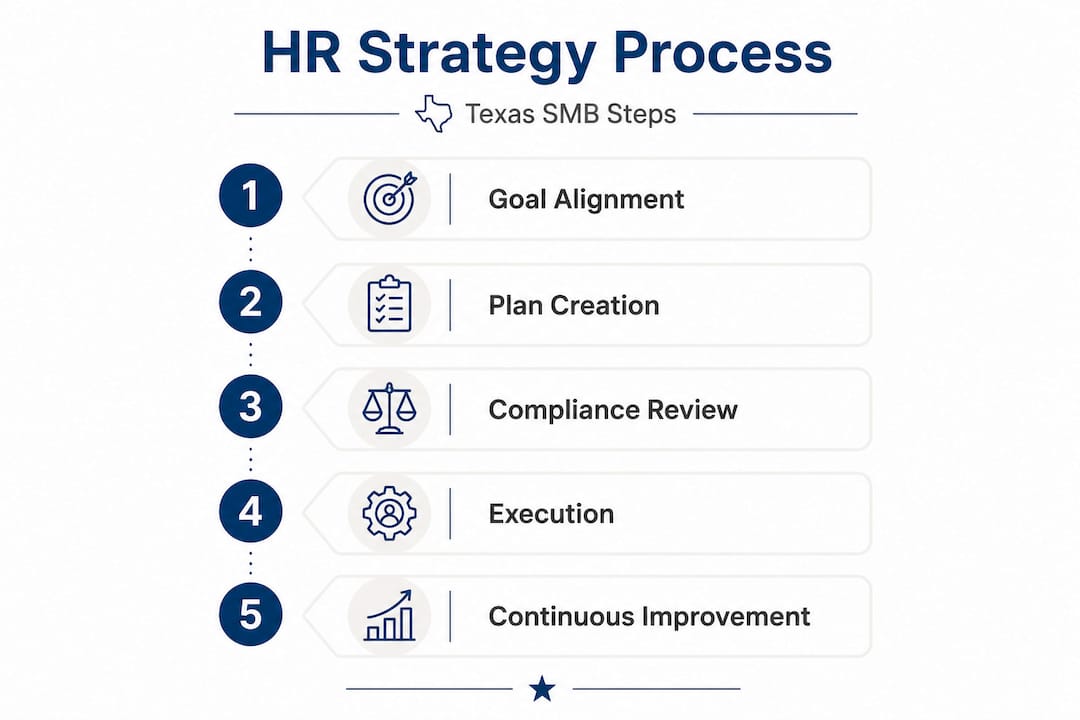
Here is where most Texas businesses get it wrong. They ask the HR team to create an HR strategy, then present it to leadership for approval. That process produces exactly what you do not want: a document built around HR preferences rather than business priorities.
Effective HR strategy works in the opposite direction. You start with where the business is going, then figure out what your workforce needs to get it there. In practice, that means sitting in the room with your CEO, COO, or leadership team before you write a single HR objective.
Follow these steps to build alignment from the start:
- Understand business goals first. What are your revenue targets, expansion plans, or service changes for the next 12 to 36 months? You cannot design HR programs without knowing where the company is headed.
- Identify the workforce implications. If you are opening a second location in Austin, that means recruiting, onboarding, compliance setup, and management coverage. Each goal creates specific HR demands.
- Translate goals into HR objectives. "Grow revenue by 30%" becomes "hire six account managers by Q3 and reduce time-to-fill from 45 days to 28 days." Specific, measurable, tied to business outcomes.
- Assign owners and timelines. Every HR objective needs a responsible person and a deadline. Vague plans produce vague results.
- Set a budget aligned to the priority. If retention is the top business risk, that gets funded first, not split evenly with twelve other initiatives.
Pro Tip: Before your next planning cycle, ask your executive team one question: "If we only solved one workforce problem in the next year, what would move the needle most for the business?" Their answer should anchor your entire HR plan.
Thinking about the tools that support execution? Start with aligning HR and business goals and consider reviewing your HR software implementation to make sure your systems support your strategy rather than complicate it.
How HR strategy drives performance and culture beyond operations
A useful way to frame the importance of HR strategy is this: culture does not happen by accident, and neither does sustained performance. Both require intentional design. That is exactly what a real HR strategy delivers.
When HR strategy is working, the effects show up in places you might not immediately connect to HR planning:
- Managers feel equipped to have real performance conversations because the company has invested in their development
- Employees understand the connection between their daily work and business goals, which drives motivation
- New hires integrate faster because the onboarding process was designed around what actually drives early success, not just compliance paperwork
- Turnover in key roles decreases because compensation and growth opportunities were built to match what those employees actually value
"An HR strategy connects what HR does day-to-day with outcomes the business needs, focusing on what people have, feel, and do to drive performance."
This is what is strategic HR management in practice. It transforms HR from a back-office compliance function into a genuine driver of business results. The difference is visible in team output, manager effectiveness, and culture quality.
For Texas SMBs where every headcount decision carries significant cost, getting this right matters enormously. Explore employee engagement strategies that connect culture to measurable performance outcomes your leadership team will care about.

Integrating compliance and agility into your HR strategy in Texas
Texas is not a high-regulation state by reputation, but 2026 is changing the picture faster than many business owners expect. Federal shifts on overtime thresholds, emerging pay transparency pressure, contractor classification scrutiny, and the rapid adoption of AI hiring tools all carry compliance risk. The businesses that get hurt are the ones that treat compliance as a separate workstream from strategy.
Texas HR leaders in 2026 are embedding governance proactively, not bolting it on after a problem surfaces. That means compliance is part of the HR strategy document, not a footnote.
Key compliance and agility priorities to build into your HR strategy:
- Pay transparency review: Know your pay ranges and be prepared to defend them internally and externally
- Worker classification audits: Misclassifying contractors in Texas creates back-tax exposure and legal liability
- AI hiring tool governance: If you use AI in screening or scheduling, your HR strategy needs a written policy for it
- Flexible staffing capacity: Build protocols for scaling headcount up or down quickly without creating classification risk
- Annual policy review schedule: Assign someone to review your employee handbook and key policies every 12 months
Pro Tip: Add a "regulatory watch" item to your quarterly HR leadership meetings. Assign one person to track changes from the Texas Workforce Commission, EEOC, and DOL and report back with any required HR strategy adjustments.
| Compliance area | Risk if ignored | Recommended action |
|---|---|---|
| Worker classification | Back taxes, penalties, lawsuits | Annual audit of all contractor relationships |
| Pay equity | EEOC complaints, reputation damage | Conduct a compensation band review |
| AI in hiring | Bias claims, regulatory violations | Draft an AI use policy before next hiring cycle |
| Overtime rules | Wage claims, DOL investigations | Audit exempt/non-exempt classifications now |
| Employee handbook | Policy gaps create legal exposure | Full review every 12 months minimum |
Use the Texas HR compliance checklist as your starting audit point, and read more about how fractional HR supports Texas SMBs in managing compliance without full-time overhead.
Practical steps to develop and implement your HR strategy
Building your HR strategy does not require a 40-page document. It requires clear thinking, honest conversations with leadership, and a written plan you will actually use. Here is a framework built specifically for small to mid-sized Texas organizations.
A written HR strategic plan should include your objectives, specific actions tied to each, and the metrics you will use to know if it is working. Without that structure, you have aspirations, not a strategy.
- Start with business goals. Pull your company's current plan or talk directly to your leadership team. Map every HR objective back to a specific business priority.
- Conduct a workforce gap analysis. Compare your current talent to what the business needs in 12 to 24 months. Identify critical skill gaps, leadership pipeline risks, and turnover patterns.
- Write the plan. Document objectives, timelines, responsible parties, and budget. One page per focus area is enough. Simplicity gets read; complexity collects dust.
- Decide on talent actions. For each gap, choose: hire externally, develop internally, outsource the function, or automate it. Each choice has different cost and speed implications.
- Set your HR metrics. Decide in advance what "working" looks like. Track the key HR metrics that connect to your business goals, not just activity counts.
- Review quarterly and adjust. Business conditions change. Your HR strategy should flex with them, not sit in a drawer until next year.
| Approach | Best for | Time to impact |
|---|---|---|
| External hiring | Immediate skill gaps, new markets | 30 to 90 days |
| Internal development | Long-term capability building | 6 to 18 months |
| Outsourced HR function | Cost control, specialized expertise | Immediate |
| Automation | Repetitive, high-volume tasks | 60 to 120 days |
Need help getting started? HR consulting for small Texas businesses walks you through what to expect when bringing in outside expertise for this process.
Why many HR strategies fail and how Texas SMBs can succeed
After working with dozens of small and mid-sized businesses across Texas, one pattern shows up repeatedly: the HR strategy was drafted before anyone truly talked to the business. It becomes a wish-list rather than a roadmap tied to measurable outcomes. The result is a polished document that gets reviewed once and ignored.
Here is the uncomfortable truth. Most HR strategies fail not because HR people lack skill, but because the strategy-building process excludes the people who own the business goals. You can have brilliant HR ideas that simply do not connect to what your CFO, operations lead, or sales director actually needs this year.
The other failure pattern is measurement. HR teams default to tracking activity: number of trainings completed, positions filled, policies updated. Those numbers say nothing about whether the business is stronger. Shift your measurement to outcomes: are managers more effective? Is turnover in revenue-generating roles declining? Is the time it takes to reach productivity for new hires shrinking? Those answers tell you if your HR strategy is actually working.
Compliance is the third landmine. Texas SMBs that embed compliance after the strategy is written spend significant time retrofitting. When you build compliance requirements into the strategy from the start, governance becomes a feature of your plan rather than a problem you discover later.
The businesses that get HR strategy right share one trait: they treat it as a living document owned jointly by HR and leadership, reviewed regularly, and adjusted when the business changes. Reducing employee turnover is one of the clearest signals that your strategy is working as intended.
How Quick HR Solutions supports your strategic HR needs in Texas
Building an HR strategy that actually connects to your business takes more than a template. It takes someone who understands Texas employment law, knows the DFW talent market, and has built strategic HR functions for organizations exactly like yours.
Quick HR Solutions offers experienced fractional HR consulting in Dallas tailored for small and mid-sized Texas businesses. From compliance audits and workforce planning to full HR strategy development, our SHRM-certified consultants deliver the strategic HR function your business needs without the cost of a full-time hire. You get a proven partner who builds agility and alignment into everything, from hiring decisions to policy frameworks, so your workforce drives growth instead of slowing it down. Book your free consultation today and get a clear picture of what your HR strategy should look like.
Frequently asked questions
What is the difference between HR strategy and HR operations?
HR strategy is a long-term plan that aligns talent decisions with business goals, while HR operations handle daily tasks like payroll and benefits administration. An HR strategy answers the multi-year talent questions that operations never addresses.
How can Texas small businesses ensure their HR strategy includes compliance?
They should build regular policy reviews, staff training on current regulations, and written governance for AI tools directly into the strategy document. Texas HR leaders embed compliance proactively, including audits and AI governance, rather than reacting after violations occur.
What are key metrics to track the success of an HR strategy?
Focus on retention rates, employee performance trends, leadership pipeline readiness, and cost-effectiveness of your talent programs. A strong HR strategy specifies success metrics upfront, including turnover rates and performance measures, so you know exactly what you are measuring against.
Why is aligning HR strategy with business goals critical for small to mid-sized companies?
Alignment ensures every HR initiative directly supports a business priority, preventing disconnected efforts that waste budget and time. Without it, HR strategy becomes a wish-list rather than a measurable plan that leadership trusts and funds.