

HR department restructuring is the deliberate process of redesigning your HR team's roles, reporting lines, and workflows to align with current business strategy and workforce demands. When done correctly, it transforms HR from a reactive administrative function into a proactive driver of organizational performance. The problem is that less than 25% of restructuring efforts actually improve organizational performance without a clear sequential roadmap. That statistic should stop any business leader cold. This guide walks you through each critical phase of the HR team reorganization process, from building your business case to stabilizing the new structure after launch.
What are the core HR department restructuring steps?
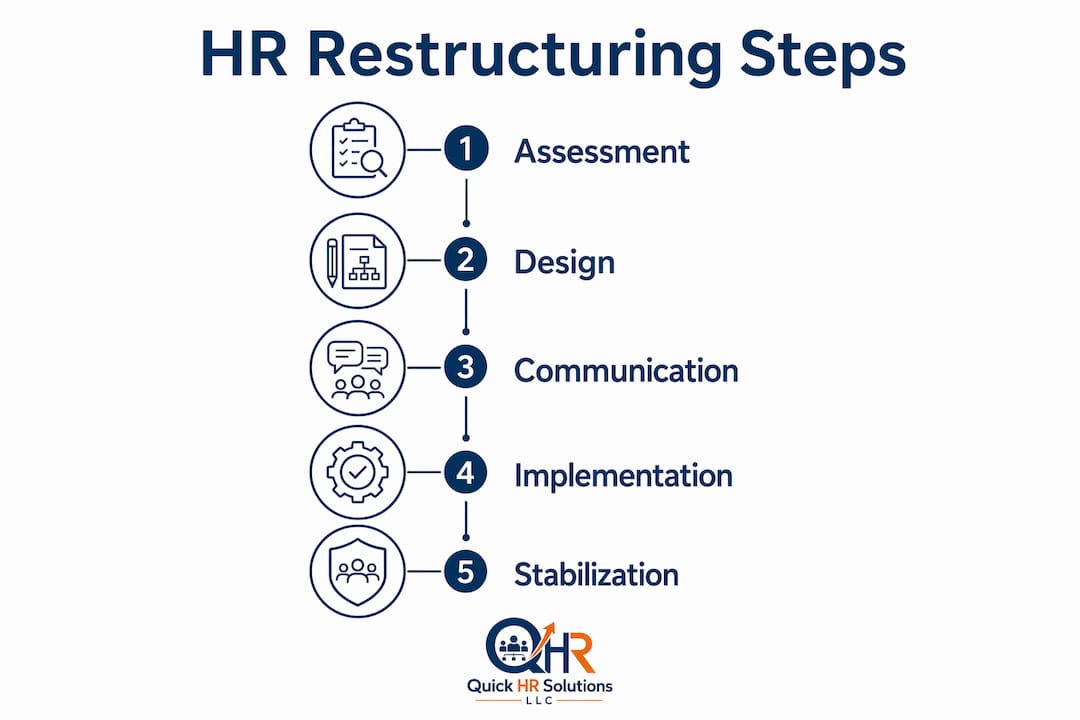
Restructuring human resources is not a single event. It is a sequenced series of decisions, each one building on the last. Skip a step, and you create gaps that surface later as legal exposure, employee disengagement, or structural misalignment. The five phases below represent the full arc of a sound HR department planning process.
Before you begin, recognize that restructuring HR functions differs from a standard reorg. HR touches every employee in the organization, which means errors in process or communication carry outsized consequences. The stakes are high, and the sequence matters.

| Phase | Focus |
|---|---|
| Assessment | Document current state, identify gaps, build business case |
| Design | Model future structure, define roles, test tradeoffs |
| Communication | Brief stakeholders, consult employees, manage feedback |
| Implementation | Execute changes, maintain continuity, handle transitions |
| Stabilization | Measure outcomes, adjust, realign culture |
How do you build a business case and assess your current HR structure?
A restructuring project must begin with a documented, genuine business case to prevent legal challenges. This is not a formality. Courts and labor regulators look for evidence that the decision was driven by real organizational need, not convenience or cost-cutting disguised as strategy.
Your business case should name specific drivers: revenue decline, a technology shift that made certain roles redundant, a merger that created duplicate functions, or a growth trajectory that outpaced your current HR capacity. Vague language like "improving efficiency" will not hold up under scrutiny.
Pro Tip: Document your business drivers with financial data, workforce analytics reports, or board-level strategic plans before you brief a single manager. This paper trail protects you legally and keeps the project grounded in facts.
Once the case is built, map your current state with precision. A real current-state org chart must include interim owners, contractors, and shared-service staff, not just permanent employees. Idealized charts miss dependencies that can derail transitions. A company that maps only its full-time HR staff and then restructures may discover mid-project that a contractor has been managing the entire onboarding workflow for two years.
Your assessment should answer four questions directly:
- Which HR roles are duplicated, underutilized, or misaligned with current business priorities?
- Where do skills gaps exist relative to where the organization is heading in the next 18 to 24 months?
- What compliance obligations apply to any role changes, including WARN Act thresholds, FLSA classifications, and state-specific Texas labor requirements?
- Which HR processes are manual and could be automated, freeing capacity for higher-value work?
The planning stage is often the most overlooked phase in HR restructuring, yet investing in data cleansing and communications planning at this stage reduces legal risks significantly. Treat assessment as a project in itself, not a two-hour meeting.
How do you design a future-state HR structure that actually works?
Designing your future HR structure requires you to hold three constraints in tension simultaneously: accountability, speed, and cost. Optimize for only one and you create problems in the other two. A structure built purely around cost reduction, for example, often collapses accountability and slows decision-making to the point where the savings evaporate.
HR structures optimal for a 50-person company differ greatly from those for a 1,000-person organization, and the timing of the shift from a generalist to a specialist model is critical. Mid-sized companies in the 150 to 500 employee range typically sit at the inflection point where a single HR generalist model starts creating bottlenecks. The design phase is where you decide whether to specialize by function (recruiting, compensation, HRBP) or by business unit.
Follow this sequence when modeling your future state:
- Define the HR outcomes the business needs in the next two to three years, not just the current year.
- Identify which HR functions require dedicated ownership versus shared or outsourced delivery.
- Draft two or three structural models and stress-test each against your top five business scenarios.
- Assess AI and automation readiness. CHROs should design roles with an AI-first mindset rather than patching technology onto old workflows.
- Gather input from at least three senior stakeholders outside HR before finalizing the model.
The AI consideration deserves specific attention. Microsoft automated 40% of transactional HR work and redeployed most affected staff through reskilling pathways, with over 80% of affected employees choosing reskilling rather than severance. That outcome required deliberate role redesign, not just layoffs. For mid-sized companies, the lesson is to identify which HR roles are primarily transactional and build a transition plan before those roles are eliminated. You can explore how HR scalability intersects with AI integration when planning your future-state model.
Pro Tip: Build a comparison table of your structural models showing headcount, cost, accountability owners, and estimated time to full productivity. Presenting three options to leadership with clear tradeoffs produces faster decisions than presenting one "recommended" structure.
How should you communicate and implement the restructuring plan?
Communication is where most restructuring efforts lose credibility. Employees do not resist change as often as they resist being surprised by change. The sequence of who hears what, and when, determines whether your restructuring lands as a strategic initiative or a morale crisis.
Follow this communication sequence without deviation:
- Brief your executive team and legal counsel before any manager is informed.
- Train direct managers on the changes affecting their teams before any broader announcement.
- Announce to affected employees in person or via live video, never by email alone.
- Open a formal feedback channel immediately after the announcement and set a clear deadline for responses.
- Communicate to the broader organization only after affected individuals have been personally notified.
Consultation is not optional in many jurisdictions, and it is not a checkbox exercise. Failing to genuinely listen to employee feedback during consultation periods leads to litigation. Genuine consultation means documenting every piece of feedback, considering alternatives to the proposed structure, and providing written responses to substantive objections.
"The goal of consultation is not to change employees' minds. It is to demonstrate that the organization considered their perspective before making a final decision. That distinction is what separates a defensible process from a legal liability."
Operational continuity during transition is a practical concern that gets underestimated. Identify every critical HR process, assign an interim owner for each one, and document the handoff. Payroll, benefits administration, and compliance reporting cannot pause because an HR manager's role is being redesigned. For guidance on managing the technology side of transitions, the HR software implementation guide from Quickhrtx covers the communication and change management phases in detail.
Pro Tip: Create a simple FAQ document for managers to use when employees ask questions during the consultation period. Consistent answers across the organization prevent rumors from filling the information vacuum.
How do you stabilize and measure success after restructuring?
Most organizational structures take two to three months to stabilize after a reorg, and directional progress is preferred over rushing for perfection. This is the phase where leaders most often make the mistake of declaring victory too early or, conversely, making additional structural changes before the first set of changes has had time to settle.
Set your success metrics before implementation, not after. Metrics tied to business outcomes carry more weight than internal HR metrics alone.
- Track time-to-fill for open roles in the new structure compared to the previous six months.
- Measure HR service delivery response times across key functions.
- Run a 30-day and 90-day pulse survey focused specifically on clarity of roles and confidence in HR support.
- Review compliance incident rates to confirm the new structure has not created gaps.
- Assess manager satisfaction with HR partnership quality at the 90-day mark.
Resistance after implementation is normal and should be treated as data, not insubordination. When a manager consistently routes around the new HR structure, that behavior signals either a design flaw or a communication gap. Investigate before concluding it is a performance issue.
Mid-size firms must evaluate organizational readiness to avoid underperformance post-change. Large companies like Microsoft have the capital to absorb experimental restructuring risks. A 200-person company in Dallas does not have that buffer, which makes the 90-day review cycle non-negotiable rather than optional. For a Texas-specific perspective on HR reporting structures that support post-restructure stability, Quickhrtx has published case studies worth reviewing.
Key takeaways
Effective HR department restructuring requires a documented business case, a real current-state org chart, and a sequenced implementation plan to protect legal compliance and deliver lasting organizational improvement.
| Point | Details |
|---|---|
| Start with a genuine business case | Document specific drivers like revenue loss or role duplication before briefing any stakeholders. |
| Map the real org chart | Include contractors and interim owners to surface hidden dependencies before redesign begins. |
| Design for AI integration | Redesign roles with automation in mind rather than layering technology onto existing workflows. |
| Sequence your communication | Brief executives first, then managers, then affected employees before any broad announcement. |
| Measure at 90 days | Run structured reviews at 30 and 90 days to catch design flaws before they become culture problems. |
What I've learned from watching restructurings succeed and fail
I have worked through enough HR restructuring projects to recognize the pattern that separates the ones that hold from the ones that quietly unravel six months later. The difference almost never comes down to the org chart design itself. It comes down to whether the leadership team treated the process as a communication challenge or a structural one.
The organizations that struggle are the ones that spend 80% of their planning time on the future-state design and 20% on everything else. The ones that succeed invert that ratio. They spend serious time on the current-state assessment, the legal review, and the communication plan, and then the design falls into place more naturally because they actually understand what they are working with.
The AI integration question is where I see the most wishful thinking right now. Traditional siloed HR models are incompatible with AI workflows, and you cannot bolt automation onto a broken process and call it transformation. If your HR team cannot clearly describe what each role produces and who depends on it, you are not ready to redesign around AI. Fix the fundamentals first.
The Microsoft example gets cited constantly, but the lesson most people take from it is the wrong one. The headline is that they automated 40% of transactional work. The real lesson is that they built reskilling pathways before they made the structural changes, not after. That sequencing is what made the difference between a workforce transition and a workforce reduction. Mid-sized companies in Texas do not have Microsoft's resources, but they can absolutely replicate that sequencing discipline.
— John
How Quickhrtx supports your HR restructuring initiative
HR restructuring is one of the highest-stakes projects a business leader will manage, and the margin for error is thin. Quickhrtx provides fractional HR consulting specifically designed for small and mid-sized companies in the Dallas-Fort Worth area that need senior HR expertise without the cost of a full-time CHRO. From building your initial business case to managing the consultation process and setting up your 90-day review framework, Quickhrtx brings SHRM-certified guidance to every phase of your restructuring. If you are planning an HR transformation and want a structured, compliant approach tailored to your organization, book a free consultation with the Quickhrtx team today.
FAQ
What triggers the need for HR department restructuring?
HR restructuring is typically triggered by business growth, a merger or acquisition, technology shifts that make roles redundant, or a strategic pivot that changes workforce requirements. Structural misalignment predictably creates bottlenecks in growing firms, making restructuring a proactive necessity rather than a reactive fix.
How long does an HR restructuring process take?
A full HR restructuring process typically takes three to six months from initial assessment to post-implementation stabilization. Most new structures take two to three months to fully stabilize after the changes go live, so rushing the timeline increases resistance and confusion.
What are the legal risks in HR restructuring?
The primary legal risks include failing to conduct genuine employee consultation, misclassifying roles under FLSA, and triggering WARN Act obligations without proper notice. A documented business case and a structured consultation process are the two most effective protections against litigation.
How do you restructure HR without disrupting operations?
Assign interim owners to every critical HR process before any role changes take effect, and document handoffs in writing. Payroll, benefits administration, and compliance reporting must have named owners throughout the transition to prevent service gaps.
Should small companies use fractional HR support during restructuring?
Fractional HR consulting gives small and mid-sized companies access to senior HR expertise for the duration of the project without committing to a permanent hire. This model is particularly effective during restructuring because it provides objective outside perspective alongside hands-on execution support.