

Most business owners treat HR audits like a fire drill: something you do when regulators are watching or a lawsuit appears on the horizon. That framing is exactly wrong. An HR audit is a structured, objective review of your HR policies, practices, documentation, and processes, and it works best as a proactive tool rather than a reactive one. Understanding what an HR audit is, how the process works, and what you can actually do with the findings will change how you think about managing your workforce and your legal exposure.
Table of Contents
- Key takeaways
- What an HR audit actually is
- The HR audit process, step by step
- Types of HR audits and when to use each
- Benefits and challenges of HR audits
- Using audit findings to drive real improvement
- My honest take on what makes HR audits work
- How Quickhrtx helps businesses audit and strengthen their HR
- FAQ
Key takeaways
| Point | Details |
|---|---|
| HR audits are more than compliance checks | They evaluate hiring, compensation, recordkeeping, training, and workforce management against both legal and operational standards. |
| Follow a structured process | Defining scope, gathering evidence, and prioritizing risks produces findings you can actually act on. |
| Choose the right audit type | Compliance, records, process, and policy audits each serve different organizational needs and triggers. |
| Findings only matter if you act on them | Pair audit results with tracked improvement plans and measurable KPIs to drive lasting change. |
| Evidence beats documentation | Having a policy on paper is not enough; audits must verify that practices are consistently implemented. |
What an HR audit actually is
An HR audit is a structured, evidence-based review of an organization's HR functions designed to check both legal compliance and operational effectiveness. It is not a performance review of your HR team, and it is not a list of boxes to tick before a government inspection. The distinction matters because confusing it with performance management is one of the most common mistakes organizations make, and it leads to reports that look thorough but produce no real change.
The typical scope covers six core areas:
- Hiring and onboarding: Job descriptions, interview practices, offer letters, I-9 documentation, background check compliance
- Compensation and benefits: Pay equity, FLSA classification, wage and hour recordkeeping
- Policy documentation: Employee handbook currency, acknowledgment tracking, policy accessibility
- Training and development: Required training completion (harassment prevention, safety), documented delivery records
- HR compliance: Federal and state law adherence, EEOC obligations, ADA accommodations, FMLA administration
- Workforce management: Disciplinary records, termination documentation, separation agreements
The goal is threefold. First, identify legal risk before it becomes a lawsuit. Second, find operational gaps where inconsistent practices are costing you time or money. Third, confirm that your HR function is actually aligned with where your business is going. An HR audit explained at this level becomes something much more useful than a compliance checklist. It becomes a strategic picture of your people operations.
Pro Tip: Do not limit your audit scope to what feels comfortable. The areas your team is reluctant to examine are usually the ones with the most significant gaps.
The HR audit process, step by step
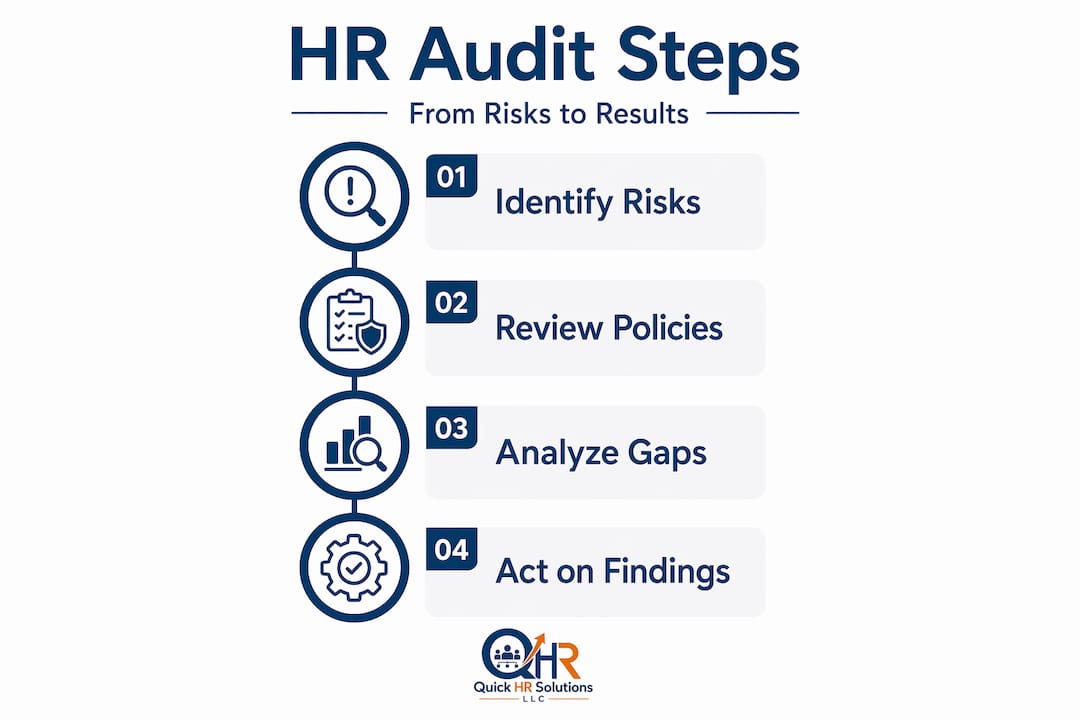
Understanding how to conduct an HR audit starts with accepting that the process is only as good as the evidence you collect. Reviewing whether a policy exists is not the same as verifying whether it is actually followed. That distinction shapes every step below.
- Define scope and objectives. Decide whether you are auditing all HR functions or focusing on a specific area, such as compensation equity or I-9 records. Narrow scope means faster execution and sharper findings.
- Secure leadership buy-in. An audit that does not have management support will stall at the data collection phase. Frame the audit as risk reduction, not HR housekeeping.
- Select your auditors. Internal HR staff can conduct certain audits, but high-stakes compliance assessments often benefit from an external reviewer who brings objectivity and specialized knowledge.
- Collect documentation and data. Gather policies, employee files, training records, compensation data, and interview managers and employees as needed. The Institute of Internal Auditors standards emphasize risk-based, evidence-driven planning, which means you collect proof of practice, not just proof of policy.
- Analyze findings and identify gaps. Compare what you find against applicable laws, internal policies, and industry standards. Note where the gap between written policy and actual practice is widest.
- Prioritize risks. Not every finding carries the same weight. Wage and hour misclassification carries far more legal exposure than an outdated job description template. Rank findings by severity and likelihood.
- Build an improvement plan. Assign owners, set deadlines, and define what "fixed" actually looks like for each finding. Vague corrective action lists get ignored.
- Monitor progress. Schedule a follow-up review at 60, 90, or 180 days depending on the severity of findings. The HR audit process does not end at the report.
Pro Tip: Use your HR audit checklist as a living document. Update it after each audit cycle to reflect new regulatory requirements, organizational changes, or prior findings that recurred.
Types of HR audits and when to use each
Not every audit looks the same, and choosing the wrong format wastes time and produces findings that do not match your actual risk profile. The table below outlines the most common types and when each one fits.
| Audit type | Primary focus | Best used when |
|---|---|---|
| Compliance audit | Legal adherence across all HR functions | Regulatory changes, EEOC complaints, new state laws |
| Records audit | Accuracy and completeness of HR documentation | I-9 issues, audit notices, M&A due diligence |
| Policy audit | Currency and consistency of HR policies | Handbook updates, significant workforce changes |
| Process audit | How HR workflows actually operate vs. how they should | High turnover, inconsistent manager practices |
| Organizational assessment | Broader HR structure, roles, culture alignment | Rapid growth, leadership transitions, mergers |
HR audits are often triggered by specific events. Mergers and regulatory changes are two of the most common catalysts, but routine audits every two to three years are the standard recommendation. Waiting for a trigger event puts you in reactive mode, which is exactly where HR problems become expensive.
A few scenarios where specific audit types add real value:
- A Texas company scaling from 20 to 75 employees needs a compliance audit to address the new legal obligations that attach at 50 employees (FMLA, ADA applicability changes).
- A business going through acquisition needs a records audit to surface any documentation gaps that could delay or complicate the deal.
- A company with high turnover in one department likely needs a process audit to identify whether inconsistent management practices are driving the problem.
Understanding HR risk management helps you determine which audit type belongs at the top of your priority list at any given time.
Benefits and challenges of HR audits
The benefits of HR audits are real, but they are also contingent on how seriously the organization takes the process. A superficial audit creates a false sense of security, which is arguably worse than no audit at all.
The core benefits include:
- Risk reduction: SHRM frames audits as foundational people risk management tools, far more cost-effective than reacting after a complaint or lawsuit.
- Compliance clarity: You get a documented picture of where you stand against federal and state law, which is particularly useful in Texas where wage and hour enforcement has increased.
- Process improvement: Audits surface inconsistencies in how managers apply policies, which drives more equitable and defensible HR decisions.
- Employee trust: When employees see that HR practices are consistent and well-documented, it supports a culture of fairness.
- Strategic alignment: A thorough HR compliance assessment confirms whether your people practices are actually supporting your business goals or working against them.
The challenges are just as real. Resource constraints are common, especially in smaller organizations where the person conducting the audit is also managing daily HR operations. Management resistance is another frequent obstacle. Leaders who view HR audits as criticism of their departments rather than as protective tools will slow the process down.
The most significant challenge is the one most organizations underestimate: confusing policy existence with policy implementation. The EEOC is explicit that completing a checklist does not guarantee legal compliance. Audits must verify that policies are actually being used, that training is actually happening, and that accountability systems are actually functioning.

Pro Tip: When you encounter management resistance, reframe the audit around financial risk. Leadership teams respond very differently to "this could cost us in litigation" than to "we need to update our handbook."
Using audit findings to drive real improvement
An audit report sitting in a shared drive is not an improvement. This is where the purpose of HR audit work either pays off or evaporates entirely.
- Communicate findings clearly. Present results to leadership with findings ranked by risk level, not alphabetically or by HR function. Executives make better decisions when they can see what is most urgent.
- Build a prioritized action plan. For each finding, define the corrective action, the person responsible, and the deadline. Findings without owners do not get resolved.
- Set metrics for success. If your audit revealed inconsistent performance documentation, the metric is not "update the process." It is "100% of performance reviews completed with documented manager notes by Q3." Tracking HR metrics transforms audit findings into measurable progress.
- Schedule follow-up reviews. A 90-day check-in on high-risk findings is the minimum standard. Some organizations build quarterly compliance snapshots into their HR calendar to maintain continuous oversight.
- Loop findings back into your HR strategy. Audit results should inform your hiring practices, compensation reviews, training calendar, and HR technology decisions. The findings are not a to-do list. They are a diagnostic that should shape how you run HR going forward.
For businesses without a full-time HR function, external support through fractional HR consulting can be a practical way to bring audit expertise in without adding headcount. Fractional HR professionals often specialize in exactly the kind of evidence-based review that produces findings worth acting on.
My honest take on what makes HR audits work
I have seen organizations complete thorough, well-documented audits and change absolutely nothing. I have also seen lean, focused audits at growing companies completely reshape how they managed hiring and compliance risk. The difference was never the length of the report.
What actually determines whether an HR audit produces value is whether leadership treats findings as operational information rather than HR paperwork. When I work with clients who are skeptical about the process, I always ask them one question: "If your company were audited by the Department of Labor tomorrow, what would they find?" Most of the time, that question alone surfaces enough uncertainty to justify starting.
The other thing I would push back on is the idea that audits are only for larger organizations. Small businesses in Texas carry the same legal obligations as large ones, and they often have more to lose from a single compliance failure because they lack the legal infrastructure to manage it quickly. A focused HR compliance checklist review can be done in a matter of days for a 30-person company. It does not need to be a massive undertaking.
The audits that fail are the ones that end at the document review. Real audits verify that what is written is actually happening out there in the organization, in manager conversations, in onboarding sessions, in the way terminations are handled. That is where the risk lives, and that is where the value of a real audit shows up.
— John
How Quickhrtx helps businesses audit and strengthen their HR
If this article has raised questions about where your own HR practices stand, that is exactly the right reaction. Quickhrtx works with small to mid-sized businesses across the Dallas-Fort Worth area to provide fractional HR services in Dallas that include structured HR audits, compliance assessments, and practical improvement planning.
You do not need a full internal HR department to have HR practices that hold up to scrutiny. Quickhrtx brings SHRM-certified expertise to the audit process, from defining your scope and collecting evidence to prioritizing risks and building a corrective action plan you can actually execute. Whether you are a 20-person company that has never done a formal audit or a growing business navigating new compliance requirements, our team is ready to help. Book a free consultation at quickhrtx.com and find out exactly where your HR stands.
FAQ
What is an HR audit in simple terms?
An HR audit is a formal review of your organization's HR policies, practices, and documentation to check for legal compliance and operational gaps. It produces findings you can use to reduce risk and improve how HR functions.
How often should a company conduct an HR audit?
Most organizations should conduct a full HR audit every two to three years, with more frequent targeted reviews when triggered by regulatory changes, rapid growth, or a merger or acquisition.
What is included in an HR audit checklist?
A standard HR audit checklist covers hiring documentation, compensation practices, employee recordkeeping, policy currency, required training completion, and compliance with federal and state employment laws.
What is the difference between a compliance audit and a process audit?
A compliance audit checks whether your HR practices meet legal requirements, while a process audit examines how HR workflows actually operate compared to how they are supposed to, often revealing inconsistent management practices.
Can a small business benefit from an HR audit?
Yes. Small businesses carry the same legal obligations as larger companies and often have more to lose from a single compliance failure. A focused audit can identify significant risk in a short time and at a manageable cost.