

HR infrastructure is defined as the integrated system of processes, technologies, policies, and structures that enables an organization to manage its workforce consistently, compliantly, and at scale. Think of it as the operating system running beneath every HR function your business depends on, from payroll and compliance to hiring and culture. Without it, even well-intentioned HR efforts collapse into disconnected tasks that drain time and create legal exposure. SHRM notes that modern HR infrastructure must go beyond basic functionality to support workflows, change management, and culture enhancement. For small and mid-sized businesses in Texas, getting this foundation right is not optional. It determines whether your workforce scales with your growth or becomes your biggest operational liability.
What is HR infrastructure, and why does it matter?
HR infrastructure, sometimes called "HR as infrastructure" in enterprise circles, refers to the full stack of systems, data structures, and operational frameworks that power human resources management across an organization. BIPO describes this as the operating system powering global workforce management through interconnected pillars and automation. That framing matters because it shifts HR from a support function into a core business platform.
The HR infrastructure definition covers three layers. The first is technology, including your Human Resource Information System (HRIS) or Human Capital Management (HCM) platform, payroll engines, and compliance tools. The second is process, meaning the documented workflows, approval chains, and standard operating procedures that govern how HR decisions get made. The third is people and culture, which includes the policies, communication norms, and feedback systems that shape the employee experience.

When these three layers work together, HR becomes predictable and scalable. When they operate in silos, you get inconsistent onboarding, payroll errors, compliance gaps, and frustrated employees. The role of HR infrastructure is to eliminate that fragmentation before it costs you money or talent.
What components make up HR infrastructure?
The components of HR infrastructure fall into five functional categories, each serving a distinct purpose in the workforce management system.
-
HRIS or HCM platform: This is the central database and automation engine for your HR operations. Tools like Rippling centralize employee records, automate payroll calculations, and generate compliance reports from a single source of truth. Rippling defines HRIS as foundational technology that automates essential HR functions and centralizes workforce data. Without this layer, HR teams spend hours reconciling spreadsheets instead of solving people problems.
-
Payroll and compensation systems: Payroll is not just a calculation. It is a compliance event tied to federal, state, and local tax law. Your payroll system must connect directly to employee records, time tracking, and benefits enrollment to avoid errors that trigger IRS penalties or employee disputes.
-
Compliance and policy management: This includes your employee handbook, documented HR policies, and the systems that track regulatory requirements. Texas businesses must navigate both federal employment law and state-specific rules around at-will employment, workers' compensation, and wage payment timing.
-
Onboarding and offboarding workflows: HR Cloud explains that AI-first HR infrastructure must engineer clean handoffs across connected HR processes to avoid automation failures. Onboarding is the most common breakpoint. When your onboarding system does not connect to benefits enrollment, payroll, and compliance training, new hires fall through the cracks.
-
Communication and feedback systems: For distributed or hybrid teams, HR infrastructure must include structured channels for equitable communication. Mission Edge emphasizes that hybrid workforce inclusion requires deliberate meeting design and communication architecture, not just good intentions.
Pro Tip: Before buying any new HR software, map your current data flows on paper. Most infrastructure failures trace back to a broken handoff between two systems, not a missing feature in either one.
Why does HR infrastructure matter for business growth?
The importance of HR infrastructure becomes clearest when a business tries to scale and discovers its HR processes cannot keep up. Hiring your 20th employee should not require reinventing your onboarding process. Expanding to a second location should not create a compliance blind spot.
Integrated HR systems increase productivity by 2.5x compared to siloed systems, according to SHRM. That gap is not about software features. It reflects the cumulative cost of manual data entry, delayed approvals, and inconsistent processes that fragmented HR infrastructure produces every single day.
"HR infrastructure is not an IT project. It is a business continuity decision. The organizations that treat it as a strategic platform, rather than a cost center, are the ones that can hire faster, retain longer, and adapt to change without losing compliance footing." — HR infrastructure best practice, BIPO
Compliance risk is the most immediate financial argument. Employment law violations in Texas can result in back pay awards, EEOC investigations, and litigation costs that dwarf the investment in proper HR systems. A well-built infrastructure automates compliance checks, flags policy violations, and maintains audit-ready records without requiring your HR team to manually track every regulatory update.
Employee retention is the longer-term argument. Workers who experience inconsistent HR processes, delayed payroll, or unclear policies leave faster. The cost of replacing a single employee ranges from 50% to 200% of their annual salary, depending on the role. HR infrastructure that delivers a consistent, professional employee experience pays for itself in reduced turnover alone.
How has HR technology changed the infrastructure model?
The shift from traditional HR infrastructure to modern platforms is the most significant operational change in workforce management over the past decade. Legacy HR systems were built as record-keeping tools. Modern platforms are built as execution engines.
Forbes highlights that HR technology's next shift is toward integrated execution platforms that coordinate work across systems, not just store data about it. This distinction matters for how you evaluate and build your HR systems and technology stack.
Here is how the evolution breaks down in practical terms:
-
From paper to cloud: Cloud-native HRIS platforms replaced on-premise servers and paper files, making employee data accessible in real time from any location. This shift enabled remote HR management and eliminated version-control problems with policy documents.
-
From manual to automated: Payroll runs, benefits enrollment reminders, compliance deadline alerts, and performance review cycles now trigger automatically based on rules you configure once. Automation removes human error from high-stakes, repetitive tasks.
-
From reactive to predictive: AI analytics built into platforms like Rippling and Workday analyze turnover risk, compensation equity gaps, and workforce capacity before problems surface. This moves HR from responding to crises to preventing them.
-
From local to global: Open API architectures allow HR platforms to connect with global payroll engines, local compliance rule sets, and third-party tools without custom development. A Dallas-based company with contractors in three states can manage all of them through one system.
Pro Tip: When evaluating HR platforms, ask vendors specifically about their API documentation and pre-built integrations. A platform with 200 native integrations will serve you far better than one with impressive AI features but limited connectivity.
How to build HR infrastructure that actually works
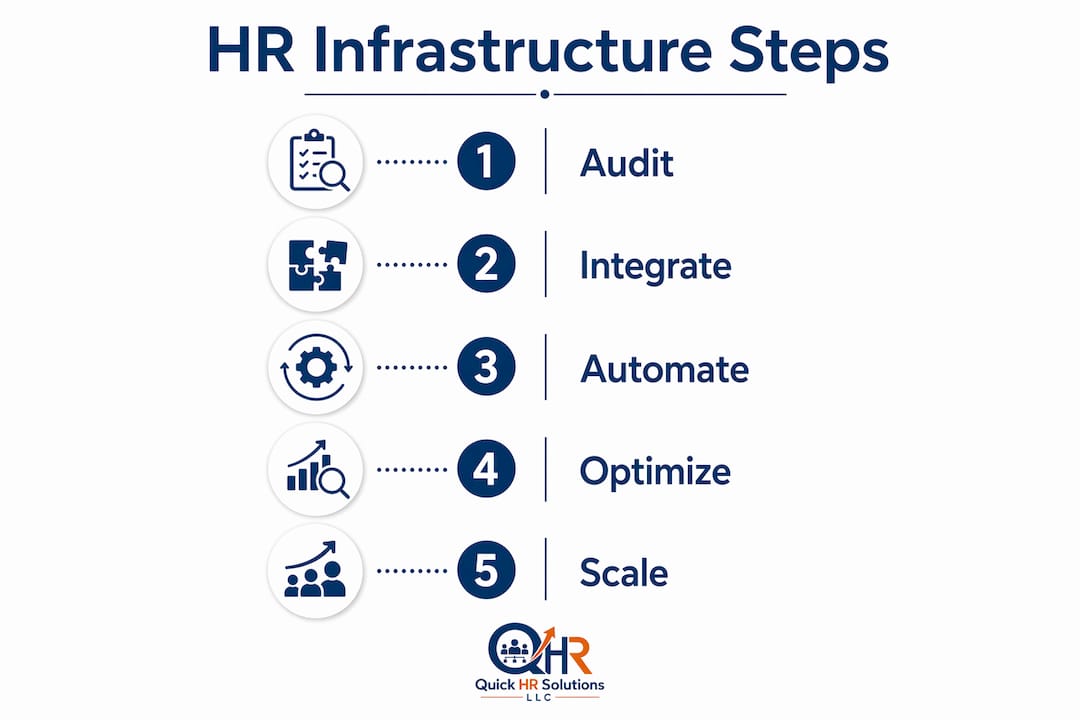
Building or improving HR infrastructure follows a logical sequence. Skipping steps, especially the early diagnostic ones, is the most common reason technology investments fail to deliver results.
The Economic Times cautions that HR infrastructure fails when data governance for employee records is weak, producing flawed automations even when the underlying technology is advanced. Fix your data before you automate it.
| Build stage | What to do |
|---|---|
| Audit current state | Document every HR process, tool, and data source currently in use. Identify gaps and redundancies. |
| Standardize data governance | Define who owns each data type, how records are updated, and what the single source of truth is. |
| Select an integrated HRIS | Choose a platform that covers payroll, compliance, onboarding, and analytics in one system. |
| Document policies and procedures | Write or update your employee handbook, job descriptions, and HR workflows to reflect current law and workforce needs. |
| Build communication systems | Design structured feedback loops and meeting protocols for hybrid or remote teams. |
| Plan for scale | Build your architecture to accommodate 2x your current headcount without requiring a system rebuild. |
The audit stage consistently reveals the most surprises. Most businesses discover they are running three to five disconnected tools that do not share data, creating manual reconciliation work that consumes 30% to 40% of HR staff time. Consolidating onto an integrated platform is the single highest-leverage move available to most small and mid-sized businesses.
For guidance on selecting and deploying the right platform, the HR software implementation guide from Quickhrtx walks through the full process with Texas-specific context. If your workforce includes remote or hybrid employees, the remote team HR policies resource covers the communication and policy infrastructure those teams require.
For businesses expanding across state lines, staying compliant during growth requires HR infrastructure that adapts to new regulatory environments without manual intervention.
Key takeaways
Effective HR infrastructure is the integrated platform of technology, processes, and policies that makes workforce management consistent, compliant, and scalable across every stage of business growth.
| Point | Details |
|---|---|
| HR infrastructure definition | It is the full system of HRIS technology, policies, workflows, and communication structures enabling workforce management. |
| Core components | Payroll, compliance, HRIS platforms, onboarding workflows, and communication systems form the foundational layers. |
| Business impact | Integrated systems increase productivity by 2.5x and reduce compliance risk and employee turnover costs significantly. |
| Technology evolution | Modern platforms shift HR from record-keeping to execution, using automation and AI analytics for proactive management. |
| Build sequence | Audit first, standardize data governance second, then select and implement an integrated HRIS platform. |
What I have learned building HR infrastructure for Texas businesses
After working with dozens of small and mid-sized businesses across the Dallas-Fort Worth area, the pattern I see most often is this: companies invest in HR technology before they have solved their process problems. They buy a sophisticated HRIS, import messy data, configure automations on top of broken workflows, and then blame the software when nothing works as expected.
The technology is rarely the problem. The foundation is.
What I tell every client before we touch a single vendor demo is to spend two weeks documenting their current HR reality. Not what they wish it looked like. What it actually is. Who approves a job offer? Where does that approval get recorded? What triggers a benefits enrollment? If you cannot answer those questions on paper, no platform will answer them for you.
The second thing I push back on is the instinct to automate everything immediately. Automation amplifies whatever process you feed it. A clean, well-documented onboarding workflow becomes a fast, consistent automated experience. A chaotic, undocumented one becomes a fast, consistent source of errors. Start with your highest-volume, highest-risk processes and get those right before expanding.
The businesses I have seen build genuinely effective HR infrastructure share one trait: they treat it as an ongoing operating discipline, not a one-time implementation project. They review their systems quarterly, update policies when law changes, and measure HR outcomes the same way they measure sales or operations. That mindset is what separates HR infrastructure that scales from HR infrastructure that breaks at 50 employees.
If you are unsure whether your current setup has the gaps I am describing, the signs you need an HR consultant checklist is a useful starting point.
— John
How Quickhrtx helps you build HR infrastructure that scales
Quickhrtx provides fractional HR consulting to small and mid-sized businesses across Texas, with deep expertise in building the HR infrastructure components that growing companies need most. From selecting and implementing the right HRIS platform to developing compliant policies and onboarding workflows, the team at Quickhrtx brings SHRM-certified expertise without the cost of a full-time HR department. Whether you are starting from scratch or fixing a system that has outgrown itself, fractional HR support from Quickhrtx gives you a structured path forward. For Dallas-Fort Worth businesses ready to build a workforce management system that scales, explore the fractional HR services in Dallas and book a free consultation today.
FAQ
What is HR infrastructure in simple terms?
HR infrastructure is the combination of technology, policies, and processes that allows a business to manage employees consistently and compliantly. It includes systems like payroll software, an HRIS platform, and documented HR workflows.
What are the main components of HR infrastructure?
The core components are an HRIS or HCM platform, payroll and compliance systems, onboarding workflows, documented HR policies, and communication structures for distributed teams. Each component must connect to the others to function effectively.
Why do small businesses need HR infrastructure?
Small businesses need HR infrastructure to avoid compliance violations, reduce manual HR work, and create a consistent employee experience that supports retention. SHRM data shows integrated HR systems increase productivity by 2.5x compared to fragmented tools.
How do I know if my HR infrastructure needs improvement?
Signs include frequent payroll errors, inconsistent onboarding experiences, compliance gaps, or HR staff spending most of their time on manual data entry. If your systems do not share data automatically, your infrastructure has a foundational problem worth addressing.
What is the difference between HRIS and HR infrastructure?
An HRIS (Human Resource Information System) is one technology component within HR infrastructure. HR infrastructure is the broader system that includes the HRIS plus all policies, workflows, compliance processes, and communication structures that support workforce management.