

HR technology is the use of digital tools and platforms that automate and optimize human resource functions, and it is the single most practical lever small to mid-sized businesses have for growing without proportionally expanding their HR headcount. The role of HR tech in scaling goes far beyond replacing paperwork. Platforms built around AI-driven recruitment, learning management systems (LMS), and workflow automation let a 50-person company operate with the HR infrastructure of a 200-person company. Remote, the payroll and workforce platform, reported a 50% revenue increase per employee by automating administrative workflows without adding headcount. That result is the clearest proof of what HR technology in business growth actually delivers.
How does HR tech drive efficiency during scaling?
HR technology platforms produce measurable results across the metrics that matter most to growing businesses. A recent survey using a 5-point Likert scale found that HR tech platforms scored 4.22 for efficiency and 4.08 each for engagement and retention. Those scores reflect real operational gains, not theoretical ones.
The efficiency gains come from a specific mechanism: automated workflows replace the manual HR tasks that consume disproportionate time at growing companies. Onboarding paperwork, benefits enrollment, time-off requests, and policy acknowledgments can all run through self-service portals without a single HR staff member touching them. That shift frees your HR team to focus on work that actually requires human judgment.

AI-powered recruitment tools compound those gains on the talent acquisition side. Research across 423 HR professionals found that AI-driven recruitment tools produce a beta score of 0.61 for efficiency and 0.38 for candidate experience, both statistically significant results. Shorter time-to-hire and a better candidate experience translate directly into competitive hiring at a lower cost per hire.
Here is what the data tells you about where HR tech delivers the most value:
- Efficiency: Automated onboarding, payroll processing, and compliance tracking reduce administrative hours by removing repetitive manual steps.
- Engagement: Self-service tools and LMS platforms give employees control over their own development, which correlates with higher engagement scores.
- Retention: When HR teams spend less time on transactions, they spend more time on the conversations that keep good people from leaving.
- Recruitment speed: AI screening tools cut time-to-hire by filtering and ranking candidates faster than any manual review process.
The HR tech benefits for scaling are not evenly distributed. Efficiency gains arrive first and fastest. Engagement and retention improvements follow once the tools are embedded in daily workflows and employees trust the systems.
Pro Tip: Train your HR team and your managers on every tool you deploy. Research confirms that leadership support and data literacy are the primary drivers of whether HR tech delivers its promised returns.
What is the right architecture for scaling HR with technology?
Scaling HR with software is an architecture problem before it is a hiring problem. Most small businesses treat HR tech as a collection of separate tools. That approach works at 20 employees. It breaks down at 150.
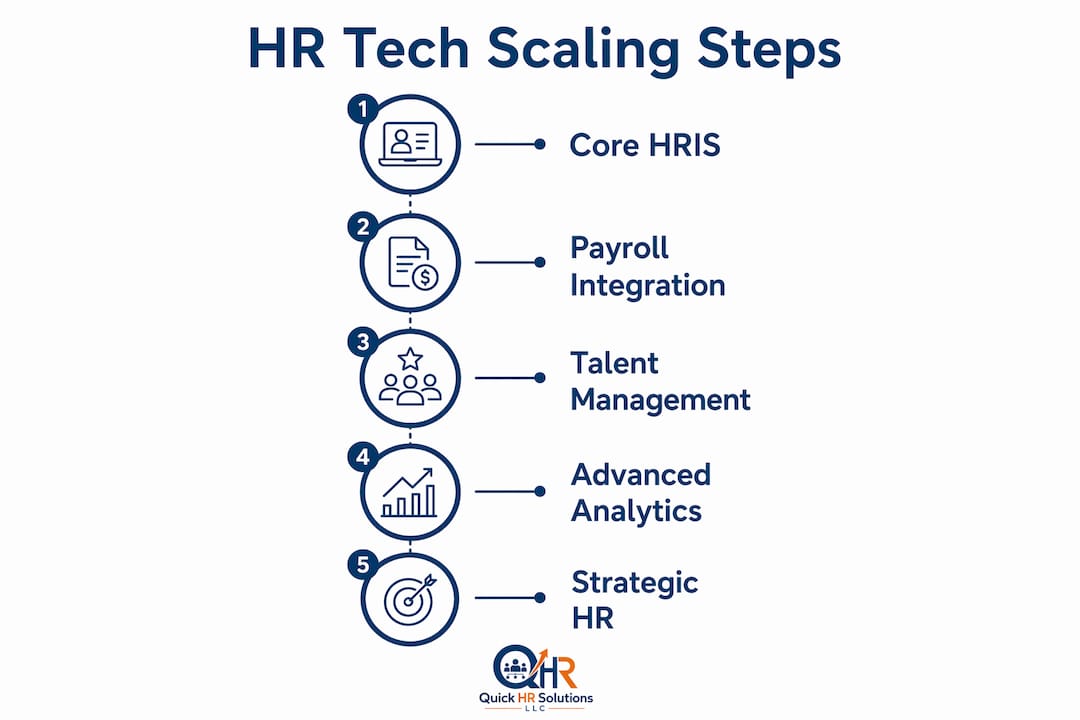
The correct model separates work by type. HR Business Partners (HRBPs) handle strategic and complex employee relations. Centers of Excellence own specialized functions like compensation design and talent strategy. Shared Services handle transactional volume. The key insight from the CHRO Playbook framework is that helpdesk, ticketing, and self-service technology must absorb the transactional layer so HRBPs never become a bottleneck for routine questions.
The table below maps the four growth inflection points to the HR tech modules that become critical at each stage.
| Employee Count | Priority HR Tech Modules | Key Risk Without Them |
|---|---|---|
| Up to 100 | Core HRIS, payroll, basic ATS | Manual errors, compliance gaps |
| 100–250 | Onboarding automation, self-service portal, helpdesk | HRBP time consumed by transactions |
| 250–500 | Performance management, LMS, API-integrated data pipeline | Culture drift, data stitching errors |
| 500–1,000 | Advanced analytics, compensation benchmarking, succession planning | Reactive decisions, talent pipeline gaps |
The data pipeline question is where most mid-sized businesses make a costly mistake. A single employee master data pipeline with API integrations across your ATS, payroll system, performance management platform, and LMS is not optional beyond 250 employees. CSV exports stitched together manually create delays, errors, and compliance exposure. If your HR tools do not talk to each other in real time, your data is always stale.
Understanding HR scalability concepts before you buy any platform saves you from purchasing tools that fit your current size but cannot grow with you.
Pro Tip: Do not enable every module in your HRIS on day one. Adopt modules at the inflection points where the business need is real. Early adoption of complex modules creates administrative overhead with no return.
What are the pitfalls of adopting HR technology at scale?
HR technology adoption carries real risks that most vendors do not advertise. The most serious risk is algorithmic opacity. When an AI tool screens resumes or flags performance issues, the logic behind its decisions is often invisible to the HR team using it. Research confirms that AI tools require human oversight to counteract bias and maintain employee trust. Without that oversight, you can build systemic bias into your hiring process at scale.
Performance management is the second critical failure point. Informal feedback models break down beyond 20 employees because founders and managers lose direct proximity to every team member. Companies that delay implementing a formal, tech-enabled performance management system past that threshold risk losing the culture they built in the early days.
The risks worth monitoring as you scale with HR software include:
- Algorithmic bias: AI recruitment tools can replicate historical hiring patterns, including discriminatory ones, if not audited regularly.
- Transparency gaps: Employees who do not understand how HR decisions are made lose trust in the process, regardless of whether the outcome is fair.
- Over-automation: Replacing every human touchpoint with a chatbot or automated workflow signals to employees that the company values efficiency over people.
- Delayed performance systems: Waiting until you have 100 employees to implement performance management means you have already lost months of structured feedback data.
The solution is a hybrid human-machine model. Use AI to handle volume and speed. Use humans to handle judgment, context, and exceptions. That division of labor preserves both efficiency and trust.
HR tech success depends on the institutional environment around the tools, not just the tools themselves. Leadership that does not model data-driven HR decisions will undermine even the best platform.
How can smbs implement HR technology step by step?
Small to mid-sized businesses need a sequenced approach to adopting HR tech for growth. Buying a full HR suite before you need it wastes money and creates complexity. Waiting too long means you are always catching up to your own growth.
Here is a practical sequence aligned with the inflection points discussed above:
- Audit your current HR workload. Identify the top five tasks consuming the most HR time each week. Those are your first automation targets. Common answers include onboarding paperwork, time-off tracking, and benefits questions.
- Select a core HRIS with a self-service portal. Platforms like BambooHR, Rippling, or Gusto give small businesses a foundation that covers payroll, basic compliance, and employee records in one place.
- Add an ATS with AI screening before your next hiring surge. Do not wait until you have 10 open roles to implement applicant tracking. Set it up when you have two or three open positions so your team learns the tool before volume pressure hits.
- Implement a formal performance management module at or before 50 employees. This is earlier than most businesses act. The payoff is a documented feedback culture that survives leadership changes and rapid growth.
- Build your data pipeline before 250 employees. Confirm that your HRIS, ATS, payroll, and LMS share data through API connections. If any two systems require a CSV export to sync, fix that before it becomes a compliance problem.
- Measure outcomes quarterly. Track turnover metrics, time-to-hire, and employee engagement scores against your pre-implementation baseline. If a tool is not moving those numbers, reconfigure or replace it.
For a detailed walkthrough of each implementation phase, the HR software implementation guide at Quickhrtx covers common failure points and how to avoid them.
Key takeaways
The role of HR tech in scaling succeeds when businesses adopt the right tools at the right growth stage, maintain human oversight in automated processes, and build integrated data pipelines before manual workarounds create compliance risk.
| Point | Details |
|---|---|
| Efficiency comes first | HR tech platforms score 4.22 out of 5 for efficiency gains, the highest of any measured outcome. |
| Architecture beats headcount | Separate transactional HR work from strategic work using helpdesk and self-service tech before you hire more HR staff. |
| Data integration is non-negotiable | API-connected HR systems prevent the data errors that manual CSV exports create beyond 250 employees. |
| Performance management starts early | Implement structured, tech-enabled performance reviews before 50 employees to protect company culture. |
| Human oversight is mandatory | AI recruitment and decision tools require regular audits and human review to prevent bias and maintain trust. |
What i have learned about HR tech and scaling
After working with dozens of small and mid-sized businesses in the Dallas-Fort Worth area, I can tell you that the most common mistake is not buying the wrong tool. The most common mistake is buying the right tool at the wrong time and with no plan for adoption.
I have watched companies purchase enterprise-grade HRIS platforms at 40 employees and spend six months configuring modules they will not need for three years. I have also watched companies hit 200 employees still running HR out of spreadsheets, then spend a frantic quarter trying to backfill data and fix compliance gaps. Both situations are avoidable.
The research backs up what I see in practice. Cost efficiency is the immediate payoff of HR tech. Long-term productivity depends on whether leadership actually uses the data the tools generate. A platform that produces engagement scores nobody reads is not an HR tech investment. It is an expensive subscription.
My honest recommendation: tie every HR tech purchase to a specific business problem you have right now, not one you might have in two years. Then train your managers, not just your HR team, on how to use the output. The technology is rarely the limiting factor. The limiting factor is whether the people responsible for acting on the data actually do.
— John
Scale smarter with fractional HR expertise
Growing businesses in Texas do not always need a full-time HR director to get the most from their HR technology investments. Quickhrtx provides fractional HR consulting in Dallas that gives you SHRM-certified expertise at a fraction of the cost of a full internal hire.
Quickhrtx helps small to mid-sized businesses select the right HR tech stack for their growth stage, implement tools without the common pitfalls, and build the data-driven HR practices that keep scaling on track. If you are not sure where your HR operations stand, the 8 signs you need an HR consultant article is a useful starting point. Book a free consultation at Quick HR Solutions to get a clear picture of what your business needs next.
FAQ
What is the role of HR tech in scaling a business?
HR technology automates transactional HR tasks, accelerates recruitment, and provides data-driven insights that allow businesses to grow their workforce without proportionally growing their HR headcount. The core function is replacing manual processes with systems that scale with the organization.
When should a small business start adopting HR technology?
The first HR tech investment should happen before 50 employees, starting with a core HRIS and self-service portal. Performance management tools should follow before the company reaches 100 employees to protect culture and feedback quality.
How does AI in HR recruitment improve hiring outcomes?
AI-driven recruitment tools produce a statistically significant efficiency score of 0.61 and a candidate experience score of 0.38, according to research across 423 HR professionals. The practical result is faster screening, shorter time-to-hire, and a more consistent candidate experience.
What are the biggest risks of HR technology adoption?
The primary risks are algorithmic bias in AI-powered tools, loss of transparency in automated decision-making, and delayed implementation of performance management systems. A hybrid human-machine model with regular audits addresses all three.
How do you measure whether HR technology is working?
Track turnover rate, time-to-hire, and employee engagement scores quarterly against your pre-implementation baseline. If those numbers are not improving within two to three quarters of full adoption, the tool configuration or the training program needs adjustment.