

Workforce planning for small businesses is the ongoing process of ensuring the right people with the right skills are in the right roles to meet business goals efficiently and cost-effectively. Unlike enterprise-level HR, small business workforce planning runs leaner, moves faster, and lives or dies by how well owners anticipate hiring needs before a crisis hits. The industry term for this discipline is strategic workforce planning, and it covers everything from skills gap analysis to replacement hire budgeting. The workforce planning examples small business owners find most useful are practical, low-cost, and built around real operational rhythms, not corporate theory.
1. What are effective workforce planning examples small businesses can implement?
Effective workforce planning follows five cyclical steps: assess your current workforce, define business goals, identify skills gaps, build a hiring plan, and review quarterly. Each step feeds the next, making this a continuous discipline rather than a one-time project.
Assess current workforce capacity. Start with a simple spreadsheet listing every role, the employee filling it, their core skills, and their tenure. This single document reveals coverage gaps, single points of failure, and roles where one resignation would create an immediate crisis.

Identify skills gaps and flight risks. Cross-reference your role list against your 12-month business goals. If you plan to expand service offerings, flag the skills you do not currently have on staff. Employees with fewer than 18 months of tenure or stagnant compensation are your highest flight risks.
Build a tiered hiring plan. Not every gap requires a full-time hire. Categorize open needs as permanent, temporary, or outsourced. A retail shop adding holiday capacity does not need a permanent employee. A law firm needing occasional bookkeeping does not need an in-house accountant.
Use scheduling technology to save time. Automated scheduling platforms can reduce manager scheduling time from 5–10 hours to just 30 minutes weekly. That frees 7–8 hours per week for training and customer-facing work, which directly improves service quality.
Review and adjust every quarter. Business conditions shift. A quarterly review catches hiring plan drift before it becomes a staffing crisis. Set a 90-minute calendar block each quarter to update your headcount sheet and reprioritize open roles.
Pro Tip: Separate your open roles into two buckets: revenue-protecting roles (positions that directly generate or protect income) and expansion roles (positions that support future growth). Fill revenue-protecting roles first, always.
2. How can small businesses optimize staffing through workforce planning?
The most effective small business staffing strategy shifts away from a static headcount model toward an adaptive workforce structure. The shamrock organization model, developed by management theorist Charles Handy, describes this well. It balances three worker types: a core of permanent full-time employees, a flexible layer of contract or part-time workers, and an outer ring of outsourced specialists.
This structure keeps fixed labor costs manageable while giving you the ability to scale up or down with demand. A 20-person marketing agency, for example, might keep 12 permanent staff, use 4 freelance designers during campaign peaks, and outsource payroll and IT support entirely.
Budget for replacement hires, not just growth hires. Small businesses see an annual turnover rate of about 15%. A 30-person firm should budget for 4–5 replacement hires per year just to maintain current capacity. Ignoring this math leads to understaffing and burnout among remaining employees.
Link workforce plans to revenue targets. Every open role should map to a specific revenue or productivity outcome. If a new sales hire is expected to generate $150,000 in annual revenue, that number justifies the hiring cost. If a role cannot be tied to a measurable outcome, it belongs in the expansion bucket, not the urgent hire list.
Invest in succession planning. Internal development improves retention and reduces the cost of replacing critical roles. Identifying one or two employees to develop for senior positions costs far less than an external search and onboarding cycle.
Pro Tip: Before posting any new full-time role, pressure-test it for 60 days using a contractor or temp worker. If the workload justifies a permanent hire after 60 days, you have real data to back the decision.
3. What practical templates and tools work for small business workforce planning?
Small business workforce planning does not require enterprise software. A well-structured spreadsheet covers most needs for businesses under 50 employees.
Core components of a workforce planning spreadsheet
Your tracking sheet should include these columns: employee name, role title, department, hire date, key skills, performance tier (top, solid, at-risk), and planned departure risk (low, medium, high). Add a second tab for open roles with columns for role title, priority tier (revenue-protecting or expansion), target hire date, and budget range.
This structure gives you a real-time snapshot of your workforce without a subscription fee. Simple tools enable effective review and cost management without enterprise software, and most small businesses find a spreadsheet sufficient until they cross 75 employees.
What to include in a quarterly workforce review
A quarterly review should answer four questions:
- Which roles are at risk of vacancy in the next 90 days?
- Which skills gaps are blocking current revenue goals?
- Are any roles overstaffed relative to current workload?
- Does the hiring pipeline match the budget available this quarter?
Block 90 minutes per quarter for this review. Bring your headcount sheet, your revenue forecast, and your current job postings. Update every field before you close the meeting.
Common pitfalls to avoid
| Pitfall | What it costs you | Better approach |
|---|---|---|
| Panic hiring | Poor fit, high turnover | Maintain a warm candidate pipeline year-round |
| Overstaffing for peaks | Excess fixed labor costs | Use temp or contract workers for seasonal spikes |
| Ignoring replacement hires | Capacity loss, team burnout | Budget 15% annual turnover into your headcount plan |
| Skipping quarterly reviews | Hiring plan drift | Set a recurring 90-minute calendar block each quarter |
Pro Tip: Keep a short list of 3–5 pre-vetted staffing agencies or freelance platforms relevant to your industry. When a vacancy opens, you can move in days rather than weeks.
4. What role does flexible scheduling play in small business workforce planning?
Flexibility is one of the highest-value retention tools available to small businesses, and it costs nothing to offer. 37% of US small business workers cited flexibility as a primary reason for staying with their current employer. That number means flexible scheduling directly reduces your 15% annual turnover rate, which cuts replacement hiring costs.
Structuring roles with hybrid or remote options and flexible shift windows gives you a recruiting advantage over larger employers who move slowly on policy changes. A small accounting firm offering a 4-day workweek or flexible start times competes effectively against larger firms for experienced talent.
Flexible work options also reduce absenteeism and unplanned overtime, two costs that rarely appear in a hiring budget but consistently erode margins. When employees control their schedules within defined parameters, they call out less and stay longer.
Scheduling technology amplifies these benefits. A fast-casual restaurant case study showed that AI-assisted scheduling cut manager scheduling time from 5–10 hours to 30 minutes weekly. That efficiency gain translates directly into better coverage, fewer scheduling conflicts, and more time for managers to develop their teams.
Build flexibility into your workforce plan by documenting which roles are remote-eligible, which can use flexible hours, and which require fixed on-site presence. This documentation prevents inconsistent application of policies, which is a common source of employee relations complaints.
Key takeaways
Effective small business workforce planning requires a continuous cycle of assessment, tiered hiring, and quarterly adjustment rather than a one-time annual plan.
| Point | Details |
|---|---|
| Plan for 15% annual turnover | Budget 4–5 replacement hires per year for every 30 employees to maintain capacity. |
| Use a tiered workforce model | Balance permanent, contract, and outsourced workers to control fixed labor costs. |
| Prioritize revenue-protecting roles | Fill roles tied to direct revenue before expansion or support positions. |
| Flexible scheduling reduces turnover | Offering flexible work options addresses a top retention driver at no added cost. |
| Quarterly reviews prevent hiring drift | A 90-minute quarterly review keeps your workforce plan aligned with business goals. |
What I have learned from working with small businesses on workforce planning
The biggest mistake I see small business owners make is treating workforce planning as a once-a-year exercise, usually buried inside a budget meeting. By the time they realize a key role is vacant or a critical skill is missing, they are already in reactive mode. Panic hiring is expensive and rarely produces the right fit.
The second mistake is building a headcount plan around growth only. Workforce planning is a continuous leadership discipline that aligns talent capability and cost with commercial outcomes. That means accounting for the employees you will lose, not just the ones you plan to add. A 15% annual turnover rate is not a worst-case scenario. It is the baseline.
What actually works is simple: a one-page headcount sheet, a quarterly 90-minute review, and a clear separation between revenue-protecting and expansion roles. Small businesses that follow this rhythm hire faster, spend less on recruiting, and retain employees longer. You do not need a dedicated HR department to do this well. You need a consistent process and the discipline to follow it.
— John
Fractional HR support for small business workforce planning
Building a workforce plan from scratch takes time most small business owners do not have. Quickhrtx provides fractional HR consulting specifically designed for small and mid-sized businesses in the Dallas-Fort Worth area, covering workforce planning, hiring strategy, compliance, and employee retention.
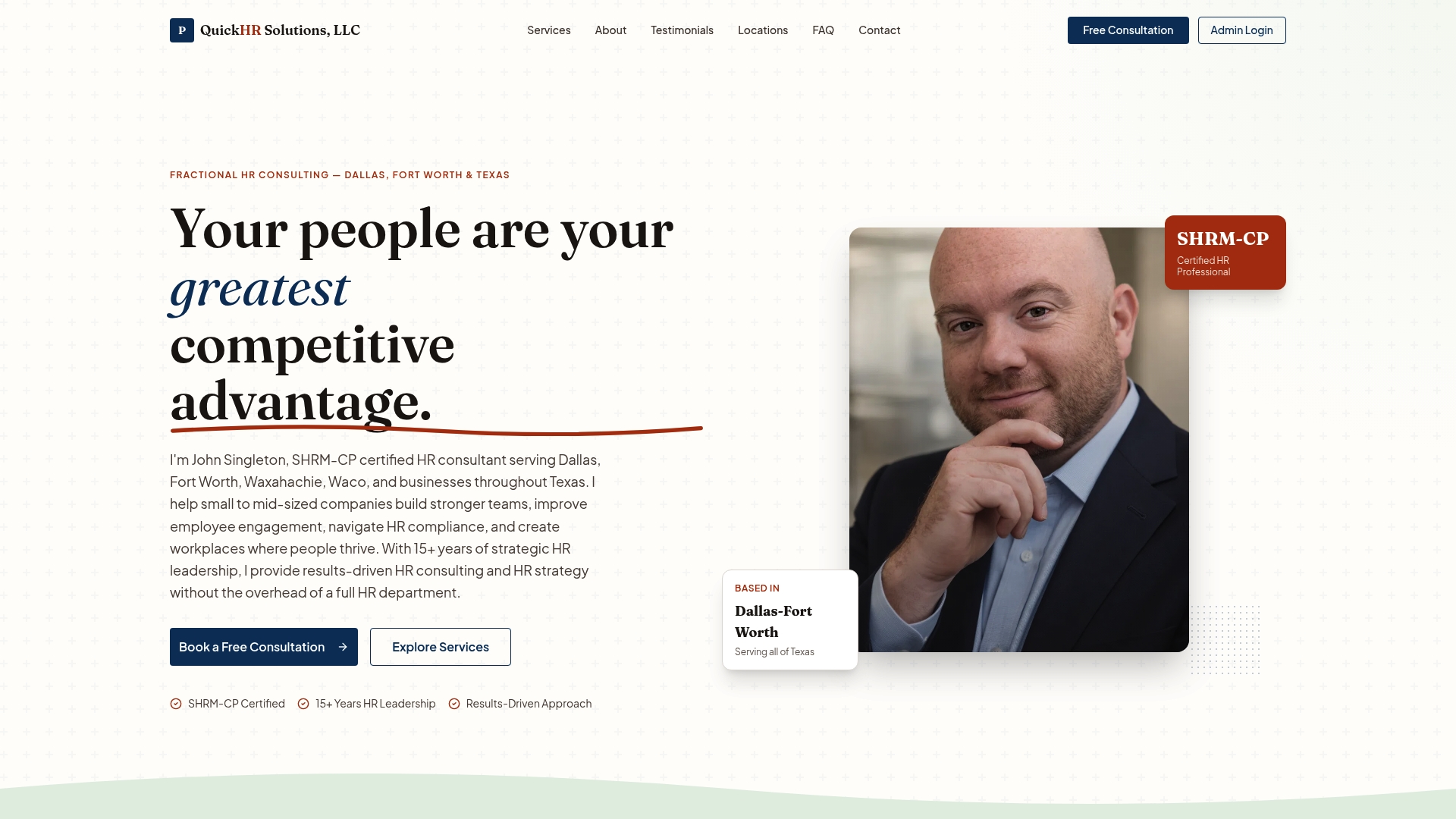
Quickhrtx works as your on-call HR partner without the cost of a full-time HR director. Services include building practical workforce plans, designing hiring processes, and aligning your staffing decisions with your revenue goals. If you are ready to move from reactive hiring to a plan that actually holds, book a free consultation with the Quickhrtx team today.
FAQ
What is workforce planning for a small business?
Workforce planning for a small business is the process of assessing current staff, identifying skills gaps, and building a hiring plan aligned with business goals. It follows a five-step cycle: assess, define goals, identify gaps, plan hires, and review quarterly.
How do I start workforce planning with no HR department?
Start with a simple spreadsheet tracking every role, key skills, and departure risk. Review it every 90 days and separate open roles into revenue-protecting and expansion categories before prioritizing.
How many replacement hires should a small business budget for?
A business with 30 employees should budget for 4–5 replacement hires per year based on a 15% annual turnover rate. Ignoring replacement hires leads to capacity loss and team burnout.
Does flexible scheduling really improve retention?
Yes. 37% of small business workers cite flexibility as a primary reason for staying with their employer. Offering remote or flexible shift options reduces turnover at no direct cost.
When should a small business move beyond spreadsheets for workforce planning?
A spreadsheet works well for businesses under 75 employees. Once you cross that threshold or manage multiple locations, a dedicated HR technology platform reduces administrative errors and saves significant manager time.