

Running HR for a small business without the right systems costs more than most owners realize. The wrong platform wastes hours on manual fixes, creates compliance gaps, and buries managers in paperwork that should take minutes. The right hr technology tools for your small business, formally known as Human Resource Information Systems (HRIS) or HR management software, do the opposite. This guide walks you through exactly what to look for in 2026, profiles the top platforms, and gives you a practical framework for picking the one that actually fits your stage, budget, and goals.
Table of Contents
- Key takeaways
- HR technology tools for small business: how to evaluate your options
- 1. BambooHR
- 2. Gusto
- 3. Rippling
- 4. Zoho People
- 5. ADP RUN
- 6. OnPay
- 7. Comparison of top small business HR platforms
- 8. Practical recommendations by business stage
- What I've learned from watching small businesses pick the wrong HR software
- Ready to choose the right HR platform for your business?
- FAQ
Key takeaways
| Point | Details |
|---|---|
| Define criteria first | Identify your must-have features, budget ceiling, and growth plans before evaluating any platform. |
| Hidden costs are real | The total first-year cost for a 50-person firm can reach $31,200 once add-ons and setup fees are counted. |
| Data readiness drives timelines | Clean employee records before go-live or risk a delayed, error-prone rollout. |
| Match the tool to your stage | Early-stage companies often need simplicity and payroll; growing SMBs need automation and compliance depth. |
| Adoption depends on managers | Manager training, not just employee training, determines whether you actually get ROI from the system. |
HR technology tools for small business: how to evaluate your options
Before you compare any platforms, you need a clear filter. Every vendor will tell you their product does everything. Your job is to know what you actually need.
Core features to prioritize:
- Employee records and document storage
- Payroll processing (or direct integration with a payroll engine)
- Benefits administration and open enrollment
- Onboarding workflows and e-signatures
- Time tracking and PTO management
- Compliance reporting and audit trails
Beyond the feature list, ask harder questions. Can the platform scale with you as you add employees? Are modules sold separately, and does the price jump significantly at 25 or 50 employees? For small HR teams, usability matters as much as features. A system your managers won't log into is a system that fails.
Cost transparency is non-negotiable. The total first-year cost for a 50-employee company can run $18,000 to $31,200 when payroll processing fees and implementation costs are included on top of the base subscription. Always request a full-cost breakdown before signing.

If you have employees in multiple states, compliance support becomes critical. Standalone HR software works fine for single-state employers but leaves you carrying the full compliance risk across state lines. A Professional Employer Organization (PEO) model shares that risk, while an Employer of Record (EOR) takes ownership of it entirely for international workers. Knowing which model you need before shopping saves you from buying the wrong product.
Pro Tip: Ask vendors how long implementation takes for a company your size with your current data setup. Most HRIS deployments for SMBs take 4 to 8 weeks with clean data, and significantly longer without it.
1. BambooHR
BambooHR is one of the most recognized names in small business HR software, and for good reason. It covers the full employee lifecycle from hire to offboard with a clean, intuitive interface that non-HR managers can actually figure out on their own.
Its strengths are in employee self-service, performance management, and reporting. The platform rates highly for small businesses due to its balance of depth across modules without overwhelming users. Payroll is available as an add-on, but if payroll is your top priority, you may find better base-plan value elsewhere.
BambooHR works best for companies between 10 and 150 employees that need structured HR processes without a dedicated HR department.
2. Gusto
Gusto is the go-to recommendation for startups and small businesses that need payroll and benefits handled well from day one. Unlike many competitors that gate payroll behind premium tiers, Gusto includes it in the base plan.
Gusto's Simple plan starts at $49 per month plus $6 per employee, with the Plus plan at $80 plus $12, and Premium at $180 plus $22. For a 30-person company, the Simple plan runs about $229 per month. That's predictable pricing that works for budget-conscious owners.
The interface is beginner-friendly, and Gusto handles new hire reporting, W-2s, and multi-state filings automatically. Its HR features are lighter than BambooHR's, so it's a better fit for companies where payroll is the core pain point, not performance management or learning.
Pro Tip: If you're a founder managing HR yourself before your first HR hire, the founder HR checklist from Quickhrtx gives you a realistic baseline before you pick a platform.
3. Rippling
Rippling plays in a different category than most platforms on this list. It connects HR, IT, and payroll in a single system, which matters if you're managing software access, device provisioning, and employee records all in one place.
Rippling also offers PEO services, making it a strong option for growing companies that need multi-state compliance support without hiring a full HR team. The automation capabilities are genuinely impressive. You can build workflows that trigger onboarding tasks, benefits enrollment, and systems access all from a single new hire action.
The trade-off is cost and complexity. Rippling is modular, meaning you pay for each module you add, and the price climbs quickly. It's a better fit for companies with 20 or more employees who have clear automation needs, not for a five-person startup that just needs payroll.
4. Zoho People
Zoho People is the most budget-friendly platform in this comparison that still covers the HR basics well. If you're already using Zoho's broader suite for CRM or project management, the integration alone makes it worth considering.
Workflow automation is a standout feature at Zoho People's price point. You can build multi-step approval flows for time off requests, performance reviews, and onboarding without needing a developer. For small businesses watching every dollar, this is affordable HR technology that doesn't feel stripped down.
The reporting and analytics are more limited compared to BambooHR or Rippling, and the interface takes some getting used to. But for solo HR practitioners managing a workforce under 50, it gets the job done at a lower cost.
5. ADP RUN
ADP RUN is built for small businesses that want payroll handled by a company with decades of tax compliance experience. Multi-state payroll, garnishments, tax filing, and workers' comp integrations are all handled reliably.
The platform is not the most modern or user-friendly in this group, but it's dependable. If you're in an industry with complex payroll requirements like construction, staffing, or healthcare, ADP RUN's compliance track record makes it a strong choice. It also scales into ADP's larger enterprise product line, which matters if you're planning to grow fast.
6. OnPay
OnPay is worth knowing because its pricing model is genuinely transparent. One flat fee covers payroll, HR, and benefits administration with no tier gating. For companies that have been burned by surprise charges on other platforms, that simplicity is refreshing.
It handles multi-state payroll well, includes onboarding and document management, and integrates cleanly with accounting tools like QuickBooks and Xero. The HR features are not as deep as BambooHR, but for small businesses that want everything in one place without deciphering a pricing matrix, OnPay delivers solid value.
7. Comparison of top small business HR platforms
Use this table as a starting point for your own HR management tools comparison, not as a final answer. Your specific employee count, states of operation, and growth timeline will change the ranking.
| Platform | Starting price | Payroll included | Best for | Watch out for |
|---|---|---|---|---|
| BambooHR | Custom quote | Add-on | Full HR lifecycle, 10-150 employees | Payroll costs extra |
| Gusto | $49 + $6/employee | Yes | Startups, payroll-first needs | Lighter on HR depth |
| Rippling | Modular pricing | Yes | Automation, multi-state, IT integration | Cost grows fast with modules |
| Zoho People | From ~$1.50/employee | No | Budget-conscious, Zoho ecosystem users | Steeper learning curve |
| ADP RUN | Custom quote | Yes | Complex payroll, high-compliance industries | Older UI, less intuitive |
| OnPay | $46 + $6/employee | Yes | Transparent pricing, small teams | Less advanced HR features |
8. Practical recommendations by business stage
Choosing from this list without context is where most small business owners go wrong. The best platform depends on where you are right now and where you're going in the next 18 months.
Early stage (under 15 employees): Keep it simple. Gusto or OnPay will cover payroll, basic onboarding, and compliance without overwhelming you. Both have transparent pricing that fits tight budgets. This is not the time to over-invest in a platform you'll underuse.
Growing phase (15 to 75 employees): This is where you'll feel the gap between a basic payroll tool and a real HRIS. BambooHR handles the HR depth you need as processes formalize. Rippling makes sense if you're hiring in multiple states or need IT and HR connected.
Multi-state or international hiring: You need to decide between standalone software, a PEO, or an EOR before evaluating platforms. The compliance risk differs significantly across these models. Rippling's PEO option or a dedicated EOR service handles this better than most standalone tools.
A few common pitfalls to avoid:
- Signing a contract before auditing your current employee data
- Choosing a platform based on a demo without testing it with actual managers
- Underestimating implementation time. Even simple setups take 4 to 8 weeks with good data
- Ignoring recruitment software integration if hiring is a core growth activity
Pro Tip: Before your go-live date, run a data audit. Duplicate records and inconsistent job titles are the leading cause of delays in HRIS rollouts. Cleaning your data first cuts weeks off your timeline.
If you want to understand the full scope of what an HRIS actually covers before committing, Quickhrtx has a plain-language HRIS guide for Texas SMBs worth reading before you start vendor calls.
What I've learned from watching small businesses pick the wrong HR software
I've worked with a lot of small businesses on HR technology selection, and the pattern that keeps showing up is not about choosing the wrong features. It's about underestimating what happens between signing the contract and actually going live.
Data is where projects stall. Teams assume their employee records are clean until they try to import them. Duplicate records, inconsistent job titles, missing start dates — these create mapping and verification issues that no vendor tells you about upfront. I've seen 6-week implementations turn into 14 weeks because no one audited the data before kickoff.
The second thing I tell every client: treat go-live as the beginning of the work, not the finish line. The early weeks after launch carry the highest risk for workflow failures. Plan for a stabilization period with dedicated support, not just a celebration.
And the piece that gets skipped most often: manager training. Manager readiness is the single biggest adoption bottleneck I see. If your managers don't know how to approve time-off requests or run a basic report, your employees stop using self-service and your HR team goes back to handling everything manually. That erases your ROI entirely.
My honest take on vendor selection? Don't buy for where you want to be in five years. Buy for where you'll be in 18 months and make sure the platform can grow with you. The switching cost of changing platforms is real, but the cost of being locked into an over-engineered system you don't use is worse.
— John
Ready to choose the right HR platform for your business?
Selecting the right HRIS is one decision, but knowing how to configure it, train your team, and keep your HR practices compliant is an ongoing process. That's where Quickhrtx helps small businesses in the Dallas-Fort Worth area and across Texas move faster.
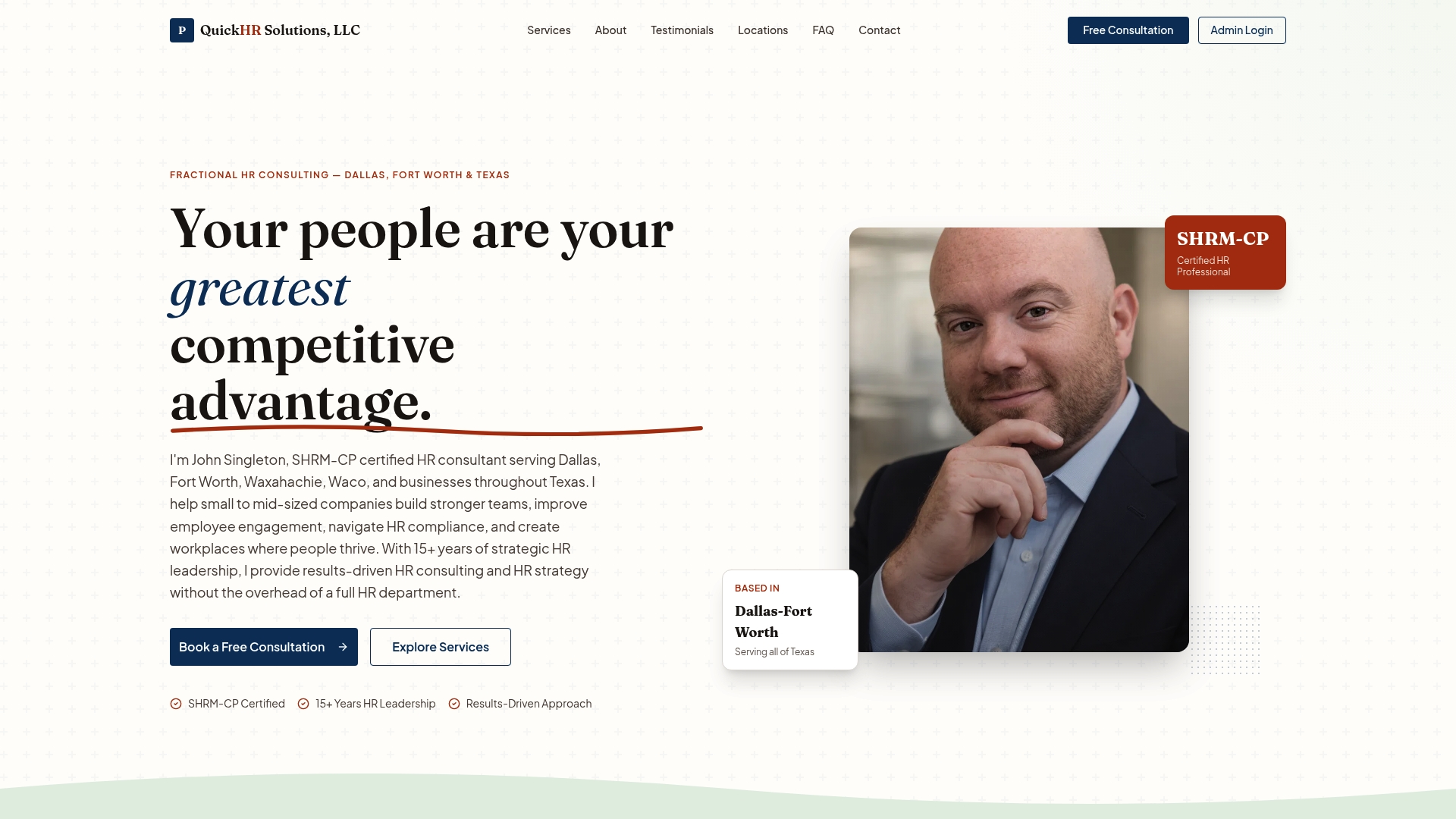
At Quickhrtx, the fractional HR consulting services are built specifically for small businesses that need expert HR guidance without adding a full-time HR director to payroll. From selecting and implementing the right HR software to building compliant onboarding workflows and manager training programs, the team brings SHRM-certified expertise to your specific situation. If you're not sure where to start, book a free consultation and get a clear path forward.
FAQ
What is the best HR software for a small business in 2026?
Gusto is the top pick for payroll-first small businesses, while BambooHR leads for full HR lifecycle management. The best choice depends on your company size, state footprint, and whether payroll or people management is your primary need.
How much does HR software actually cost for a small business?
Base prices start around $46 to $80 per month plus per-employee fees, but the total first-year cost for a 50-person firm often reaches $18,000 to $31,200 once add-ons and implementation are factored in.
How long does it take to implement an HRIS?
Most HRIS implementations for SMBs take 4 to 8 weeks with clean, organized employee data. Companies with 50 to 500 employees or messy records should plan for 6 to 12 weeks.
Do small businesses need a PEO or just HR software?
Single-state businesses with straightforward payroll typically do fine with standalone HR software. Companies hiring across multiple states benefit from a PEO's shared compliance model, and international hiring is best handled through an EOR. Knowing which model fits before selecting a platform saves significant time and money.
What are the signs that a small business needs an HR consultant?
If your managers are making HR decisions without clear policies, you're growing faster than your current processes can handle, or you're facing compliance questions you can't confidently answer, those are clear signals. Quickhrtx outlines 8 specific signs that it's time to bring in outside HR expertise.