

HR metrics are defined as the quantitative data points that measure workforce health, hiring efficiency, and compliance status across your organization. For small business owners, tracking the right HR metrics is the difference between reacting to workforce problems and preventing them. HR analytics for small businesses does not require a data team or expensive software. It requires discipline, a focused set of numbers, and the habit of reviewing them regularly. This guide covers the key HR metrics for owners at every growth stage, with 2026 benchmarks and practical tools to get started.
1. What are the essential HR metrics small business owners should track?
Small businesses under 50 employees should track 6–8 core HR metrics. Tracking more than that early on dilutes focus and reduces data reliability. The metrics below cover the full employee lifecycle from hire to exit.
Voluntary turnover rate measures the percentage of employees who choose to leave in a given period. A healthy annual voluntary turnover rate for most small businesses sits below 15%. Rates above that signal a culture, compensation, or management problem worth investigating.

90-day new hire retention tracks whether new employees stay through their first three months. This metric directly reflects onboarding quality. If new hires leave before day 90, your onboarding process is the first place to look.
Time to hire measures the number of days from job posting to accepted offer. Roles should ideally fill in under 30 days. Longer timelines increase workload on existing staff and raise the risk of losing top candidates to faster-moving competitors.
Offer acceptance rate shows what percentage of candidates accept your job offers. A low rate signals that your compensation, benefits, or employer reputation is falling short of market expectations.
Onboarding completion rate tracks whether new hires finish all required onboarding steps, including compliance training. This metric protects you legally and ensures employees are set up to perform.
Cost per hire captures total recruiting spend divided by the number of hires. Average cost per hire for SMB roles runs $3,000 to $5,000, with executive hires reaching $28,000. Knowing this number helps you budget realistically and evaluate whether your recruiting channels are worth the spend.
Absenteeism rate measures unplanned absences as a percentage of scheduled hours. The target is under 3%. Rates above 5% typically indicate engagement problems, burnout, or workplace stress that need direct attention.
Pro Tip: Calculate absenteeism monthly and flag any team or department where the rate spikes above 4%. Early detection prevents a single disengaged employee from affecting the broader team.
2. How do these HR metrics impact small business performance?
Retention metrics directly affect your bottom line and your culture. High voluntary turnover raises recruiting and training costs, disrupts team continuity, and signals to remaining employees that something is wrong. Tracking turnover metrics strategically gives you the data to address root causes before they compound.
Recruitment metrics like time to hire and offer acceptance rate reflect your pipeline health. A slow time to hire often means your job descriptions are unclear, your interview process has too many steps, or your compensation is not competitive. Fixing these issues shortens your hiring cycle and improves candidate quality.
Onboarding completion rate has a direct compliance dimension. Incomplete onboarding means employees may be missing required safety training, harassment prevention courses, or policy acknowledgments. That gap creates legal exposure, particularly in Texas where employment law violations can carry significant penalties.
Headcount-to-revenue ratio tracks organizational efficiency and should improve as your processes mature. This metric links HR directly to financial performance. If revenue grows but headcount grows faster, your team is becoming less productive per person.
Absenteeism is one of the most underused signals in small business HR. A spike in unplanned absences often precedes voluntary turnover. Treating absenteeism as an early HR risk indicator rather than a scheduling nuisance gives you weeks to intervene before you lose a key employee.
3. What tools and practices do small business owners need to track HR metrics?
Tracking HR metrics does not require expensive software at the start. Simple spreadsheets are effective until manual tracking becomes too complex. Google Sheets or Microsoft Excel can handle turnover calculations, headcount logs, and absenteeism tracking for teams under 20 people.
The transition to a dedicated HRIS platform makes sense when your team grows past 20–25 employees or when data entry errors start affecting your reporting. Platforms like BambooHR, Gusto, and Rippling centralize employee records, automate calculations, and generate reports without manual formulas. Centralized data is the foundation of reliable HR analytics.
Here is a practical approach to building your tracking system:
- Start with a master employee log. Record hire date, role, department, and exit date for every employee. This single file enables turnover and retention calculations immediately.
- Add a recruiting tracker. Log every open role, posting date, interview stages, offer date, and outcome. This produces time to hire and offer acceptance rate automatically.
- Create a monthly attendance log. Track scheduled hours and unplanned absences by employee. Calculate absenteeism rate at the end of each month.
- Build a quarterly summary report. Pull turnover rate, time to hire, and absenteeism into one page. Review it with your leadership team every quarter.
- Upgrade to HRIS when manual tracking takes more than two hours per week. That time cost signals that your data volume has outgrown spreadsheets.
Pro Tip: Centralizing employee data before adopting any AI-powered HR tool is non-negotiable. Scattered records make advanced analytics useless, regardless of how sophisticated the software is.
4. Which HR metrics should small businesses prioritize at different growth stages?
Not every metric matters equally at every stage. Tracking the wrong numbers at the wrong time wastes effort and produces unreliable data. The table below maps metric priorities to team size.
| Growth stage | Team size | Priority metrics | Reporting cadence |
|---|---|---|---|
| Early stage | 1–10 employees | Voluntary turnover, 90-day retention, time to hire | Quarterly |
| Growing | 11–20 employees | Add offer acceptance rate, onboarding completion | Quarterly |
| Scaling | 21–50 employees | Add cost per hire, absenteeism rate | Monthly |
| Established | 50+ employees | Add headcount-to-revenue ratio, training completion | Monthly |
Monthly turnover tracking for teams under 20 employees is misleading. One resignation in a 10-person team produces a 10% monthly turnover rate that looks alarming but means almost nothing statistically. Quarterly reporting smooths out those fluctuations and gives you a trend line you can actually act on.
As your team grows past 20 people, absenteeism and cost per hire become worth tracking because the data volume is large enough to be meaningful. Before that threshold, these metrics can produce false signals that lead to poor decisions.
Compliance complexity also grows with headcount. Once you cross 15 employees, federal laws like Title VII and the Americans with Disabilities Act apply. Once you reach 50, the Family and Medical Leave Act kicks in. Your metric focus should shift to include training completion rates and policy acknowledgment tracking at these thresholds.
5. How can small business owners interpret and act on HR metrics data?
Stopping to see HR data as just reports and starting to use it to identify risks early is where real workforce strategy begins. A high voluntary turnover rate is not just a number. It is a signal that something specific is driving people out, whether that is compensation, a manager, or a lack of growth opportunity.
Red flags worth acting on immediately include:
- Voluntary turnover above 20% annually. Investigate exit interview data for patterns. If you do not conduct exit interviews, start now.
- Offer acceptance rate below 70%. Benchmark your compensation against local market data using tools like the Bureau of Labor Statistics Occupational Employment and Wage Statistics or LinkedIn Salary Insights.
- Absenteeism above 5%. Survey the affected team for engagement and workload issues before assuming the problem is individual.
- 90-day retention below 80%. Audit your onboarding process for gaps in training, manager support, and role clarity.
Benchmarking matters. Industry-specific benchmarks for 2026 are available through SHRM, the Bureau of Labor Statistics, and HR Acuity. Comparing your numbers against sector averages tells you whether a metric is a you problem or an industry-wide trend.
Qualitative data strengthens quantitative findings. A turnover rate tells you something is wrong. Exit interviews, stay interviews, and employee pulse surveys tell you what is wrong. Tracking HR metrics effectively means pairing numbers with conversations, not replacing one with the other.
Key takeaways
Tracking a focused set of HR metrics like turnover, onboarding completion, and time to hire yields better workforce decisions and lower compliance risk than attempting broad analytics before your data is ready.
| Point | Details |
|---|---|
| Start with 6–8 core metrics | Small teams under 50 employees get the most value from a focused, manageable metric set. |
| Use quarterly reporting early | Monthly turnover data for small teams is volatile; quarterly trends are more reliable and actionable. |
| Spreadsheets work at first | Manual tracking in Google Sheets or Excel builds data discipline before you need dedicated HRIS software. |
| Link metrics to compliance thresholds | Track onboarding completion and training rates to reduce legal exposure as headcount grows. |
| Pair numbers with qualitative feedback | Exit interviews and pulse surveys explain what the metrics signal but cannot fully diagnose on their own. |
What I have learned from working with small business owners on HR data
Small business owners consistently underestimate how much they already know about their workforce and overestimate how much technology they need to start tracking it. The owners I work with who make the fastest progress are not the ones with the fanciest HRIS. They are the ones who built a simple spreadsheet habit first and stuck with it.
The most common mistake I see is chasing too many metrics at once. An owner reads an article listing 20 HR KPIs and tries to track all of them in month one. The data becomes inconsistent, the reporting falls apart, and they conclude that HR analytics does not work for their size. It does work. It just requires starting with three to five numbers and getting those right before adding more.
The second thing I have learned is that the value of HR data is not in the report itself. It is in the conversation the report starts. When a manager sees that their team's absenteeism rate is twice the company average, that number opens a conversation that would never have happened otherwise. That is where HR scalability actually begins. Not with software. With a habit of looking at the right numbers and asking why.
— John
How Quickhrtx helps small business owners build HR metric systems
Small business owners in the Dallas-Fort Worth area often know they need better HR data but do not have the time or internal expertise to build the systems themselves. Quickhrtx provides fractional HR consulting that covers exactly this gap, from setting up your first tracking spreadsheet to implementing a full HRIS and compliance reporting structure.
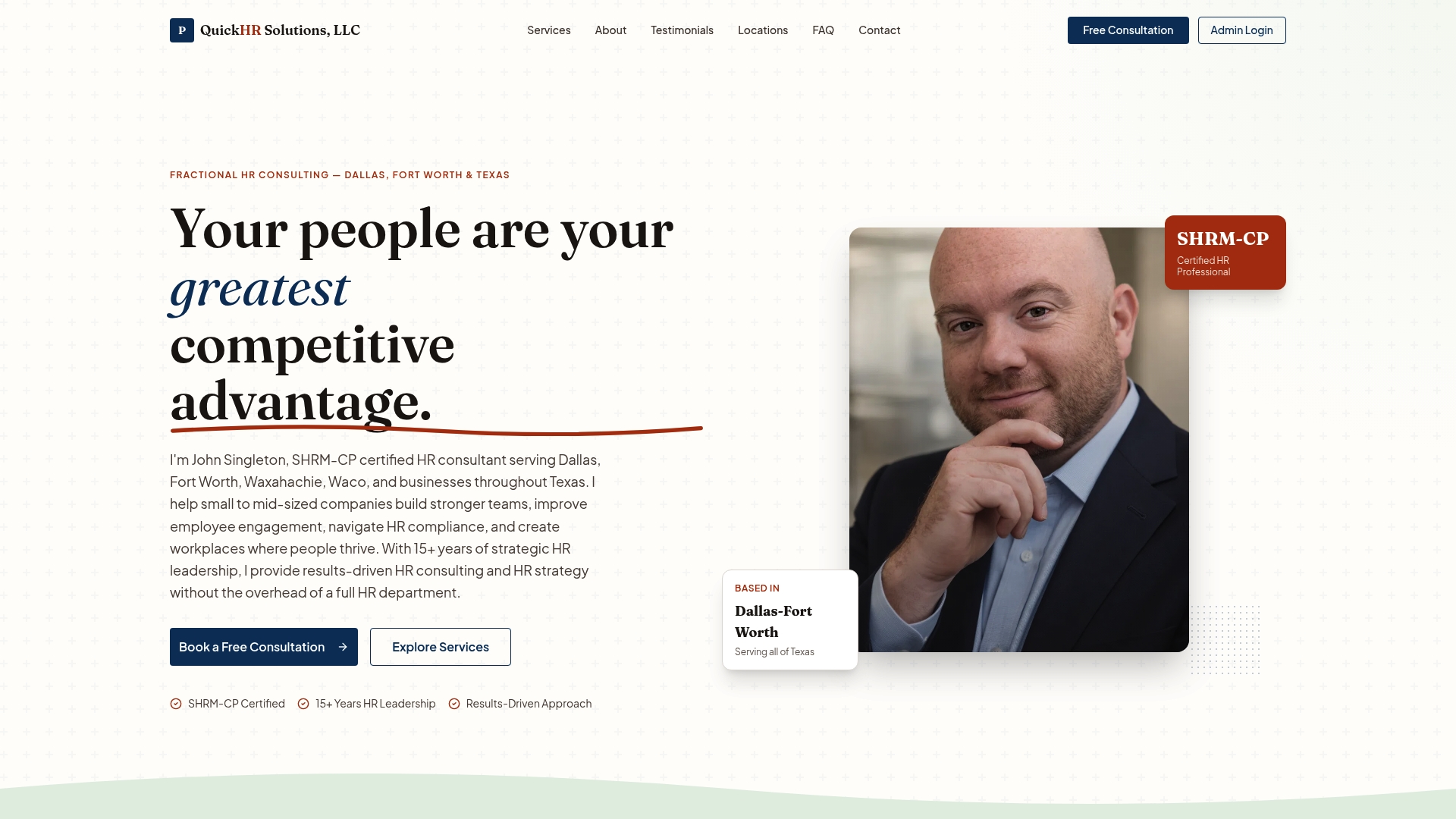
Quickhrtx's SHRM-certified consultants work with your team to identify the metrics that matter most at your current growth stage, build reporting habits that stick, and connect your workforce data to real business decisions. You get expert HR support without the cost of a full-time HR director. If you are ready to move from guesswork to data-driven workforce management, fractional HR consulting in Dallas is the practical next step.
FAQ
What are the most important HR metrics for small businesses?
The most important HR metrics for small businesses are voluntary turnover rate, 90-day new hire retention, time to hire, offer acceptance rate, onboarding completion rate, and absenteeism rate. Teams under 50 employees get the most value from tracking these 6–8 core metrics consistently.
How do I track HR metrics without expensive software?
Google Sheets or Microsoft Excel are sufficient for teams under 20 employees. A master employee log, a recruiting tracker, and a monthly attendance sheet cover the core metrics without any specialized tools.
What is a good voluntary turnover rate for a small business?
A voluntary turnover rate below 15% annually is a healthy benchmark for most small businesses. Rates above 20% signal a systemic issue with culture, compensation, or management that warrants direct investigation.
When should a small business switch from spreadsheets to HRIS software?
The right time to upgrade is when manual tracking consistently takes more than two hours per week or when data entry errors start affecting your reports. Platforms like BambooHR, Gusto, and Rippling are common choices for growing teams in the 20–50 employee range.
How often should small business owners review HR metrics?
Quarterly reporting is the right cadence for teams under 20 employees, since monthly data is too volatile to produce reliable trends. Teams above 20 employees benefit from monthly reviews of absenteeism and recruiting metrics alongside quarterly turnover analysis.