

Human Resources is the strategic infrastructure every startup must build from day one, not the administrative afterthought most founders treat it as. Establishing HR early is how you prevent legal exposure, build a culture that attracts talent, and create the systems that let your company scale without chaos. HR roles globally have surged 83% since 2011, yet most startups still delay formal HR until a crisis forces their hand. That delay is expensive. Understanding why startups need HR early means understanding that every people decision you make without a framework costs you more to fix later than it would have cost to get right the first time.
Why startups need HR early: the core case
HR is not a department you add when you hit 50 employees. It is a set of decisions, policies, and systems that shape every hire, every conflict, and every growth milestone from your first week of operations. Effective HR is a strategic foundation that mitigates risk, improves retention, and directly supports profitability. That framing matters because it changes how you allocate resources as a founder.
Texas startups face a specific regulatory environment. The Texas Workforce Commission enforces state labor laws that interact with federal requirements from the Equal Employment Opportunity Commission (EEOC) and the Department of Labor (DOL). Without HR infrastructure in place, founders make compliance decisions by instinct, and instinct is not a legal defense. The role of HR in new businesses is to translate these regulatory requirements into daily operating practice before a violation occurs.

The cost argument is straightforward. Every HR problem is easier and cheaper to fix early than late. A poorly documented termination that costs $500 to handle correctly at the time can cost $50,000 or more in legal fees and settlement costs after the fact. Early HR benefits for startups are not theoretical. They show up directly on your balance sheet.
What HR policies do startups need first?
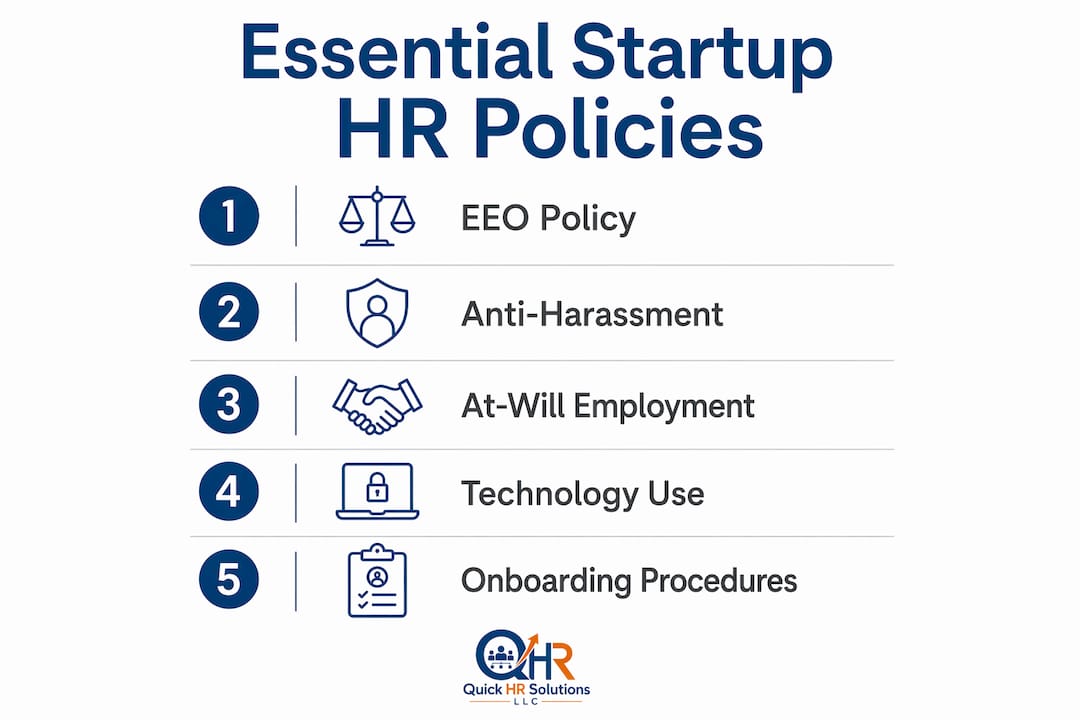
The hr policies startups need first are the ones that reduce your largest legal and operational risks immediately. For companies with 5–50 employees, 7–10 core policies cover the vast majority of situations you will encounter in your first two years.
The table below separates what you need on day one from what can wait until you scale.
| Policy | Priority | Why It Matters |
|---|---|---|
| Equal Employment Opportunity (EEO) | Essential | Federal law requires it; sets the tone for fair hiring |
| Anti-Harassment and Anti-Discrimination | Essential | Protects employees and limits employer liability |
| At-Will Employment Statement | Essential | Clarifies the employment relationship under Texas law |
| Technology and Acceptable Use | Essential | Covers company devices, email, and data security |
| Time Off and Leave (PTO, FMLA) | Essential | Prevents disputes and ensures federal compliance |
| Confidentiality and Non-Disclosure | Essential | Protects intellectual property from day one |
| Performance Management Process | Recommended | Creates consistency before managers make costly mistakes |
| Remote Work Policy | Recommended | Critical for distributed Texas teams in 2026 |
| Social Media Use | Optional | Relevant once your brand has public visibility |
| Expense Reimbursement | Optional | Needed once team travel or purchases become regular |
One critical warning for Texas founders: generic policy templates create legal exposure when they do not reflect your actual practices or align with Texas-specific statutes. A template written for California employment law can actively harm a Texas company. Your policies must match what you actually do, not what a generic document says you should do.
Pro Tip: Deliver your core policies on Day 1 of employment and collect signed acknowledgments. Strong onboarding that includes policy delivery on Day 1 improves retention by 82%, which is the single highest-return HR investment most early startups can make.
You can also review a remote HR policies guide to see how these core policies translate to distributed team environments.
How does early HR improve hiring and onboarding?
Structured hiring is one of the clearest early HR benefits for startups because it directly determines the quality of every person on your team. Without a defined hiring process, founders rely on gut feel, which produces inconsistent results and creates discrimination liability. A structured process includes a written job description, a defined interview scorecard, and a documented offer process. These three elements alone eliminate most of the legal risk in early-stage hiring.
Onboarding is where most Texas startups lose the value they spent recruiting. A new hire who takes 3–4 months to reach full productivity is a warning sign, not a normal ramp period. A 3–4 month onboarding lag indicates broken systems that need HR infrastructure to fix. The cost of that lag compounds across every hire you make.
Here is what a functional early-stage onboarding process looks like:
- Pre-boarding (before Day 1): Send offer letter, policy documents, and equipment setup instructions at least three business days before the start date.
- Day 1 orientation: Cover company mission, team structure, tools access, and policy acknowledgments in a single structured session.
- Week 1 check-in: A 30-minute conversation between the new hire and their manager to confirm role clarity and answer questions.
- 30-day review: A structured conversation assessing early performance and identifying any gaps in training or resources.
- 90-day milestone: A formal check-in that confirms the employee is meeting expectations and sets goals for the next quarter.
This five-step process requires no dedicated HR staff to execute. It requires documentation, consistency, and a founder who treats onboarding as a system rather than an improvised welcome.
Pro Tip: The most common onboarding mistake that delays productivity is skipping the 30-day review. Founders assume no news is good news. It rarely is. Build the check-in into your calendar before the hire starts.
What risks come from delaying HR in your startup?
Delaying HR does not mean avoiding HR problems. It means accumulating them until they become unmanageable. Hiring HR too late means repairing damage rather than preventing it. That distinction is the entire argument for building HR infrastructure early.
The risks fall into three categories:
- Legal violations: Without documented policies and consistent application, founders expose the company to EEOC complaints, wage and hour claims under the Fair Labor Standards Act (FLSA), and wrongful termination suits. Texas is an at-will employment state, but at-will status does not protect employers from discrimination claims.
- Inconsistent decision-making: When managers make people decisions without a framework, similarly situated employees get treated differently. That inconsistency is the factual basis of most employment lawsuits.
- Investor and acquisition risk: Investors and acquirers expect documented policies and clear employee acknowledgments during due diligence. Missing documentation can stall acquisition timelines and reduce purchase price. Governance hygiene is not just an HR concern. It is a fundraising concern.
"Every HR problem is easier and cheaper to fix early than late." The startups that treat this as a guiding principle build companies that scale. The ones that ignore it spend their Series A money on legal fees.
Investors increasingly require governance hygiene as a condition of closing deals. If your cap table is clean but your employee files are a mess, you will feel that gap at the worst possible moment. The signs you need an HR consultant often appear long before founders recognize them.
How do you build HR in a lean startup without overhead?
The most practical answer to the importance of HR for startups is that you do not need a full-time HR director to get the benefits. Phased HR with fractional consulting lets lean startups implement compliance and culture-building without the cost of a full-time hire. This is the model that works for most Texas startups in the 5–30 employee range.
Here is how to operationalize early HR without breaking your budget:
- Designate a compliance owner internally. This does not have to be an HR professional. It can be your COO or office manager. Someone must own the task of tracking policy updates, managing employee files, and flagging compliance deadlines.
- Use fractional HR consulting for strategy and risk. A fractional HR partner gives you SHRM-certified expertise on demand. You pay for the hours you need, not a full salary and benefits package.
- Invest in HR technology early. Platforms like Gusto, Rippling, and BambooHR automate payroll compliance, benefits administration, and document management. These tools cost far less than the mistakes they prevent.
- Build your employee handbook before you need it. The handbook is your legal first line of defense. Write it when you have time to do it right, not after a complaint forces you to.
- Review your HR setup at each growth milestone. The policies that work at 10 employees need updating at 25. Build a review cycle into your calendar.
Pro Tip: Use your first fractional HR engagement to audit what you already have. Most founders are surprised to discover they have made three or four policy decisions informally that need to be documented before they create liability.
The HR outsourcing guide for small businesses walks through exactly how to structure this kind of phased approach for Texas companies at different growth stages.
Key takeaways
Early HR investment is the single most cost-effective risk management decision a Texas startup founder can make, and every month of delay increases the cost of getting it right.
| Point | Details |
|---|---|
| HR is strategic infrastructure | Build policies and systems from day one, not after a crisis forces your hand. |
| Start with 7–10 core policies | EEO, anti-harassment, at-will, and technology use policies cover most early-stage risk. |
| Onboarding drives retention | Delivering policies on Day 1 and running structured check-ins improves retention by 82%. |
| Delay creates compounding risk | Legal violations, inconsistent decisions, and investor concerns all grow the longer HR is absent. |
| Fractional HR solves the cost problem | SHRM-certified fractional consulting gives startups expert HR without full-time overhead. |
What i've learned watching texas founders delay HR
I have worked with enough early-stage Texas companies to recognize the pattern. The founder is brilliant at the product. They have a clear vision, a growing team, and real traction. HR feels like something for later, something for when the company is "real enough" to need it. That belief is the most expensive mistake I see founders make.
The signals that HR is already overdue are not dramatic. They are quiet. Managers start making different decisions about the same situations. New hires take longer to get up to speed than they should. Someone files a complaint and the company has no documentation to support its position. By the time these signals are obvious, the damage is already accumulating.
What I tell founders is this: you are already doing HR. Every time you hire someone, set a schedule, handle a conflict, or make a pay decision, you are making an HR decision. The only question is whether you are making those decisions inside a framework that protects you or outside one that exposes you. Building that framework early is not overhead. It is the foundation that every other part of your company stands on.
The Texas startup ecosystem is competitive. The founders who build durable companies are the ones who treat their people systems with the same rigor they apply to their product and their finances. HR is not the last thing you build. It is one of the first.
— John
Build your HR foundation with Quickhrtx
Texas startup founders do not need a full HR department to get professional-grade HR results. Quickhrtx delivers fractional HR consulting built specifically for Dallas-Fort Worth startups and small businesses across Texas. The team holds SHRM-CP and SHRM-SCP certifications and understands the specific labor law environment Texas founders operate in.
Whether you need your first employee handbook, a compliance audit, or an ongoing fractional HR partner who scales with your team, Quickhrtx provides the expertise without the full-time cost. Book a free consultation at Quickhrtx.com and find out exactly where your HR gaps are before they become legal problems.
FAQ
When should a startup hire its first HR resource?
Most startups benefit from HR infrastructure at 5–10 employees, well before a dedicated hire makes financial sense. Fractional HR consulting covers this gap without full-time overhead costs.
What are the first HR policies a startup needs?
The first policies every startup needs are EEO, anti-harassment, at-will employment, and technology use. These 7–10 core policies cover the majority of legal and operational risk for companies with 5–50 employees.
How does early HR help startups raise funding?
Investors and acquirers review employee documentation during due diligence. Missing policies can stall acquisitions and reduce purchase price, making HR hygiene a direct factor in fundraising outcomes.
Can a texas startup use generic HR policy templates?
Generic templates create legal exposure when they do not align with Texas law or your actual company practices. Mismatches between policy and reality are a primary source of employment liability for early-stage companies.
What is fractional HR and is it right for my startup?
Fractional HR is on-demand HR expertise from a certified professional, billed by the hour or project rather than as a full-time salary. It is the most cost-effective way for startups with 5–50 employees to access SHRM-level HR strategy without the overhead of a dedicated hire.