

Managing a dispersed workforce without a clear framework for remote team hr policies is one of the fastest ways to accumulate compliance risk, lose top performers, and create an equity problem you won't see until it's already expensive. Most small to mid-sized companies figure this out the hard way. The good news is that getting your HR policies for remote employees right does not require a 100-page manual. It requires the right structure, practical language, and a willingness to treat remote work as a permanent operating model rather than a temporary accommodation.
Table of Contents
- Key takeaways
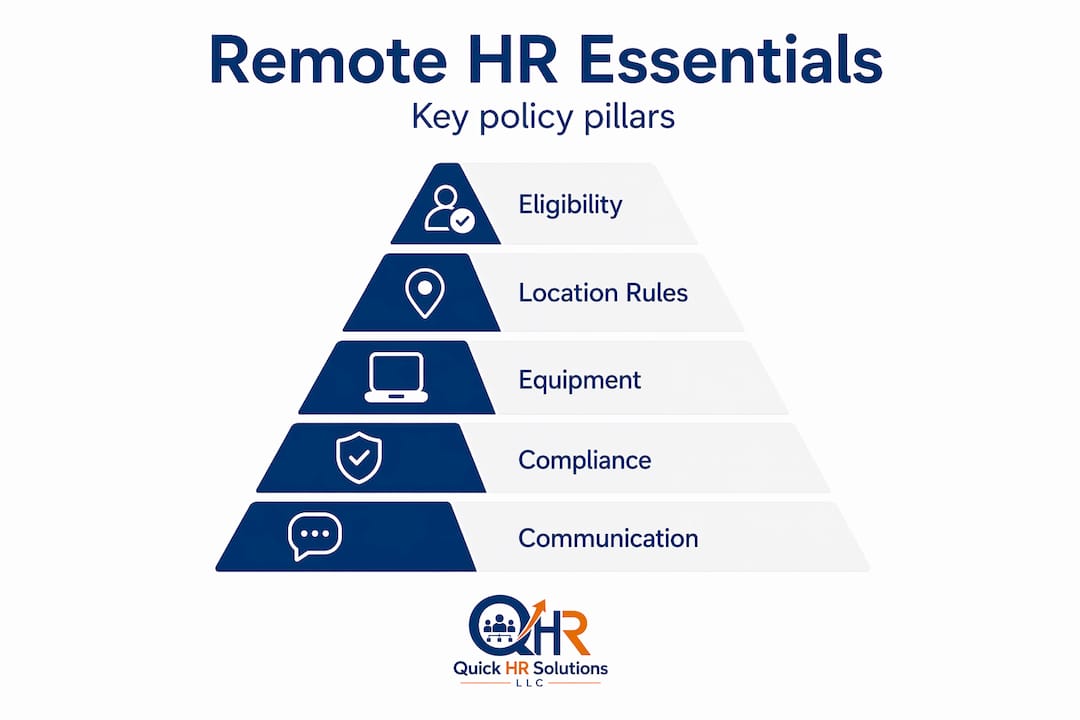
- Remote team HR policies: eligibility and location rules
- Communication protocols and core hours
- Performance management designed for remote work
- Legal compliance, security, and employee well-being
- Maintaining and evolving your remote policies
- My honest take on why remote HR keeps failing
- Build better remote policies with Quickhrtx
- FAQ
Key takeaways
| Point | Details |
|---|---|
| Define eligibility and location rules | Approved work locations protect you from tax nexus liability and payroll errors before they start. |
| Set core hours, not just schedules | Three to four hours of daily overlap keeps collaboration alive without killing flexibility. |
| Shift to outcome-based performance | Measuring deliverables and KPIs, not hours logged, builds fairness and drives real results. |
| Document security and legal requirements | VPN policies, device rules, and right-to-disconnect provisions reduce both risk and turnover. |
| Review policies regularly | A living remote handbook beats a static PDF. Update it quarterly and collect employee feedback. |
Remote team HR policies: eligibility and location rules
Before you write a single policy, you need to decide who qualifies for remote work and from where. This sounds administrative, but it has direct legal consequences. Employing staff in various states triggers tax nexus and payroll obligations that vary significantly by jurisdiction. A software engineer working from Colorado when your company only registered payroll in Texas is not a minor oversight. It's an audit waiting to happen.
Your eligibility criteria should be role-based and documented. Not every position translates well to a fully remote setup, and that's fine to say explicitly. Define which roles are approved for full remote, hybrid, or in-office arrangements, and make sure the reasoning connects to actual job functions rather than manager preference.
Location rules deserve equal attention. Build a list of approved states or countries where employees may work. Create a process for requesting exceptions or temporary location changes, such as working abroad for two weeks. Without that process, you'll find out someone spent a month working from Portugal when you get hit with a foreign employment inquiry.
- Tie eligibility to role requirements, not seniority
- Require employees to request and receive approval before changing work locations
- Specify equipment and workspace standards (reliable internet, private workspace for calls)
- Address stipends or reimbursements for home office setup upfront
Pro Tip: Address equipment stipends in the eligibility section, not buried in a separate benefits document. Employees who see clear reimbursement terms upfront are more likely to invest in a proper workspace, which reduces tech support issues and productivity complaints later.
Common workforce compliance risks include worker misclassification, payroll processing errors, and data privacy violations. All three become significantly more likely when your location policies are vague or nonexistent. Clear eligibility rules are your first line of defense.
Communication protocols and core hours
One of the biggest pain points in virtual team management practices is the assumption that people will just figure out how to communicate remotely. They won't. Or rather, they will each figure it out differently, which creates friction, missed decisions, and a slow erosion of team culture.
The most practical fix is establishing core overlap hours. Three to four hours of daily overlap is the standard recommendation for distributed teams, and it works because it preserves space for real-time collaboration without mandating a rigid schedule for everyone. For teams spanning multiple time zones, this might mean 10 a.m. to 2 p.m. Central Time as your collaboration window.
Outside that window, asynchronous communication should be the default. That means defining which tools to use for what purpose. A typical setup looks like this:
- Chat (Slack, Teams): Quick questions, status updates, informal check-ins. Expected response within a few hours during the workday.
- Email: Formal communication, external parties, documentation of decisions. Response expected within 24 hours.
- Video calls: Scheduled meetings, one-on-ones, team syncs. Always include an agenda sent in advance.
- Project management tools: Task assignment, progress updates, documentation. Treated as the system of record.
Response time expectations matter as much as tool selection. When you don't define them, you create an always-on culture by accident. Employees start checking messages at 9 p.m. because they aren't sure what the expectation is. That's how burnout builds quietly.
For teams with significant time zone differences, rotating meeting times prevents the same group from always taking the early or late slot. It signals fairness and tends to reduce the informal resentment that builds when distributed team members feel like second-class attendees.
Pro Tip: Document every significant decision in a shared channel or project tool immediately after the meeting where it was made. Async team members miss meetings. They should never miss decisions.
Performance management designed for remote work
The most persistent mistake in remote HR strategies is applying office-centric evaluation to a workforce that no longer works in an office. Applying office-centric metrics to remote employees, such as judging productivity by visible activity or hours online, actively undermines engagement and fairness.
The shift you need to make is from activity monitoring to outcome measurement. Here's how to structure that practically:
- Define outcomes at the start of each review cycle. Every employee should know what success looks like in terms of deliverables, KPIs, or OKRs, not time logged.
- Schedule regular check-ins, not just annual reviews. Monthly one-on-ones and quarterly goal reviews catch problems early and create documentation that protects both the employee and the company.
- Standardize feedback formats. Use the same structure across all managers to reduce the impact of individual bias. A consistent format also makes it easier to identify patterns across the team.
- Address proximity bias directly in manager training. Proximity bias, where in-office employees get more visibility and advancement opportunities than remote peers, is real. Name it, train on it, and build equity checks into your review process.
- Track performance data over time. Outcome-based performance management focused on goals and deliverables gives you a defensible record if a performance issue escalates to a legal matter.
Your performance management policy for remote employees should also specify which tools managers use to track progress. This doesn't mean surveillance software. It means project management systems, shared dashboards, and documented goals that everyone can see.
Legal compliance, security, and employee well-being

This is where remote team HR policies get serious. Three distinct risks converge here: legal compliance, data security, and employee mental health. Each one requires its own policy language.
| Risk area | What your policy must address |
|---|---|
| Tax and payroll compliance | Approved work locations, state tax obligations, payroll registration requirements |
| Data security | VPN requirements, device encryption, two-factor authentication, acceptable use standards |
| Mental health and well-being | Right-to-disconnect provisions, access to EAP services, PTO guidelines, workload monitoring |
| Documentation and audits | Centralized policy storage, automated acknowledgment tracking, training completion records |
Automating policy acknowledgments and training completion tracking dramatically reduces your audit exposure. If you cannot prove that an employee received and acknowledged your security policy, that policy offers you very limited legal protection. Many HR software platforms now handle this automatically. You can review options through this HR software implementation guide to find tools that work for your team size.
On the security side, define upfront what's required: VPN use on public networks, two-factor authentication on all company accounts, encrypted devices, and a clear process for reporting lost or compromised equipment. Defining security protocols upfront prevents confusion and protects company data in ways that reactive policies simply cannot.
Right-to-disconnect provisions deserve more attention than most small business HR policies give them. An explicit statement that employees are not expected to respond to work messages outside core hours sends a signal that the company actually means it when it talks about work-life balance. That signal affects retention, particularly among high performers who have options.
Pro Tip: Write your compliance and security policies in plain language, not legal language. If an employee has to read a paragraph twice to understand what's expected, you've already reduced the chance they'll follow it. Short sentences, clear directives, and real examples go a long way.
For Texas-based businesses, you can find a solid starting point in this HR compliance checklist that covers state-specific requirements relevant to remote workforce management.
Maintaining and evolving your remote policies
A remote work policy that never gets updated is a liability. Your workforce changes, employment laws change, and the tools your team uses change. What worked in 2023 may create gaps in 2026.
Build a review cycle into the policy itself. Quarterly reviews work well for fast-growing companies. Annual reviews may suffice for more stable teams. Either way, assign ownership. Someone specific should be accountable for reviewing the policy, not just "HR."
A remote team handbook serves as a single source of truth for expectations around PTO, mental health support, communication norms, and right-to-disconnect provisions. When you maintain it actively, it also becomes a culture document, not just a compliance document. New hires know exactly what's expected. Managers have something to point to when questions arise. Disputes get resolved faster.
Here's what a policy maintenance rhythm should look like:
- Collect employee feedback quarterly through short surveys or listening sessions
- Review compliance requirements annually or when entering new states or markets
- Update tool recommendations and security protocols as your tech stack changes
- Retrain managers on remote leadership expectations at least once a year
- Communicate updates to the full team with a plain-language summary of what changed and why
Flexible scheduling policies with defined collaboration windows support work-life balance across distributed teams. Build that flexibility into the handbook explicitly rather than leaving it to manager discretion. When flexibility is policy, it's equitable. When it's manager discretion, it becomes a source of inconsistency and frustration.
Culture building in remote teams requires deliberate effort. Shared rituals, transparent decision-making, and regular recognition go further than any team-building event. The best remote HR strategies weave culture into the policy structure rather than treating it as a separate initiative.
My honest take on why remote HR keeps failing
I've worked with enough small and mid-sized companies to see the same pattern repeat. They build remote policies reactively, usually after a compliance scare or a turnover spike, and those policies carry the fingerprints of the office-first mindset they were supposed to replace.
What I've learned is that the companies struggling most with how to manage remote teams effectively are not struggling because their employees are remote. They're struggling because their policies still assume the manager can see whether someone is working. Once you remove that assumption completely and design for outcomes instead, most of the friction dissolves.
The other thing I've noticed is that the legal risks rarely come from malicious decisions. They come from a lack of clarity. An employee works from their parents' house in another state for two months and nobody thought to ask whether that triggered a payroll obligation. A manager has their remote team member respond to messages at 11 p.m. because no one ever said that was a problem. Clear policies do not just protect the company. They protect employees from being put in impossible positions by managers who don't know the boundaries either.
Remote work HR guidelines work best when they're built to be understood, not just signed. If your people are skimming their policy acknowledgment without reading it, the policy isn't working. Simplify. Clarify. And review it before something forces you to.
— John
Build better remote policies with Quickhrtx
Crafting HR policies for remote employees that actually hold up under compliance scrutiny while keeping your team engaged is not a one-time project. It's an ongoing function. For small to mid-sized businesses that don't have the bandwidth to maintain a full internal HR department, that gap creates real risk.
Quickhrtx provides fractional HR consulting in Dallas specifically designed to solve this problem. The team brings SHRM-certified expertise to remote work compliance, policy development, and employee engagement without the cost of a full-time hire. Whether you need to build your remote team handbook from scratch, audit your current policies for legal exposure, or train your managers on remote leadership practices, Quickhrtx delivers support that scales with your business. Visit Quick HR Solutions to book a free consultation and get a clear picture of where your remote HR policies stand today.
FAQ
What should remote team HR policies cover?
Remote team HR policies should address eligibility criteria, approved work locations, communication expectations, performance standards, data security requirements, and mental health provisions. Clear policies in each area reduce compliance risk and improve employee experience.
How do you prevent tax compliance issues with remote employees?
Define approved work locations in your policy and require employees to request approval before changing where they work. Tax nexus and payroll obligations vary by state, so even temporary location changes can trigger new registration requirements.
What is proximity bias and why does it matter for remote HR?
Proximity bias is the tendency to favor employees who are physically visible over remote peers when making advancement decisions. It's a documented risk in hybrid environments and should be addressed directly in your performance management policy and manager training.
How often should remote work policies be reviewed?
Most companies benefit from a quarterly feedback cycle and an annual formal review of the full policy. Review immediately whenever you expand into a new state, add significant headcount, or change your core technology tools.
What is a remote team handbook?
A remote team handbook is a centralized document covering communication norms, PTO, mental health support, security requirements, and work-life boundaries. A well-maintained handbook scales your culture and reduces ambiguity as your team grows.