

Fractional HR services are defined as expert human resources leadership and compliance management delivered on a part-time or project basis, giving Texas small and mid-sized businesses strategic HR capacity without the cost of a full-time hire. According to fractional HR research, proper onboarding of this model includes defining scope, sharing policies, and setting communication practices from day one. For Texas employers navigating federal requirements alongside state-specific rules under the Texas Labor Code and Texas Payday Law, this model is not a convenience. It is a compliance necessity. This fractional hr services guide covers everything from evaluating providers to avoiding costly mistakes in the Dallas-Fort Worth market and beyond.
What Texas-specific HR compliance must fractional HR services address?
Texas employers carry a compliance load that surprises many business owners. The state has no income tax, but that simplicity stops there. Texas HR compliance requires detailed documentation, firm deadlines, and operational checklists that go well beyond federal law. A fractional HR provider who only knows federal standards will leave your business exposed.
The foundational compliance requirements every Texas employer must manage include:
- Form W-4 and Form I-9 completion at the time of hire, with I-9 documentation retained and available for federal audit
- New hire reporting to the Texas Workforce Commission within 20 days of the hire date, a requirement that applies to all employers regardless of size
- Employee handbook policies aligned with the Texas Labor Code, covering at-will employment, anti-harassment, and workplace conduct
- Final wage payment deadlines under the Texas Payday Law, which requires terminated employee wages to be paid within six calendar days. Missing this deadline triggers penalties that accumulate quickly.
- Anti-discrimination documentation for employers with 15 or more employees, covering protected classes under both Title VII and Texas state law
A skilled fractional HR provider builds repeatable checklists and audit routines around each of these items. Without that structure, compliance becomes reactive rather than preventive.
Pro Tip: Ask any fractional HR candidate to walk you through their Texas-specific onboarding checklist before you sign a contract. If they cannot produce one, that tells you everything you need to know about their operational depth.

For a detailed breakdown of these requirements, Quickhrtx maintains a Texas compliance checklist that maps each obligation to the responsible party and the relevant deadline.
How to evaluate and select the best fractional HR services for your business
Not all fractional HR providers deliver the same thing. The most important distinction is whether a provider offers advisory-only guidance or hands-on operational execution. Advisory versus execution models differ significantly in scope, budget impact, and the actual compliance protection they provide. A provider who advises you to update your handbook but does not write it leaves the work undone.
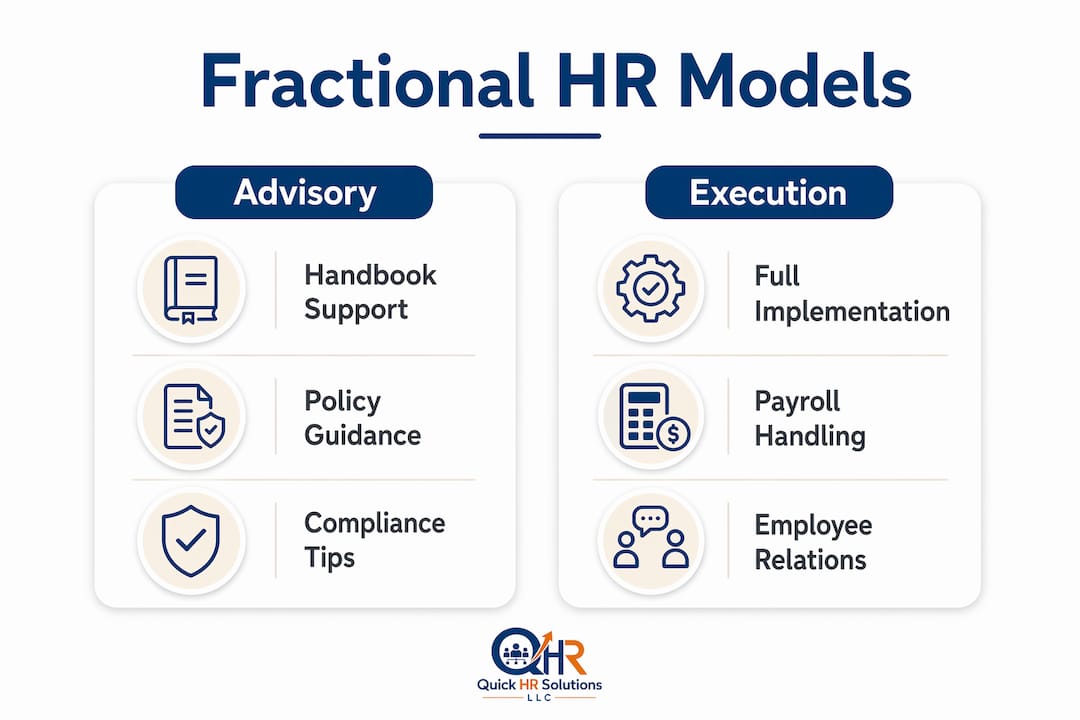
Use this comparison to assess where a prospective provider sits:
| Criteria | Advisory-only model | Execution-focused model |
|---|---|---|
| Handbook creation | Recommends updates | Drafts and finalizes documents |
| Onboarding compliance | Provides guidance | Runs the process end to end |
| Wage/hour audits | Flags risks | Conducts audits and corrects records |
| Manager training | Suggests topics | Delivers training sessions |
| Cost structure | Lower monthly retainer | Higher retainer, broader deliverables |
Texas-specific compliance knowledge is a non-negotiable filter. A provider must explicitly understand the difference between federal wage law and Texas Payday Law obligations. Federal versus state compliance distinctions in Texas include different final pay deadlines, different new hire reporting channels, and different documentation standards. A provider who conflates the two creates liability rather than reducing it.
Budget evaluation goes beyond the monthly retainer figure. Consider scope, deliverables, and whether the engagement scales as your headcount grows. A 10-person company and a 75-person company need different levels of support, and the best providers price accordingly.
Pro Tip: Before signing, ask three questions: What is your process for tracking Texas Payday Law deadlines? How do you handle an I-9 audit request? What does your onboarding checklist look like for a new Texas hire? Vague answers are a red flag.
Quickhrtx has published a resource on fractional HR benefits for Texas SMBs that breaks down cost comparisons in more detail, including the finding that fractional HR can save up to 40% compared to hiring a full-time HR manager.
What are the practical steps to onboard fractional HR into your business?
Engaging a fractional HR provider without a structured onboarding plan produces the same result as hiring without a job description. You get activity without direction. Successful integration requires defined scope, shared access, and consistent communication from the first week.
Follow these steps to get the engagement right from the start:
-
Define scope and priorities in writing. Specify which HR functions the provider owns, which they advise on, and which remain internal. Include compliance deadlines, handbook updates, and any open employee relations issues as immediate priorities.
-
Grant access to key documents and systems. Share your current employee handbook, payroll records, existing policies, and any prior audit findings. A fractional HR provider cannot fix what they cannot see.
-
Establish a communication cadence. Weekly check-ins with the business owner or operations lead, monthly reporting to leadership, and a clear escalation path for urgent compliance issues. This structure prevents the engagement from drifting into occasional advice calls.
-
Integrate with your finance team. Strategic HR alignment connects people management with business outcomes. Your fractional HR provider should understand your payroll budget, headcount plans, and any upcoming organizational changes that affect HR risk.
-
Train managers on new workflows. If your fractional HR provider introduces a new onboarding checklist or a revised performance documentation process, managers need to understand why the change matters and how to execute it. Compliance fails at the manager level more often than at the policy level.
-
Build in a 90-day review. Assess what is working, what gaps remain, and whether the scope needs to expand. Fractional HR engagements that never get reviewed tend to stagnate into a monthly retainer with diminishing returns.
Common pitfalls Texas employers make with fractional HR services
Texas employers frequently underestimate the complexity of state-specific compliance. The absence of a state income tax creates a false sense of regulatory simplicity. Texas wage-payment rules are among the strictest in the country on final pay timing, and the Texas Workforce Commission actively enforces new hire reporting requirements.
The most damaging mistakes include:
- Treating advisory engagement as full execution. If your provider recommends a policy change and you assume they will implement it, nothing gets done. Clarify in writing who executes each deliverable.
- Failing to distinguish federal from Texas-specific obligations. Federal I-9 rules and Texas new hire reporting are separate processes with separate deadlines. Conflating them creates gaps in both.
- Neglecting documentation updates. An employee handbook written in 2021 does not reflect current Texas Labor Code guidance. Outdated handbooks are a liability in any employment dispute.
- Ignoring the six-day final wage rule. Many Texas employers learn about this deadline after their first violation. The Texas Payday Law requires final wages paid within six calendar days of termination, not the next regular pay cycle.
- Skipping audit routines. Compliance is not a one-time setup. It requires quarterly reviews of I-9 files, handbook currency, and wage records.
"The most expensive HR mistake a Texas employer makes is assuming that because the state has no income tax, the regulatory environment is simple. It is not. The Texas Payday Law, the Texas Workforce Commission, and the Texas Labor Code each carry their own enforcement mechanisms."
How fractional HR services drive long-term business growth
Fractional HR becomes most valuable when it moves beyond compliance management into strategic partnership. Strategic HR aligns HR activities with measurable business results rather than transactional tasks. That shift requires a provider who understands your business model, not just your headcount.
The growth-oriented functions a fractional HR provider can own include:
- CFO-CHRO alignment. Connecting compensation structures, headcount planning, and benefits costs to financial forecasts gives leadership a clearer picture of people-related expenses and risks.
- Leadership coaching and talent strategy. Fractional HR providers with SHRM-CP or SHRM-SCP credentials can design manager development programs that reduce turnover and build internal promotion pipelines.
- Scalable HR infrastructure. Building an HR function that works for 20 employees and scales to 100 requires documented processes, technology recommendations, and policy frameworks that grow with the business.
- M&A and rapid growth preparation. Companies entering acquisition conversations or planning aggressive hiring need clean HR records, current handbooks, and documented compliance histories. Fractional HR builds that foundation before it is urgently needed.
- Continuous risk assessment. Proactive policy updates tied to legislative changes in Texas or at the federal level prevent the scramble that follows a regulatory shift.
Pro Tip: If your fractional HR provider never mentions your business goals in a conversation, that is a sign the engagement has become transactional. Push for quarterly strategy sessions that connect HR metrics to revenue, retention, and growth targets.
Key takeaways
Fractional HR services give Texas small and mid-sized businesses expert compliance management, operational HR execution, and strategic people leadership at a fraction of the cost of a full-time hire.
| Point | Details |
|---|---|
| Texas compliance is complex | Final wage deadlines, new hire reporting, and handbook requirements go beyond federal law. |
| Model selection matters | Advisory-only providers differ fundamentally from execution-focused ones. Match the model to your risk level. |
| Onboarding drives outcomes | Define scope, share documents, and set a communication cadence before the first deliverable is due. |
| Pitfalls are predictable | The six-day final wage rule and outdated handbooks are the two most common and costly Texas HR mistakes. |
| Strategic value compounds | Fractional HR that connects to business goals delivers retention, leadership development, and M&A readiness over time. |
What I have learned from implementing fractional HR in Texas businesses
After working with dozens of Texas SMBs across the Dallas-Fort Worth area, one pattern stands out clearly. The businesses that get the most from fractional HR are the ones that treat the provider like a part of their leadership team, not a vendor they check in with once a month.
The biggest mistake I see is hiring a fractional HR provider for compliance and then being surprised when they do not show up to a leadership planning meeting. That is a scope problem, and it starts with the contract. If you want strategic input, write it into the agreement from day one.
Texas-specific compliance knowledge is genuinely non-negotiable. I have seen providers from other states come into Texas engagements and miss the six-day final wage rule entirely. That single oversight can cost a business thousands in penalties and create an employment dispute that drags on for months. Local expertise is not a premium feature. It is the baseline.
The businesses that build the most durable HR functions are the ones that designate an internal champion, usually an operations manager or a senior leader, who owns the relationship with the fractional HR provider. That person attends every check-in, tracks deliverables, and escalates issues before they become violations. Fractional HR works best when it has a counterpart inside the business who takes it seriously.
As companies grow past 50 employees, I consistently see fractional HR evolve from compliance management into talent strategy. That transition is worth planning for. The provider who helped you build your first handbook may not be the right partner for succession planning. Evaluate the relationship annually and adjust the scope as your needs change.
— John
Ready to strengthen your HR with local Texas expertise?
Texas employers cannot afford to treat HR as an afterthought. Quickhrtx delivers hands-on fractional HR consulting built specifically for small and mid-sized businesses in Texas, with deep expertise in Texas Payday Law, employee handbook compliance, onboarding documentation, and workforce risk management. Every engagement is backed by SHRM-CP and SHRM-CPC certified professionals who understand the difference between federal requirements and Texas-specific obligations.
Whether you need a one-time compliance audit or ongoing fractional HR support, Quickhrtx offers flexible engagement models that fit SMB budgets without cutting corners on execution. Explore fractional HR services in Dallas or book a free consultation to see how the right HR partner changes the way your business operates.
FAQ
What is fractional HR and how does it differ from outsourced HR?
Fractional HR provides part-time expert HR leadership embedded in your business, while outsourced HR typically refers to transactional services like payroll processing or benefits administration handled by a third party. Fractional HR providers act as a strategic partner, not just a vendor.
How much do fractional HR services cost for a small Texas business?
Costs vary based on scope and whether the engagement is advisory-only or execution-focused. Fractional HR can save up to 40% compared to hiring a full-time HR manager, making it a practical option for businesses with 10 to 150 employees.
What Texas-specific compliance issues should my fractional HR provider handle?
Your provider must manage new hire reporting to the Texas Workforce Commission, final wage payment within six calendar days of termination, and employee handbook policies aligned with the Texas Labor Code. These obligations exist independently of federal requirements.
How do I know if a fractional HR provider understands Texas law?
Ask them to explain the Texas Payday Law final wage deadline and describe their process for Texas Workforce Commission new hire reporting. Providers with genuine Texas expertise answer these questions without hesitation. Vague or generalized answers indicate a federal-only knowledge base.
When should a Texas SMB consider moving from fractional to full-time HR?
Most businesses make this transition between 75 and 150 employees, when the volume of HR activity justifies a full-time salary. Until that threshold, fractional HR services deliver equivalent expertise at significantly lower cost.