

Running a Texas small business means wearing a dozen hats, and HR often ends up as the hat nobody trained for. Recognizing the signs you need an HR consultant before problems compound is what separates businesses that scale cleanly from ones that stall in avoidable fires. From compliance gaps under Texas law to hiring slowdowns eating up founder time, the indicators are specific and actionable. This article walks you through eight concrete warning signs, a comparison of your support options, and what consulting actually costs, so you can make a clear decision.
Table of Contents
- Signs you need an HR consultant: hiring cycles taking longer than four weeks
- 2. Founders or ops leaders spend five or more hours per week on HR tasks
- 3. Payroll errors and compliance gaps increase, especially in Texas-specific areas
- 4. Employee conflicts go unresolved or are handled informally without policies
- 5. Rising employee turnover without clear reasons indicates process breakdown
- 6. Rapid headcount growth outpaces your existing HR processes
- 7. You lack formal HR policies or track compliance manually
- 8. Your employee experience is visibly inconsistent from onboarding to evaluations
- Comparison of HR support options for Texas SMBs
- Typical costs and budgeting for HR consulting engagements in Texas
- Why many Texas SMBs underestimate the true cost of delayed HR consulting
- Get expert fractional HR consulting in Dallas to guide your Texas business
- Frequently asked questions
Key Takeaways
| Point | Details |
|---|---|
| Long hiring cycles | Taking over four weeks to fill roles typically signals inefficient recruitment needing HR expertise. |
| Leadership time drain | Founders spending 5+ hours weekly on HR tasks should delegate to free strategic capacity. |
| Texas compliance urgency | Missed new hire reporting and harassment response expose businesses to penalties and legal risk. |
| Employee conflicts and turnover | Unmanaged conflicts and rising unexplained attrition indicate broken HR processes. |
| Fractional HR value | Part-time HR consultants provide tailored support for growing Texas SMBs without full-time cost. |
Signs you need an HR consultant: hiring cycles taking longer than four weeks
Long hiring times are rarely a candidate shortage problem. More often, they signal broken process. No clear job brief, no candidate pipeline, no structured interview, no offer workflow. Every step gets rebuilt from scratch each time a role opens up.
Hiring cycles exceeding four weeks for standard roles signal HR process breakdowns requiring structured recruitment support. That threshold matters because beyond four weeks, quality candidates typically accept competing offers and your cost-per-hire climbs fast.
What a broken recruitment process usually looks like in practice:
- Job descriptions pulled from old postings with no defined success criteria
- No assigned interview panel or scoring rubric
- Verbal offers with delayed written confirmation
- No feedback loop to improve future hiring decisions
Getting HR consulting for small businesses in Dallas can establish the templates, pipelines, and accountability structures that compress your hiring timeline significantly. A fractional HR consultant can audit your current process and identify exactly where candidates are dropping or stalling.
Pro Tip: Track your time-to-hire by role type every month. A single month of data tells you very little. Three months of data shows you a pattern worth acting on.
2. Founders or ops leaders spend five or more hours per week on HR tasks
Five hours a week is 260 hours a year. For a founder or operations lead in a 20-person Texas company, that is roughly 13% of your working year spent on payroll questions, onboarding paperwork, and policy lookups. That time is not going toward growth.

Spending five or more hours weekly on HR duties means key leadership is distracted from core business growth. The compounding effect is what most owners miss: the longer this goes on, the more informal your HR practices become, and informal practices create compliance exposure.
Common HR tasks that consume leadership time without adding strategic value:
- Processing payroll corrections and answering pay stub questions
- Onboarding new hires without a standardized checklist
- Writing offer letters and employment agreements from scratch each time
- Fielding employee complaints with no documented process for response
Understanding the benefits of fractional HR for Texas SMBs comes down to simple math: a consultant handles these tasks at a fraction of what your leadership time actually costs.
Pro Tip: Log your HR-related tasks in a notes app for two weeks. Categorize them: administrative, compliance, employee relations. The breakdown usually surprises people and makes the case for outside help immediately obvious.
3. Payroll errors and compliance gaps increase, especially in Texas-specific areas
Payroll mistakes are not just an annoyance. They erode employee trust and create legal liability. In Texas, two specific compliance areas catch small businesses off guard more than any others.
First, Texas requires new hire reporting within 20 calendar days, with a $25 penalty per employee for late or missing filings. That sounds minor until you realize missing reports can also trigger federal child support enforcement flags, which becomes a much larger problem. Second, Texas SB 45 mandates employers take immediate and appropriate corrective action on harassment reports or face legal liability, including personal liability for managers and executives.
Steps Texas employers should confirm they have covered:
- New hire reporting filed within 20 calendar days of each hire
- Payroll accuracy verified against timekeeping records each pay period
- A written harassment policy with a clear reporting procedure and documented corrective action
"Most compliance failures we see in small Texas businesses are not ignorance of the law. They are delayed responses to known problems, which is actually harder to defend in a legal proceeding than simply not knowing."
An HR compliance checklist for Texas is a practical starting point, but for businesses already seeing errors and gaps, an HR consultant brings the documented systems to ensure nothing slips. See the full Texas new hire reporting requirements to understand exactly what your obligations include.
4. Employee conflicts go unresolved or are handled informally without policies
When managers handle employee complaints on the fly, with no written process and no consistent response, it creates two problems. The employee with the complaint feels unheard. Every other employee watching wonders whether they would get the same treatment.
Informal handling of employee conflicts often leads to unresolved issues and damages workplace culture. That damage is cumulative. One poorly handled conflict rarely destroys a team. A pattern of them does.
What unstructured conflict management typically signals:
- No written grievance or complaint procedure in your employee handbook
- Managers resolving disputes based on personal relationships rather than policy
- No documentation of complaints or their outcomes
- Escalated situations reaching the owner because there is no middle-ground process
An HR consultant can design a formal grievance procedure calibrated for your team size, write it into your policies, and train your managers to apply it consistently. For small businesses in Dallas dealing with rapid growth, this kind of structural work pays for itself in retention alone.
5. Rising employee turnover without clear reasons indicates process breakdown
When people leave and you genuinely do not know why, that is the indicator. High turnover you can explain, such as seasonal work or a single difficult manager who has since moved on, is manageable. Turnover you cannot explain means your HR systems are not generating the data you need to act.
Annual turnover above 15 to 20% without external cause indicates internal HR and cultural problems. The most common culprits, based on exit interview patterns, are poor onboarding, unclear performance expectations, and inconsistent management.
What drives unexplained attrition in small businesses:
- No formal onboarding beyond the first day logistics
- No career path conversations or defined growth opportunities
- Managers with wildly different styles and expectations
- No exit interview process to capture departing employee feedback
A consultant analyzes your exit data, identifies patterns across departments, and recommends targeted retention strategies. Generic fixes, such as adding a ping pong table, do not work. Specific fixes tied to actual feedback do.
6. Rapid headcount growth outpaces your existing HR processes
Growth feels good until your HR infrastructure starts cracking under the weight. If you are hiring fast, your onboarding, payroll, and compliance systems need to scale at the same pace. Most do not.
Scaling faster than three hires per quarter without proper HR system growth creates management gaps that become expensive to fix retroactively. New employees do not know who to go to with questions. Managers who were hired for technical skills are suddenly people-managing without support. Policies that worked for a 10-person team become unenforceable at 30.
Signs your HR infrastructure is not keeping up with growth:
- Onboarding is inconsistent depending on who is available that week
- New managers get no management training or policy orientation
- You are manually tracking PTO, certifications, or performance reviews in spreadsheets
- Compliance tasks are falling through the cracks as headcount increases
HR consulting services in Dallas can build scalable frameworks before the gaps become visible problems. The right consultant designs systems that grow with you, not ones you have to rebuild every 18 months.
7. You lack formal HR policies or track compliance manually
A shared Google Doc is not an employee handbook. A spreadsheet is not a compliance system. These tools are fine when you have three people, but they create real risk at 15.
Managing compliance manually and lacking written policies causes errors and inconsistent employee experiences. When policies are not written down, every manager interprets them differently, and every employee gets a slightly different version of your company.
What missing policies and manual tracking create in practice:
- Inconsistent application of PTO, disciplinary action, and performance management
- Missed regulatory deadlines because nothing is systematized
- Disputes over verbal agreements with no documentation to reference
- New employees getting different information based on who onboards them
An HR consultant installs the right systems and writes policies calibrated to Texas law and your specific industry. The HR compliance checklist for Texas businesses is a starting point, but a consultant builds the complete infrastructure around it.
8. Your employee experience is visibly inconsistent from onboarding to evaluations
Ask five of your employees what happens when someone files a complaint. Ask five more how performance reviews work. If you get five different answers to each question, your employee experience is inconsistent, and inconsistency erodes trust faster than most leaders realize.
Inconsistent onboarding and unclear progression pathways signal reactive, not systemic, people management. That distinction matters because reactive HR is always more expensive. You are solving problems after they surface rather than preventing them.
What inconsistent employee experience looks like across a growing team:
- No standardized 30-60-90 day onboarding plan for new hires
- Performance review formats and timelines differ by department
- Career growth conversations happen for some employees and never for others
- Policy questions get different answers depending on which manager you ask
HR consultants build consistent communication frameworks, performance templates, and development structures that every manager can apply the same way. For Dallas-area small businesses competing for talent, consistent employee experience is a real competitive advantage.
Comparison of HR support options for Texas SMBs
Once you have identified the signs, you need to choose the right level of support. Not every business needs the same solution.
| HR support option | Best fit | Typical cost range | Key strengths |
|---|---|---|---|
| Outsourced HR (PEO) | 1 to 15 employees with admin-heavy needs | $100 to $200 per employee/month | Payroll, benefits admin, basic compliance |
| Fractional HR consultant | 15 to 60 employees needing strategic support | $2,500 to $8,000 per month retainer | Policy design, compliance, recruitment, culture |
| Full-time internal HR hire | 50+ employees with daily HR demand | $65,000 to $110,000 per year salary | Dedicated presence, deep organizational knowledge |
A fractional HR consultant fits businesses needing strategic HR support without the cost of a full-time hire, typically those with 15 to 60 employees. For most Texas SMBs in the growth phase, this is the most practical path.
Explore fractional HR services in Dallas or the full fractional HR consultant guide to understand exactly what this engagement looks like in practice.
Typical costs and budgeting for HR consulting engagements in Texas
Understanding what you will spend helps you plan and evaluate whether a consulting investment makes sense relative to the cost of inaction.
HR compliance audits range between $8,000 and $30,000 depending on scope. A full employment law audit for a 40-person company covers more ground than a targeted review of one policy area. Common engagement types and their typical ranges:
| Engagement type | Typical price range | What it covers |
|---|---|---|
| Compliance audit | $8,000 to $30,000 | Policy review, legal gap analysis, Texas-specific checks |
| Fractional HR retainer | $2,500 to $8,000/month | Ongoing support, recruitment, employee relations |
| HR project engagement | $3,000 to $15,000 | Handbook creation, onboarding design, training |
| Advisory hourly | $150 to $350/hour | Targeted questions, document review, specific issues |
What affects pricing most:
- Consultant certification level (SHRM-CP or SHRM-SCP commands higher rates)
- Scope complexity and number of employees
- Whether you need ongoing support versus a one-time project
- Texas-specific compliance complexity in your industry
Value-based pricing, where fees reflect business risk avoided and outcomes delivered, is increasingly standard among experienced consultants. A $5,000 retainer that prevents a single wrongful termination claim paying out five figures is not an expense. It is a return.
Pro Tip: Start with a paid discovery engagement before committing to a retainer. A structured two-week scoping process surfaces your biggest gaps and lets you budget with clarity rather than guessing.
Why many Texas SMBs underestimate the true cost of delayed HR consulting
Here is the uncomfortable reality most business owners discover too late: the signs were there months or even years before the problem became a crisis. High turnover, slow hiring, informal conflict handling, manual compliance tracking. These are not independent issues. They are symptoms of the same underlying gap.
Delaying HR consulting does not save money. It defers cost while the problem grows. A single mishandled termination in Texas can produce a Payday Law complaint, a discrimination claim, or both. The fastest way to know you need HR consulting is your inability to quickly produce a defensible separation packet, meaning your termination processes lack legal readiness. Most Texas SMB owners cannot pull that together on short notice. That is not a legal failure. It is an HR infrastructure failure.
The businesses we see come out of growth phases cleanly are the ones that treated HR as a system, not a reactive task. They brought in expertise before the first compliance audit, not after the first complaint. They built onboarding before they had 25 people, not when 30 people were getting inconsistent experiences.
There is also a talent dimension that rarely gets discussed. Employees in competitive Texas markets compare experiences. A company with clear policies, consistent managers, and a structured growth path attracts better candidates than one where everything is informal and verbal. The investment in professional HR support for Dallas businesses shows up in hiring quality, not just compliance scores.
Proactive HR consulting is not about anticipating every problem. It is about building systems that reduce the frequency and severity of problems when they do occur. That distinction, prevention versus reaction, is where the real cost difference lives.
Get expert fractional HR consulting in Dallas to guide your Texas business
If several of the signs in this article sound familiar, you are not behind. You are simply at the decision point that most Texas business owners reach between 15 and 50 employees.
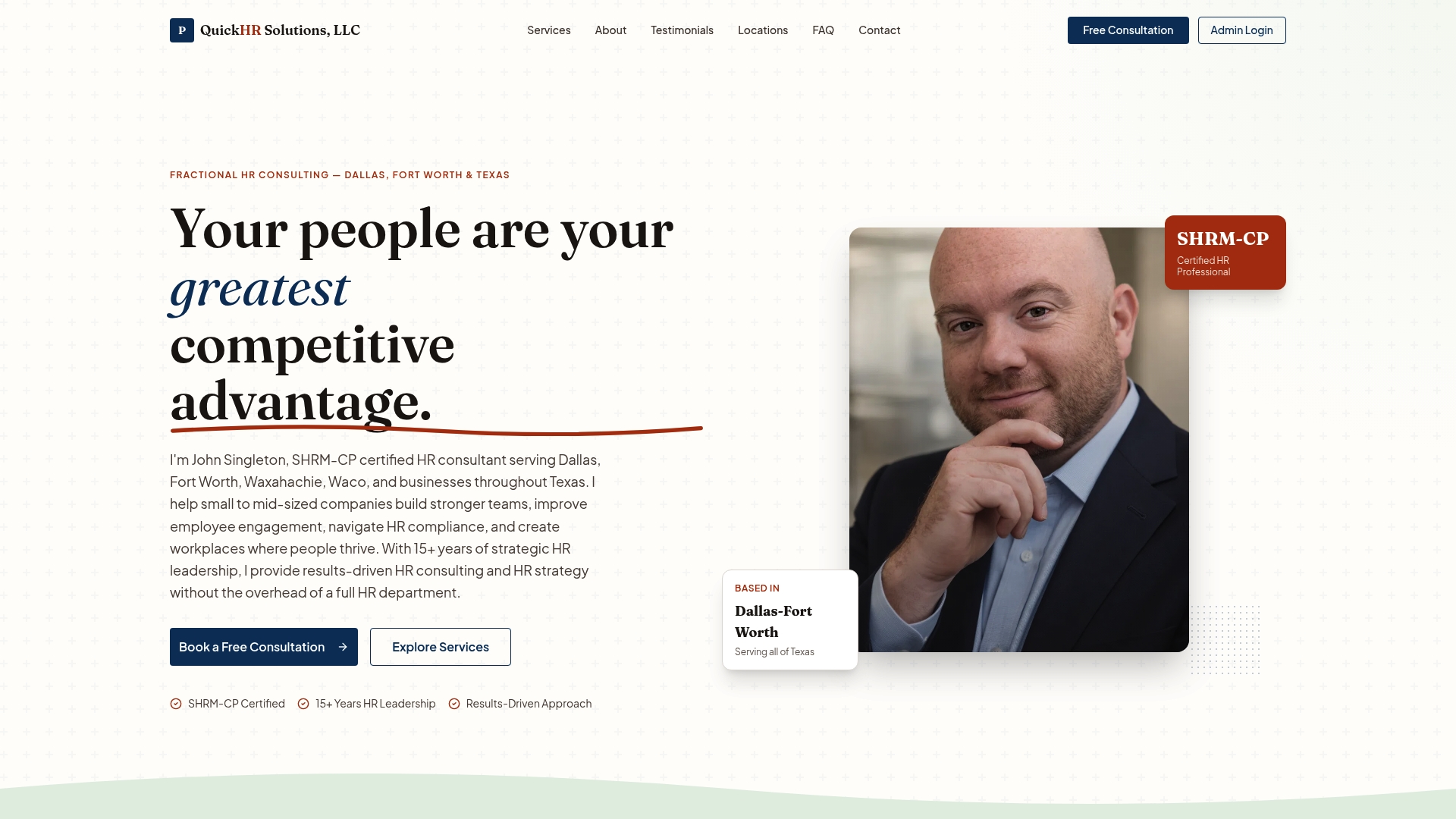
QuickHR Solutions offers fractional HR services in Dallas built specifically for small to mid-sized Texas businesses navigating compliance, growth, and employee relations challenges. Every engagement is guided by SHRM-certified consultants who understand Texas employment law, DFW market dynamics, and the practical realities of running a lean operation. Whether you need a compliance audit, a complete policy overhaul, or ongoing fractional HR leadership, QuickHR Solutions offers flexible structures that fit your stage and budget. Book a free consultation to find out exactly where your biggest gaps are.
Frequently asked questions
What is the first sign a Texas business needs an HR consultant?
A key early sign is when hiring cycles consistently exceed four weeks for standard roles, indicating a structural problem with your recruitment process that outside expertise can fix quickly.
Do all Texas employers have to submit new hire reports?
Yes, every Texas employer must report new hires within 20 calendar days, and the filing requirement applies even if you have a single employee, with financial penalties for late or missing submissions.
What does Texas harassment law SB 45 require from employers?
Employers must take immediate corrective action upon receiving harassment complaints, and Texas SB 45 extends personal liability to individual managers and executives who fail to respond appropriately.
How much does an HR compliance audit typically cost in 2026?
HR compliance audits range from $8,000 to $30,000 depending on the scope of the review and the size of your organization, with narrower audits targeting specific policy areas costing less.
Can a small Texas business avoid hiring full-time HR staff by using fractional HR consultants?
Yes, fractional HR consultants provide part-time strategic and operational HR support ideal for businesses with 15 to 60 employees who need expert guidance without committing to a full-time HR salary.