

Most founders learn HR the hard way — a misclassified contractor, a missing Form I-9, or a termination that turns into a lawsuit. Using a solid founder hr responsibilities checklist from day one protects you from all of that. This guide walks you through every major HR duty you carry as a founder, from your first hire through your first audit. You'll find concrete steps, compliance updates for 2026, and the kind of specific guidance that actually holds up when things get complicated.
Table of Contents
- Key takeaways
- 1. Build your founder HR responsibilities checklist before you hire
- 2. Register and set up your HR compliance framework
- 3. Recruit legally and document everything
- 4. Create a repeatable onboarding process
- 5. Set up payroll, benefits, and worker classification correctly
- 6. Write an employee handbook that actually protects you
- 7. Implement performance management from the start
- 8. Prepare for audits before they happen
- 9. Decide when and how to outsource HR functions
- 10. Assign ownership for every HR task
- My honest take on founder HR
- Get expert help managing your HR responsibilities
- FAQ
Key takeaways
| Point | Details |
|---|---|
| Start with structure | Define HR ownership and basic compliance foundations before your first hire, not after. |
| Documentation is your defense | Form I-9 errors and missing onboarding files are among the most common and costly founder mistakes. |
| Classification risk is real | Audit every contractor relationship before the DOL's 2026 rule takes full effect. |
| Handbooks must be state-specific | Federal boilerplate alone won't protect you; Texas has its own requirements you need to meet. |
| Assign ownership for every task | RACI-style accountability keeps HR tasks from falling through the cracks as your team grows. |
1. Build your founder HR responsibilities checklist before you hire
A startup HR checklist should begin with structure, recruiting and onboarding processes, and audit readiness. That sequence matters because you cannot retrofit compliance onto a team that's already been hired incorrectly.
Start by deciding who owns HR in your company. Even if that person is you, write it down. Define what "HR" covers in your organization: hiring, payroll, policy, benefits, and performance reviews. Without a clear owner, critical tasks fall through the cracks.
The foundational elements you need before your first hire:
- A registered employer identification number (EIN) with the IRS
- A payroll system or provider selected and configured
- Workers' compensation insurance in place if required by your state
- A plan for where you'll store employee records securely
- Basic safety and anti-harassment policies documented
Pro Tip: Treating HR as optional or something to address later significantly increases your compliance and operational risk. Build the foundation first, even if you are a team of two.
2. Register and set up your HR compliance framework
Texas founders operating in Dallas-Fort Worth face state-specific requirements on top of federal ones. You need to register with the Texas Workforce Commission for unemployment insurance, post required federal and state labor law notices, and understand your obligations under OSHA if you operate in an industry with physical risks.

Your HR compliance checklist for Texas should include payroll tax registration, worker classification review, and Form I-9 readiness. These are not optional steps you get to later. They are prerequisites.
Set up your compliance calendar at this stage. EEOC filings, ACA reporting thresholds, and Texas Payday Law requirements all have deadlines. Missing them costs money you don't have and creates paper trails you don't want.
3. Recruit legally and document everything
Hiring right means more than finding a great candidate. Every step of your recruiting process carries legal weight.
- Write job descriptions that reflect actual duties and avoid language that could signal age, gender, or disability bias.
- Use consistent interview questions across all candidates for the same role.
- Conduct background checks only after a conditional offer and only with written authorization.
- Complete Form I-9 within the required window. Section 2 completion must happen within three business days of the hire date. Missing this deadline is one of the most common and correctable founder mistakes.
- Send offer letters that clearly state at-will employment status (required in Texas).
- Retain all hiring documentation for at least three years.
Remote hiring adds a layer of complexity. ICE now treats procedural mistakes in remote Form I-9 verification as substantive violations. If you use the alternative procedure, you must have active E-Verify enrollment at the time of verification. Electronic I-9 systems also need to align perfectly with ICE's requirements to avoid audit penalties.
Pro Tip: Audit your I-9 files every 12 months. Errors in remote verification are often non-correctable, so proactive review beats reactive damage control.
4. Create a repeatable onboarding process
Onboarding is where your culture shows up in writing. It's also where most documentation errors happen.
A repeatable onboarding checklist should include the signed offer letter, Form I-9 with supporting documents, W-4 and state tax withholding forms, direct deposit authorization, employee handbook acknowledgment, benefits enrollment paperwork, and emergency contact information. That's the baseline. Beyond documentation, your onboarding process should walk every new hire through their role expectations, team structure, and how performance will be measured.
The difference between onboarding that sticks and onboarding that doesn't is usually 30-60-90 day planning. Assign a point of contact. Schedule check-ins. Give the new hire a clear picture of what success looks like in their first quarter. Founders who skip this step often find themselves re-hiring the same role six months later.
5. Set up payroll, benefits, and worker classification correctly
Payroll errors are expensive. Benefits gaps drive turnover. And misclassifying a contractor as an employee (or the reverse) can generate back taxes, penalties, and lawsuits that dwarf whatever you saved by skipping the setup work.
The DOL's 2026 contractor classification rule shifts focus to two core factors: control and economic dependence. The final rule is expected late summer or fall 2026. If you currently work with independent contractors, audit those relationships now. Maintain a living contractor file with documentation and run periodic audits as the regulatory environment shifts.
Your payroll and benefits checklist:
- Choose a payroll schedule (weekly, biweekly, or semimonthly) and stick to it. Texas Payday Law requires consistent payment.
- Set vacation, sick leave, and holiday policies in writing before anyone asks.
- Decide whether you'll offer health insurance, and if so, whether you meet ACA employer mandate thresholds.
- Document retirement benefit options, even if you start with nothing beyond an option to enroll later.
- Establish clear benefits policies early to reduce turnover risk and manage employee expectations.
6. Write an employee handbook that actually protects you
Most founders either skip the handbook or download a generic federal template and call it done. Both approaches leave you exposed.
State-compliant employee handbooks must reflect jurisdictional requirements beyond federal boilerplate. In Texas, that means addressing the at-will employment doctrine clearly, outlining your anti-harassment and anti-discrimination policies, and including your social media, remote work, and paid leave policies if applicable.
Here's a quick comparison of what a bare-minimum handbook covers versus what a compliant Texas startup handbook needs:
| Area | Minimum (federal only) | Texas startup standard |
|---|---|---|
| At-will employment | General disclaimer | Explicit Texas at-will language |
| Leave policies | FMLA for 50+ employees | PTO, sick time, jury duty, voting leave |
| Anti-harassment | Federal protected classes | State-level additions and reporting process |
| Social media policy | Optional | Recommended to protect trade secrets |
| Safety | General OSHA reference | Industry-specific safety procedures |
Update your handbook at least once a year. Policies that are outdated are almost as risky as no policy at all.
7. Implement performance management from the start
Performance management is often neglected in early-stage companies, but skipping it creates problems fast. Employees don't know what's expected. Managers don't have documentation when a tough conversation is needed. And when you need to let someone go, you have nothing on file to support the decision.
You don't need an elaborate system. What you need is consistency. Set clear goals at the start of each quarter or review period. Use a simple written format for performance conversations. Document outcomes, not just impressions. If you use an HRIS, most platforms include a basic performance management module that tracks reviews, goals, and feedback in one place.
Performance documentation also feeds your career development conversations. Founders who build this habit early create a culture where feedback is normal and growth is expected. That's a retention asset, not just a compliance tool.
8. Prepare for audits before they happen
Audit readiness is a proactive discipline. Preparing for regulatory reviews involves documentation readiness, compliance training, and internal process checks. You shouldn't be scrambling to pull files when an investigator calls.
Your audit-ready HR practices:
- Keep I-9 forms in a separate binder or folder from regular personnel files (this is standard practice and makes audits cleaner).
- Maintain payroll records for at least three years; keep tax records for at least four.
- Document every disciplinary action with dates, specifics, and employee acknowledgment.
- Run an annual internal HR audit to catch gaps before an outside agency does.
- Train managers on documentation standards, even if your management team is small.
Pro Tip: Identify the three areas most likely to draw regulatory attention in your industry and focus your first audit prep there. For most Texas startups, that means I-9 compliance, contractor classification, and wage and hour records.
9. Decide when and how to outsource HR functions
At some point, your HR duties for founders exceed what one person can manage well. That's normal. The question is how to hand things off without losing compliance continuity.
Outsourcing HR works best for repeatable, process-heavy tasks like payroll and benefits administration. It's less suited to complex employee relations issues that require judgment and context. Before you sign any outsourcing contract, get specific clarity on which tasks transfer, which remain in-house, and who owns compliance accountability for each.
Annual contract and scope reviews matter here. Outsourcing relationships drift over time. The provider assumes you're handling something; you assume they are. Clarifying scope annually closes those gaps before they become violations.
If you're not sure whether you need outside help, reviewing signs you need an HR consultant for your Texas business can help you make the call with specifics rather than instinct.
10. Assign ownership for every HR task
No checklist works without accountability. Using a RACI-style responsibility framework for HR tasks prevents founder overwhelm and makes sure no critical item is owned by everyone (which means no one).
Map each task in your HR checklist to a person who is Responsible, one who is Accountable, and any who need to be Consulted or Informed. Even in a five-person startup, this matters. Onboarding paperwork, payroll changes, policy updates, and performance reviews all need a named owner.
Treat your checklist as a living document. Update it when laws change, when your team grows, and when you add new HR functions. The best checklist for startup HR is one that gets used and revised, not one that gets filed and forgotten.
My honest take on founder HR
I've worked with dozens of founders who treat HR like it's a back-office function someone else will eventually handle. That assumption is where most of the expensive mistakes come from.
What I've seen consistently is this: the founders who invest in formal HR processes early don't just avoid fines. They build companies that people actually want to stay in. The ones who don't build a culture of improvisation, and that catches up with them fast.
The biggest misconception I encounter is that HR is primarily about compliance. Compliance is the floor. What you're really building is a framework for how work happens in your company. Who gets hired, how they're treated, how performance gets measured, and how exits are handled. All of that reflects your values whether you've written them down or not.
My advice to any founder: don't wait until you have 10 employees to think about HR structure. Build the essentials at employee one. Use technology where it saves time, get external expertise where the stakes are high, and don't confuse being busy with having your HR in order. Those are two very different things.
— John
Get expert help managing your HR responsibilities
Knowing what belongs on your founder HR responsibilities checklist is one thing. Actually executing it without dropping a compliance ball while also running your business is another challenge entirely.
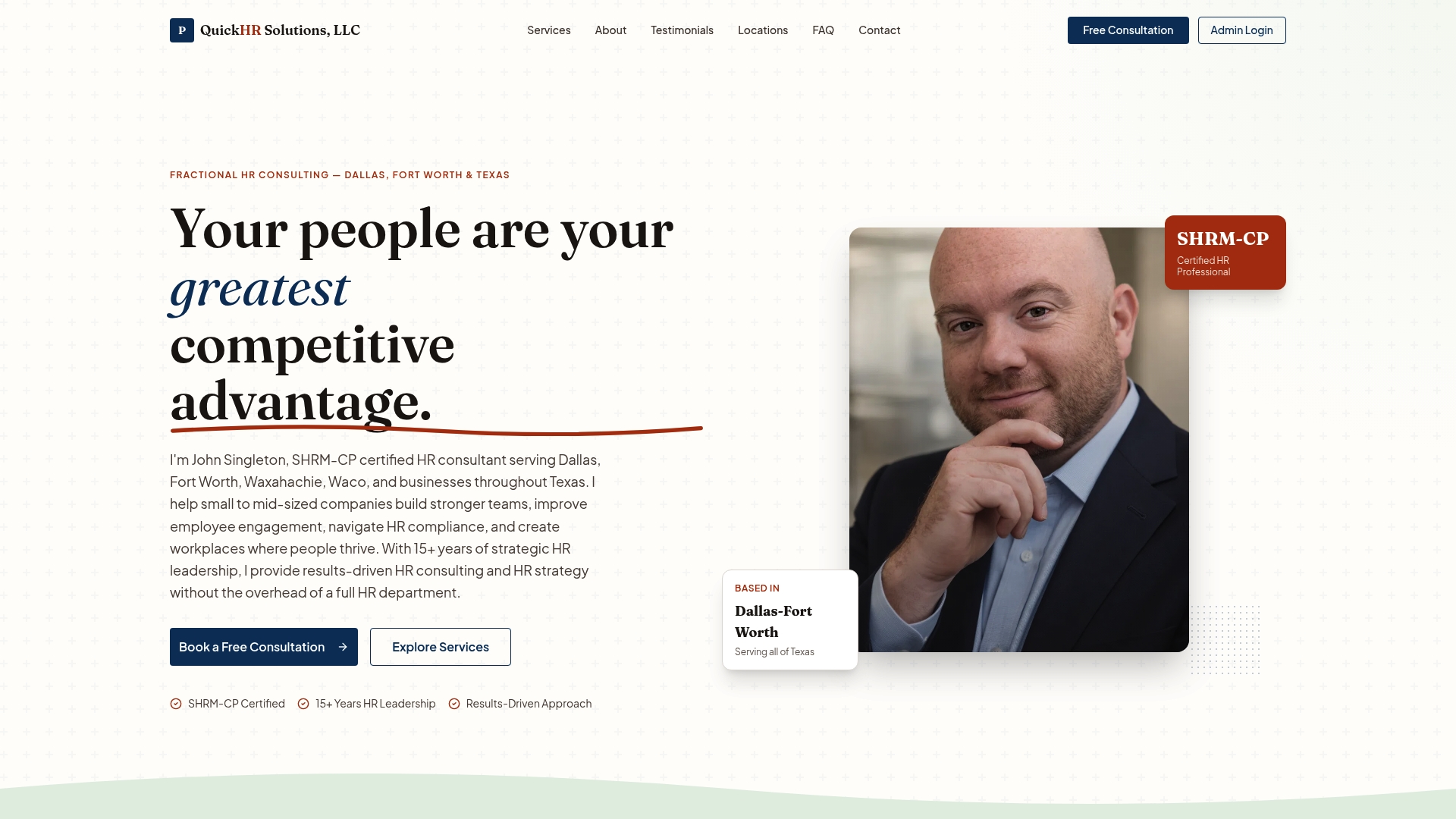
Quickhrtx offers fractional HR consulting built for exactly this situation. Texas startups and small businesses in the Dallas-Fort Worth area get SHRM-certified HR expertise without the cost of a full-time HR hire. Whether you need help building your HR foundation, managing a classification audit, or writing a state-compliant handbook, Quickhrtx delivers the kind of practical, experienced support that keeps you compliant and your team focused. Book a free consultation at quickhrtx.com and find out what a fractional HR partner can take off your plate.
FAQ
What should a founder HR responsibilities checklist include?
A founder HR responsibilities checklist should cover HR structure setup, recruiting and onboarding documentation, payroll and benefits administration, employee handbook creation, performance management, and audit preparation. Use a RACI framework to assign ownership for each task.
When should a startup founder start thinking about HR?
Before your first hire. Foundational steps like EIN registration, payroll setup, and posting labor law notices must be in place before an employee's first day, not after.
What is the Form I-9 deadline for new hires?
Section 2 of Form I-9 must be completed within three business days of the hire date. Remote verification requires active E-Verify enrollment at the time of verification.
How do I know if I should outsource HR tasks?
Outsourcing suits repeatable tasks like payroll and benefits administration well. If HR tasks are eating into your strategic time or you're unsure about compliance obligations, those are clear signals you need outside support.
Does my employee handbook need to be Texas-specific?
Yes. State-compliant handbooks must include Texas-specific at-will language, leave policies, and reporting procedures that go beyond what a federal-only template provides.