

HR indemnification is defined as a contractual obligation where one party agrees to compensate another for specific losses, legal defense costs, and liabilities arising from human resources functions. Understanding what does HR indemnification mean is critical for Texas business owners and HR professionals who work with payroll vendors, professional employer organizations, or fractional HR providers. Settlement costs in major business litigation range from $20,000 to over $1 million, which shows exactly why these clauses carry real financial weight. Getting this right from the start protects your organization from absorbing costs that should belong to someone else.
What does HR indemnification mean in a contract?
HR indemnification is a risk-allocation mechanism in contracts that defines who pays when HR operational functions lead to losses or claims. The party agreeing to cover losses is called the indemnitor. The party receiving that protection is the indemnitee. These roles determine who absorbs the financial hit when a claim arises from payroll errors, benefits administration mistakes, or employment disputes.
The standard framework in HR indemnification clauses covers three distinct obligations: indemnify, defend, and hold harmless. "Indemnify" means reimbursing the other party for losses after the fact. "Defend" means paying for legal representation during an active claim. "Hold harmless" means agreeing not to pursue the other party for damages at all. Each obligation carries different financial exposure, and contracts often bundle all three together without clearly explaining the difference.

HR indemnification agreements often accompany broader Administrative Services Agreements or can stand alone as separate contracts. They typically cover payroll processing, benefits administration, compliance obligations, and employment claims. For Texas businesses using outside HR vendors or fractional HR services, these agreements define the financial boundaries of each party's responsibility.
Key elements inside a typical HR indemnification clause
A well-drafted clause specifies the trigger events that activate coverage, the categories of costs covered, and the defense obligations of each party. Common covered costs include attorney fees, court costs, settlement payments, and regulatory fines. Trigger events typically include payroll processing errors, wrongful termination claims, and discrimination allegations tied to HR functions.
- Trigger events: The specific actions or failures that activate the indemnification obligation, such as a payroll error or a benefits enrollment mistake.
- Covered costs: Attorney fees, court costs, settlement amounts, and regulatory penalties directly tied to the triggering event.
- Defense obligations: The indemnitor's duty to provide or fund legal defense from the moment a claim is filed, not just after a judgment.
- Notice requirements: The contractually specified window in which the indemnitee must formally notify the indemnitor of a claim in writing.
- Cooperation duties: The indemnitee's obligation to assist the indemnitor during the defense process, including providing documentation and access to records.
Pro Tip: Read the notice requirements section of every HR contract before signing. Missing a written notice deadline can void your indemnification rights entirely, leaving your business to cover costs that should have been the vendor's responsibility.
Mutual vs. one-sided indemnification: what Texas businesses should know
Not all indemnification clauses share risk equally. One-sided clauses require the client to indemnify the HR vendor for virtually any claim, including claims caused by the vendor's own errors. Industry standards since early 2026 favor mutual indemnification where both parties indemnify each other for their own actions or omissions. This shift reflects growing awareness that one-sided clauses unfairly transfer risk to the party with less negotiating power.
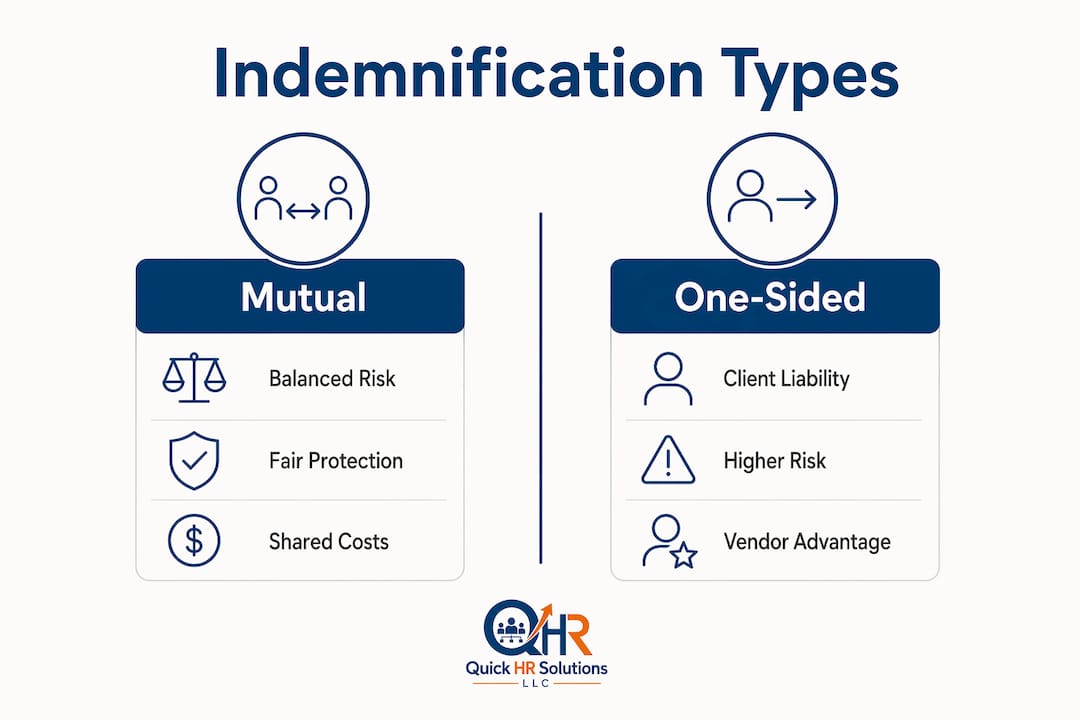
One-sided indemnification is a major risk many Texas business owners overlook. A clause that reads "client shall indemnify vendor for any and all claims" could legally require you to cover losses caused by your vendor's own negligence. That is not a hypothetical. It happens regularly in PEO and HR service agreements where clients sign standard contracts without legal review.
Mutual indemnification works differently. Each party covers claims that arise from its own conduct. The vendor covers losses from its payroll processing errors. The client covers losses from its own termination decisions. This structure reflects how operational control and indemnification responsibility should align in a fair agreement.
Here is a practical framework for evaluating any HR indemnification clause before signing:
- Identify who controls the function. The party that controls a specific HR function should bear the indemnification obligation for errors in that function.
- Check for mutual language. Look for phrases like "each party shall indemnify the other" rather than clauses that only obligate one side.
- Locate carve-outs. Confirm that gross negligence and willful misconduct by the vendor are excluded from your indemnification obligations.
- Review the scope of covered claims. Broad language covering "any and all claims" is a red flag. Specific categories are more enforceable and fairer.
- Assess the financial cap. Some contracts cap indemnification liability at the value of the contract. Know your ceiling before a claim arises.
Pro Tip: Treat indemnification negotiation as a normal part of contract review, not an afterthought. Vendors expect pushback on one-sided clauses. A simple request to add mutual indemnification language often succeeds without damaging the business relationship.
How enforceable are HR indemnification clauses in Texas?
Enforceability depends almost entirely on how precisely the clause is written. Broad and vague language like "any and all claims" is often unenforceable because courts frequently challenge sweeping indemnity clauses that lack clear definitions of covered events. Texas courts apply this standard consistently. Specificity protects both parties and makes the clause far more reliable when a dispute reaches litigation.
Several factors determine whether a Texas court will enforce an HR indemnification clause:
- Clarity of covered events: Clauses that name specific HR functions, such as payroll processing or benefits enrollment, hold up better than generic language.
- Carve-outs for misconduct: Courts expect exclusions for gross negligence and willful misconduct. Clauses that attempt to indemnify a party for its own intentional wrongdoing are routinely struck down.
- Defined financial limits: Unlimited indemnification obligations raise enforceability concerns. Caps tied to contract value or insurance limits add credibility.
- Notice of claim protocol: Failing to provide timely written notice can void indemnification rights entirely, regardless of the merits of the underlying claim.
"Broad indemnity provisions are often less protective than clearly defined categories and exclusions, improving reliability in dispute resolution."
The notice of claim protocol deserves special attention. Many businesses wrongly assume their vendor will automatically step in to handle defense when a claim surfaces. That assumption is wrong. Most contracts require formal written notice within a specific window, sometimes as short as 30 days from the date the claim is first made. Missing that window can eliminate your right to coverage entirely. HR documentation practices that track dates and communications become critical when a notice deadline is in play.
Practical applications: managing HR indemnification risks for Texas businesses
The most effective way to manage indemnification risk is to align each clause with the party that actually controls the relevant HR function. Misalignment of control and indemnification responsibility is the top cause of HR-related litigation between clients and providers. When a payroll vendor controls payroll processing, the vendor should bear indemnification responsibility for payroll errors. When your management team makes termination decisions, your business should carry the indemnification obligation for wrongful termination claims.
Consider two common scenarios that Texas businesses face regularly.
Scenario 1: Payroll processing error. Your payroll vendor miscalculates overtime for a group of employees. The employees file a wage claim with the Texas Workforce Commission. If your contract properly aligns indemnification with operational control, the vendor covers the defense costs and any settlement. Without that alignment, your business absorbs the loss.
Scenario 2: Wrongful termination claim. A manager terminates an employee without following the documented performance management process. The employee files a discrimination claim. Because your management team controlled the termination decision, your business carries the indemnification obligation. The vendor has no exposure here, and a well-drafted clause makes that clear from the start.
| Scenario | Controlling party | Indemnification responsibility |
|---|---|---|
| Payroll calculation error | HR vendor | Vendor covers defense and settlement costs |
| Benefits enrollment mistake | HR vendor | Vendor covers regulatory fines and claims |
| Wrongful termination decision | Business owner | Business covers legal defense and damages |
| Harassment by a manager | Business owner | Business covers investigation and settlement |
| Compliance filing error by vendor | HR vendor | Vendor covers penalties and correction costs |
Indemnification is a risk-allocation tool distinct from insurance. Insurance actually pays covered claims through a policy. Indemnification shifts financial responsibility contractually between parties. Many business owners treat them as interchangeable. They are not. A vendor could be contractually obligated to indemnify you but lack the financial resources to actually pay. Maintaining your own HR risk management strategies alongside indemnification clauses closes that gap.
Pro Tip: Review your HR service agreements every time you renew a contract or add a new HR function. Indemnification clauses are not permanent. They should evolve as your business grows and your vendor relationships change.
Indemnification clauses also require active monitoring, not just a one-time review at signing. Track claim notices, document all communications with vendors during disputes, and confirm that your legal counsel reviews any amendments to indemnification language. The HR compliance framework you build around these agreements determines how well they protect you when a real claim arrives.
Key takeaways
HR indemnification is a contractual risk-allocation tool that defines who pays for HR-related losses, and its enforceability depends entirely on how precisely the clause is written and how consistently the notice protocol is followed.
| Point | Details |
|---|---|
| Core definition | HR indemnification obligates one party to cover another's losses, legal defense costs, and liabilities from HR functions. |
| Mutual vs. one-sided | Mutual indemnification fairly allocates risk; one-sided clauses can force clients to cover vendor negligence. |
| Enforceability factors | Specific language, carve-outs for misconduct, and defined financial limits make clauses enforceable in Texas courts. |
| Notice protocol | Missing the written notice deadline can void indemnification rights, regardless of the merits of the claim. |
| Indemnification vs. insurance | Indemnification shifts contractual responsibility but does not replace insurance as the actual payment mechanism. |
Why I think most Texas businesses underestimate this clause
After working with dozens of small and mid-sized businesses across the Dallas-Fort Worth area, I have seen the same pattern repeat itself. Business owners sign HR service agreements, skip past the indemnification section because it looks like standard legal boilerplate, and then face a real claim with no protection. The clause was there. They just did not understand what it said.
The most common misunderstanding is treating indemnification like a passive safety net. It is not. It is an active contractual right that requires you to take specific steps, including sending formal written notice on time, cooperating with the defense process, and maintaining records that support your position. If you miss any of those steps, the protection disappears.
One-sided clauses are the second major problem I see. Vendors draft their standard agreements to protect themselves. That is rational. But it means the first draft almost always favors the vendor. Texas business owners who push back on indemnification language during negotiation consistently get better terms. Those who do not push back often end up indemnifying the vendor for the vendor's own mistakes.
Treat your indemnification clauses as living contract elements. Review them when your business changes. Review them when your vendor relationship changes. Review them when a claim surfaces, before you respond to anyone. The businesses that manage these clauses proactively rarely end up in costly disputes. The ones that ignore them often do.
— John
How Quickhrtx helps Texas businesses manage HR indemnification
Texas business owners navigating HR service agreements need more than a template. They need someone who understands how indemnification clauses work in practice and can identify the specific language that creates risk.
Quickhrtx provides fractional HR consulting in Dallas tailored to small and mid-sized businesses across the Dallas-Fort Worth area. The team holds SHRM-CP and SHRM-CPC certifications and works directly with business owners to review HR contracts, identify one-sided indemnification language, and build risk management practices that hold up when claims arise. Whether you are signing a new PEO agreement or renegotiating an existing HR services contract, Quickhrtx gives you the expertise to protect your business without the overhead of a full internal HR department. Book a free consultation at quickhrtx.com to get started.
FAQ
What does HR indemnification mean in simple terms?
HR indemnification is a contract clause where one party agrees to cover another party's financial losses, legal defense costs, and liabilities that arise from HR-related functions like payroll, benefits, or employment claims.
What is the difference between indemnify, defend, and hold harmless?
"Indemnify" means reimbursing losses after the fact, "defend" means paying for legal representation during a claim, and "hold harmless" means agreeing not to pursue the other party for damages at all. Most HR contracts bundle all three obligations together.
Is mutual indemnification better than one-sided indemnification?
Mutual indemnification is the fairer and more protective structure. It requires each party to cover losses arising from its own actions, preventing vendors from shifting their own negligence costs onto the client.
Can a Texas business lose indemnification rights?
Yes. Failing to send timely written notice of a claim within the contractually specified window can void indemnification rights entirely, leaving the business responsible for costs the vendor should have covered.
Does indemnification replace business liability insurance?
No. Indemnification is distinct from insurance because it shifts contractual responsibility between parties rather than actually paying claims through a policy. Both protections serve different functions and should be maintained together.