

Most Texas small business owners assume HR risk management means one thing: don't get sued. That framing is dangerously narrow. What is HR risk management, really? It's the systematic process of identifying, assessing, and mitigating HR-related risks, including employee behavior, compliance failures, and workplace culture breakdowns. Done well, it protects your business before problems appear, not just after they land in your inbox. This guide breaks down the core concepts, Texas-specific legal risks, and the practical steps you need to build a real HR risk management plan that works.
Table of Contents
- Understanding HR risk management and its importance
- Key types of HR risks facing Texas businesses today
- Strategies and techniques for effective HR risk management
- Developing a Texas-specific HR risk management plan
- Best practices for compliance and safeguarding employee relations in Texas
- Why proactive HR risk management is a game-changer for Texas businesses
- How Quick HR Solutions helps Texas businesses master HR risk management
- Frequently asked questions
Key Takeaways
| Point | Details |
|---|---|
| HR risk management definition | It involves identifying and managing workforce risks to protect business operations and employees. |
| Texas-specific risks | New laws increase employer liability and require timely compliance actions in Texas. |
| Strategic approach | Proactive, consistent HR risk strategies reduce legal exposure and improve workplace culture. |
| Plan development | Effective HR risk management requires tailored plans, ongoing monitoring, and integration into HR strategy. |
| Expert support available | Fractional HR consulting can help Texas businesses manage risks without added full-time costs. |
Understanding HR risk management and its importance
HR risk management is the practice of spotting and addressing workforce-related threats before they become costly problems. For Texas small and mid-sized businesses, that means going well beyond posting a harassment policy on the breakroom wall.
The scope is wide. HR-related risks include:
- Legal compliance failures such as missing wage deadlines, improper terminations, or inadequate harassment procedures
- Employee conduct issues including misconduct, harassment, discrimination, and retaliation claims
- Workplace safety gaps that expose you to OSHA violations or workers' compensation claims
- Operational risks tied to poor recordkeeping, inconsistent policies, or undertrained managers
- Cultural risks like low morale, high turnover, and disengagement that quietly drain profitability
The benefits of getting this right are real and measurable. Businesses with consistent HR practices reduce legal exposure significantly, according to SHRM risk management insights. Beyond legal protection, effective HR risk management also cuts the cost of employee turnover, strengthens your company's reputation as an employer, and builds the kind of workplace culture that actually retains good people. You can explore more on that last point in our employee engagement consulting guide.
The core difference between businesses that handle HR risks well and those that don't comes down to mindset. Reactive HR means you write a new policy after someone files a complaint. Proactive HR risk management means your policies, training, and documentation already exist when that complaint comes in, and they clearly show you acted in good faith. That distinction can be the difference between a resolved complaint and an expensive lawsuit. Our HR compliance checklist for Texas gives you a solid starting point for that proactive approach.
Key types of HR risks facing Texas businesses today
Texas has its own legal landscape, and it shifted meaningfully in recent years. If you haven't updated your HR practices to reflect those changes, you're carrying more risk than you realize.

Sexual harassment liability under Texas SB 45 is the biggest change many small employers don't know about. Texas expanded the definition of employer for sexual harassment claims in 2021, which means even a business with a single employee can now face a claim, and individual supervisors can be held personally liable. That's not how most owners understood the rules before.
Under Texas Labor Code Section 21.141, employers must take immediate and appropriate corrective action once they know about harassment. Vague investigations and delayed responses no longer protect you. The standard requires speed and documentation.
Beyond harassment, here are other Texas-specific compliance risks that demand attention:
- New hire reporting: Texas requires reporting new hires to the Attorney General's Child Support Division within 20 calendar days of the employee's first day of wages. Missing this deadline creates legal exposure you probably don't think about until it's too late.
- Final paycheck timing: Texas law sets strict deadlines depending on whether an employee resigned or was terminated. Violations trigger wage claim processes that are time-consuming and costly.
- Retaliation claims: Texas employers who take adverse action against employees who report violations face significant legal exposure. Even well-meaning managers can trigger retaliation claims through informal actions like shifting schedules or excluding employees from meetings.
- Recordkeeping failures: Poor documentation of performance issues, disciplinary actions, or complaint investigations is one of the most common ways Texas employers lose claims they should have won.
Use our Texas HR compliance checklist to audit your current practices against these requirements.
Strategies and techniques for effective HR risk management
Knowing your risks is step one. Building a system to manage them is where most Texas businesses fall short. Effective HR risk management isn't a one-time project. It's a set of ongoing habits embedded in how you run the business.
There are four core risk management techniques every Texas employer should understand:
- Avoidance: Eliminate the risk entirely. For example, if a particular role consistently creates wage classification confusion, restructure it so the classification is clear.
- Retention: Accept the risk and manage it internally. Smaller, low-probability risks may be cheaper to self-insure than to outsource.
- Loss prevention: Reduce the likelihood or impact of a risk. Training managers on harassment response is a classic loss prevention tool.
- Transfer or sharing: Move the financial exposure through employment practices liability insurance (EPLI) or by engaging an HR consultant to handle functions you're not equipped to manage in-house.
For most Texas SMBs, a combination of loss prevention and transfer works best. Here's how to put that into practice:
- Assess before you act. Map your highest-probability risks first. A new hire reporting failure is more likely than a mass layoff, so prioritize accordingly.
- Document everything. From performance conversations to complaint investigations, written records are your best defense.
- Train managers, not just employees. Most HR risks enter through management decisions. Untrained managers are your biggest liability.
- Act promptly on complaints. Delayed responses are the fastest way to turn a manageable situation into a legal claim.
Human behavior underlies most people-driven risks, which is why training and culture are front-line controls, not just nice-to-haves. Cybersecurity is a strong example: the most sophisticated technical defenses still fail when an employee clicks a phishing link. The same logic applies to harassment, retaliation, and discrimination. You need people who understand why the rules exist, not just that the rules exist. Our building company culture guide covers how to build that foundation.
Pro Tip: Texas's "immediate and appropriate corrective action" standard is not just about intent. Keeping a written log of every step you took after receiving a complaint, including the date, who was interviewed, and what action was taken, gives you evidence of compliance that protects you if the matter escalates.
If this feels like more than your internal team can manage, our fractional HR consultant guide explains how outsourced HR support makes expert-level risk management accessible without full-time staffing costs.
Developing a Texas-specific HR risk management plan
A generic HR risk plan won't cut it in Texas. You need something built around your actual workforce, your industry, and the specific legal requirements your state imposes.
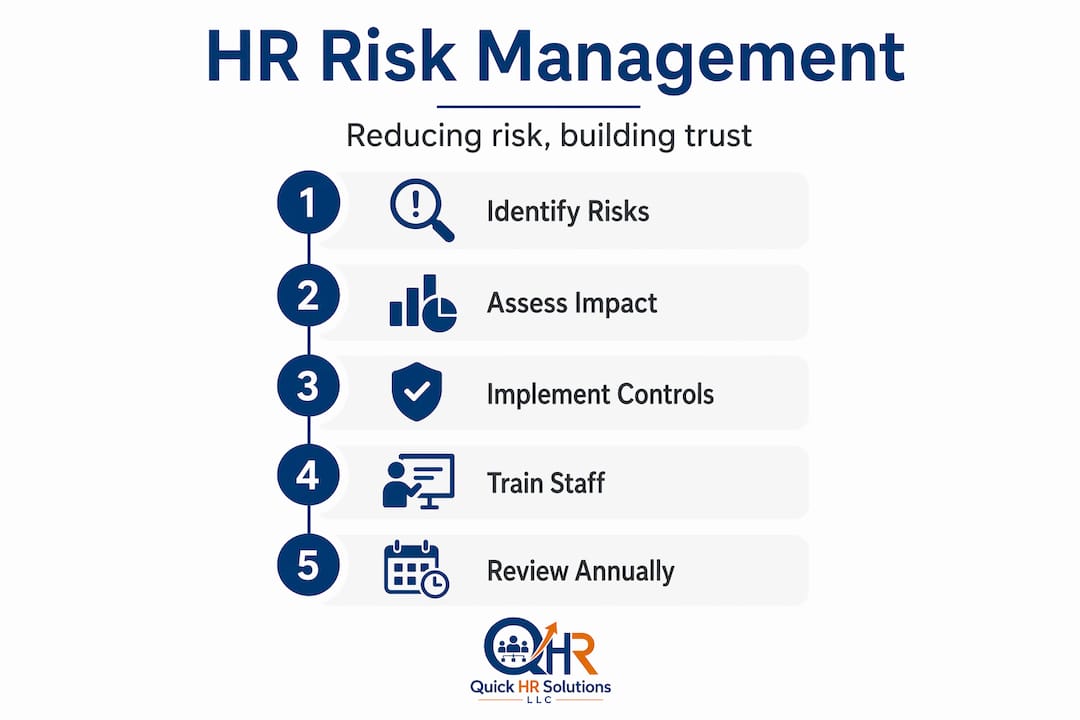
Intentional, ongoing monitoring with a tailored framework is what separates businesses that stay out of trouble from those that end up in it. Here are five practical steps to build your plan:
- Step 1: Identify your risks. Walk through every employment touchpoint, hiring, onboarding, performance management, termination, and list what could go wrong legally, operationally, or culturally.
- Step 2: Assess likelihood and impact. Not all risks are equal. A sexual harassment claim in a client-facing industry carries more reputational and financial weight than a documentation gap in a back-office process.
- Step 3: Design your solutions. Match each risk to the right technique. Some need policies, some need training, some need insurance coverage, and some need all three.
- Step 4: Use technology. HR software can track compliance deadlines, flag missing documentation, and store investigation records securely. You don't need enterprise software for this. Many affordable tools work well for teams under 100 people.
- Step 5: Review continuously. Texas law changes. SB 45 was not the last word on employer liability. Set a quarterly calendar reminder to review any legislative updates and adjust your policies accordingly.
| Risk type | Recommended technique | Texas-specific consideration |
|---|---|---|
| Sexual harassment claims | Loss prevention + transfer | SB 45 expanded personal liability for supervisors |
| New hire reporting failures | Avoidance | 20-day deadline to Texas AG's Child Support Division |
| Wage and hour violations | Loss prevention | Final paycheck rules differ by separation type |
| Retaliation claims | Loss prevention + retention | Requires consistent, documented decision-making |
| Cybersecurity and data breaches | Transfer + loss prevention | Human error is the leading entry point |
Pro Tip: Don't try to manage your Texas HR risk plan in isolation. Bring in your employment attorney at least once a year to review your policies and flag anything that needs updating. Legal changes in Texas can happen faster than most business owners realize, and outdated policies offer false comfort.
Our guides on HR consulting for small businesses in Dallas and reducing employee turnover connect directly to how a risk plan improves both compliance and workforce stability.
Best practices for compliance and safeguarding employee relations in Texas
Compliance isn't a filing cabinet full of signed acknowledgments. It's a pattern of behavior that shows up in how you investigate complaints, how you train managers, and how your employees experience the workplace every day.
Under Texas SB 45, employers and their supervisors carry real personal exposure for sexual harassment claims. Prompt, documented, and meaningful corrective action is now the legal standard, not the best practice. Here's what meeting that standard actually looks like:
- Acknowledge the complaint in writing on the same day you receive it
- Begin the investigation within 24 to 48 hours, not two weeks later
- Interview all relevant parties and document every conversation
- Separate the complainant and the alleged harasser during the investigation if the working relationship makes that necessary
- Apply discipline that is proportional to the behavior and consistent with how you've handled similar situations before
- Follow up with the complainant after resolution to confirm the behavior has stopped
Immediate and appropriate corrective action means you respond quickly enough to actually stop the harassment, not just respond eventually. Courts and the Texas Workforce Commission look at the speed and substance of your response, not just whether you technically did something.
Common pitfalls that increase legal exposure include slow investigations, verbal warnings with no documentation, and applying different standards to different employees. Any of these can turn a defensible situation into an expensive one.
Pro Tip: Keep a separate complaint file for every incident you investigate, including all notes, emails, and outcomes. Store it securely, away from the general personnel file. If a claim surfaces months later, that file is your defense.
Building a culture where employees feel safe raising concerns early is itself a risk mitigation tool. When people trust the process, issues get reported while they're still manageable. Our guide on building company culture covers how to create that environment deliberately. Cross-referencing it with your Texas HR compliance checklist gives you both the cultural and legal foundation you need.
Why proactive HR risk management is a game-changer for Texas businesses
Here's what nobody tells small business owners in Texas: the companies that treat HR risk management as optional are not saving money. They're deferring costs to the worst possible moment.
Consistent HR strategies and procedures reduce legal exposure over time. That's not a theory. It's the pattern you see when you look at which businesses end up in employment litigation and which ones don't. The difference is almost never about whether something bad happened. It's about whether the business had a documented, consistent response when it did.
The misconception that a small Texas business is "too small to worry about this" is exactly the kind of thinking SB 45 was designed to challenge. One employee is enough to trigger a claim. One supervisor acting badly is enough to create personal liability. The law no longer gives small employers a pass, and yet many still operate as if it does.
What we've seen consistently is this: businesses that invest in training and culture spend far less on HR crises than those that don't. The investment is smaller, more predictable, and it has a positive return that shows up in retention, morale, and reputation. Waiting to react to an HR crisis means paying attorney fees, settlement costs, and the hidden cost of lost productivity and damaged team trust. That math almost never works out in the employer's favor.
Proactive risk management also builds something harder to quantify but genuinely valuable: employee trust. When your people see that complaints are handled fairly and quickly, they believe the company's stated values are real. That belief is what separates high-retention workplaces from revolving-door ones. Our HR consulting for small businesses in Dallas resource explores how that translates into operational results.
The bottom line is that proactive HR risk management is not a luxury for large companies with full HR departments. It is a basic requirement for any Texas business serious about protecting its people, its reputation, and its bottom line.
How Quick HR Solutions helps Texas businesses master HR risk management
If this article made you realize your current HR practices have gaps, you're not alone. Most small and mid-sized Texas businesses are running on policies that haven't been reviewed since they were first written, if they were ever written at all.

Quick HR Solutions offers fractional HR consulting for Texas businesses, including Dallas-Fort Worth and surrounding areas, giving you access to certified HR expertise without the cost of a full-time HR hire. Our SHRM-certified consultants work alongside your team to build risk management plans, update compliance practices, and create training programs tailored to what Texas law actually requires today. Key ways we help include:
- Compliance assurance: Policies and procedures aligned with current Texas and federal law
- Risk assessment and mitigation: Identifying your highest-exposure areas and addressing them before they become claims
- Expert policy development: Employee handbooks, harassment policies, and documentation systems built for Texas employers
- Culture-building programs: Training and engagement initiatives that reduce human-error-driven risks
- Employee relations guidance: Support for investigations, corrective actions, and difficult workplace situations
Ready to stop reacting and start managing HR risks with a real plan? Visit Quick HR Solutions to book a free consultation.
Frequently asked questions
What does HR risk management involve for Texas small businesses?
HR risk management involves identifying, assessing, and addressing risks like legal compliance, employee conduct, and workplace safety to protect your Texas business and employees before problems escalate.
How has Texas law changed employer liability for sexual harassment?
Since September 2021, Texas expanded liability to all employers and supervisors, meaning even single-employee businesses face claims and individuals can be held personally liable without taking immediate corrective action.
What actions count as "immediate and appropriate corrective action" under Texas law?
Timely acknowledgment, investigation, documentation, and meaningful discipline all count, and the response must be fast enough to actually stop the harassing behavior, not just eventually address it.
What are common HR risks beyond legal compliance that Texas businesses should manage?
People-driven incidents tied to human behavior including cybersecurity threats, cultural breakdowns, high turnover, and inconsistent management decisions all require proactive HR risk strategies alongside legal compliance.
How can technology help with HR risk management in Texas businesses?
Technology supports monitoring compliance and tracking risks by flagging missed deadlines, maintaining secure investigation records, and helping you maintain continuous oversight of your HR obligations without building a large internal team.