

An HR audit is a systematic review of a company's human resources policies, practices, and documentation designed to ensure compliance and reduce risk. Texas business owners and HR professionals face this process for a clear reason: 85% of business leaders report increased complexity in compliance requirements over the past three years. Federal laws like the Fair Labor Standards Act (FLSA), the Americans with Disabilities Act (ADA), and the Family and Medical Leave Act (FMLA) create layered obligations that shift regularly. Understanding why businesses face HR audits is the first step toward turning a reactive process into a proactive advantage.
Why businesses face HR audits: compliance risks in Texas
Texas businesses operate under both federal labor law and a state regulatory environment that continues to evolve. The combination creates compliance exposure that grows quietly until a formal review forces it into the open.
The most common compliance risks that trigger HR audits include:
- Wage and hour violations under the FLSA, including misclassified exempt employees and unpaid overtime
- I-9 documentation errors, which carry per-form fines from U.S. Immigration and Customs Enforcement
- ADA and FMLA gaps, such as missing accommodation records or incomplete leave tracking
- Outdated employee handbooks that reference superseded policies or omit required disclosures
- Inconsistent disciplinary records that expose businesses to discrimination claims
25% of HR leaders admit they do not fully understand all applicable laws. That knowledge gap is not a minor oversight. It means policies get written once and never updated, creating what compliance professionals call "compliance drift," where the gap between written policy and actual practice widens until a complaint or investigation forces a correction.
Noncompliance with labor laws can cost up to $10,000 per employee in fines. Data breaches linked to non-compliant HR processes add an average of $174,000 in additional costs. Those numbers make the cost of a proactive audit look minor by comparison.

Pro Tip: Schedule a compliance review every time a federal or Texas labor law update takes effect. Documented reviews serve as evidence of good-faith compliance efforts if a regulatory investigation occurs.
What financial and operational costs come from skipping audits?
The direct fines are only part of the picture. The less visible costs of skipping HR audits compound over time and are harder to recover from.
| Cost Category | With Regular Audits | Without Regular Audits |
|---|---|---|
| Regulatory fines | Caught and corrected early | Up to $10,000 per employee |
| Data breach exposure | Reduced through compliant processes | Average $174,000 in added costs |
| Employee turnover | Lower due to consistent, fair practices | Higher due to policy gaps and poor culture |
| Legal defense costs | Minimized with documented decisions | Significant without written records |
| Productivity loss | Reduced through efficient HR workflows | Ongoing due to unresolved inefficiencies |
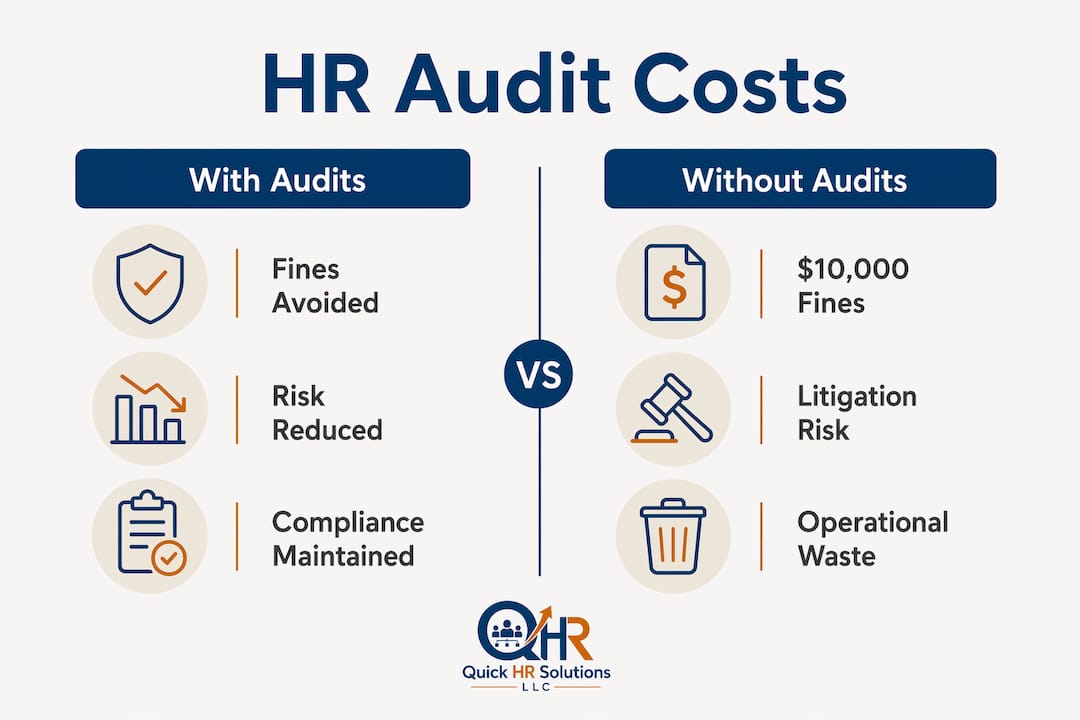
Failure to update policies for evolving regulations results in penalties, legal claims, reputational damage, and increased employee turnover. Each of those outcomes carries a dollar cost that rarely appears in a single line item but accumulates across departments.
One of the most overlooked risks is undocumented decision-making. Verbal agreements during terminations or bonuses are major audit red flags. Without written records, a business has no defense when a former employee files a wage claim or wrongful termination suit. Audits surface these gaps before they become litigation.
The operational costs matter too. Misclassified workers, duplicate onboarding steps, and inconsistent performance review processes all drain time and money. An audit identifies those inefficiencies and creates a clear path to fix them.
What triggers an HR audit for most businesses?
Certain business events reliably expose compliance gaps. Recognizing these triggers helps you act before a regulator or plaintiff does.
- Rapid headcount growth. Adding employees quickly means onboarding shortcuts. I-9 forms get missed, offer letters become inconsistent, and pay bands drift out of alignment.
- Geographic expansion. Rapid growth or geographic expansion triggers compliance drift by making legacy policies inadequate for new operational realities. A Dallas-based company opening locations in Austin or Houston faces different local ordinances and workforce dynamics.
- Regulatory updates. New federal rules on overtime thresholds, AI-driven hiring tools, or hybrid work arrangements create immediate compliance exposure if policies are not updated.
- Leadership or ownership changes. New executives often inherit undocumented practices. An audit establishes a baseline before those practices create liability.
- Employee complaints or EEOC charges. A single formal complaint often reveals systemic gaps that a full audit would have caught earlier.
- Fragmented HR data. Fragmented HR data and undocumented workflows increase audit difficulty and compliance risk. If your HR team cannot pull a complete employee file in under five minutes, that is a warning sign.
High-risk areas like pay practices and I-9 documentation should be audited annually. Full compliance audits are recommended every 12–24 months. Waiting for a trigger event to force the review is always more expensive than scheduling it proactively.
Pro Tip: Avoid relying on verbal agreements for any employment decision, including bonuses, schedule changes, or termination terms. Every agreement should exist in writing and be stored in the employee's file.
How do HR audits improve businesses beyond compliance?
The importance of HR audits extends well past avoiding fines. Businesses should view HR audits as strategic performance evaluations that enable proactive workforce growth rather than merely punitive measures. That reframe changes how leadership engages with the process.
HR audits improve operational efficiency by identifying redundancies and freeing HR staff for higher-value work. When an audit reveals that onboarding takes three different forms across three managers, standardizing that process saves hours per new hire. Multiply that across a year of hiring activity and the time savings become significant.
The benefits of a regular audit program include:
- Cleaner HR data that supports better workforce planning and compensation analysis
- Consistent employee experiences that reduce turnover and improve engagement scores
- Documented processes that make scaling the business faster and less risky
- Technology gaps identified, so HR software investments are targeted rather than speculative
- Audit readiness that reduces the disruption of any external regulatory review
Regular audits create essential evidence to defend against potential litigation and prevent costly regulatory investigations. That documentation function alone justifies the investment for any Texas business with more than 10 employees.
HR audits also surface opportunities that have nothing to do with compliance. A review of performance management records often reveals that managers are applying different standards across teams. Fixing that inconsistency improves both fairness and retention.
How should Texas businesses conduct an effective HR audit?
A well-run HR audit follows a defined process. Improvising the scope or skipping documentation review defeats the purpose.
Step 1: Define the scope. Decide whether the audit covers all HR functions or focuses on high-risk areas like wage and hour compliance, I-9 records, or leave administration. Focused audits are faster and easier to act on.
Step 2: Gather documentation. Pull employee files, offer letters, handbook acknowledgments, performance reviews, and payroll records. Gaps in this step reveal themselves immediately.
Step 3: Review against current law. Compare your policies to current FLSA, ADA, FMLA, and Texas Workforce Commission requirements. Policies written before 2022 are likely missing updates on remote work, pay transparency, and AI-assisted hiring.
Step 4: Identify gaps and root causes. A missing I-9 is a symptom. The root cause might be an onboarding checklist that does not assign I-9 completion to a specific person. Fix the system, not just the individual record.
Step 5: Prioritize and act. Not every gap carries equal risk. Wage misclassification and I-9 errors carry the highest regulatory exposure. Address those first.
Internal HR teams may have blind spots due to proximity to legacy workflows. External auditors provide objective insights that internal teams often miss. For Texas businesses without a dedicated compliance function, an external HR consultant with SHRM credentials brings both objectivity and current regulatory knowledge.
Pro Tip: Pair your HR audit with a review of your HR technology stack. Outdated or disconnected systems are a leading cause of fragmented HR data and documentation failures.
Key takeaways
HR compliance audits are the most cost-effective tool Texas businesses have to prevent regulatory fines, reduce legal exposure, and build a workforce that scales without hidden liability.
| Point | Details |
|---|---|
| Compliance complexity is rising | 85% of business leaders report increased regulatory complexity, making audits a necessity, not an option. |
| Non-compliance carries steep costs | Fines can reach $10,000 per employee, with data breaches adding an average of $174,000 in additional costs. |
| Growth triggers audit needs | Rapid expansion, leadership changes, and regulatory updates all create compliance gaps that audits catch early. |
| Audits deliver operational value | Beyond compliance, audits reduce redundancies, improve HR data quality, and support consistent employee experiences. |
| External auditors close blind spots | Internal teams miss legacy workflow problems; external auditors with SHRM credentials provide the objectivity needed. |
What I've learned from auditing Texas businesses firsthand
Most Texas business owners I work with come to an HR audit expecting a checklist exercise. What they find instead is a mirror. The audit shows them the gap between the company they think they're running and the one that exists on paper.
The most common misconception I see is that audits are only for large companies or businesses already in trouble. A 25-person company in the Dallas-Fort Worth area with no HR department is often carrying more compliance risk than a 200-person company with a dedicated HR team. The smaller business has the same federal obligations but far less infrastructure to manage them.
The second misconception is that passing an audit means you're done. Compliance drift is real and it moves fast. A policy that was current in 2023 may already be out of step with 2026 requirements on AI-assisted hiring or remote work documentation. The businesses that avoid crises are the ones that treat audits as a recurring calendar event, not a one-time project.
The practical advice I give every client is this: build your audit into your annual business planning cycle. Assign ownership to a specific person or external partner. Document everything, including the decisions you decide not to change and why. That documentation is your defense if a regulator or plaintiff ever questions your practices.
The benefits of proactive HR compliance are not abstract. They show up in lower turnover, faster hiring, and the confidence that comes from knowing your business can withstand scrutiny.
— John
How Quickhrtx helps Texas businesses stay audit-ready
Texas businesses that want expert support for HR audits and compliance reviews work with Quickhrtx, a SHRM-certified HR consulting firm serving small to mid-sized businesses across Dallas-Fort Worth and the surrounding region.
Quickhrtx provides fractional HR consulting that covers full compliance audits, documentation reviews, policy updates, and ongoing HR support without the cost of a full internal HR department. Whether you need a focused I-9 review or a complete HR compliance assessment, the team brings the regulatory knowledge and objectivity that internal teams often lack. Book a free consultation to find out exactly where your business stands and what needs to change before a problem forces the issue.
FAQ
What is an HR audit?
An HR audit is a systematic review of a company's HR policies, practices, documentation, and compliance with applicable labor laws. It identifies gaps, risks, and inefficiencies before they result in fines or legal claims.
What triggers an HR audit for a business?
Common triggers include rapid growth, geographic expansion, regulatory updates, employee complaints, leadership changes, and fragmented HR records. High-risk areas like pay practices and I-9 forms should be reviewed annually.
How often should Texas businesses conduct HR audits?
Full HR compliance audits are recommended every 12–24 months. High-risk areas such as wage classifications and I-9 documentation require annual review to stay current with federal and Texas labor law requirements.
What are the costs of skipping an HR audit?
Noncompliance fines can reach $10,000 per employee, and data breaches tied to non-compliant processes add an average of $174,000 in costs. Additional consequences include legal claims, reputational damage, and higher employee turnover.
Should Texas businesses use an external auditor?
External auditors provide objectivity that internal HR teams often cannot. Internal staff may overlook non-compliant practices due to familiarity with legacy workflows. An external SHRM-certified consultant identifies blind spots and delivers an unbiased assessment.