

HR documentation is defined as the systematic recording of employment-related events, decisions, and policies that creates a verifiable record of how a business manages its workforce. Understanding why HR documentation protects employers is not optional for business owners and HR professionals. It is the first line of defense against lawsuits, regulatory audits, and costly settlements. Proper records support consistent policy enforcement, demonstrate compliance with federal and state law, and build the kind of workplace transparency that prevents disputes before they start. Organizations like SHRM and employment law firms consistently identify poor documentation as the most common reason employers lose cases they should have won.
Why HR documentation protects employers in legal disputes
Documentation serves as critical evidence showing what an employer did, when they did it, and why. When a former employee files a wrongful termination or discrimination claim, the employer's personnel file tells the story. An empty or disorganized file tells the worst possible story: that no process existed.

Empty personnel files signal "no process" to judges and juries, and legal experts identify poor documentation as the most common pitfall in employment disputes. That single gap can turn a defensible termination into a six-figure settlement. The financial exposure is not theoretical. Disorganized HR records create direct financial risk through regulatory penalties and failed audits. Every dollar spent on a preventable lawsuit is a dollar that proper record-keeping would have saved.
The documentation types that carry the most weight in litigation include:
- Performance reviews that show a pattern of feedback over time
- Disciplinary records with dates, witnesses, and employee signatures
- Coaching memos and written warnings tied to specific incidents
- Performance improvement plans with measurable goals and deadlines
- Accommodation request records showing the interactive process was followed
- Investigation notes from workplace complaints or misconduct inquiries
Performance reviews, coaching memos, and improvement plans create a comprehensive narrative of employee performance and conduct. That narrative is what separates a credible employer defense from a weak one. Inconsistent or missing records, by contrast, imply that discipline was arbitrary or retaliatory, which is exactly what plaintiffs' attorneys argue.
The core principle: Clear, consistent documentation reduces the likelihood of workplace disputes turning into lawsuits or prolonged litigation. Early and accurate record-keeping facilitates dispute resolution before it reaches a courtroom.
What are the best practices for HR documentation?
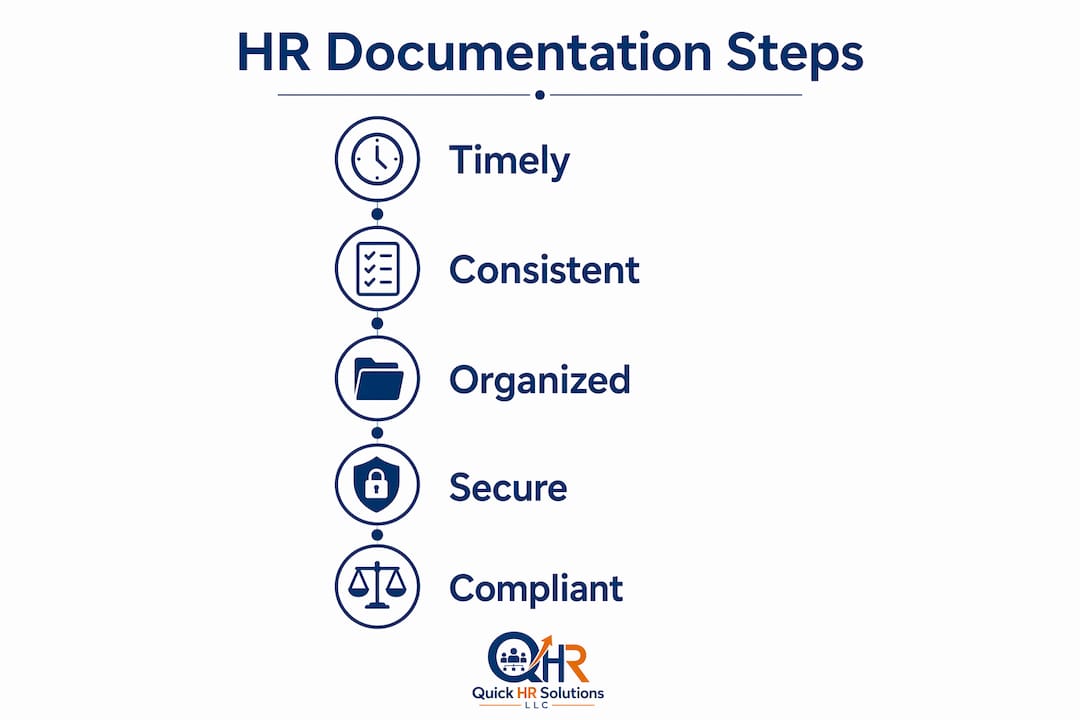
The most effective documentation systems share three qualities: they are timely, consistent, and organized. A record written three weeks after an incident carries far less credibility than one written the same day. Consistency means every employee at every level receives the same documentation process for the same types of events.
Use a dedicated HRIS, not a shared folder
Cloud storage lacks audit logs and role-based access control required for legal compliance. Dedicated HRIS platforms provide ESIGN and UETA compliance that a shared Google Drive folder cannot guarantee. That distinction matters when an attorney subpoenas your records. Platforms built for HR document management also enforce retention schedules automatically, which removes the risk of accidentally deleting records you are legally required to keep.
Train managers to document in real time
Most documentation failures are not intentional. Poor documentation results from neglecting professional record-keeping standards, not from bad faith. Managers need clear training on what to document, how to document it, and when. A one-page documentation standard, reviewed annually, gives managers a practical reference they will actually use.
A strong documentation program includes these numbered steps:
- Record every meaningful performance conversation in writing within 24 hours
- Have the employee sign or acknowledge receipt of written warnings and reviews
- Store disciplinary records separately from general personnel files
- Apply the same documentation process to every employee in the same role
- Review and audit personnel files at least once per year for completeness
- Use your HRIS retention settings to flag records approaching their legal retention deadline
Pro Tip: Set a five-minute end-of-day habit for managers: before logging off, write one sentence about any significant employee interaction that occurred. Over a year, that habit builds a defense file that most employers never have.
Consistent application of documented policies reduces the risk of claims stemming from perceived inconsistent treatment or retaliation. Consistency is not just a legal shield. It is also the foundation of a fair workplace.
How does HR documentation support compliance with employment laws?
Regulatory compliance is one of the clearest benefits of HR documentation. Federal and state agencies do not accept verbal explanations during audits. They review records. Organized documentation ensures you are ready for FMLA audits, I-9 inspections, EEOC investigations, and wage and hour reviews without scrambling.
The table below summarizes the key documentation types required for major compliance areas:
| Compliance Area | Required Documentation |
|---|---|
| FMLA leave | Leave requests, medical certifications, return-to-work notices |
| I-9 employment eligibility | Completed I-9 forms, supporting identity documents |
| ADA accommodations | Interactive process notes, accommodation agreements, medical records |
| Wage and hour laws | Time records, pay stubs, overtime authorizations |
| Anti-discrimination statutes | Hiring records, promotion decisions, disciplinary history |
| Workplace investigations | Complaint records, interview notes, findings, corrective actions |
Missing or incomplete accommodation notes invite regulatory scrutiny because the interactive process under the ADA is required by law. An employer who cannot show that they engaged in that process has no defense, regardless of the outcome they reached. The documentation of the process is as important as the decision itself.
Documentation of employee handbooks and consistent policy enforcement is equally critical. Undefined or generic policies increase the risk of legal challenges. A signed handbook acknowledgment, updated annually, closes the gap between having a policy and being able to prove an employee knew about it.
For Texas employers specifically, HR recordkeeping requirements add state-level layers to federal obligations. Knowing both sets of rules is the only way to stay fully protected.
How does documentation build a positive workplace culture?
Documentation is not just a legal tool. It is a culture tool. When employees see that performance conversations are recorded fairly, that recognition is noted alongside discipline, and that policies apply equally to everyone, trust increases. That trust directly reduces turnover and the grievances that lead to formal complaints.
Reframing documentation as a strategic asset rather than a punitive measure fosters transparency and objective accountability. That shift in mindset changes how managers approach the process. Instead of documenting only problems, they document the full picture: goals set, progress made, feedback given, and recognition earned.
The practical benefits of this approach include:
- Reduced misunderstandings because employees have written records of expectations and feedback
- Stronger employee engagement when recognition and development are documented alongside discipline
- Lower turnover because documented career conversations signal that the employer is invested in the employee
- Fewer grievances because consistent records make it harder to claim unfair treatment
Strong documentation habits connect directly to retention outcomes. Employees who receive clear, documented feedback know where they stand. That clarity reduces the anxiety that drives people to look for other jobs.
Pro Tip: Document positive performance moments with the same rigor you apply to discipline. A file that contains only warnings looks punitive. A file that contains warnings, coaching notes, and recognition looks like a managed relationship.
Clear policies backed by documentation also reduce the volume of HR investigations. When expectations are written down and consistently enforced, employees have less ground to claim they were treated differently. That is the role of HR in policy enforcement: not just to write policies, but to create the records that prove those policies were applied.
Key Takeaways
Proper HR documentation is the single most effective tool employers have to prevent legal disputes, satisfy regulatory audits, and build a workplace where expectations are clear and consistently enforced.
| Point | Details |
|---|---|
| Documentation is legal evidence | Personnel files, reviews, and disciplinary records are your primary defense in employment claims. |
| Empty files lose cases | Missing records signal no process existed, which courts and regulators treat as employer failure. |
| Dedicated HRIS is required | Cloud folders lack audit logs and ESIGN compliance; use a purpose-built HR document system. |
| Compliance requires specific records | FMLA, I-9, ADA, and wage laws each require distinct documentation types to survive an audit. |
| Documentation builds culture | Consistent, fair records reduce turnover, increase trust, and prevent disputes before they escalate. |
What I've learned after years of watching employers lose cases they should have won
Poor documentation is the most common fatal flaw I see in employer legal defenses. Not bad intentions. Not unfair policies. Just missing paperwork. An employer fires someone for legitimate performance reasons, but the file has one vague warning from two years ago and nothing else. That employer is now in a very difficult position, regardless of what actually happened.
The mindset shift that changes everything is treating documentation as a daily business practice, not a reaction to problems. The employers who win disputes are the ones who documented consistently long before any dispute existed. Their files tell a clear, credible story. The employers who lose are the ones who tried to reconstruct that story after the fact.
Technology makes this easier than it has ever been. A good HRIS with built-in document management, electronic signatures, and automated retention schedules removes most of the friction. The barrier is not the tools. The barrier is the habit. Build the habit first, then let the technology support it.
My recommendation for 2026: audit every personnel file in your organization right now. Look for gaps. Look for inconsistencies. Look for files that contain only negative records. Fix those gaps before a dispute forces you to. Proactive documentation is always cheaper than reactive litigation.
— John
How Quickhrtx helps Texas businesses build compliant documentation systems
Building a documentation system that actually protects your business takes more than good intentions. It takes structure, training, and ongoing oversight.
Quickhrtx provides fractional HR consulting to small and mid-sized businesses across Dallas-Fort Worth and Texas, including hands-on support for building compliant HR documentation practices. From auditing existing personnel files to training managers on documentation standards, Quickhrtx delivers the expertise of a full HR department without the overhead. If your business needs a documentation system that holds up in court and satisfies regulators, Quickhrtx's HR consulting services are built for exactly that. Book a free consultation to find out where your current records stand.
FAQ
What is HR documentation and why does it matter?
HR documentation is the systematic recording of employment events, decisions, and policies. It matters because it serves as evidence in legal disputes and demonstrates regulatory compliance during audits.
What types of records are most important for employer legal protection?
Performance reviews, disciplinary records, coaching memos, signed handbook acknowledgments, accommodation request notes, and investigation records are the most critical documents for defending employment claims.
How long should employers keep HR records?
Retention requirements vary by document type and law. I-9 forms must be kept for three years after hire or one year after termination, whichever is later. FMLA and payroll records carry their own federal retention periods, and Texas employers must also follow state-specific rules.
Does HR documentation help prevent lawsuits, or only defend against them?
Documentation does both. Consistent, documented policies reduce the likelihood that disputes escalate to litigation at all. When employees see fair, transparent records, they are less likely to file formal complaints.
What is the biggest documentation mistake employers make?
Empty or incomplete personnel files are the most common and most damaging mistake. A file with no performance history, no warnings, and no signed acknowledgments gives an employer almost no defense in a termination dispute.