

Workplace misconduct cases are rising fast. Workplace harassment reached a near seven-year high in 2025, and that trend is not reversing. For small and mid-sized Texas businesses, this means the role of HR in investigations has shifted from a procedural nicety to a legal necessity. Get it right, and you protect your organization. Get it wrong, and you hand a plaintiff's attorney exactly what they need. This guide breaks down what HR must do, when to bring in outside help, and how to run an investigation that holds up under scrutiny.
Table of Contents
- Understanding HR's role as the neutral fact-finder in investigations
- Navigating the changing legal landscape in Texas for workplace investigations
- When to bring in external investigators: enhancing credibility and managing conflicts
- Creating strong investigation reports and effective closeout meetings
- Applying best practices: practical steps for Texas HR managers and business owners
- A Texas HR perspective: why standard processes often fall short and how to improve investigations
- How Quick HR Solutions supports Texas businesses with expert HR investigations
- Frequently asked questions
Key Takeaways
| Point | Details |
|---|---|
| HR as neutral fact-finder | HR must maintain objectivity and professional distance to ensure fair, legally defensible investigations. |
| Legal landscape changes | Texas employers must adapt to EEOC guidance rescission and understand state-specific retaliation timelines. |
| Use external investigators selectively | Engage outside experts when conflicts of interest or leadership involvement could compromise impartiality. |
| Report and closeout importance | Thorough factual reports and formal closeout meetings reduce risks and build trust. |
| Practical steps for compliance | Timely, documented, and legally informed investigations protect Texas businesses effectively. |
Understanding HR's role as the neutral fact-finder in investigations
HR's job during an investigation is not to defend the company, side with the complainant, or punish anyone before the facts are in. The role is singular: gather facts impartially. HR must act as a neutral, objective fact-finder, maintaining professional distance to ensure a legally defensible process. That means setting aside personal impressions, relationships, and organizational politics.
This is harder than it sounds in smaller Texas businesses. When your HR manager has worked alongside the accused for four years, or when the complaint involves a business owner's close friend, objectivity takes real discipline. But the cost of failing here is severe. If an investigation later appears biased, a court can use that bias to support a finding of negligence or bad faith. Neutrality is not just ethical; it is your legal armor.
Here is what maintaining that neutral HR role looks like in practice:
- Treat all parties with equal professional courtesy throughout the process
- Avoid pre-investigation discussions that could signal a predetermined outcome
- Keep investigation records separate from the employee's general personnel file
- Decline to investigate cases where you have a personal conflict of interest
- Apply consistent interview techniques to complainants, respondents, and witnesses
Pro Tip: Before opening any investigation, document the scope in writing. Define what you are investigating, who is involved, and what standard of evidence you will use. This single step prevents scope creep and protects you if the process is later challenged.
Evidence gathering, interviewing, and documentation are technical skills. They benefit from training and, where complexity demands it, external investigation expertise. Treating them as instinctive or improvised is one of the most common mistakes Texas HR teams make.
Navigating the changing legal landscape in Texas for workplace investigations
The legal ground under workplace investigations shifted in 2026. The EEOC rescinded its 2024 Enforcement Guidance on Harassment in the Workplace, removing a detailed interpretive resource that many HR professionals had come to rely on. Critically, this did not eliminate Title VII protections or employer obligations. The core federal laws remain fully in force. What changed is that HR now has less federal guidance on how regulators interpret edge cases.
For Texas employers, this makes internal clarity even more important. You cannot rely on federal interpretation documents to fill your policy gaps. Your anti-harassment policy, your investigation procedures, and your documentation standards need to carry the weight.
Here is a quick reference for the timelines Texas HR professionals must track:
| Claim type | Filing deadline | Filed with |
|---|---|---|
| Harassment or discrimination | 300 days from incident | EEOC or Texas Workforce Commission |
| Retaliation (employment law) | 300 days from adverse action | EEOC or Texas Workforce Commission |
| OSHA whistleblower retaliation | 30 days from adverse action | OSHA directly |
| Texas Payday Law wage claims | 180 days from incident | Texas Workforce Commission |
These are not suggestions. Miss a timeline, and your organization could face procedural liability for failing to respond before a claim was even filed. The 30-day OSHA window in particular catches employers off guard because it is far shorter than most HR professionals expect.
Texas HR teams should review their HR compliance checklist at least annually, and more often as federal guidance shifts. The key compliance commitments remain:
- Maintain a written anti-harassment policy aligned with Title VII
- Provide a clear reporting mechanism that does not require reporting to the accused
- Investigate all complaints promptly regardless of who is involved
- Enforce anti-retaliation policies with the same seriousness as the original conduct
When to bring in external investigators: enhancing credibility and managing conflicts
Most employee investigations can and should be handled internally by a competent HR function. But there is a category of cases where internal handling creates more risk than it solves. Knowing when to step back is itself a best practice.
Use external investigators when allegations involve senior leaders, HR personnel themselves, or situations where a genuine conflict of interest exists. These scenarios do not just create bias; they create the appearance of bias, and in litigation, appearance matters nearly as much as reality.
Consider the practical implications:
- Allegations against the owner or a C-suite executive: An HR manager who reports directly to the accused cannot credibly investigate that person. Even with good intentions, the power imbalance is obvious to any outside observer.
- Accusations involving HR itself: If the complaint names an HR team member, the entire HR function has a conflict that requires outside resolution.
- Cases with high litigation potential: Complex discrimination or harassment claims where employment lawsuits are likely benefit from an investigation conducted by someone with legal training and no internal ties.
- Pattern complaints with prior failures: If similar complaints were mishandled internally before, an external investigator resets the credibility of the process.
Pro Tip: When you bring in an external investigator, brief them on the facts but step back from the process. Continued HR involvement in substantive decisions after hiring an outside investigator can undermine the independence you paid for.
External HR investigation options for Texas businesses range from specialized employment attorneys to fractional HR consultants with investigation experience. The right choice depends on case complexity, likely legal exposure, and budget. Do not let cost alone drive the decision. The cost of a weak investigation that leads to litigation dwarfs the expense of getting it right the first time. And for serious cases, consider that international HR outsourcing experience often translates into structured, process-driven investigation methods that improve consistency.
Creating strong investigation reports and effective closeout meetings

An investigation that produces weak documentation is almost as bad as no investigation at all. If a claim ends up before a judge or the Texas Workforce Commission, your investigation report becomes a primary exhibit. It needs to be ready for that audience from the moment you write it.
What a sound investigation report must include:
- A factual summary of the complaint as originally received
- A description of the investigation methodology, including who was interviewed and when
- A summary of evidence gathered, including witness accounts and documents reviewed
- A credibility assessment for each witness that explains the reasoning in objective terms
- Findings of fact, stated plainly without language like "I believe" or "in my opinion"
- A conclusion on whether the conduct alleged occurred, based on the preponderance of evidence standard
- Recommended next steps or disciplinary actions, with rationale
Investigation reports must be objective, prepared as potential legal evidence, and focused entirely on facts over opinions. Avoid editorializing. Do not describe a witness as "defensive" unless you can document the specific behaviors that support that observation.
The report is only part of the close. The other piece, often skipped, is the closeout meeting. Closeout meetings with both the complainant and respondent prevent either party from feeling ignored, which directly reduces retaliation claims after the process ends.
Key elements of an effective closeout meeting:
- Communicate findings at the appropriate level of detail without disclosing confidential information about other employees
- Explain what corrective actions, if any, will be taken (even if specifics remain confidential)
- Reiterate the company's anti-retaliation policy and expectations clearly
- Document that the meeting occurred, who attended, and what was communicated
A structured close also gives HR a documented moment to reset expectations and reduce post-investigation friction in the workplace.
Applying best practices: practical steps for Texas HR managers and business owners
Good intentions do not produce compliant investigations. Process does. Here is a step-by-step framework tailored to Texas small and mid-sized businesses:
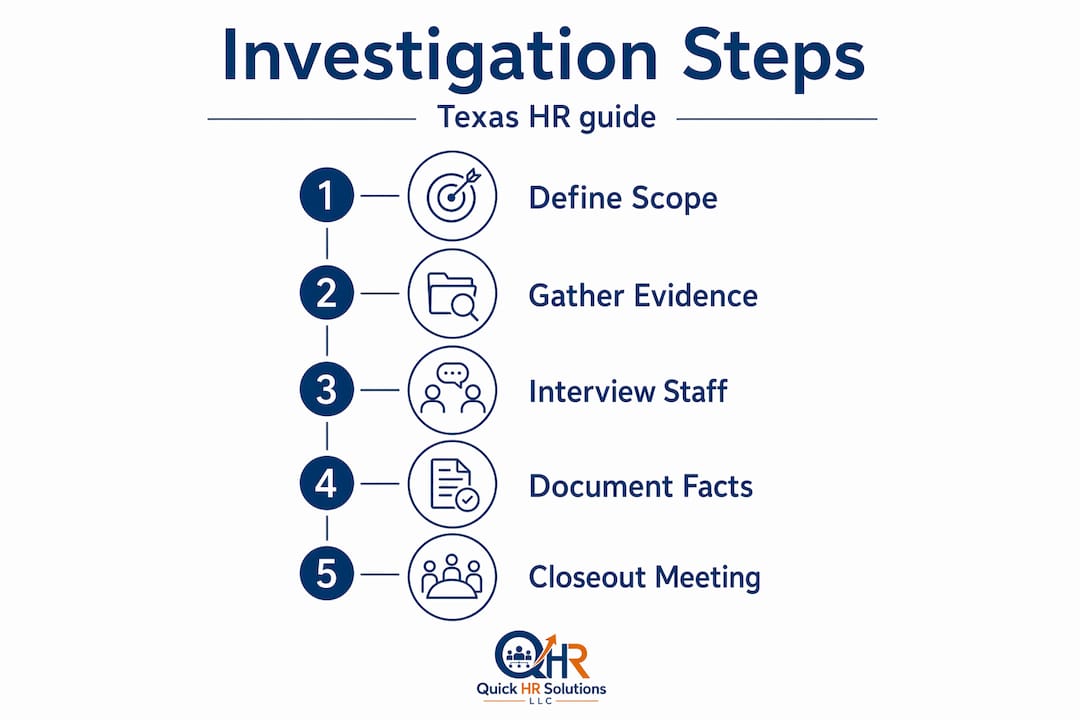
- Receive and document the complaint immediately. Note the date, time, method of reporting, and exact language used. This timestamp is critical for legal timelines.
- Assess the complaint before investigating. Determine its severity, who is involved, and whether internal HR can handle it without a conflict of interest.
- Assign the investigator. Internal HR works for most cases. Escalate to external resources for cases involving leadership, HR, or high litigation risk.
- Plan the interviews. Start with the complainant, then witnesses, then the respondent. Give the respondent a fair opportunity to respond to specific allegations.
- Gather documentary evidence. Pull relevant emails, records, schedules, camera footage, or other materials concurrent with interviews, before anyone has time to alter or delete them.
- Write the report. Follow the structure above. Assume a judge will read it.
- Conduct closeout meetings. With both parties, separately, before any disciplinary action is communicated broadly.
- Take corrective action proportionate to findings. Document the connection between the findings and the discipline imposed.
- Follow up. Check in with the complainant within 30 days to confirm no retaliation has occurred.
Research shows that 78% of employees who reported misconduct saw their issues investigated and resolved, which demonstrates that well-run internal processes genuinely work. The gap between organizations that protect themselves and those that face liability is mostly procedural discipline.
| Investigation element | High-risk approach | Low-risk approach |
|---|---|---|
| Investigator selection | HR with conflict of interest | Neutral internal or external party |
| Documentation | Informal notes, no structure | Formal report with evidence trail |
| Timing | Delayed response to complaint | Prompt start within 24 to 48 hours |
| Closeout | No formal communication | Documented meetings with both parties |
| Legal timeline tracking | Informal | Tracked against compliance requirements |
| Post-investigation follow-up | None | 30-day retaliation check-in |
A Texas HR perspective: why standard processes often fall short and how to improve investigations
After working with Texas businesses across a wide range of sizes and industries, we see the same failures repeat. They are not failures of intent; they are failures of discipline and awareness.
The most common problem is personal relationships overriding professional judgment. In a 40-person Texas company, everyone knows everyone. When the complaint involves a long-tenured manager who is also a personal friend of the HR lead, the investigation often softens in subtle ways. Questions get gentler. Evidence that would normally be pursued gets left alone. The report uses language that hedges findings rather than states them. Courts see through this. So do employees.
The second major failure is timing. Adverse actions taken immediately after a complaint is filed create powerful circumstantial evidence of retaliation, even when the action was already planned for unrelated reasons. A performance improvement plan issued three days after an employee files a harassment complaint looks like retaliation. HR must document the independent basis for any adverse action taken within 90 days of a complaint, and when in doubt, delay non-urgent actions until the investigation is complete.
Third: closeout meetings. Skipping them is a risk most businesses do not realize they are taking. When complainants hear nothing after reporting, they assume the worst, and they often act on that assumption by filing an external charge or consulting an attorney. A brief, professional meeting that communicates respect for the process costs almost nothing. The absence of it can cost considerably more.
The fix for all of these is a combination of training and external accountability. HR professionals handling investigations should receive structured training on interviewing, documentation, and legal timelines. When the internal team is too close to a situation, retaliation prevention strategies and fractional HR consultants provide the outside perspective that keeps the process clean. These are not expensive fixes. They are investment protection.
How Quick HR Solutions supports Texas businesses with expert HR investigations
Running a compliant, impartial investigation while managing daily business operations is genuinely hard, especially without a dedicated HR team. That is the problem Quick HR Solutions was built to solve.
Our fractional HR consulting team brings SHRM-certified expertise directly to Texas small and mid-sized businesses, including the Dallas-Fort Worth area, without the cost of a full-time hire. We handle HR involvement in employee investigations from intake through closeout, ensuring your process is documented, neutral, and built to withstand legal scrutiny. Whether you need guidance on a single complaint or an ongoing investigation framework, our fractional HR services in Dallas give you senior-level support on demand. Book a free consultation and put the right process behind your next investigation.
Frequently asked questions
What is the primary role of HR during an employee investigation?
HR acts as a neutral, objective fact-finder responsible for gathering evidence fairly to ensure a legally defensible process. HR's function requires professional distance from all parties involved, regardless of prior relationships.
How has the EEOC's rescission of the 2024 harassment guidance affected investigations?
The rescission removes a key interpretive resource but does not change federal harassment laws or employer responsibilities under Title VII.
When should Texas businesses use external investigators instead of internal HR?
External investigators are recommended when allegations involve senior leaders, HR personnel, or where conflicts of interest exist. External investigators boost credibility and legal defensibility in high-stakes cases.
What is a retaliation claim and how long can employees wait to file in Texas?
Retaliation involves adverse actions against employees for protected activities such as filing complaints. Texas employees have 300 days to file with the EEOC or Texas Workforce Commission, though OSHA whistleblower claims must be filed within just 30 days.
Why are closeout meetings important after investigations?
Closeout meetings formally communicate findings to all parties, reduce misunderstandings, mitigate retaliation risks, and demonstrate that HR took the process seriously from start to finish.