

The hiring manager training process is a structured program that equips managers with behavioral interviewing skills, bias mitigation techniques, legal compliance knowledge, and scorecard usage to make better hiring decisions. Only 38% of hiring managers receive formal interview training before conducting interviews. That gap creates real risk: inconsistent evaluations, legal exposure under EEOC guidelines, and poor retention. Formal training can double the accuracy of hiring decisions and improve employee retention outcomes significantly. For small and mid-sized businesses without a full HR department, a well-built training program is not optional. It is the difference between a team that grows and one that churns.
What core skills should hiring managers learn first?
Effective training for hiring managers starts with behavioral interviewing. The STAR method (Situation, Task, Action, Result) gives managers a repeatable framework for drawing out specific, verifiable examples from candidates. Without it, interviews drift toward hypothetical questions that reveal very little about actual performance.
Bias mitigation is the second critical skill area. Telling managers to "be objective" does not work. Objective rating rubrics and structured scorecards replace gut feelings with evidence-based evaluations. Every candidate gets scored on the same criteria, in the same order, using the same scale.

Legal compliance rounds out the foundation. EEOC guidelines prohibit questions about age, religion, national origin, disability, and several other protected categories. Managers need to know exactly which questions are off-limits and why. Pairing this knowledge with mandatory HR training requirements specific to Texas employers adds another layer of protection for your business.
Two additional skills belong in every program:
- Candidate assessment alignment: Hiring managers and recruiters must agree on what "strong" looks like before interviews begin. Shared standards accelerate hiring and produce more useful candidate feedback.
- Candidate experience: Interviewing is a two-way process. Managers who reserve time for candidate questions improve employer branding and acceptance rates. A respectful interview reflects directly on company culture.
Pro Tip: Build a one-page interview guide for each role that lists approved questions, scoring criteria, and a reminder of legally prohibited topics. Managers who walk in with a guide make fewer compliance errors and score candidates more consistently.
How do you implement a hiring manager training program?
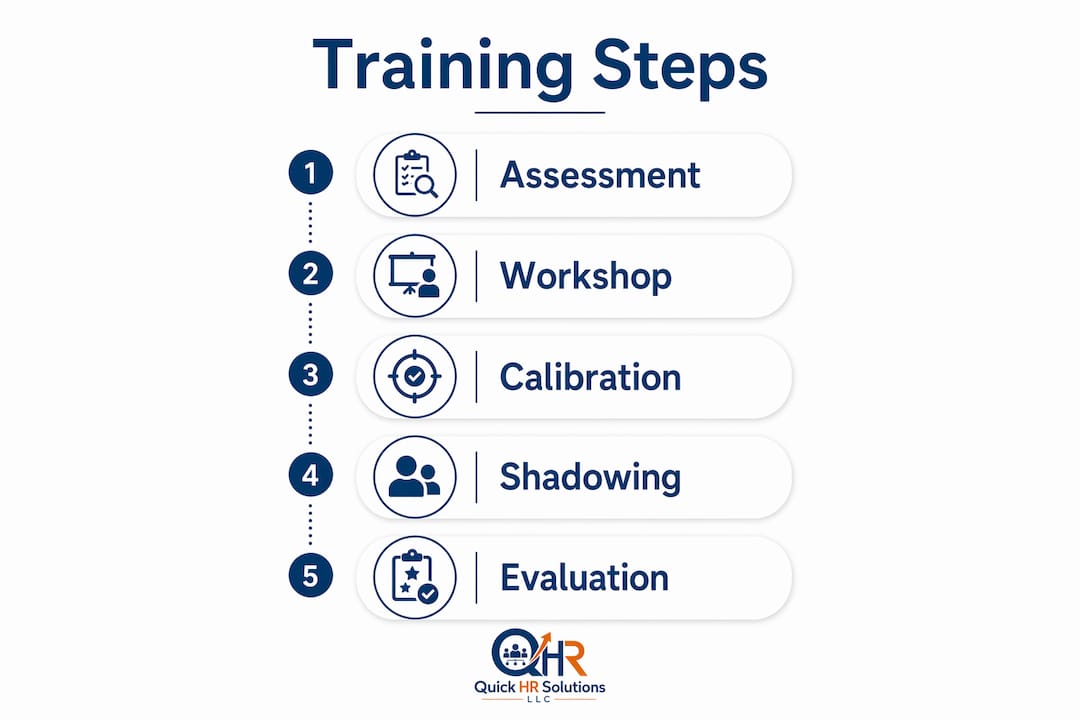
A four-phase rollout produces the most durable results. Effective hiring training follows a skills workshop, calibration, shadowing, and ongoing calibration sequence. Each phase builds on the last.
-
Assess current skills. Survey hiring managers on their interviewing experience and review recent hiring outcomes. Identify gaps in scorecard usage, legal knowledge, and structured questioning before designing any content.
-
Run a core skills workshop. Two hours suffices to cover behavioral questioning, note-taking, legal compliance, and scorecard usage. Keep the session practical. Role-play at least two mock interviews so managers practice before they go live.
-
Hold calibration sessions. Present anonymized candidate answers and have managers score them independently. Then compare scores as a group. Calibration sessions align interviewers on what "strong" looks like and expose scoring discrepancies that would otherwise go undetected.
-
Shadow and observe live interviews. Pair newer hiring managers with experienced interviewers for at least two observed interviews. Debrief immediately after each one. This phase converts classroom knowledge into real-world skill.
-
Schedule quarterly calibration. Skill drift is real. Managers who go more than six months without interviewing revert to gut-based judgment. Quarterly 30-minute sessions keep standards consistent across your team.
The tools you need at each phase are straightforward:
| Phase | Key Tool | Purpose |
|---|---|---|
| Assessment | Skills gap survey | Identify training priorities |
| Workshop | Interview guide + scorecard | Standardize question and scoring |
| Calibration | Anonymized answer sets | Align scoring standards |
| Shadow | Observation checklist | Provide structured feedback |
| Ongoing | Quarterly calibration deck | Prevent skill drift |
Pro Tip: For small businesses with limited time, combine the workshop and first calibration session into a single half-day event. You cover the theory and immediately test it with real scoring practice, which cuts the time to competency significantly.
What tools and metrics measure training effectiveness?
The primary metric for hiring manager training adoption is scorecard completion rate. A rate above 95% signals that the process is working and that friction is low. When rates drop below that threshold, the problem is almost always unclear instructions or a cumbersome workflow, not manager resistance.
Three tools drive consistent results:
- Interview scorecards with rating rubrics. Each competency gets a defined scale (1–4 or 1–5) with behavioral anchors at each level. Managers know exactly what a "3" looks like versus a "4." This removes ambiguity and makes post-interview debriefs faster.
- Anonymized calibration sets. Pull real candidate answers from past interviews (with identifying details removed) and use them in calibration sessions. This grounds the training in your actual hiring context rather than generic examples.
- Harvard's Implicit Association Test (IAT). The IAT is a free, research-backed tool that helps managers recognize unconscious bias patterns. Pairing it with scorecard training gives managers both the awareness and the structural fix.
For SMBs with limited budgets, low-cost training options like self-study guides, video modules, and peer calibration sessions deliver strong results without large program overhead. The key is consistency, not cost. A well-run 30-minute calibration session beats a one-time all-day seminar every time.
Tracking scorecard completion by manager and by role also reveals patterns. If one department consistently scores below 95%, that signals a process problem specific to that team. Fix the workflow before adding more training content.
What challenges derail hiring manager training?
Interview skill drift is the most common and least discussed problem in hiring manager development. Managers who go over six months without interviewing revert to gut-based judgment. The fix is not retraining from scratch. It is a 30-minute quarterly calibration that refreshes standards before drift sets in.
Three other challenges show up repeatedly in SMB hiring programs:
- Recruiter and manager misalignment. When recruiters and hiring managers use different definitions of "qualified," the process stalls. Calibration sessions that include both groups solve this directly.
- Unconscious bias persistence. Structural tools like scorecards reduce bias. Awareness training alone does not. Managers need both the knowledge and the process to act on it consistently.
- Gut-feel reliance. Some managers trust their instincts over scorecard results. Structured interviews using consistent questions and scoring rubrics are the strongest predictors of job performance. That data point is worth sharing directly with resistant managers.
"Calibration sessions are critical yet often neglected. Real-world practice is the only way to align interview standards across a team. Skipping calibration is the single fastest way to undo every other investment in hiring manager training."
Resistance to process change is also real. Managers who have hired "their way" for years push back on scorecards and structured questions. The most effective response is not mandating compliance. It is showing them their own past hiring outcomes and letting the data make the case. Pairing that conversation with cultural fit assessment examples gives managers a concrete alternative to gut-feel evaluation.
Key Takeaways
A structured hiring manager training process built on behavioral interviewing, legal compliance, calibration, and scorecard discipline produces measurably better hiring decisions and stronger retention outcomes.
| Point | Details |
|---|---|
| Start with a skills gap assessment | Survey managers and review past hiring data before designing any training content. |
| Use a four-phase rollout | Workshop, calibration, shadowing, and quarterly maintenance produce the most durable results. |
| Scorecards replace gut feeling | Objective rating rubrics with behavioral anchors remove subjectivity from candidate evaluation. |
| Track scorecard completion rates | A rate above 95% signals low friction; below that, fix the workflow before adding more training. |
| Quarterly calibration prevents drift | Managers who go six months without interviewing revert to inconsistent, gut-based judgment. |
What I've learned from building hiring programs for SMBs
The biggest mistake I see in small and mid-sized businesses is treating hiring manager training as a one-time event. A two-hour workshop is a starting point, not a solution. The managers who improve most are the ones whose organizations build calibration into the calendar as a standing quarterly meeting, not a reaction to a bad hire.
The second thing I have learned is that hiring managers respond better when you treat them as partners in the process rather than compliance problems to solve. When you show a manager how structured interviews reduce their own time-to-fill and improve the quality of their team, they stop resisting scorecards. They start asking for better ones.
Smaller businesses actually have an advantage here. Without layers of approval and bureaucracy, you can run a calibration session next Tuesday. You can update an interview guide this week. The agility that makes SMBs feel under-resourced is the same agility that lets them build better hiring habits faster than large enterprises.
The one thing I would not compromise on, regardless of budget or team size, is the calibration step. You can cut the workshop to 90 minutes. You can use free video resources instead of a paid platform. But if you skip calibration, you are training managers in isolation and hoping they all arrived at the same standards. They did not. Calibration is where training becomes a shared language.
— John
How Quickhrtx supports your hiring manager training
Building a hiring manager training program from scratch takes time that most SMB leaders do not have.
Quickhrtx provides fractional HR consulting tailored to small and mid-sized businesses across the Dallas-Fort Worth area. The team designs and implements hiring process training programs, including skills workshops, calibration sessions, interview guides, and scorecard systems, all scaled to your team size and budget. If your hiring managers are conducting interviews without formal training, or if your current process produces inconsistent results, Quickhrtx can build a program that fits your business. Book a free consultation at quickhrtx.com to get started.
FAQ
What is the hiring manager training process?
The hiring manager training process is a structured program that teaches managers behavioral interviewing, legal compliance, bias mitigation, and scorecard usage. It typically follows a four-phase model: skills workshop, calibration, shadowing, and ongoing quarterly maintenance.
How long does hiring manager training take?
A core skills workshop takes approximately two hours. Full program implementation, including calibration and shadow interviews, typically spans four to six weeks depending on team size and hiring volume.
What is the STAR method in interview training?
The STAR method (Situation, Task, Action, Result) is a behavioral interviewing framework that prompts candidates to describe specific past experiences. It gives hiring managers a consistent structure for evaluating real evidence of job-relevant skills.
How do you prevent interview skill drift?
Quarterly 30-minute calibration sessions are the most effective prevention. Managers who go more than six months without interviewing revert to gut-based judgment, so regular calibration keeps standards consistent across the team.
What metrics show that hiring manager training is working?
A scorecard completion rate above 95% is the primary indicator of effective training and low process friction. Tracking this metric by manager and by department reveals where workflow problems exist before they affect hiring quality.