

Mandatory HR training requirements refer to the legally required courses and programs employers must deliver to employees to comply with applicable federal and Texas state laws, protecting the organization from liability and workforce harm. Texas employers face a layered compliance picture in 2026: federal mandates from OSHA, HIPAA, and Title VII sit alongside Texas-specific statutes like SB 45 and SB 240, each carrying distinct obligations based on your industry, employee count, and workforce geography. Getting this wrong does not just create audit exposure. It weakens your legal defense when incidents occur.
What mandatory HR training requirements apply in Texas
Texas employers operate under two parallel sets of obligations: federal law and Texas state law. Neither fully replaces the other, and understanding where they overlap is the starting point for any compliant training program.
Federal mandates that apply to Texas employers include:
- OSHA safety training: Federal OSHA standards apply in Texas because the state has no approved state OSHA plan. Training is topic-specific, covering hazard communication under 29 CFR 1910.1200, fall protection, respiratory protection, and bloodborne pathogens for healthcare workers.
- HIPAA training: Required for covered entities and business associates handling protected health information. This applies to healthcare providers, insurers, and many third-party vendors.
- Title VII and ADA compliance awareness: While federal law does not mandate a specific training course, documented harassment prevention training is the primary mechanism employers use to establish the Faragher-Ellerth defense against hostile work environment claims.
- Bloodborne pathogens training: Required annually under OSHA 29 CFR 1910.1030 for any employee with occupational exposure to blood or infectious materials.
Texas-specific mandates add another layer:
- SB 45 sexual harassment guidance: Texas private employers are not legally required to provide sexual harassment training, but SB 45 (effective September 1, 2021) raised the corrective action standard to "immediate and appropriate." Employers who skip training lose a critical line of legal defense when claims arise.
- SB 240 healthcare workplace violence prevention: Texas healthcare facilities must conduct annual workplace violence prevention training under SB 240. This applies to healthcare providers and employees, not just new hires at onboarding.
- Texas Labor Code compliance training: Supervisors in particular need training on wage and hour rules, leave entitlements, and retaliation prohibitions under Texas law.
Employer size matters here. Businesses with one or more employees fall under SB 45's corrective action standard. OSHA requirements activate based on industry and specific hazard exposure, not headcount alone.
Pro Tip: Build a master compliance matrix listing each applicable law, the employee population it covers, and the required training frequency. Review it every January to catch legislative updates before they catch you.

How to determine which training applies to your workforce
Identifying which employee training standards apply to your business requires looking at three variables: where your employees work, what roles they hold, and what industry you operate in.
-
Map employee work locations. State mandates add 5 to 12 additional training programs beyond the federal baseline, and they change year to year. If you have remote employees working from California, New York, or Illinois, those states' harassment training mandates apply to those workers regardless of where your company is headquartered. A Texas-based employer with a remote employee in California must deliver California-compliant harassment training to that individual.
-
Separate supervisor training from general employee training. SB 45 places heightened responsibility on supervisors to recognize and respond to harassment. Supervisor-specific training covering investigation protocols, reporting obligations, and corrective action steps is a separate requirement from general awareness training for all staff.
-
Identify industry-specific mandates. Healthcare organizations face the most layered requirements. SB 240 mandates annual violence prevention training tied to specific facility roles. OSHA's bloodborne pathogens standard applies to clinical staff. HIPAA training is required for anyone touching patient data. A manufacturing employer faces a completely different set of OSHA topic-specific requirements around lockout/tagout, fall protection, and chemical handling.
-
Assess hazard exposure for OSHA compliance. OSHA training cadence depends on the specific hazardous activity and the applicable standard. Contractor-driven OSHA 10 card requirements frequently apply on job sites. Align training to the actual hazards your employees encounter, not a generic safety checklist.
-
Account for part-time and seasonal workers. Federal OSHA standards apply based on exposure, not employment status. A part-time warehouse employee who handles hazardous chemicals needs hazard communication training just as a full-time employee does.
Pro Tip: Automated HRIS tools that assign training based on employee location and role eliminate the manual tracking burden and reduce the risk of missing a state-specific mandate for a remote worker.
How to build a compliant training program step by step
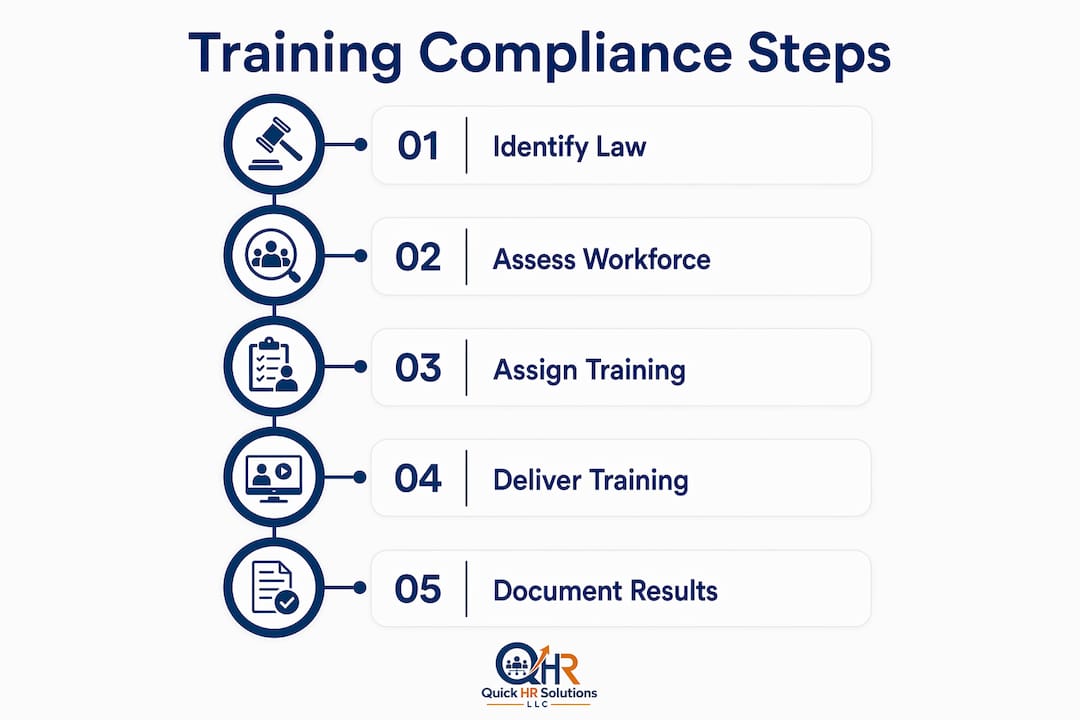
Building a training program that satisfies HR training compliance obligations requires more than purchasing an online course catalog. Here is a structured approach Texas employers can follow.
-
Conduct a training audit. List every employee by location, role, and department. Cross-reference that list against your compliance matrix to identify every applicable training obligation. Flag gaps between what employees have completed and what the law requires.
-
Build an annual training calendar. Assign training events to specific months, accounting for annual renewal requirements like SB 240's violence prevention training and OSHA refreshers tied to specific hazards. A calendar prevents the common mistake of completing training once and never revisiting it.
-
Select training providers and formats. Live instructor-led training works best for supervisor-specific harassment training because it allows scenario-based discussion. Online modules work well for general awareness topics and OSHA hazard communication. Role-specific OSHA training often requires hands-on demonstration, not just a video.
-
Document everything with precision. Proper documentation connecting training to incident response is what defends employers against harassment claims under SB 45. Record who attended, the date, the content covered, and the trainer's credentials. Store records in a system that allows you to pull them quickly during an investigation.
-
Address turnover and onboarding gaps. New hires need training before they encounter the hazards or situations the training covers. Build training into your onboarding checklist with hard deadlines, not optional completion windows.
-
Schedule refresh cycles. OSHA standards specify retraining triggers, such as when an employee demonstrates unsafe behavior or when procedures change. SB 240 requires annual recurrence. Build these triggers into your calendar rather than waiting for an incident to prompt a review.
The table below maps common training types to their frequency and applicable law:
| Training type | Frequency | Governing law |
|---|---|---|
| Harassment prevention (supervisors) | Annual recommended | Texas SB 45 |
| Workplace violence prevention (healthcare) | Annual required | Texas SB 240 |
| Hazard communication | At hire, when new hazards introduced | OSHA 29 CFR 1910.1200 |
| Bloodborne pathogens | Annual | OSHA 29 CFR 1910.1030 |
| HIPAA privacy and security | At hire, annually recommended | Federal HIPAA |
Common mistakes that put Texas employers at risk
Most HR training compliance failures are not the result of ignorance. They are the result of treating training as a one-time administrative task rather than an ongoing legal obligation.
- Skipping harassment training because it is not technically required. Ignoring recommended harassment training significantly raises risk under SB 45. Well-documented remedial training is recognized as appropriate corrective action. Its absence weakens your defense in a claim.
- Forgetting multi-state obligations for remote workers. A Texas employer with five remote employees in different states may face five different sets of required HR courses. Each state's mandate applies to the employee working there, not the employer's home state.
- Treating completion as the finish line. Completing a course is not the same as demonstrating compliance. Defensibility under Texas law requires documented training tied to actual incident corrective steps, not just a certificate of completion sitting in a file.
- Overlooking annual recurrence for healthcare training. Texas healthcare entities often underappreciate the recurring nature of SB 240 training. Annual updates tied to specific facility roles are required, not optional.
- Using generic online modules without customization. A module built for a national audience will not reference Texas Labor Code provisions, SB 45's corrective action standard, or your company's specific reporting procedures. Generic content creates a false sense of compliance.
The most defensible training program is one where every record answers three questions: who received it, what it covered, and how it connects to your response when something goes wrong.
Key takeaways
Texas employers who treat mandatory HR training requirements as a legal obligation tied to documentation, role, and industry will build the strongest compliance posture and the most defensible record when incidents arise.
| Point | Details |
|---|---|
| Federal and Texas law both apply | OSHA, HIPAA, and Title VII requirements layer on top of SB 45 and SB 240 obligations. |
| Training must match role and location | Supervisors, remote workers, and healthcare staff each face distinct required HR courses. |
| Documentation is the real compliance product | Records linking training to corrective action are what protect employers under SB 45. |
| Annual recurrence is not optional | SB 240 healthcare training and most OSHA standards require scheduled refreshers, not one-time completion. |
| Generic modules create false security | Customizing training to Texas law and company policy is what makes it legally defensible. |
What I've learned about Texas HR training after years in the field
After working with dozens of Texas small and mid-sized businesses, the pattern I see most often is not willful neglect. It is a genuine belief that buying an online course library equals compliance. It does not.
SB 45 changed the game in Texas more than most business owners realize. The "immediate and appropriate corrective action" standard it established means your response to a harassment complaint will be evaluated against what you trained your supervisors to do. If your supervisors never received training on how to receive a complaint, document it, and escalate it, your corrective action will look inadequate regardless of what you actually did. That gap is entirely preventable.
The other thing I tell every client is this: your training program is only as strong as your documentation system. I have seen employers who ran excellent training sessions lose legal disputes because they could not produce records. Conversely, I have seen employers with modest training programs successfully defend claims because their records were precise, timestamped, and tied directly to the incident response file.
Texas also sits in an interesting position because it has no state OSHA plan. That means federal OSHA enforces directly, and HR compliance for Texas employers requires staying current with federal standard updates rather than a single state agency's guidance. For multi-hazard industries like construction, manufacturing, and healthcare, that means tracking multiple OSHA standards simultaneously.
My honest recommendation for any Texas business with fewer than 150 employees: do not try to manage this alone. The compliance picture is too fragmented and too consequential. An annual compliance calendar reviewed by someone who tracks Texas legislative changes is worth far more than a subscription to a generic training platform.
— John
How Quickhrtx helps Texas businesses stay training-compliant

Quickhrtx provides fractional HR consulting built specifically for Texas small and mid-sized businesses that need expert HR guidance without a full-time HR department. For mandatory workforce training, that means auditing your current obligations, building a customized training calendar, selecting the right providers, and setting up documentation systems that hold up under scrutiny. Whether you are a Dallas-area manufacturer navigating OSHA topic-specific requirements or a healthcare practice managing SB 240 annual training cycles, Quickhrtx delivers compliance expertise tailored to your workforce. Explore fractional HR services in Dallas or book a free consultation to assess your current training gaps.
FAQ
What HR training is legally required in Texas?
Texas requires annual workplace violence prevention training for healthcare employers under SB 240 and mandates compliance with all applicable federal OSHA standards. Sexual harassment training is strongly recommended under SB 45 but not technically required for private employers.
Does Texas require harassment training for all employees?
Texas does not legally mandate harassment training for private employers, but SB 45's corrective action standard makes documented training a practical necessity for legal defense when claims arise.
How does OSHA training work for Texas employers?
Federal OSHA standards apply directly in Texas because the state has no approved state plan. Training requirements are topic-specific and tied to the hazards employees actually encounter, not a single statewide checklist.
Do remote employees in other states need different training?
Yes. Multi-state compliance requires training based on where the employee works, not where the employer is headquartered. A Texas company with remote staff in California must meet California's harassment training mandates for those workers.
How should employers document HR training for compliance?
Employers should record the employee name, training date, content covered, and trainer credentials, then store those records in a system that links them to any related incident response or corrective action file.