

Cultural fit assessment is a structured method to evaluate how well a candidate's values, behaviors, and work style align with an organization's culture before an offer is made. The cost of a bad hire runs approximately 30% of that employee's first-year earnings. That number makes culture alignment one of the highest-ROI decisions in your hiring process. This article gives HR professionals and hiring managers in small to mid-sized organizations a practical set of cultural fit assessment examples, scoring methods, and common pitfalls to avoid.
1. What are the top cultural fit assessment examples HR teams use?
The best cultural fit assessment examples in hiring share one trait: they measure observable behaviors, not gut feelings. Tools like MyCulture.ai and VisionAlign, combined with structured interviews, give you a repeatable, defensible process. Here are the most effective methods.
Structured behavioral interviews
A standard 45-minute cultural fit interview uses 5–6 consistent questions scored on a 1–5 scale across values alignment, work style, and collaboration. Every candidate answers the same questions. That consistency makes comparison fair and legally defensible.

Values-based screening assessments
Automated platforms like MyCulture.ai map candidate responses to your defined organizational values before the first interview. This pre-screens for alignment and saves your team from spending interview time on candidates who are clearly misaligned.
Situational judgment tests
Situational judgment tests (SJTs) present realistic work scenarios and ask candidates how they would respond. SJTs built on the Big Five personality framework or the Organizational Culture Assessment Instrument (OCAI) have documented selection validity. They measure judgment and decision-making in context, not abstract personality traits.
Work sample and trial tasks
A short paid work sample gives you direct evidence of how a candidate operates. You see their communication style, how they handle ambiguity, and whether their approach matches your team's norms. This method works especially well for remote or project-based roles.
Reference checks with culture-specific questions
Most reference checks focus on skills. A culture-focused reference check asks former managers about the candidate's behavior under pressure, how they handled disagreement, and whether they thrived in a similar environment. These questions surface patterns that interviews miss.
Panel interviews with culture representatives
A panel that includes peers, not just managers, gives candidates a realistic view of your culture. It also gives your team multiple data points on fit. Assign each panelist a specific dimension to assess so you avoid redundant questions and cover more ground.
Pro Tip: Follow the 6-step assessment process: profile your team culture, translate values into observable behaviors, choose a validated framework, score candidates, combine scores, and recalibrate after each hire cycle.
Avoid non-validated personality tests like MBTI and DISC for formal hiring decisions. Neither tool has sufficient selection validity for predicting job performance or culture alignment.
2. How to design and score cultural fit interviews using scenario-based questions
Scenario-based questions are the most reliable format for assessing cultural compatibility in an interview. They force candidates to describe real behavior rather than recite rehearsed answers. VisionAlign recommends measuring five dimensions: judgment, communication, ownership, mission alignment, and operating fit.
Here is a practical set of scenario-based cultural fit interview questions organized by dimension:
- Judgment: "Tell me about a time you disagreed with a decision your manager made close to a deadline. What did you do?"
- Communication: "Describe a situation where you had to deliver difficult feedback to a colleague. How did you approach it?"
- Ownership: "Walk me through a project that went off track. What was your role in fixing it?"
- Mission alignment: "What drew you to this organization specifically? What about our mission resonates with your own goals?"
- Operating fit: "Describe the work environment where you do your best work. What conditions slow you down?"
- Ethical judgment: "Tell me about a time you were asked to do something that felt wrong. What did you do?"
Ask every candidate the same six questions in the same order. Consistency is not just good practice. It is your legal protection against discrimination claims.
Pro Tip: Build a simple scoring rubric before interviews start. Define what a score of 1, 3, and 5 looks like for each question. Interviewers who score independently before comparing notes produce more reliable results.
Score each answer immediately after the candidate responds, not at the end of the interview. Memory degrades fast. A structured scoring rubric reduces the influence of likeability bias and keeps your evaluation grounded in observable evidence. After scoring, average the panel's scores per dimension and flag any dimension where scores diverge by more than two points. That gap signals a conversation worth having before you make a decision.
3. Automated vs. manual cultural fit assessments: which works better?
Automated and manual assessments serve different stages of the hiring funnel. Neither replaces the other. The question is where each adds the most value.
| Factor | Automated tools | Manual interviews |
|---|---|---|
| Speed | Pre-screens hundreds of candidates quickly | Time-intensive per candidate |
| Consistency | Applies identical criteria every time | Varies by interviewer skill |
| Depth | Captures stated values and preferences | Reveals nuance, tone, and judgment |
| Bias risk | Reduces likeability bias | Higher risk without structured rubrics |
| Cost | Subscription cost, lower per-candidate cost | Higher recruiter time investment |
| Best use | Top-of-funnel screening | Final-round culture evaluation |
IKEA uses automated values-based screening paired with trained cultural interviewers to scale 51,000 hires annually. That model works because automation handles volume and human judgment handles depth.
For small to mid-sized businesses in Texas, the practical approach is this: use an automated tool like MyCulture.ai or VisionAlign to filter the top of your funnel. Reserve your structured panel interviews for the final two or three candidates per role. This protects recruiter time without sacrificing the quality of your culture evaluation.
- Automated tools work best when your values are clearly defined and documented.
- Manual interviews work best when you need to assess judgment, nuance, and mission pull.
- Blending both gives you speed at the top and depth at the bottom of the funnel.
Values-based screening early in the funnel prevents wasting interview resources on candidates who are clearly misaligned. That efficiency matters most when your hiring team is small.
4. Common mistakes and biases in cultural fit assessments
The most common failure in culture fit evaluation is confusing "fits our culture" with "reminds me of us." That instinct produces clones, not culture. Cloning current team members as a culture fit leads to groupthink and weakens the team's ability to solve new problems.
Watch for these specific errors:
- Likeability bias: Scoring candidates higher because they are easy to talk to, not because their values align.
- Affinity bias: Favoring candidates who share your background, communication style, or interests.
- Vague criteria: Using phrases like "culture add" or "good energy" without defining what those mean in behavioral terms.
- Skipping recalibration: Running the same assessment criteria for years without checking whether they still reflect your actual culture.
"High-retention organizations reject candidates who don't provoke a 'hell yes' cultural alignment feeling, even when their technical qualifications are strong."
That standard sounds harsh. It is actually protective. A technically strong hire who misaligns on values creates friction that costs far more than a longer search. Assessing cultural compatibility means measuring whether a candidate can thrive within your operating realities, not whether you would enjoy having lunch with them.
The fix for most of these errors is the same: define your values as observable behaviors before you open a role. "We value transparency" is not a hiring criterion. "Candidates proactively share bad news with their manager before being asked" is. That specificity makes scoring possible and bias much harder to hide.
Values are intrinsic and non-teachable, which is why values-based screening must happen early. You cannot train someone to care about accountability. You can only hire people who already do.
Interviewers also need authority to act on their assessment. Treating values interviews as genuine gates, not formalities, means giving interviewers the standing to reject even technically strong candidates who lack alignment. Without that authority, the process is theater.
Key takeaways
Effective cultural fit assessments combine validated frameworks, structured scoring, and early-funnel automation to produce hiring decisions grounded in observable behavior rather than instinct.
| Point | Details |
|---|---|
| Define values as behaviors | Convert abstract values into specific, observable actions before opening any role. |
| Use validated frameworks | Choose SJTs, OCAI, or structured interviews over MBTI or DISC for hiring decisions. |
| Score immediately and independently | Interviewers should score right after each answer, before comparing notes with the panel. |
| Automate the top of the funnel | Use tools like MyCulture.ai or VisionAlign to pre-screen for alignment before interviews. |
| Recalibrate after each cycle | Review your criteria against retention data to keep assessments accurate over time. |
What I've learned about cultural fit assessments in small businesses
Most small to mid-sized businesses in Texas treat cultural fit as a final-round gut check. That is backwards. By the time a candidate reaches the final round, you have already invested hours of recruiter and manager time. Running a values screen at that stage is like checking the foundation after you have already built the walls.
The organizations I have seen hire well do one thing differently. They define their culture in writing before they post a job. Not a values poster on the wall. An actual document that says: here is how we make decisions, here is how we handle conflict, here is what we expect when things go wrong. That document becomes the basis for every interview question and every scoring rubric.
The second shift is treating interviewers as gatekeepers, not guides. A lot of hiring managers feel uncomfortable rejecting a technically strong candidate on culture grounds. They worry about seeming subjective. But subjectivity is the problem you are solving with a structured rubric. When you have a score sheet and defined criteria, a culture-based rejection is just as defensible as a skills-based one. Check out the building company culture guide for a practical framework to document your culture before your next hire cycle.
The third thing I would tell any HR manager running this process: plan the onboarding before you make the offer. A 30-60-90 day culture onboarding plan with written culture documents, a culture buddy, and structured check-ins turns a good culture hire into an integrated team member. Without it, even the best culture fit can drift.
— John
How Quickhrtx helps you build a better hiring process
Hiring for culture fit is not a one-time project. It requires defined values, trained interviewers, validated tools, and a scoring process that holds up over time. For small to mid-sized businesses in Texas, building that infrastructure from scratch is a significant lift without dedicated HR support.
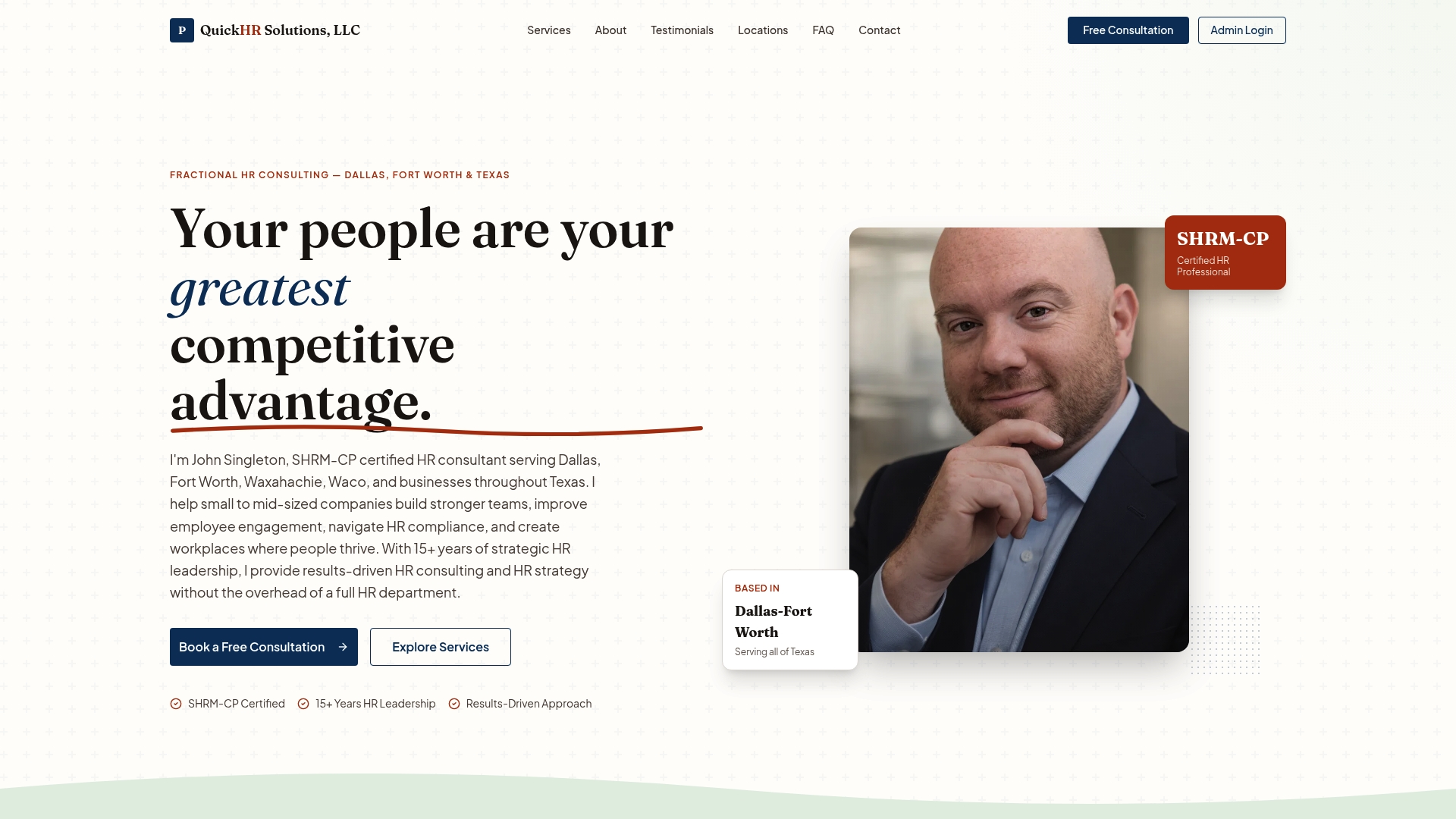
Quickhrtx provides fractional HR consulting tailored to organizations that need structured hiring processes without the overhead of a full internal HR department. From designing your culture profile to training your interview panel and selecting the right assessment tools, Quickhrtx builds the system with you. If your hiring process relies on instinct more than structure, that is the gap worth closing first. Book a free consultation to see where your current process stands.
FAQ
What is a cultural fit assessment in hiring?
A cultural fit assessment is a structured method to evaluate whether a candidate's values, behaviors, and work style align with an organization's culture. Common formats include structured interviews, situational judgment tests, and automated values-based screening tools.
How do you score cultural fit interviews objectively?
Use a written scoring rubric that defines what a strong, average, and weak answer looks like for each question. Score each candidate independently and immediately after their response, then compare scores across the panel.
Are MBTI and DISC valid for hiring decisions?
MBTI and DISC lack sufficient selection validity for formal hiring decisions. Validated alternatives include situational judgment tests built on the Big Five framework or the OCAI, which have stronger evidence for predicting job performance.
How early in the hiring funnel should culture fit be assessed?
Values-based screening should happen at the top of the funnel, before the first interview. Values are intrinsic and non-teachable, so filtering for alignment early protects recruiter time and improves interview quality.
What is the difference between cultural fit and cultural add?
Cultural fit measures alignment with existing values and operating norms. Cultural add measures whether a candidate brings new perspectives that strengthen the team without conflicting with core values. Both are valid criteria, but both require behavioral definitions to be scored fairly.