

The first employee hiring process is the structured sequence of steps a business owner takes to legally and effectively bring on their initial staff member, covering readiness assessment, legal registration, candidate selection, and onboarding. For Texas entrepreneurs, this process involves federal requirements from the IRS, state obligations through the Texas Workforce Commission, and a series of decisions that directly affect your business's long-term stability. Get it right, and you build a foundation for growth. Get it wrong, and you face compliance fines, wasted salary, and early turnover. The complete process from recognizing the need to having a productive employee typically takes 4 to 5 months, with active candidate search running 3 to 6 weeks inside that window.
What does the first employee hiring process actually involve?
Hiring and recruiting are not the same thing. Recruiting is proactive pipeline building; hiring is the reactive act of filling a defined role when a ready candidate exists. Texas entrepreneurs often confuse the two and start posting job ads before they have defined what the role actually requires. That confusion is where most first-hire mistakes begin.
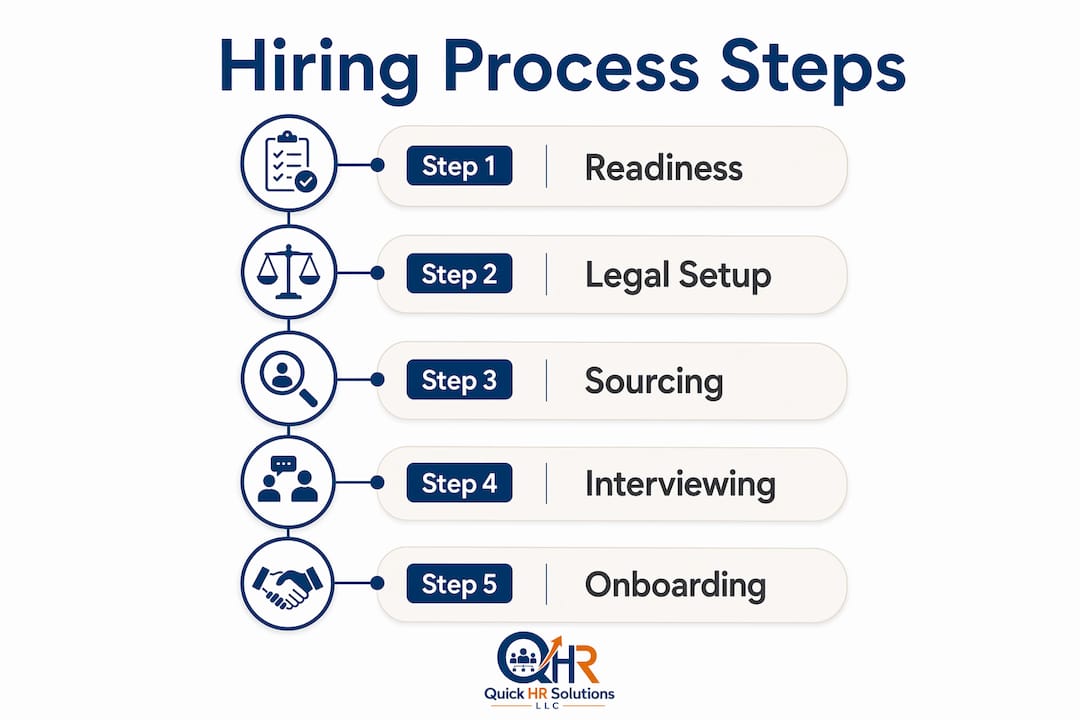
The full process covers five distinct stages: readiness assessment, legal and administrative setup, candidate sourcing and selection, offer and acceptance, and onboarding. Each stage has its own deadlines, documents, and decision points. Skipping or rushing any one of them creates problems that compound over time. The founder HR responsibilities checklist from Quickhrtx maps these stages clearly for entrepreneurs who are starting from zero.

How do you know when you are ready to hire your first employee in Texas?
Readiness is financial and operational. On the financial side, you need either 12 months of runway or stable revenue that covers at least 6 months of the new hire's salary. On the operational side, the role is justified when a specific function is consuming 15 or more hours per week of your time and pulling you away from work only you can do.
The clearest test of readiness is role definition. You are not ready to hire until you can write down concrete, measurable 90-day deliverables for the position. "Help with operations" is not a deliverable. "Process 50 client invoices per week with zero errors by day 60" is. Hiring without that clarity wastes your investment and sets the new employee up to fail.
Watch for these readiness signals before you post a single job listing:
- You spend more than 60% of your time on tasks someone else could handle
- A specific function is bottlenecking revenue or client delivery
- You can define 5 to 7 core responsibilities with measurable outcomes
- You have documented processes the new hire can follow from day one
- Your cash flow supports salary plus payroll taxes and benefits for at least 6 months
Pro Tip: Write the 90-day success plan before you write the job description. If you cannot define what success looks like in the first three months, you are not ready to hire.
Premature hiring with vague expectations is one of the most expensive mistakes a Texas entrepreneur can make. The first-year cost of a bad hire runs between 112% and 125% of that employee's base salary when you factor in recruiting, training, and lost productivity.
What legal steps must you complete before your first hire's start date in Texas?
Legal compliance is not optional, and the deadlines are tight. Texas does not have a state income tax, but employers still carry significant registration obligations before the first paycheck clears.
Complete these steps in order before your new hire's first day:
- Obtain your Employer Identification Number (EIN) from the IRS. This is your federal tax ID and is required for payroll, tax filings, and opening a business bank account.
- Register with the Texas Workforce Commission (TWC) for State Unemployment Tax Act (SUTA) obligations. Texas employers pay unemployment taxes on wages up to the taxable wage base each year.
- Secure workers' compensation insurance. Texas is the only state where workers' comp is not legally mandatory for most private employers, but carrying it protects you from personal liability in workplace injury lawsuits.
- Collect a signed Form W-4 from your new hire before the first paycheck. This determines federal income tax withholding.
- Complete Form I-9 employment eligibility verification. The employee must complete Section 1 on day one. You must complete Section 2 within three business days of the start date.
- Report the new hire to the Texas Attorney General's office within 20 days of the hire date. Federal law mandates this for child support enforcement purposes.
| Document | Who Completes It | Deadline |
|---|---|---|
| Form W-4 | Employee | Before first paycheck |
| Form I-9, Section 1 | Employee | Day 1 |
| Form I-9, Section 2 | Employer | Within 3 business days |
| New hire report | Employer | Within 20 days of hire |
| EIN application | Employer | Before first payroll |
Pro Tip: Set up a dedicated digital folder for each employee's compliance documents from day one. The Texas Workforce Commission and IRS can audit records going back several years, and disorganized files cost you time and legal fees.
Texas-specific HR compliance requirements carry real penalties for missed deadlines. Employers who skip the new hire reporting requirement face fines, and I-9 violations can result in federal civil penalties per form. Getting these right the first time is far cheaper than correcting them later.
How do you find and select the right candidate for your first role?
The job description is your first filter. A weak description attracts the wrong applicants and wastes weeks of your time. Write a description that lists 5 to 7 core responsibilities, states the required qualifications clearly, and includes the success metrics you defined in your 90-day plan. Avoid vague language like "team player" or "self-starter." Describe the actual work.
Building your candidate pool
Reactive hiring, posting a job and waiting, fills roles slowly and with whoever happens to apply. Proactive recruiting builds a pipeline of qualified candidates before the need becomes urgent. For a first hire, your pipeline can be as simple as telling five trusted professional contacts what you are looking for and why. LinkedIn, industry-specific job boards, and local Texas professional associations are practical sourcing channels that cost little or nothing.
Screening and interviewing with structure
Gut-based hiring is the single most common mistake first-time employers make. A candidate who interviews well is not necessarily the right person for the job. Structured interviews using behavioral questions mapped to 5 to 7 core competencies, scored on a 1 to 4 scale, reduce bias and produce defensible hiring decisions. Every interviewer uses the same questions. Every answer gets scored the same way. The scorecard documents your reasoning if a hiring decision is ever challenged.
Run your screening process in these stages:
- Phone screen (15 to 20 minutes): Confirm basic qualifications, compensation expectations, and availability
- Structured interview (45 to 60 minutes): Behavioral questions tied to competencies, scored with a rubric
- Practical assessment: A short, relevant work sample that mirrors actual job tasks
- Reference checks: Call at least two former managers, not just colleagues
Pro Tip: Ask every reference the same closing question: "Would you rehire this person without hesitation?" The pause before the answer tells you as much as the words that follow.
For evidence-based candidate selection, map each behavioral question to a specific competency before the interview begins. This prevents interviewers from asking whatever comes to mind and comparing incompatible answers afterward.
How do you onboard your first employee to maximize retention and productivity?
Structured onboarding is not administrative paperwork. It is the single highest-return investment you make after the hire decision. Onboarding programs improve new hire retention by 82% and productivity by over 70% when phased across 90 days. That number reflects the difference between an employee who stays and performs versus one who leaves within the first two months.
The 90-day onboarding plan runs in three phases:
- Week 1: Logistics and orientation. Set up equipment, complete all compliance paperwork, introduce the team, and walk through company culture and expectations. The goal is comfort and clarity, not output.
- Weeks 2 through 4: Role-specific training. Cover systems, processes, and tools. Assign real tasks with close supervision. Document every process the employee will own.
- Months 2 and 3: Independent work with check-ins. The employee takes ownership of their responsibilities. Weekly one-on-ones with you catch problems early and reinforce expectations.
Skipping structured onboarding causes 20% of new hires to leave within 45 days. That attrition wastes the full cost of recruiting, training, and lost productivity from the search process. Many founders focus entirely on finding the right candidate and then treat onboarding as an afterthought. That is the mistake that turns a good hire into an expensive turnover statistic.
Assign an onboarding buddy, a peer rather than a manager, to answer day-to-day questions. New employees ask their buddy questions they would hesitate to bring to you. That approachable support accelerates comfort and productivity faster than any formal training program alone.
Pro Tip: Schedule a 30-day, 60-day, and 90-day check-in on your calendar before the employee's first day. Waiting until problems surface is too late. Proactive check-ins catch misalignment while it is still easy to fix.
For retention strategies that extend beyond the first 90 days, the same principles apply: clear expectations, regular feedback, and documented processes that give employees the tools to succeed independently.
Key takeaways
A structured first employee hiring process, covering readiness, legal compliance, candidate selection, and phased onboarding, is the most reliable way to protect your investment and build a productive team.
| Point | Details |
|---|---|
| Define readiness before posting | Hire only when a role consumes 15+ hours per week and you can write 90-day deliverables. |
| Complete legal steps before day one | Secure your EIN, register with the Texas Workforce Commission, and file Form I-9 within three business days. |
| Use structured interviews | Score behavioral questions on a 1–4 rubric to reduce bias and document your hiring rationale. |
| Invest in 90-day onboarding | Phased onboarding improves retention by 82% and productivity by over 70%. |
| Report new hires within 20 days | Federal law requires new hire reporting to the state within 20 days of the start date. |
What I have learned working with Texas entrepreneurs on their first hires
Most founders I work with underestimate how much the hiring decision itself costs them when they get it wrong. They spend weeks interviewing, make an offer based on a good conversation, and then wonder why the person is not performing at 60 days. The answer is almost always one of two things: the role was not defined clearly enough before the search started, or the onboarding was treated as a one-day orientation rather than a 90-day investment.
The structured interview scorecard feels bureaucratic to entrepreneurs who pride themselves on reading people. I get it. But gut-based hiring at the first-employee stage is genuinely risky. You have no HR infrastructure to catch problems early, no team culture to absorb a bad fit, and no budget to absorb the cost of starting over. The scorecard is not about distrust. It is about giving yourself a defensible record of why you made the decision you made.
Texas-specific compliance is the other area where I see founders get burned. The I-9 deadline, the new hire reporting requirement, and the workers' compensation decision are not things you want to figure out after the fact. The penalties are real, and retroactive corrections are expensive. Getting a fractional HR partner involved before the first hire, not after the first problem, is the move that saves you money in the long run.
The best first hires I have seen come from founders who treated the process like a project: defined scope, clear deliverables, documented steps, and a plan for what success looks like at 30, 60, and 90 days. That discipline is not natural for most entrepreneurs, but it is learnable. And it makes every subsequent hire easier.
— John
How Quickhrtx supports Texas entrepreneurs through their first hire
Hiring your first employee is one of the highest-stakes decisions you will make as a business owner. Quickhrtx provides fractional HR consulting for small and mid-sized businesses across Texas, with deep expertise in Dallas-Fort Worth employment compliance, structured hiring processes, and 90-day onboarding systems.

Quickhrtx holds SHRM-CP and SHRM-CPC certifications and works directly with founders who need expert HR guidance without the cost of a full-time HR department. From EIN registration and Texas Workforce Commission setup to building your interview scorecard and onboarding plan, Quickhrtx handles the process so you can focus on running your business. Entrepreneurs in the Dallas area can access localized fractional HR support built specifically for businesses at the first-hire stage. Book a free consultation to get started.
FAQ
How long does hiring your first employee take?
The complete process from recognizing the need to having a productive employee typically takes 4 to 5 months, with active candidate search running 3 to 6 weeks inside that window.
What forms are required before a new hire's first day in Texas?
Employers must have a signed Form W-4 on file before the first paycheck. The employee completes Form I-9 Section 1 on day one, and the employer must complete Section 2 within three business days of the start date.
When must Texas employers report a new hire to the state?
Federal law requires employers to report new hires to the Texas Attorney General's office within 20 days of the hire date. This applies to all employers regardless of company size.
What is the biggest mistake first-time employers make during onboarding?
Skipping structured onboarding is the most costly mistake. Twenty percent of new hires leave within 45 days when onboarding is neglected, wasting a first-year investment that can reach 112% to 125% of the employee's base salary.
Do Texas employers have to carry workers' compensation insurance?
Texas is the only state where workers' compensation insurance is not legally required for most private employers. Carrying it is still strongly advisable because it protects you from direct personal liability in workplace injury lawsuits.