

Documenting startup HR decisions is the single most reliable way to protect your company from lawsuits, retain top talent, and build the kind of organizational trust that attracts serious investors. Founders who skip this practice do not just risk legal exposure. They lose institutional knowledge, create inconsistent management, and signal to employees that fairness is optional. This guide explains why document startup HR decisions matters at every growth stage, which records to prioritize from day one, and how Texas founders can build a documentation habit without drowning in paperwork.
What are the key HR decisions startups need to document from day one?
HR documentation is the formal practice of recording employment decisions, policies, and performance events in writing. Every Texas startup needs this foundation before problems arise, not after.
The decisions that cause the most damage when undocumented are also the most common early-stage choices. These include:
- Employment contracts and offer letters: Every hire should receive a written offer that specifies role, compensation, and at-will employment status under Texas law.
- Compensation structures: Undocumented pay decisions create serious risk. Compensation disparities of 30% or more for the same work damage employee trust and drive turnover. A written pay band policy prevents this.
- Confidentiality and non-disclosure agreements: Especially critical for Texas tech and energy startups where IP protection is non-negotiable.
- Hiring rationales: Write down why you selected a candidate. This protects you in discrimination claims and builds a consistent culture.
- Performance check-in records: Structured 30–60 minute check-ins focused on specific progress are the standard for effective ongoing performance management. Document the date, topics covered, and any agreed action items.
- Culture and values statements: A written culture statement is not a feel-good exercise. It is a reference point for every future hiring and conduct decision.
Pro Tip: Keep early documentation founder-proximate. A two-page offer letter and a one-page culture statement beat a 40-page employee handbook that nobody reads.
Texas startups also need to document compliance with state-specific requirements. Texas follows federal employment law but has its own rules around final pay timing, workers' compensation, and unemployment insurance. Documenting your compliance decisions from the start is far cheaper than reconstructing them during an audit.

How does documenting HR decisions benefit startups legally and operationally?
The legal case for documentation is direct. Every lawsuit, audit, or mediation eventually comes down to one question: what does the file say? Attorney Lee Jacobs makes this point clearly, and it reflects what HR professionals see in practice every day.
"In disputes, what the personnel file shows matters more than policies or memories. A well-documented file is a company's strongest defense." — Lee Jacobs, Jacobs Legal
The operational benefits are equally real. Here is how documentation pays off across four areas:
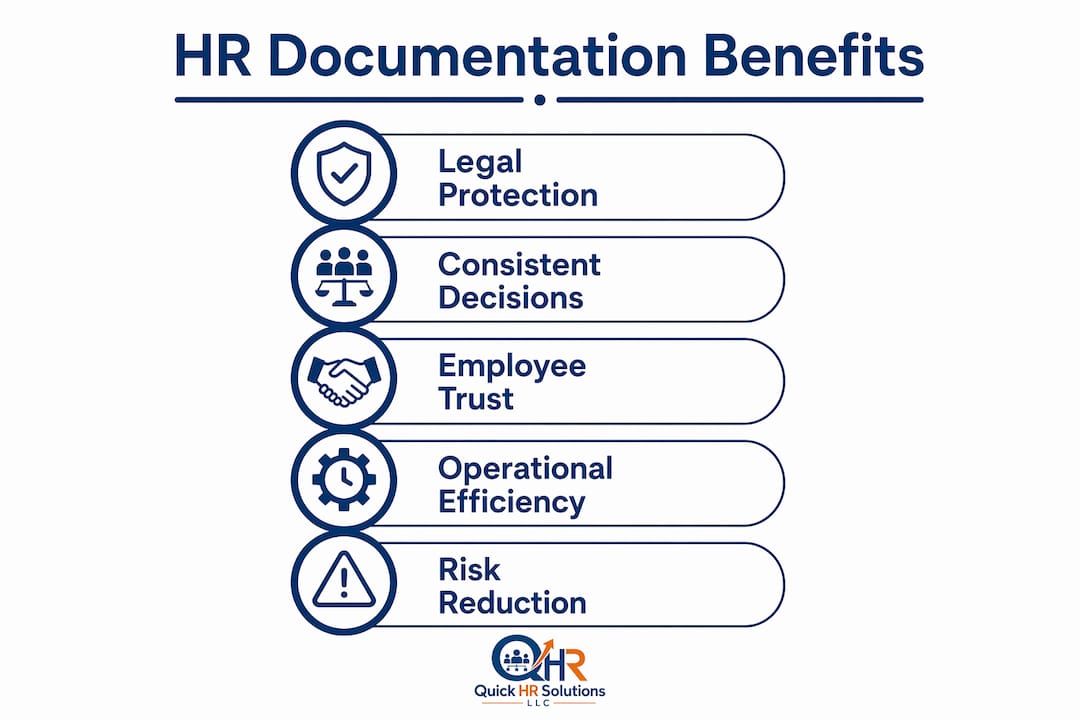
- Legal defense: A written record of coaching conversations, performance warnings, and policy acknowledgments gives you concrete evidence in wrongful termination or discrimination claims. Without it, your word against an employee's word is a coin flip.
- Manager development: When managers document their coaching conversations, they become better coaches. The act of writing forces clarity. Vague feedback becomes specific. Promises become trackable commitments.
- Employee trust: Transparent documentation signals that decisions are based on facts, not favoritism. Employees who see consistent, written policies are more likely to trust leadership and stay longer.
- Investor confidence: Startups that build strong HR foundations early receive better investor confidence and easier scaling paths. A clean HR file room tells investors that your operations are under control.
The benefits of proactive HR compliance go beyond avoiding fines. They create a management culture where decisions are defensible, consistent, and fair. That culture compounds over time into a genuine competitive advantage for Texas startups competing for talent in markets like Dallas-Fort Worth and Austin.
How to document HR decisions effectively without creating bureaucracy?
Effective documentation does not require a dedicated HR team or expensive software. It requires discipline and a clear standard for what to write down and how.
The most important rule is to use factual, neutral language. Small business HR documentation should use strictly factual, unemotional language so that a neutral third party unfamiliar with your company can understand the record clearly. "Employee arrived 45 minutes late on three consecutive Mondays" is documentation. "Employee has a bad attitude about schedules" is not.
A second rule: document both good and bad performance. Personnel files that reflect only negative events appear to be case-building rather than genuine management records. Include positive performance notes, promotions, and commendations alongside warnings and corrective actions. This creates a complete, credible narrative.
Pro Tip: After any coaching conversation, send a quick follow-up email to the employee summarizing the issue discussed, what the employee acknowledged, and the agreed action plan. A 30-second email summary of a coaching conversation can prevent costly litigation. Save that email to the employee's personnel file.
Common pitfalls to avoid:
- Copying generic policies from the internet: A policy that does not match your actual practices is worse than no policy. Courts look at what you actually do, not what your handbook says.
- Skipping documentation during busy growth phases: Delaying documentation until urgent problems arise greatly increases risk and cost. The time to build the habit is before you need it.
- Using emotional or subjective language: Phrases like "difficult personality" or "not a culture fit" without factual support create discrimination liability, not protection.
- Storing records inconsistently: Personnel files should be centralized, access-controlled, and retained according to federal and Texas record-keeping requirements.
For most early-stage Texas startups, a shared secure folder system like Google Drive with restricted access is a workable starting point. The goal is consistency, not complexity. You can review HR risk management strategies to understand which documentation gaps create the highest legal exposure as you grow.
When should Texas startups scale their HR documentation efforts?
Documentation needs grow with headcount, and the thresholds are more specific than most founders expect.
| Headcount | Required HR action |
|---|---|
| 1–4 employees | Offer letters, basic confidentiality agreements, Texas-compliant pay practices |
| 5+ employees | Formal HR systems required, including a written employee handbook and documented performance processes |
| 15+ employees | Dedicated HR function or consultant required; EEOC and ADA compliance documentation becomes mandatory |
| 50+ employees | FMLA documentation requirements apply; formal compensation bands and promotion criteria needed |
The jump from informal to formal is where most Texas startups get hurt. A founder who managed five employees by memory cannot manage fifteen that way. The institutional knowledge that lived in one person's head becomes a liability the moment that person is unavailable or the company faces a dispute.
Founder-proximate HR strategies that are concise maintain startup culture far better than formal policies copied from larger companies. The goal at each stage is to add just enough structure to protect the business without killing the agility that makes startups competitive.
Fractional HR consulting is the right solution for most Texas startups between 5 and 50 employees. A fractional HR consultant brings SHRM-certified expertise without the cost of a full-time hire. They can build your documentation framework, train your managers, and keep you compliant with Texas-specific requirements as you scale. Startups that have worked with professional HR advisors, including those supported through PEO partnerships, consistently report faster compliance readiness and fewer costly disputes. You can also use the founder HR responsibilities checklist to assess where your current documentation stands before bringing in outside help.
Key Takeaways
Documenting startup HR decisions from day one is the most cost-effective way to protect your business legally, build employee trust, and scale with confidence.
| Point | Details |
|---|---|
| Start documentation at hire one | Offer letters, pay structures, and confidentiality agreements must be written before problems arise. |
| Use factual, neutral language | Records must be clear to a neutral third party, not just to insiders familiar with your company. |
| Document both good and bad performance | A complete personnel file is more credible and more defensible than a file full of only warnings. |
| Scale your HR systems with headcount | Formal HR systems are required at 5+ employees; a dedicated HR function is needed at 15+. |
| A quick email can save thousands | A short follow-up email after a coaching conversation serves as strong contemporaneous legal evidence. |
What I've learned about founders who skip HR documentation
Most founders I work with do not skip documentation because they are careless. They skip it because they genuinely believe they will remember what happened and why. That belief is the most expensive mistake in early-stage HR.
Memory is not a personnel file. When a former employee files a complaint six months after termination, the details that felt obvious at the time become genuinely murky. What exactly was said in that performance conversation? Was the employee warned once or three times? Was the pay decision based on market data or a gut call? Without written records, you cannot answer those questions with confidence, and your legal exposure grows with every gap.
What I have seen work, consistently, is treating documentation as a communication habit rather than a compliance chore. When managers write a quick email after a difficult conversation, they are not just protecting the company. They are clarifying their own thinking, giving the employee a fair record of what was discussed, and creating a paper trail that reflects genuine management. That habit, built early, changes how a team operates.
Texas startups face a specific challenge here. The Dallas-Fort Worth market is competitive for talent, and founders are often managing rapid growth with thin teams. Documentation feels like overhead when you are moving fast. But the startups I have seen scale cleanly are the ones that built the documentation habit at five employees, not fifty. They did not wait for a lawsuit to teach them the lesson.
The uncomfortable truth is that good HR documentation is not about distrust. It is about respect. It tells your employees that decisions about their careers are made carefully, recorded honestly, and applied consistently. That is the kind of workplace people stay in.
— John
How Quickhrtx helps Texas startups build HR documentation that holds up
Texas startup founders should not have to choose between moving fast and staying compliant. Quickhrtx provides fractional HR consulting in Dallas tailored specifically to early-stage and growing businesses across the Dallas-Fort Worth area and beyond.
Quickhrtx builds the documentation frameworks, employee handbooks, performance management processes, and compliance systems that protect your business at every growth stage. The team holds SHRM-CP and SHRM-CPC certifications, which means you get expert-level HR strategy without the overhead of a full-time hire. Whether you are onboarding your fifth employee or preparing for a Series A, Quickhrtx HR solutions give you the structure to scale with confidence. Book a free consultation to find out exactly where your documentation gaps are before they become costly problems.
FAQ
Why is HR documentation critical for startups?
HR documentation protects startups from lawsuits, ensures consistent management decisions, and builds the employee trust needed for retention and growth. Without written records, disputes become a matter of competing memories rather than verifiable facts.
What HR documents should a Texas startup create first?
Start with offer letters, compensation structures, confidentiality agreements, and a basic employee handbook that reflects Texas at-will employment rules. These four documents cover the highest-risk areas for early-stage companies.
How detailed does HR documentation need to be?
Documentation should be factual, neutral, and clear to an outside reader, but it does not need to be lengthy. A two-page offer letter and a short email summary of a coaching conversation are both valid, defensible records.
When does a Texas startup need a dedicated HR function?
Startups with 15 or more employees need a dedicated HR function or a qualified consultant to manage compliance, documentation, and performance management at that scale. Waiting until a problem forces the issue is significantly more expensive than planning ahead.
Can a fractional HR consultant help with documentation?
A fractional HR consultant can build your entire documentation framework, train your managers, and keep your records compliant with Texas and federal requirements, all without the cost of a full-time HR hire.