

Most HR professionals assume HIPAA is primarily a healthcare issue. That assumption creates real legal exposure. Understanding what does HIPAA mean in HR context is not optional for anyone who handles employee benefits, wellness programs, or self-insured health plans. The law draws a precise line between your role as an employer and your role as a health plan administrator, and crossing that line without knowing it is exactly how organizations end up with corrective action plans and six-figure fines. This guide gives you the clarity to operate on the right side of that line.
Table of Contents
- Key takeaways
- What does HIPAA mean in HR context
- When HIPAA actually applies to your HR department
- Essential compliance requirements for HR
- Common HIPAA myths HR professionals still believe
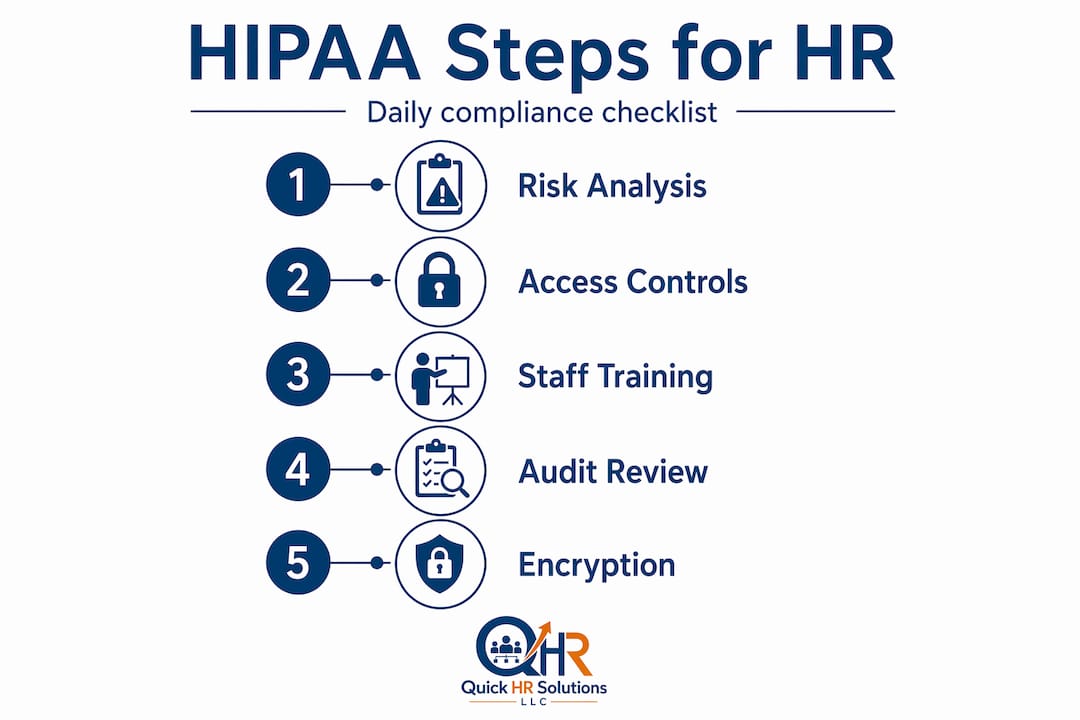
- Practical steps to manage HIPAA compliance daily
- My take on HIPAA's real impact on HR
- How Quickhrtx can help you get compliant
- FAQ
Key takeaways
| Point | Details |
|---|---|
| Employers aren't automatically covered | HIPAA applies to your organization only when you act as a group health plan sponsor or administrator. |
| PHI and employment records differ | Medical info kept in employment files is not PHI under HIPAA, but mishandling it still carries legal risk. |
| Firewalls protect your HR team | Segregating plan PHI from general HR records is a legal requirement, not just a best practice. |
| Vendors need BAAs | Any third-party handling plan PHI must sign a Business Associate Agreement before they touch that data. |
| 2026 brought new notice rules | Notices of Privacy Practices must now address 42 CFR Part 2 substance use disorder records by February 2026. |
What does HIPAA mean in HR context
The Health Insurance Portability and Accountability Act became law in 1996, originally designed to protect workers' health coverage when changing jobs and to standardize electronic health data. Over time, its Privacy Rule and Security Rule became the most consequential parts for HR professionals.
The Privacy Rule governs how Protected Health Information (PHI) can be used and disclosed. PHI is any individually identifiable health information held or transmitted by a covered entity, including names, diagnoses, treatment records, and even payment history tied to healthcare. The Security Rule applies specifically to electronic PHI (ePHI) and mandates technical, physical, and administrative safeguards to prevent unauthorized access.
Here is where HR professionals often get confused. Covered entities under HIPAA are health plans, healthcare clearinghouses, and healthcare providers. Employers, as standalone entities, are not covered entities by default. HIPAA applies to employers only when they act as group health plan sponsors or administrators handling PHI.
A few terms worth knowing before you go further:
- Protected Health Information (PHI): Any health data that could identify an individual, held by a covered entity or its business associate.
- Business Associate: A vendor or contractor who handles PHI on behalf of a covered entity.
- Minimum Necessary Standard: The rule requiring covered entities to access, use, or disclose only the PHI needed for the task at hand.
- Notice of Privacy Practices (NPP): A document health plans must provide informing individuals of their privacy rights.
Organizations must also note that NPP updates were required by February 16, 2026 to address 42 CFR Part 2 confidentiality rules for substance use disorder records. If your health plan has not updated its notice, that is an immediate compliance gap.
Pro Tip: Review your health plan's Notice of Privacy Practices now. If it doesn't reference 42 CFR Part 2 substance use disorder protections, contact your plan administrator or TPA to update it before your next open enrollment.
When HIPAA actually applies to your HR department
This is the section that changes how most HR professionals think about their daily work. The critical distinction is not whether your organization has health benefits. It is what role you play when you handle health information.

When you act as an employer collecting a sick note for payroll purposes, HIPAA does not govern that transaction. When you act as the administrator of a self-insured group health plan and you access an employee's insurance claim data, HIPAA does apply. The key distinction between employer and plan administrator roles determines your entire HIPAA obligation.
Here are the most common HR situations and whether HIPAA governs them:
- Requesting a doctor's note for FMLA leave: Not governed by HIPAA. The note becomes an employment record.
- Administering an ADA accommodation with medical documentation: Not governed by HIPAA. Maintain it in a separate confidential file per ADA requirements.
- Accessing employee claims data from a self-insured health plan: Governed by HIPAA. This is PHI accessed through your health plan administrator role.
- Managing an employer-sponsored wellness program that collects health screenings: Governed by HIPAA if the program is part of the group health plan.
- Receiving a disability or workers' comp report: Generally not HIPAA, but state laws and ADA confidentiality rules still apply.
Many mid-sized employers operate as what the law calls "hybrid entities." That means one organization functions both as an employer and as a health plan sponsor. In this case, firewalls and minimum necessary standards are required to separate the HR staff members with PHI access from those who handle general employment matters.
Pro Tip: If your HR team has any staff member who touches both benefits administration and general employment decisions, you need a documented firewall policy. Without it, you're treating your hybrid entity like a single-function organization, which creates compliance exposure.
A striking data point: a single enforcement action in April 2026 resulted in a $245,000 fine and a two-year corrective action plan against an organization managing group health plans. The consequences of treating HIPAA as an abstract compliance checkbox are not theoretical.
Essential compliance requirements for HR
If you have confirmed your organization handles PHI through a health plan role, these are the requirements that govern how your HR department must operate.
-
Implement role-based access control. Only HR staff with a specific need to access plan PHI should have that access. This reflects the minimum necessary standard and must be documented and enforced through your systems.
-
Segregate plan PHI from employment records. Claim data, plan enrollment records, and any PHI received through your health plan administration function must be stored separately from general personnel files.
-
Execute Business Associate Agreements (BAAs) with all vendors handling PHI. Third-party administrators, benefits platforms, and payroll providers who access plan data are business associates. Maintaining BAAs and vetting vendors is one of the most commonly cited failures in enforcement actions.
-
Apply encryption to all electronic PHI transmissions. Standard email platforms like Gmail and Outlook do not meet HIPAA transmission security requirements without added encryption. This is a technical safeguard your IT team must address.
-
Retain documentation for at least six years. HIPAA documentation, including BAAs and audit logs, must be kept for a minimum of six years from the date of creation or last effective date.
-
Conduct regular risk analyses and audits. This is not annual paperwork. HR must conduct regular audits to confirm only authorized employees are accessing PHI, and those audits should be documented.
Here is a quick comparison of what requires HIPAA protections versus what falls under other frameworks:
| Scenario | Governing Framework | PHI Applies? |
|---|---|---|
| FMLA medical certification | FMLA / ADA | No |
| Self-insured plan claims data | HIPAA | Yes |
| Workers' compensation report | State law | No |
| Employer wellness screening (plan-linked) | HIPAA | Yes |
| ADA accommodation documentation | ADA | No |
| Group health plan enrollment records | HIPAA | Yes |
Pro Tip: Work with your IT vendor to implement HIPAA-compliant email encryption before your next benefits renewal cycle. This is one of the lowest-cost, highest-impact technical safeguards you can add. For guidance on selecting compliant HR technology, explore our HR software implementation guide.
Common HIPAA myths HR professionals still believe
The most pervasive myth in workforce management is that HIPAA prevents employers from asking any health-related questions. This is wrong, and believing it causes HR teams to underdocument legitimate medical situations.
"HIPAA governs covered entities, not employer-employee relationships. Employers can request doctor's notes for leave or ADA accommodations without HIPAA restrictions, as long as that information is maintained as an employment record." (HIPAA Journal)
Let's address the most damaging myths directly:
-
Myth: HIPAA stops employers from asking employees about their health. False. HIPAA restricts covered entities from disclosing PHI, not employers from collecting relevant medical information for legitimate HR purposes like FMLA or ADA.
-
Myth: A doctor's note given to HR is automatically PHI. False. Once that note enters your employment files as an employer, it is an employment record, not PHI, though ADA still requires you to keep it confidential and separate.
-
Myth: HIPAA, ADA, and FMLA all say the same thing about health confidentiality. They do not. ADA requires you to keep medical information in separate files and treat it as confidential. FMLA governs the process of medical certification. HIPAA governs health plan data. Confusing these three leads to HR compliance checklist gaps that auditors find quickly.
-
Myth: Partial compliance is acceptable if you mostly follow the rules. HIPAA does not grade on a curve. Your HR compliance reporting structure must reflect clear accountability for every function that touches PHI.
-
Myth: Small employers are exempt from HIPAA. Size does not grant exemption when you act as a health plan sponsor. A 20-person company running a self-insured health plan has the same HIPAA obligations as a 2,000-person company.
Practical steps to manage HIPAA compliance daily
Knowing the rules is only half of it. Applying them inside your actual HR workflow is where most teams fall short. Here is how to build that into your operations.
-
Map the flow of PHI through your HR processes. Start by identifying every point where health information enters your organization. That includes benefits enrollment, wellness programs, leave requests tied to the health plan, and vendor data exchanges.
-
Implement internal firewalls between HR roles. If you have staff who handle both benefits and employment decisions, document in writing which functions each person performs. Access to plan PHI must be role-specific, not team-wide.
-
Train HR staff on HIPAA responsibilities annually. Training is not a one-time onboarding item. An effective compliance program requires workforce training, incident response plans, and documentation retention working together.
-
Vet every vendor with a PHI touchpoint and execute BAAs. Before signing any new benefits platform, TPA, or HR technology contract, confirm they are willing to sign a BAA. If they are not, they should not handle your plan data.
-
Create a breach response plan before you need it. HIPAA requires breach notification within 60 days of discovery for breaches affecting 500 or more individuals. Know your reporting chain before an incident occurs.
-
Leverage technology built for compliance. For insight into how enterprise-level security supports HIPAA-compliant HR operations, IT security examples from 2026 show what best-in-class technical safeguards look like in practice.
Here is a quick-reference table for managing key HIPAA compliance activities in HR:
| Activity | Frequency | Owner |
|---|---|---|
| Risk analysis | Annually | HR + IT |
| Access control audit | Quarterly | HR Manager |
| BAA review | At contract renewal | HR + Legal |
| Staff HIPAA training | Annually | HR |
| PHI breach drill | Annually | HR + IT + Legal |
| NPP review and update | As regulations change | Benefits Admin |
My take on HIPAA's real impact on HR
I've worked with dozens of small to mid-sized businesses that are genuinely surprised to learn they have HIPAA obligations at all. The typical response is, "We're not a hospital." That framing misses the point entirely.
What I've found consistently is that the organizations with the biggest exposure are not the ones who knowingly cut corners. They are the ones who never mapped their PHI flows, assumed their TPA handled everything, and never trained their HR staff on the difference between their employer role and their plan administrator role. That gap is invisible until an enforcement action makes it visible.
The shift toward proactive compliance enforcement in 2025 and 2026 is real. OCR is not waiting for breaches to investigate. They are conducting audits, and organizations without documented policies, access logs, and training records are failing them.
My practical advice: stop treating HIPAA compliance as a legal department problem and start treating it as an operational one. Your HR team is on the front lines of health data every day. When HR and IT sit down together to review access controls and encryption, compliance stops being a checkbox and starts being a daily habit.
— John
How Quickhrtx can help you get compliant
If reading this guide surfaced gaps in how your organization handles health plan data, you are not alone. Most small to mid-sized businesses in Texas are operating with informal processes and underdocumented policies when it comes to HIPAA in HR.
Quickhrtx offers fractional HR consulting specifically designed for businesses that need structured HR compliance without the cost of a full internal department. That includes helping you map PHI flows, implement internal firewalls, review vendor BAAs, and build training programs your team will actually use. Whether you are in Dallas-Fort Worth or across Texas, Quickhrtx brings SHRM-certified expertise directly to your workforce management challenges. Explore fractional HR services from Quickhrtx and book a free consultation to find out where your compliance program stands today.
FAQ
What does HIPAA mean for HR professionals?
HIPAA applies to HR professionals when they act as administrators of a group health plan, requiring them to protect PHI through access controls, documentation, and vendor agreements. It does not govern all employer-employee health communications.
Does HIPAA prevent employers from requesting a doctor's note?
No. Employers can request medical documentation for FMLA leave or ADA accommodations without violating HIPAA, as long as that information is stored as an employment record and kept confidential per ADA requirements.
What is PHI and how does it differ from regular employee records?
PHI is health information held by a covered entity that can identify an individual. Employment records containing medical notes collected directly by the employer are not PHI under HIPAA, though they still require separate, confidential storage.
What are Business Associate Agreements and why does HR need them?
A Business Associate Agreement (BAA) is a contract requiring vendors who handle PHI on your behalf to meet HIPAA security standards. HR must execute BAAs with every TPA, benefits platform, or vendor that accesses group health plan data.
How long must HR retain HIPAA-related documents?
HIPAA requires that documentation including BAAs, policies, and audit logs be retained for a minimum of six years from creation or last effective date.