

Most Texas employers assume HR recordkeeping means storing offer letters in a folder and calling it done. The reality is far more demanding. Understanding what does HR recordkeeping require means grasping a web of federal laws, retention timelines, data privacy obligations, and yes, Texas-specific wrinkles that can trip up even experienced HR teams. Get it wrong and you are looking at audits, fines, and legal exposure that no small business wants. This guide breaks down exactly what the requirements are, what best practices look like, and how to build a records system that actually protects your organization.
Table of Contents
- Key takeaways
- What HR recordkeeping requires: federal minimums every Texas employer must know
- Texas-specific nuances and multi-state compliance challenges
- Best practices for organizing, securing, and managing HR records
- Handling legal holds, audits, and document destruction
- My perspective on HR recordkeeping in Texas
- How Quickhrtx helps Texas businesses get HR recordkeeping right
- FAQ
Key takeaways
| Point | Details |
|---|---|
| Federal minimums vary by record type | Payroll, I-9, OSHA, and medical records each carry different legally mandated retention timelines. |
| Texas mostly mirrors federal rules | Texas defers to federal minimums but industry, contract, or multi-state obligations can extend what you must keep. |
| Written retention policy is non-negotiable | A formal policy mapping documents to retention periods and disposal methods prevents costly inconsistency. |
| Medical records require separate storage | ADA and HIPAA mandate that health-related files stay segregated with restricted access. |
| Litigation holds override destruction schedules | When legal action is reasonably anticipated, routine record destruction must stop immediately. |
What HR recordkeeping requires: federal minimums every Texas employer must know
Federal law establishes the baseline for HR compliance records, and no Texas employer can afford to ignore it. The Fair Labor Standards Act (FLSA) requires that payroll records be kept for at least three years, while I-9 forms must be retained for three years after the hire date or one year after termination, whichever is later. Tax records carry a four-year retention requirement. These are not suggestions. They are the legal floor.
OSHA adds another layer. Injury and illness records must be maintained for five years. If an employee was exposed to toxic substances on the job, those exposure records must be kept for a striking 30 years after employment ends. That requirement catches a lot of employers off guard, particularly in manufacturing, construction, and chemical industries common across Texas.
Here is a quick reference for the federal minimums you need to know:
| Record type | Governing law | Minimum retention |
|---|---|---|
| Payroll records | FLSA | 3 years |
| I-9 forms | USCIS | 3 years after hire or 1 year post-termination |
| Tax records | IRS | 4 years |
| OSHA injury records | OSHA | 5 years |
| Toxic exposure records | OSHA | 30 years post-employment |
| Medical records | ADA, HIPAA | Duration of employment plus applicable period |
| EEOC records | EEOC | 1 year minimum |
One nuance worth flagging: the EEOC has signaled potential rescission of certain EEO-1 recordkeeping obligations, but no official rulemaking is complete. Texas employers must continue meeting existing EEOC recordkeeping obligations until the rules formally change.
Pro Tip: Tie every retention timeline to a specific triggering event, not just a calendar year. For example, an I-9 clock starts on the hire date, not when you filed it. Using event-based triggers prevents costly miscalculations.
Texas-specific nuances and multi-state compliance challenges
Texas operates without a state-level HR recordkeeping statute that goes beyond federal minimums in most areas. Texas employers generally follow federal retention periods, with potential extensions based on industry regulations or contractual obligations. If you operate in healthcare, finance, or government contracting, your specific sector rules likely impose stricter or longer retention timelines than the federal baseline.
The complexity multiplies when you have employees working outside Texas. This is one of the most overlooked issues in HR compliance records management for growing companies. California, for example, requires wage records for three years but has far more expansive rules around personnel file access and other documentation. New York has its own set of requirements. Employers with remote workers in California or New York must comply with the most stringent rule that applies to those employees' work locations. You cannot apply Texas standards to a remote employee sitting in Sacramento.
The practical solution for multi-state workforces comes down to a single principle: always adopt the strictest applicable rule across your entire employee population. Here is what that means operationally:
- Audit your workforce geography. Know exactly where each employee performs their work, not just where your company is headquartered.
- Map state-specific requirements. For each state where you have employees, document the retention periods that exceed federal minimums.
- Apply the longest period. When federal, Texas, and another state's rules conflict, keep records for the longest required period.
- Review annually. State laws change. What was compliant in 2024 may not be in 2026.
Pro Tip: If you have even one employee in California, treat their records as if California law applies to them entirely. The legal and financial exposure of getting it wrong outweighs any administrative convenience of a one-size approach.
Check the HR compliance checklist for Texas if you want a side-by-side breakdown of where Texas tracks federal rules and where it diverges by industry.
Best practices for organizing, securing, and managing HR records
Knowing retention timelines is only half the battle. How you organize and protect those records determines whether they actually serve their legal purpose when you need them. This is where most small and mid-sized businesses fall short, not because they lack intention, but because they lack a system.

The foundation is a written record retention policy. Organizations without a formal retention policy rely on individual judgment, which creates wildly inconsistent outcomes across departments. A strong policy specifies the document type, the triggering event for the retention clock, the total retention period, the approved destruction method, and who owns each category. It should be reviewed at least annually to reflect regulatory changes.
Here is a step-by-step approach to building that system:
- Categorize your records. Group documents by type: payroll, I-9, benefits, performance, medical, and legal. Each category may carry different retention requirements and access rules.
- Segregate medical records. Under ADA requirements, medical files must be stored separately from general personnel records. This is not optional. Mixing them creates liability even when no harm occurs.
- Implement role-based access. Not everyone in your HR department needs access to every record. Payroll administrators do not need to see medical files. Configure digital systems so access matches job function.
- Choose a digital platform with retention automation. Modern HRIS platforms can automatically flag records for review or destruction when their retention period expires. This removes human error from the equation.
- Document your destruction. Every record you destroy should be logged with the record type, date range covered, destruction date, method used, and name of the authorizing person.
- Conduct annual audits. Pull a sample of records quarterly or at minimum annually to verify they are being retained correctly and that access logs look clean.
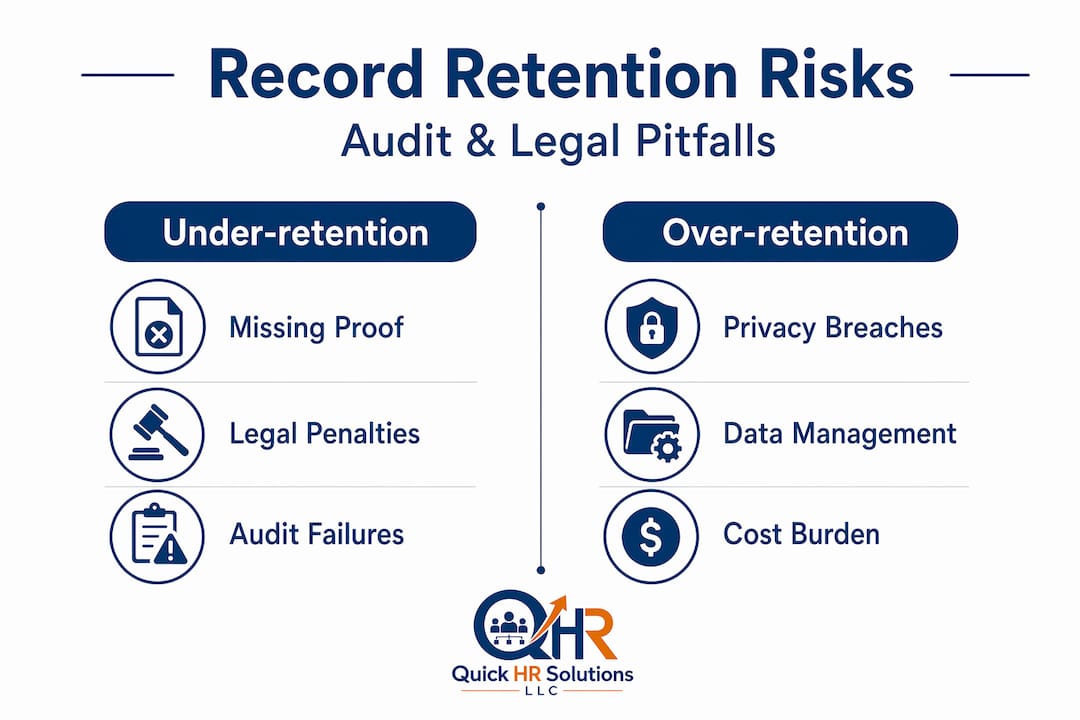
One mistake that deserves more attention is over-retention. Keeping records longer than required does not make you safer. It actually increases your legal exposure during litigation discovery and your risk profile in a data breach. If a record has passed its retention period and no legal hold is in place, destroy it on schedule.
Pro Tip: Build your retention policy around your HRIS platform's capabilities, not the other way around. If your software cannot automate retention flags, build manual calendar reminders into your HR team's workflow until you upgrade.
Handling legal holds, audits, and document destruction
Routine recordkeeping is one thing. Managing records when legal action looms is something most HR teams are genuinely unprepared for. When litigation is reasonably anticipated, destruction must halt immediately across all record categories relevant to the matter. Courts treat the failure to preserve relevant documents as spoliation, and sanctions can range from fines to adverse jury instructions.
Here is what a solid legal hold process looks like in practice:
- Designate a trigger authority. Your policy should name who has the power to issue a hold. Typically this is your General Counsel or senior HR leader. Do not leave it ambiguous.
- Issue written notices immediately. Anyone in HR, IT, management, or accounting who handles relevant records must receive written notification to halt destruction.
- Catalog what is covered. The hold notice should specify which record types, which employees, and which date ranges are implicated.
- Track compliance. Confirm in writing that all notified parties have received and acknowledged the hold.
- Re-evaluate periodically. Holds should be lifted in writing once the legal matter concludes, and normal retention schedules should resume.
Government audits, whether from the Department of Labor, EEOC, or IRS, require a different kind of preparation. Organized, accessible records that are clearly labeled by category and date range demonstrate good-faith compliance. Disorganized files, missing documents, or unexplained gaps create the impression of negligence even when none exists.
For record destruction outside of a hold period, physical documents should be cross-cut shredded and digital records should be permanently deleted using approved methods, not simply moved to a trash folder. Proper destruction requires a log that captures the record type, date range, destruction method, and the name of the person who authorized the action.
The comparison below shows the risk difference between under-retention and over-retention, two sides of the same problem:
| Risk factor | Under-retention | Over-retention |
|---|---|---|
| Audit readiness | Records unavailable to prove compliance | Excess data creates confusion and discoverability risk |
| Litigation exposure | Cannot defend claims without documentation | More records in scope during discovery |
| Data breach risk | Lower (fewer records stored) | Higher (more sensitive data exposed if breach occurs) |
| Regulatory penalty | High, if records are legally required | Low from retention perspective, higher from privacy standpoint |
Understanding how HR records support investigations is equally important when preparing for audits or legal proceedings in Texas.
My perspective on HR recordkeeping in Texas
I have worked with dozens of Texas businesses, from small family-run operations to companies with several hundred employees spread across multiple states, and the pattern I see most often is not willful negligence. It is confident ignorance. Business owners genuinely believe they have recordkeeping handled because they have a shared drive with employee folders. They are shocked when I tell them their medical files are sitting next to performance reviews in the same folder, or that they have remote employees in California whose records should have been governed by different rules for the past two years.
What I find most counterintuitive, and what I wish more people understood, is that a great retention policy actually reduces your workload over time. When records are categorized, automated, and scheduled for destruction, you stop accumulating digital clutter that becomes a liability. You stop spending hours searching for documents during audits. The upfront investment in a written policy and a proper digital system pays dividends in legal defensibility and operational clarity.
The other thing I tell every client: your retention schedule is only as good as its triggering event logic. I have seen payroll records retained from the "hire date" when they should have been measured from the "last wage payment date." That single mistake could create a gap in coverage right when you need those records most.
Proactive, policy-driven recordkeeping is not paperwork for paperwork's sake. It is the difference between walking into an audit with confidence and scrambling to piece together a defense.
— John
How Quickhrtx helps Texas businesses get HR recordkeeping right

If reviewing this article made you realize your current system has gaps, you are not alone. Most Texas businesses reach out to Quickhrtx after a compliance scare or a close call during an audit. The better time to get support is before that moment arrives. Quickhrtx provides fractional HR consulting in Dallas and across Texas, helping businesses build written retention policies, conduct compliance audits, configure recordkeeping systems, and train HR teams on documentation best practices. You get SHRM-certified expertise without the cost of a full-time HR director. If your records are not where they need to be, book a free consultation at quickhrtx.com and get a clear picture of where you stand.
FAQ
What records must Texas employers keep under federal law?
Texas employers must retain payroll records for three years, I-9 forms for three years after hire or one year after termination, tax records for four years, and OSHA injury records for five years. Toxic substance exposure records require a 30-year retention period.
Does Texas have its own HR recordkeeping requirements?
Texas generally follows federal minimums for HR compliance records, with few state-specific additions. Industry regulations or contractual obligations may impose longer retention periods in certain sectors such as healthcare or government contracting.
What happens if you destroy records during pending litigation?
Destroying records after litigation is reasonably anticipated constitutes spoliation of evidence, which can result in court sanctions, fines, or adverse rulings against your organization. A litigation hold must be issued immediately to suspend all routine destruction.
How should medical records be stored separately from HR files?
Under ADA requirements, medical records must be maintained in a separate, secured file with restricted access, distinct from general personnel files. Only individuals with a legitimate need to know should have access to employee health information.
What is the biggest risk of keeping records longer than required?
Over-retention increases your exposure during litigation discovery, expands the volume of data at risk in a breach, and can create privacy compliance issues. Records that have passed their required retention period and are not subject to a legal hold should be destroyed on schedule with a documented destruction log.