

The role of HR in policy enforcement is defined as the full cycle of developing, communicating, monitoring, and supporting consistent application of workplace rules to protect both employees and the organization. HR does not simply write policies and file them away. It owns the process from creation through compliance, and when that process breaks down, the costs are severe. Non-compliance costs average $14.8 million yearly, and only 32% of organizations take a proactive approach to compliance in 2026. For small and mid-sized businesses in Texas and across the country, that gap represents real legal and financial exposure.
What are the core responsibilities of HR in policy enforcement?
HR policy implementation begins long before a policy reaches an employee's inbox. HR is responsible for drafting policies that reflect both legal requirements and operational realities, then making sure every person in the organization understands what those policies mean in practice.
The core HR responsibilities in policy enforcement include:
- Policy development: Writing clear, legally compliant policies with input from legal counsel, operations, and frontline managers
- Employee communication: Distributing policies through handbooks, onboarding sessions, and digital platforms, then tracking acknowledgment
- Manager training: Equipping supervisors with the tools and language to enforce policies fairly and consistently
- Documentation support: Guiding managers on how to record performance conversations, warnings, and disciplinary actions
- Compliance monitoring: Using technology to track acknowledgment rates and flag overdue responses
- Policy review: Scheduling regular audits and updating policies when laws, operations, or technology change
The monitoring piece is where many small businesses fall short. Automated tracking systems that measure acknowledgment rates and provide audit trails are industry best practice for policy enforcement evidence. These systems generate exportable evidence packs with version history and employee acknowledgments, which matter enormously during audits or legal disputes.
Pro Tip: Set a calendar reminder every quarter to review your acknowledgment completion rates. If any team falls below 80%, that is your signal to follow up before a compliance issue becomes a legal one.

How does HR ensure effective communication and employee compliance?
Poor communication is the leading reason policies fail. Employees cannot follow rules they do not understand, and managers cannot enforce standards they were never trained on. HR's communication role is not a one-time event at onboarding. It is a continuous process.
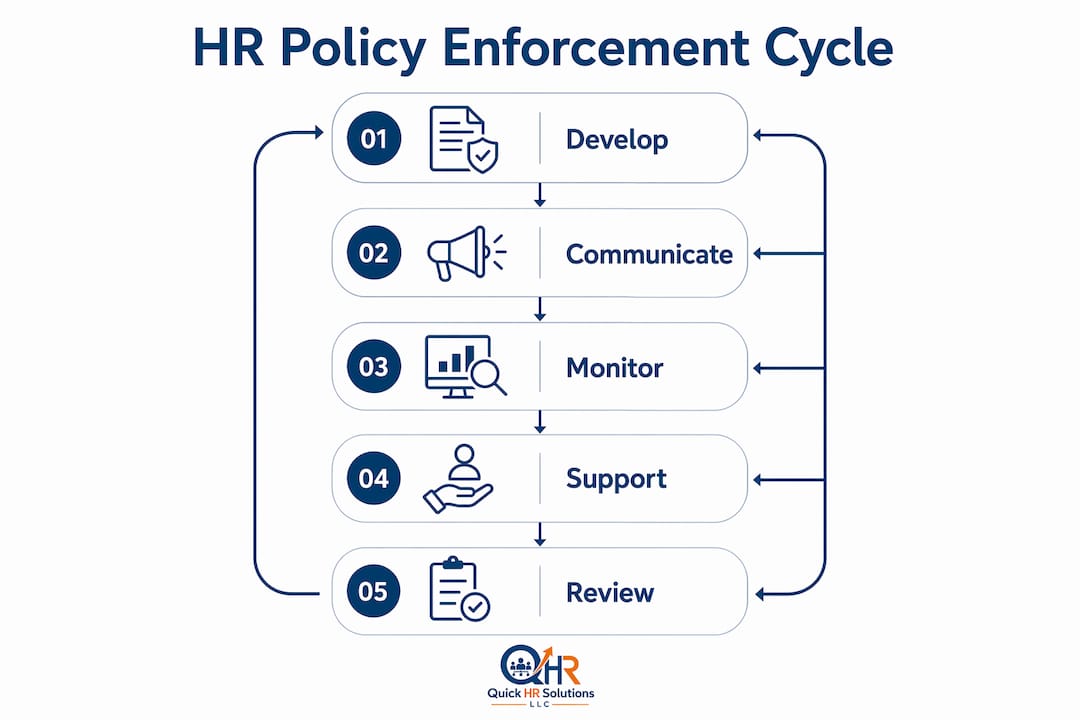
Industry benchmarks from Leapsome's policy management research set clear targets: 100% re-attestation within 7 days for high-risk policies and 90% within 14 days for standard policies. Manager alerts should trigger when compliance falls below 80%, and overdue acknowledgments should stay under 5% after reminders. These numbers give HR a measurable standard instead of a vague goal.
Here are the communication best practices that produce consistent compliance results:
- Distribute through multiple channels. Use the employee handbook, email, your HR information system, and in-person meetings. Different employees absorb information differently.
- Require written acknowledgment. Digital signatures or electronic confirmations create a defensible record and signal that the policy is serious.
- Segment by risk level. High-risk policies such as harassment, safety, and data security warrant faster re-attestation cycles and more frequent reminders.
- Train managers separately. Managers need a deeper briefing than general employees. They need to know not just what the policy says, but how to apply it and document it.
- Send reminders before deadlines. Automated reminders at 48 hours and 24 hours before a deadline dramatically reduce overdue rates without requiring manual follow-up.
- Review communication after incidents. When a policy violation occurs, audit whether the communication process failed first. That finding shapes your next update.
HR's influence on workplace policy depends heavily on whether employees trust that the rules are applied fairly. Clear, consistent communication builds that trust before any enforcement action is ever needed.
Pro Tip: When rolling out a policy update, send a plain-language summary alongside the full document. Most employees will read the summary and skip the full text. Give them the key points upfront.
What are best practices for HR in supporting managers during enforcement?
Managers are the front line of policy enforcement. HR sets the framework, but supervisors execute it daily. When managers are undertrained or unsupported, enforcement becomes inconsistent, and inconsistency creates legal risk.
Consistent enforcement reduces discrimination risk because it demonstrates that all employees are treated by the same standard. HR's job is to make that consistency possible by giving managers clear internal discipline protocols and the confidence to use them. HR should not be the last resort managers call after a situation has already escalated. HR should be the first call when a pattern of behavior begins.
Progressive discipline and follow-up timelines
Progressive discipline works in a predictable sequence: verbal warning, written warning, final warning, and termination. Each step must be documented, and each step must include a follow-up date. Setting a follow-up date at the time of a warning, typically 30 days out, gives the manager a structured opportunity to document improvement or escalate appropriately. Skipping that follow-up is where wrongful termination risk enters the picture.
HR should provide managers with a standard documentation template that captures the date, the behavior observed, the policy violated, the corrective action taken, and the follow-up date. This removes ambiguity and protects the organization if the situation reaches litigation.
Avoiding selective documentation bias
Documentation serves as both communication and legal defense, and it must cover all employees, not just those with performance problems. When managers only document negative incidents for certain employees, the record looks biased. HR should train supervisors to log all significant performance conversations, positive and negative, for every team member. That practice creates an objective record that holds up in court and in internal reviews.
Pro Tip: Run a quarterly documentation audit for each manager. If one employee has 10 documented conversations and another has zero, that gap is a liability. Coach managers to document consistently across their entire team.
How does HR maintain and adapt policies to ensure ongoing compliance?
Policies are living documents, not static files. Outdated policies reduce perceived relevance and decrease compliance. When employees sense that a policy has not been updated since 2018, they treat it as optional. HR's role in compliance includes owning the review cycle and making sure policies keep pace with regulatory, operational, and technological change.
Assigning clear policy owners and involving appropriate stakeholders, including legal, compliance, and frontline workers, improves both the accuracy and the adoption of policy updates. A policy written only by HR without operational input often misses practical realities that frontline managers encounter daily.
The table below outlines the most common review triggers and the activities each one should prompt:
| Review trigger | Review activity |
|---|---|
| Annual calendar review | Audit all active policies for legal accuracy and operational relevance |
| New or amended legislation | Immediate update with legal counsel review and re-attestation cycle |
| Organizational restructure | Review affected policies, update ownership, redistribute to new teams |
| Technology or process change | Update any policy referencing the old system or workflow |
| Incident or near-miss | Root cause analysis to determine if a policy gap contributed |
| Employee or manager feedback | Evaluate whether language is unclear or enforcement is inconsistent |
Version control is non-negotiable. Every policy update should carry a version number, an effective date, and a record of who approved the change. Software platforms like PowerDMS and Leapsome provide audit trails that satisfy both internal governance requirements and external regulatory inquiries. For small businesses without dedicated compliance staff, these tools reduce the manual burden significantly.
HR should also build a proactive HR compliance mindset into the review cycle. Waiting for a violation to trigger a policy review is reactive and expensive. Scheduling reviews in advance, tied to both the calendar and specific business events, keeps the organization ahead of risk rather than behind it.
Small businesses spend over $12,000 per employee annually on compliance, with significant time devoted to managing enforcement gaps. That figure makes a strong case for investing in a structured review process now rather than absorbing the cost of non-compliance later.
Key takeaways
Effective HR policy enforcement requires a continuous cycle of development, communication, manager support, and policy review to protect the organization and its workforce.
| Point | Details |
|---|---|
| HR owns the full enforcement cycle | HR develops, communicates, monitors, and reviews policies, not just writes them. |
| Acknowledgment tracking is measurable | Target 100% re-attestation in 7 days for high-risk policies and 90% in 14 days for standard ones. |
| Manager training prevents legal risk | HR must equip supervisors with documentation templates and progressive discipline protocols. |
| Consistent documentation protects everyone | Log all performance conversations for all employees to avoid selective documentation bias. |
| Policies require scheduled review | Tie review cycles to the calendar and to specific triggers like legislation changes or incidents. |
What I have learned about enforcement and employee relations
After working with dozens of small and mid-sized businesses across Texas, I have seen one pattern repeat itself more than any other. Organizations treat policy enforcement as a punishment system rather than a communication system. That framing is the root cause of most HR crises I encounter.
When a manager delivers a written warning, the employee should not be surprised. If they are surprised, the communication process failed long before the discipline did. The best enforcement programs I have seen treat every policy conversation as a coaching moment. The documentation exists to protect both parties, not just the company.
The other thing I push back on consistently is the idea that small businesses cannot afford structured enforcement. HR compliance challenges disproportionately affect small businesses, but the solution is not to avoid enforcement. It is to build simple, repeatable systems that managers can actually use. A one-page documentation template and a 30-day follow-up calendar are not expensive. A wrongful termination lawsuit is.
HR's role has genuinely shifted from rule enforcer to proactive partner. The organizations that get this right are the ones where HR sits at the table before problems develop, not after. If you are a business leader reading this and HR is only involved when something goes wrong, that is the first thing to fix. Proactive policy education and regular manager coaching cost far less than reactive damage control.
For businesses managing HR risk management without a dedicated internal team, the fractional HR model gives you expert-level enforcement support without the overhead of a full-time hire.
— John
How Quickhrtx supports your policy enforcement needs
Quickhrtx works with small and mid-sized businesses across the Dallas-Fort Worth area to build policy enforcement systems that actually hold up. Whether you need help drafting compliant policies, training your managers on documentation and progressive discipline, or setting up acknowledgment tracking, the team at Quickhrtx brings SHRM-certified expertise to every engagement.
You do not need a full internal HR department to enforce policies correctly. You need the right partner. Quickhrtx offers fractional HR services in Dallas tailored to your industry, your size, and your specific compliance risks. Book a free consultation at quickhrtx.com and find out what a structured enforcement program looks like for your organization.
FAQ
What is the role of HR in policy enforcement?
HR is responsible for developing, communicating, monitoring, and supporting the consistent application of workplace policies. This includes training managers, tracking employee acknowledgments, and maintaining documentation for legal defense.
How does HR track employee compliance with policies?
HR uses automated tracking systems that measure acknowledgment rates and generate audit trails. Industry benchmarks call for 100% re-attestation within 7 days for high-risk policies and 90% within 14 days for standard ones.
Why does consistent documentation matter in policy enforcement?
Selective documentation looks biased and weakens an organization's legal defense in disputes. HR trains managers to document all performance conversations for all employees, creating an objective and defensible record.
How often should HR review and update company policies?
Policies should be reviewed on a scheduled basis and also triggered by events such as new legislation, organizational changes, or incidents. Treating policies as living documents keeps them relevant and legally current.
How can small businesses manage HR policy enforcement without a full HR team?
Small businesses can use fractional HR consulting services to access expert-level policy enforcement support without the cost of a full-time hire. Structured templates, automated tracking tools, and manager training programs make consistent enforcement achievable at any size.