

The role of HR in open enrollment is to plan, execute, and manage every stage of the annual benefits selection process, from carrier negotiations to employee communication and post-enrollment compliance. Benefits represent 30–40% of total compensation costs, which means open enrollment is not a seasonal administrative task. It is one of the highest-stakes HR responsibilities of the year. For small to mid-sized Texas companies, where HR teams are often lean, getting this right requires strategy, structure, and the right tools. This guide covers every phase of the process so you can lead enrollment with confidence.
How does HR strategically prepare for open enrollment?
HR's preparation for open enrollment should begin months before the enrollment window opens, not when carrier renewal rates arrive in the mail. Waiting for renewal rates before planning cedes negotiating leverage to carriers. When you start early, you control the conversation around plan design, cost sharing, and benefit changes.
Here is a practical preparation sequence for Texas HR teams:
- Audit last year's enrollment data. Review participation rates, plan selections, and employee feedback from the prior cycle. Identify which plans underperformed and where employees expressed confusion.
- Engage your broker early. Work with your benefits broker three to four months out to model plan options, benchmark costs against Texas market data, and identify opportunities to add or drop coverage tiers.
- Build your compliance checklist. Confirm that your Summary Plan Descriptions, Summary of Benefits and Coverage documents, and required notices are updated and ready for distribution before enrollment opens.
- Set your enrollment timeline. Map out every milestone: carrier rate confirmation, employee communication launch, enrollment window open and close, and data reconciliation deadline.
- Select or configure your enrollment platform. Tools like Empyrean and Deel offer self-service enrollment portals that reduce manual HR workload and give employees direct access to plan comparison tools.
Communications should begin 4–6 weeks before the enrollment window opens. That lead time gives employees enough context to make informed decisions rather than defaulting to last year's elections.
Pro Tip: Do not wait for your carrier to send renewal packets before you start planning. Build your internal timeline first, then slot carrier deliverables into it. You stay in control of the schedule.

What are hr's top responsibilities during the enrollment window?
Open enrollment windows typically last 2–4 weeks, which is a short runway for HR to manage communications, answer questions, track participation, and handle exceptions. The teams that execute this phase well treat it like a project sprint with daily check-ins and clear ownership.
Your core responsibilities during the active window include:
- Launching and sustaining communication. Send a kickoff email on day one with clear instructions, deadlines, and links to the enrollment platform. Follow up with reminder messages at the midpoint and three days before close.
- Tracking participation daily. Use your HRIS or enrollment platform dashboard to monitor who has enrolled, who has not, and which departments are lagging. Real-time visibility lets you target reminders where they matter most.
- Providing decision-support tools. Plan comparison calculators, FSA estimators, and side-by-side benefit summaries reduce the volume of one-off questions HR receives. Post these resources on your intranet or HR portal.
- Handling exceptions and late enrollments. Document every exception request with a timestamp and reason. Establish a clear policy in advance for qualifying life events and late submissions to avoid inconsistent treatment.
- Coordinating with managers. Training managers before enrollment reduces the volume of basic questions routed to HR. Brief your managers on plan changes, key deadlines, and how to direct employees to self-service resources.
Pro Tip: Set up a real-time participation dashboard in your enrollment system and review it every morning during the window. Catching a low-participation department on day five gives you time to act. Catching it on the last day does not.
How does HR manage post-enrollment activities?
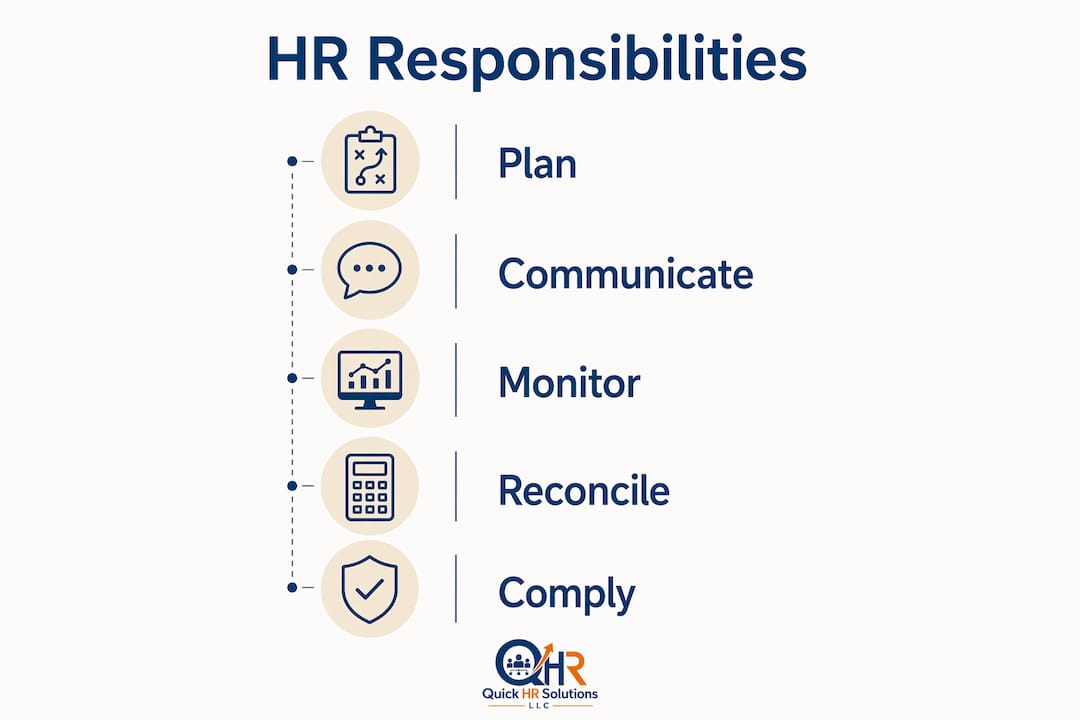
The enrollment window closing is not the finish line. Post-enrollment is where errors surface and where compliance exposure is highest. Data reconciliation between your HRIS and carriers is the first priority after enrollment closes. Discrepancies between what employees selected and what carriers have on file cause billing errors and coverage gaps that damage employee trust.
The post-enrollment phase covers four distinct areas:
| Activity | Purpose | Timing |
|---|---|---|
| Carrier data reconciliation | Match enrollment elections to carrier records and correct discrepancies | Within 5 business days of close |
| Waiver and declination processing | Confirm employees who waived coverage signed documented waivers | Before plan effective date |
| COBRA notification updates | Notify eligible participants of continuation rights after qualifying events | Within 14 days of qualifying event |
| Feedback collection | Survey employees on enrollment experience to identify friction points | Within 2 weeks of close |
Maintaining auditable records for ERISA and IRS requirements is HR's legal obligation, not a best practice. Keep enrollment confirmations, waiver forms, and communication logs in a secure, retrievable format for a minimum of six years. Texas employers subject to the Affordable Care Act must also retain IRS Form 1094-C and 1095-C documentation for the same period.
Post-enrollment data also feeds your next planning cycle. Participation rates by plan tier, average employee contribution levels, and waiver rates tell you where your benefit offerings are landing and where they are not. Treat this data as a strategic asset, not just a compliance record.
What communication strategies maximize employee engagement?
HR overwhelm during open enrollment signals under-planning, and most of that overwhelm comes from employees who did not understand their options until the last minute. The fix is a structured communication plan that starts early and uses multiple channels.
Effective HR communication during enrollment follows a few non-negotiable principles. Each message should carry one clear call to action. Employees who receive an email with five things to do typically do none of them. Send the deadline reminder separately from the plan comparison guide.
Channel variety matters as much as timing. Emails reach employees at their desks. Slack or Teams messages reach remote workers in real time. Short explainer videos posted to your intranet work for employees who absorb information visually. A 15-minute live Q&A session, whether in person or via Zoom, handles the questions that employees are reluctant to ask in writing.
Plain language is not optional. Replace phrases like "high-deductible health plan with HSA compatibility" with "a lower-premium plan where you pay more upfront but can save pre-tax dollars for medical costs." Your employees are not benefits experts. Your job is to translate, not to inform.
Pro Tip: Create a one-page enrollment guide specific to your company's plans. Include the three or four most common employee profiles, such as single, family with young children, or employee nearing retirement, and show which plan typically fits each. Employees make faster, better decisions when they see themselves in an example.
For a deeper look at building communication plans that hold up under pressure, the guide on HR department restructuring covers how lean HR teams can structure workflows without losing quality.
What compliance risks does HR face during open enrollment?
Compliance is the area where open enrollment mistakes become expensive. HR's role in health benefits administration includes managing legal obligations under federal and Texas state law. The three primary frameworks are ERISA, Internal Revenue Code Section 4980H (the ACA employer mandate), and applicable Texas Insurance Code provisions.
| Compliance Area | Requirement | Risk of Noncompliance |
|---|---|---|
| ERISA | Distribute SPD and SBC documents; maintain plan records | Penalties up to $110 per day per participant for late notices |
| IRC Section 4980H | Offer minimum essential coverage to full-time employees | Employer shared responsibility payments starting at $2,900 per employee |
| COBRA | Timely election notices for qualifying events | Penalties up to $110 per day; excise tax exposure |
| Texas Insurance Code | State-mandated benefit inclusions for fully insured plans | Plan non-compliance; carrier contract issues |
Noncompliance risks include penalties under ERISA and the Internal Revenue Code, and the IRS does conduct employer audits. The most common triggers are late or missing required notices, failure to offer coverage to eligible employees, and inaccurate 1095-C reporting.
Audit readiness means your records are organized before you need them. Build a compliance folder for each plan year that includes all required notices with distribution dates, enrollment confirmations, waiver forms, and carrier contracts. For Texas-specific compliance guidance, the HR compliance checklist for Texas is a practical starting point.
The HR risk management strategies guide also covers how to build audit-ready documentation practices that protect your company year-round, not just during enrollment.
Key takeaways
HR's role in open enrollment succeeds or fails based on how early planning begins, how clearly employees are communicated with, and how rigorously post-enrollment data and compliance records are maintained.
| Point | Details |
|---|---|
| Start planning months early | Begin broker conversations and build your timeline before carrier rates arrive to maintain negotiating control. |
| Benefits are a major cost driver | Benefits represent 30–40% of total compensation, making enrollment one of HR's highest-impact annual responsibilities. |
| Communication drives participation | Launch employee communications 4–6 weeks before enrollment opens and use multiple channels to reach every worker. |
| Post-enrollment reconciliation is critical | Match HRIS data to carrier records within five business days to prevent coverage gaps and billing errors. |
| Compliance recordkeeping is non-negotiable | Maintain ERISA and IRS-required documents for a minimum of six years to withstand audits and avoid penalties. |
What i've learned running open enrollment for texas smbs
After working with dozens of small and mid-sized Texas companies on open enrollment, the pattern I see most often is this: HR waits too long, then scrambles. The enrollment window opens, employees are confused, HR is fielding 40 questions a day, and the whole experience leaves everyone frustrated. That is not a staffing problem. It is a planning problem.
The companies that run clean enrollments share one habit. They treat benefits administration as a year-round discipline, not a six-week sprint. They review their plans in the spring, brief their brokers in the summer, and launch employee communications before most companies have even pulled last year's files.
The other thing I push hard on is manager training. HR cannot be the only person in the building who understands the benefits. When managers can answer basic questions about plan options and deadlines, HR gets to focus on exceptions and compliance instead of repeating the same explanation 50 times. That shift alone changes the entire tone of enrollment season.
If your team is stretched thin, outsourcing enrollment coordination to a fractional HR partner is not a workaround. It is a smart allocation of resources. You get experienced execution without the overhead of a full-time hire.
— John
How Quickhrtx helps texas businesses manage open enrollment
Open enrollment is manageable when you have the right support structure behind it. Quickhrtx provides fractional HR consulting in Dallas and across the DFW area, giving small and mid-sized Texas businesses access to experienced HR leadership without the cost of a full internal department.
Quickhrtx supports benefits administration, compliance documentation, employee communication planning, and enrollment coordination. Whether you need help building your first enrollment timeline or want a seasoned HR professional to manage the entire cycle, Quickhrtx delivers results-driven support tailored to your company's size and industry. Book a free consultation at quickhrtx.com to see how fractional HR can take enrollment off your plate and put it in expert hands.
FAQ
What is the role of HR in open enrollment?
HR leads every phase of open enrollment, from negotiating plan options with carriers to communicating choices to employees and maintaining compliance records. HR responsibilities in open enrollment include managing the enrollment platform, tracking participation, handling exceptions, and reconciling data after the window closes.
When should HR start preparing for open enrollment?
HR should begin strategic preparation months before the enrollment window opens. Starting early gives HR control over plan design negotiations and allows time to build a communication plan that launches 4–6 weeks before enrollment begins.
What compliance laws apply to open enrollment in texas?
Texas employers must comply with ERISA, Internal Revenue Code Section 4980H, COBRA notice requirements, and applicable Texas Insurance Code provisions for fully insured plans. Noncompliance can result in daily penalties, excise taxes, and IRS audit exposure.
How can HR improve employee engagement during open enrollment?
HR improves engagement by using plain-language communications, starting outreach early, offering decision-support tools like plan comparison calculators, and briefing managers to handle basic employee questions before the enrollment window opens.
What should HR do immediately after open enrollment closes?
HR should reconcile enrollment elections against carrier records within five business days to catch discrepancies before the plan effective date. Collecting employee feedback and archiving all compliance documentation are the next priorities.