

An annual HR compliance review is the systematic process of auditing your organization's HR policies, practices, and documentation against all applicable federal and Texas state employment laws to identify and remediate legal risk. Texas employers face a layered compliance environment that combines federal standards from the FLSA, FMLA, and Title VII with state-specific rules under the Texas Payday Law, Texas Labor Code, and Senate Bill 45. Skipping or delaying this review exposes your business to penalties, lawsuits, and regulatory investigations that a structured HR compliance audit would have caught early. This guide walks Texas HR professionals and business owners through every stage of the process, from scoping the audit to maintaining compliance year-round.
What are the critical areas to cover in an annual HR compliance review for Texas businesses?
A thorough annual HR compliance review covers eight core domains. Each one carries distinct legal risk, and Texas law often sets a stricter standard than the federal baseline.
- Hiring and onboarding: Verify that job applications, offer letters, and background check authorization forms comply with the EEOC and Texas law. Confirm that Form I-9s are completed correctly and stored separately from personnel files.
- Payroll compliance: Audit pay rates, overtime calculations, and pay frequency against FLSA and Texas Payday Law requirements. The Texas Payday Law governs final pay timelines and wage deduction rules that differ from federal defaults.
- Benefits administration: Confirm ACA compliance, COBRA notices, and plan document accuracy for employers meeting applicable thresholds.
- Leave administration: Review FMLA eligibility tracking, Texas-specific leave policies, and any written leave policies for accuracy and consistent application.
- Workplace safety: Confirm OSHA 300 log maintenance. OSHA 300 logs are required for employers with 10 or more employees in most industries, and EEO-1 reports are required once you reach 100 employees. Both are common audit gaps for growing Texas companies.
- Employee records and documentation: Audit retention schedules, access controls, and file organization for personnel records, payroll records, and I-9 forms.
- Anti-discrimination and harassment policies: SB 45 extends sexual harassment liability to every Texas employer regardless of size, including single-person companies, and requires immediate corrective action. This is one of the most frequently overlooked compliance gaps in Texas small businesses.
- Termination and final pay: Confirm that final pay timelines comply with the Texas Payday Law, which requires payment by the next regularly scheduled payday for voluntary resignations and within six days for involuntary terminations.
High-risk areas including payroll, worker classification, and leave administration warrant quarterly compliance reviews, not just annual attention. Required workplace postings and new hire reporting deadlines also belong on your checklist.
Pro Tip: Texas employers must report new hires to the Texas Office of the Attorney General within 20 calendar days of hire. Electronic filers must report at least twice per month with no more than 16 days between submissions. Missing this deadline triggers penalties that a simple calendar reminder prevents.
How to prepare effectively for your annual HR compliance review
Preparation determines whether your audit produces real findings or just paperwork. Follow these steps before the review begins.
- Define your audit scope. Identify which compliance domains apply to your business based on headcount, industry, and any recent changes in Texas or federal law. A 12-person professional services firm has different exposure than a 75-person manufacturer.
- Gather documentation in advance. Pull personnel files, payroll records, I-9 binders, benefits plan documents, and written policies at least two weeks before the audit start date. Waiting until the audit begins wastes hours and creates gaps.
- Secure leadership buy-in. Present the audit to ownership or executive leadership as a risk management exercise with a defined timeline and resource ask. Audits without leadership support stall at the remediation stage.
- Select your audit tools. A structured HR compliance checklist tailored to Texas requirements is the most efficient starting point. Generic federal checklists miss state-specific requirements like SB 45 and Texas Payday Law.
- Assign an audit lead. Designate one person, whether internal or a fractional HR consultant, to own the process, track findings, and drive remediation.
A first-time full HR compliance audit for a company with 15 to 30 employees typically takes 8 to 16 hours. That estimate assumes documentation is organized and accessible before the audit begins. Disorganized records can double that time.
| Preparation task | Why it matters |
|---|---|
| Define audit scope | Prevents scope creep and keeps the review focused on your actual risk profile |
| Gather records in advance | Reduces audit time and surfaces missing documents before the clock starts |
| Secure leadership support | Ensures remediation items get funded and completed after findings are reported |
| Select Texas-specific tools | Catches state-level requirements that federal checklists omit |
| Assign a single audit lead | Creates accountability and prevents findings from falling through the cracks |
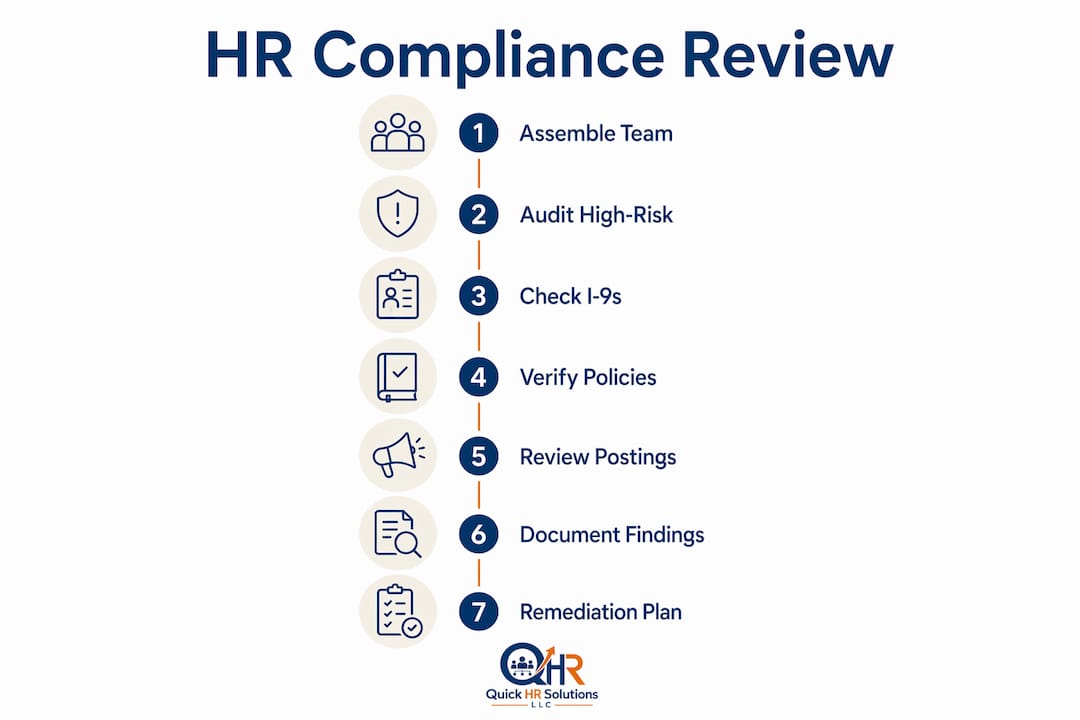
Step-by-step process to conduct your annual HR compliance review
A structured workflow turns the audit from a vague obligation into a repeatable, defensible process. The multi-step HR compliance audit process begins with scope definition and ends with verified remediation. Here is how to execute it.
Step 1: Assemble your audit team. Identify who will review each domain. For small businesses, this is often the HR lead plus the payroll administrator. Companies with 50 or more employees benefit from including legal counsel or a fractional HR consultant with Texas-specific experience.
Step 2: Start with high-risk, high-evidence domains. Audit programs prioritize payroll classification and I-9s because they carry high enforcement exposure and are straightforward to remediate. Review worker classification status for every contractor and verify that FLSA exemption designations are documented and defensible.

Step 3: Audit I-9 compliance with precision. Employers must retain Form I-9s for three years after the date of hire or one year after employment ends, whichever is later. USCIS requires original signed paper forms. Photocopies and faxed copies do not satisfy retention requirements. This is one of the most common audit failures Quickhrtx sees in Texas small businesses.
Step 4: Verify Texas-specific compliance points. Confirm that your written sexual harassment policy meets SB 45 standards and that managers have received training on complaint response. Check that new hire reporting to the Texas OAG is current and that your payroll system calculates final pay correctly under the Texas Payday Law.
Step 5: Review required postings and notices. Confirm that all required federal and Texas workplace posters are current and displayed in locations accessible to all employees, including remote workers who must receive electronic versions.
Step 6: Document findings by legal risk level. Categorize each finding as critical (immediate legal exposure), moderate (policy gap), or low (administrative improvement). This prioritization drives the remediation plan.
Step 7: Build and assign the remediation plan. Every finding needs an owner, a corrective action, and a deadline. Findings without assigned owners do not get fixed. Schedule a 30-day and 90-day check-in to verify closure.
| Finding category | Example | Recommended response timeline |
|---|---|---|
| Critical | Missing I-9 for active employee | Correct within 3 business days |
| Moderate | SB 45 policy not updated post-2021 | Update and distribute within 30 days |
| Low | Outdated job description on file | Revise within 90 days |
Pro Tip: Use your remediation plan as a living document in a shared project management tool like Asana or Monday.com. Findings tracked in a spreadsheet emailed to one person rarely get closed. Shared visibility creates accountability.
Common challenges and mistakes in annual HR compliance reviews
Most compliance failures are not caused by ignorance of the law. They are caused by process breakdowns that a structured annual compliance assessment would catch.
- Mixing I-9 photocopies with originals. USCIS is explicit: photocopies do not satisfy I-9 retention requirements. Employers who store photocopied I-9s believing they are compliant face the same penalties as employers with no I-9s at all.
- Missing new hire reporting deadlines. Texas requires new hire reporting within 20 calendar days to the Texas OAG. Many small businesses report only when they remember, which creates a pattern of late filings that compounds penalty risk.
- Ignoring SB 45 for small employers. The most common misconception Quickhrtx encounters is that SB 45 only applies to larger companies. It applies to every Texas employer, including sole proprietors with one employee.
- Confusing Texas Payday Law timelines with federal standards. Federal law does not specify a final pay deadline. Texas law does, and the timelines differ based on whether the separation was voluntary or involuntary. Applying the wrong standard is a direct wage claim risk.
- No follow-up on remediation plans. HR audits prevent regulatory investigations only when findings are actually corrected. Audits that produce a report but no verified remediation provide a false sense of security and, in litigation, can actually demonstrate that the employer knew about a problem and failed to fix it.
"The most expensive HR audit is the one you never did. The second most expensive is the one you did but never acted on."
How to maintain HR compliance year-round after your annual review
The annual review is the foundation, not the ceiling. Ongoing compliance requires a calendar-driven approach between audits.
- Calendarize recurring filings and deadlines. Build a compliance calendar that includes Texas OAG new hire reporting cycles, OSHA 300 log posting deadlines (February 1 through April 30 each year), EEO-1 filing windows, and benefits open enrollment notices.
- Conduct quarterly reviews of high-risk areas. Payroll classification, leave tracking, and worker classification status change as your workforce changes. A quarterly check on these three areas catches drift before it becomes a violation.
- Update policies after every Texas legislative session. The Texas Legislature meets every two years. The session that produced SB 45 also changed several other employment-related statutes. Review your HR policy documentation after each session closes.
- Train managers on SB 45 complaint response annually. Manager behavior during harassment investigations is where most employer liability is created or avoided. Annual training is not optional under SB 45's "immediate and appropriate corrective action" standard.
- Prepare for event-triggered audits. A significant layoff, an acquisition, a new benefits plan, or a shift to remote work each triggers a compliance review of the affected domains. Build a short-form audit template for these events so you are not starting from scratch.
For Texas employers managing remote teams, remote HR policies require their own compliance layer, particularly around workplace posting requirements and multi-state classification rules.
Key takeaways
A successful annual HR compliance review in Texas requires auditing eight core domains, prioritizing high-risk areas like I-9s and payroll classification, and completing every remediation item with a named owner and deadline.
| Point | Details |
|---|---|
| Start with high-risk domains | Audit I-9s, payroll classification, and harassment policies first to reduce enforcement exposure fastest. |
| Texas law adds specific obligations | SB 45, Texas Payday Law, and OAG new hire reporting create requirements that federal checklists miss entirely. |
| Remediation must be verified | Findings without assigned owners and follow-up check-ins do not get fixed and can increase legal liability. |
| Frequency matters beyond annual | Payroll, classification, and leave administration require quarterly review, not just annual attention. |
| Preparation cuts audit time | Organizing records before the audit begins reduces a 15-person company's audit from 16 hours to 8. |
What I've learned from auditing Texas employers year after year
After working through dozens of HR compliance audits with Texas small and midsize businesses, the pattern that surprises me most is not what employers do not know. It is what they think they have handled but have not.
The I-9 issue is the clearest example. I have walked into offices where the HR lead is confident their I-9 binder is perfect, only to find it full of photocopies. They followed a process. The process was wrong. That gap between perceived compliance and actual compliance is exactly what a structured annual review is designed to close.
The SB 45 situation is similar. I regularly meet business owners with two or three employees who have never heard of SB 45 because they assumed harassment law only applied to bigger companies. When I explain that individual manager liability exists under SB 45 regardless of company size, the reaction is always the same: genuine alarm followed by immediate action. That is the right response. The problem is that it took an audit conversation to get there rather than a proactive review.
What I tell every client is this: view your annual HR compliance review as a strategic tool, not a legal obligation you check off once a year. The businesses I have seen avoid costly wage claims, EEOC charges, and OSHA citations are not the ones with the biggest HR departments. They are the ones with consistent processes, clear ownership, and a culture where compliance is treated as a leadership responsibility. That is achievable for any Texas employer willing to build the habit.
— John
How Quickhrtx supports your annual HR compliance review
Quickhrtx provides fractional HR consulting services built specifically for Texas small and midsize businesses that need expert compliance support without the cost of a full-time HR department. Our SHRM-certified consultants conduct structured HR compliance audits covering all eight core domains, with deep knowledge of Texas-specific requirements including SB 45, the Texas Payday Law, and OAG new hire reporting. We deliver a prioritized findings report and a remediation plan with assigned owners and deadlines so nothing falls through the cracks. If you are ready to get your compliance house in order, explore our fractional HR services in Dallas or book a free consultation to discuss your specific needs.
FAQ
What is an annual HR compliance review?
An annual HR compliance review is a structured audit of an organization's HR policies, practices, and documentation to verify adherence to applicable federal and state employment laws. For Texas employers, it covers domains including payroll, I-9 compliance, SB 45 harassment policies, and Texas Payday Law requirements.
How long does an HR compliance audit take for a small business?
A first-time full HR compliance audit for a company with 15 to 30 employees typically takes 8 to 16 hours. Having organized records and a structured checklist before the audit begins significantly reduces that time.
Does SB 45 apply to my Texas business if I have fewer than 15 employees?
Yes. SB 45 applies to every Texas employer regardless of size, including single-person companies. It requires immediate and appropriate corrective action in response to sexual harassment complaints and creates individual liability for managers.
How often should Texas employers review HR compliance?
Annual reviews are the minimum standard, but high-risk areas like payroll classification, worker classification, and leave administration require quarterly attention. Event-triggered reviews are also necessary after significant workforce changes.
What is the penalty for missing Texas new hire reporting?
Texas requires employers to report new hires to the Office of the Attorney General within 20 calendar days. Missing this deadline triggers financial penalties. Electronic filers must report at least twice per month with no more than 16 days between submissions.