

HR's role in legal risk reduction is defined as the systematic practice of identifying, managing, and preventing legal exposures through policy enforcement, compliance monitoring, and workforce governance. Texas employers face a layered compliance environment in 2026, where federal standards from the FLSA, Title VII, and the ADA intersect with state-specific labor rules and the growing complexity of remote work across multiple jurisdictions. The 2025 PwC Global Compliance Survey found that 90% of organizations report increasing compliance complexity requiring HR, legal, and IT to work together. That figure signals a fundamental shift: HR is no longer a support function. It is a frontline risk management operation.
What are the primary legal risks HR must manage and reduce?
HR professionals carry direct accountability for the legal risk areas most likely to generate claims, investigations, and lawsuits. Understanding where exposure concentrates is the first step toward reducing it.
The highest-priority risk categories include:
- Wage and hour compliance. Misclassifying employees as exempt, failing to pay overtime, or miscalculating final paychecks generates significant FLSA liability. Texas employers with hourly workforces face this risk daily.
- Employee classification. Misclassifying workers as independent contractors instead of employees triggers IRS, DOL, and TWC scrutiny simultaneously.
- Anti-harassment and discrimination. Title VII, the ADA, and the ADEA require documented investigation procedures, consistent enforcement, and regular training. Gaps in any of these create direct legal exposure.
- Recordkeeping failures. The EEOC and DOL both require specific retention periods for personnel files, I-9 forms, and payroll records. Missing records turn audits into penalties.
Each of these risks shows up in daily HR decisions: a manager approving an off-clock work request, a recruiter writing a job description that inadvertently screens out a protected class, or a supervisor skipping a written warning before termination.
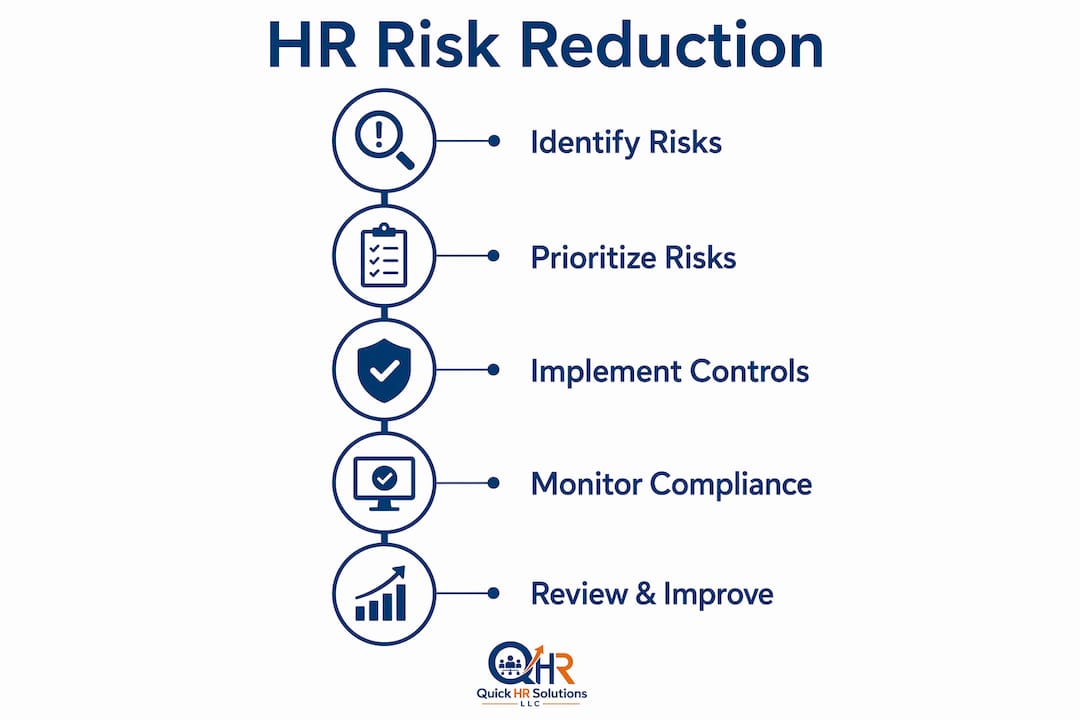
Prioritizing these risks requires more than intuition. A scoring model using a 1–5 scale across frequency, impact, auditability, and complexity helps HR identify the top three highest-risk workflows for a focused 90-day compliance improvement plan. That structure converts a broad compliance mandate into a manageable, measurable project.

Pro Tip: Map your three highest-scoring risk workflows to specific job roles and decision points. Targeted training at those exact moments reduces risk faster than company-wide policy refreshers.
How does HR operationalize legal risk reduction through compliance programs?
Embedding compliance into daily operations is the difference between a policy that exists on paper and one that actually prevents claims. Leading organizations treat compliance as an ongoing operational discipline, not a one-time handbook update. That mindset requires building compliance into the systems HR already uses.
The four core steps for operationalizing HR compliance are:
- Embed labor law requirements into HRIS and payroll systems. Automating overtime thresholds, break time tracking, and pay rate changes removes human error from high-risk calculations. Embedding compliance into operational systems surfaces risks early, before they become claims.
- Build audit trails into every workflow. Timekeeping systems, offer letter approvals, and termination checklists should generate automatic records. Those records are your defense in any DOL or EEOC investigation.
- Map your geographic compliance footprint. Texas businesses hiring remote workers in other states must track each state's specific wage, leave, and classification rules. A compliance map updated quarterly prevents the gap that appears when a new hire in California or Colorado triggers requirements the Texas team did not anticipate.
- Run routine self-audits on exception activity. Proactive auditing of employment policies limits compliance gaps and reduces costly investigations. Schedule quarterly reviews of I-9s, job descriptions, and pay equity data rather than waiting for a complaint to surface the problem.
The table below shows how compliance infrastructure compares across two common organizational approaches:
| Compliance approach | Risk detection method | Response time | Documentation quality |
|---|---|---|---|
| Reactive (policy-only) | Employee complaint or audit | Weeks to months | Inconsistent, often missing |
| Embedded (systems-based) | Automated exception flags | Days | Consistent, timestamped |
Proactive HR risk management including automated monitoring and geographic mapping reduces costly legal responses. The upfront investment in compliance infrastructure is consistently lower than the cost of a single wage claim or EEOC investigation.
Pro Tip: Use your HRIS to generate a monthly exception report covering overtime approvals, classification changes, and pay adjustments. Review it with your legal or compliance contact before it becomes a pattern.
What role does organizational culture play in legal risk reduction?
Culture is not a soft metric. Risk management experts identify leadership transparency and accountability as the ultimate risk management tool, because culture shapes compliance habits at every level of the organization.
The contrast between culture-driven compliance and reactive legal response is stark:
- Culture-driven organizations train managers to document conversations, apply policies consistently, and escalate concerns before they become grievances. Compliance becomes a habit, not a checklist.
- Reactive organizations respond to complaints after the fact, apply policies inconsistently across departments, and rely on legal counsel to manage damage rather than prevent it.
Leadership behavior sets the tone. When executives model transparency, acknowledge mistakes, and hold managers accountable for policy violations, employees see that the rules apply equally. That consistency builds trust and reduces the likelihood that employees will escalate disputes externally to the EEOC or TWC.
Culture influences compliance behaviors and transforms legal risk management from reactive to habitual. HR's job is to design the systems and training that make compliant behavior the path of least resistance for every manager. The role of HR in culture change is not separate from compliance work. It is compliance work.
What are best practices for HR risk governance and cross-department collaboration?
HR's legal responsibilities extend beyond the HR department. Effective HR risk governance involves collaboration with legal, compliance, and IT to anticipate and mitigate workforce-related risks across the enterprise.
The most effective governance structures share three characteristics:
- HR holds a seat on the enterprise risk committee alongside legal and compliance. This gives HR visibility into business decisions that carry workforce risk before those decisions are finalized.
- HR professionals develop data literacy skills to read audit reports, interpret exception logs, and present risk findings to leadership in financial terms. A compliance gap framed as a dollar exposure gets faster executive attention than one framed as a policy violation.
- Every policy exception goes through a documented approval and review process. Tracking and reviewing business exceptions regularly prevents informal policies that erode compliance over time. When managers grant exceptions without documentation, those exceptions become the de facto standard, and the written policy becomes unenforceable.
The table below outlines how governance responsibilities divide across functions:
| Function | Primary governance role | HR's collaboration point |
|---|---|---|
| Legal | Interpret law, manage litigation | Policy language, investigation support |
| Compliance | Monitor regulatory changes | Training updates, audit coordination |
| IT | Secure data, maintain system access | HRIS permissions, audit trail integrity |
| HR | Enforce policy, manage workforce risk | All of the above |
HR compliance strategies that include cross-functional governance reduce both legal exposure and workforce instability. When HR, legal, and IT share a common risk framework, gaps close faster and the organization responds to regulatory changes before they create liability.
Pro Tip: Build a shared exception log that HR, legal, and compliance can all access. Reviewing it together quarterly surfaces patterns that no single department would catch alone.
Key takeaways
HR's role in legal risk reduction requires embedding compliance into systems, culture, and governance structures rather than treating it as a periodic policy exercise.
| Point | Details |
|---|---|
| Prioritize by risk score | Use a 1–5 scoring model across frequency, impact, and complexity to identify your top three risk workflows. |
| Embed compliance in systems | Build labor law requirements into HRIS, payroll, and timekeeping to automate detection and create audit trails. |
| Culture drives compliance habits | Leadership accountability and consistent enforcement reduce legal exposure more reliably than policy updates alone. |
| Govern exceptions formally | Document every policy exception and review it regularly to prevent informal practices from replacing written policy. |
| Collaborate cross-functionally | HR, legal, compliance, and IT must share a common risk framework to close gaps before they generate claims. |
The compliance burden is real, and it is not going away
I have worked with enough Texas businesses to say this plainly: the organizations that treat compliance as a once-a-year handbook review are the ones calling their employment attorney in a panic. The ones that build it into their systems and their management culture rarely end up in that situation.
What I see most often in thriving organizations is not a perfect policy manual. It is a culture where managers know exactly what to document, who to call, and how to escalate, because HR has made those steps automatic. That takes time to build, but it is far less expensive than a single EEOC investigation or a wage claim that drags through TWC for months.
The hardest part of this work is balancing legal risk avoidance with a positive employee experience. Compliance that feels punitive drives good employees out. Compliance that feels fair and consistent builds the kind of trust that keeps people from filing complaints in the first place. That balance is where HR earns its seat at the leadership table.
Continuous learning matters here too. The regulatory environment in Texas and across the country changes faster than most HR teams can track alone. The organizations I see managing this best are the ones investing in SHRM certifications, external compliance partners, and technology that flags changes automatically. You cannot manage what you do not know is changing.
— John
How Quickhrtx helps Texas businesses reduce legal risk
Texas businesses managing compliance without a dedicated HR team carry significant legal exposure every day. Quickhrtx provides fractional HR consulting built specifically for small to mid-sized businesses in the Dallas-Fort Worth area and across Texas, with SHRM-CP and SHRM-CPC certified professionals who understand both federal requirements and Texas-specific labor law.
Quickhrtx delivers compliance audits, policy development, exception management frameworks, and HR risk management strategies tailored to your industry and workforce size. The goal is to close your compliance gaps before they become claims, not after. Book a free consultation at quickhrtx.com and get a clear picture of where your legal risk exposure sits today.
FAQ
What is the role of HR in legal risk reduction?
HR's role in legal risk reduction covers policy enforcement, compliance monitoring, employee classification, recordkeeping, and anti-harassment program management. HR identifies legal exposures before they generate claims and builds the systems and culture that prevent violations.
What are the most common legal risks HR must manage?
The most common legal risks include wage and hour violations, employee misclassification, discrimination and harassment claims, and recordkeeping failures. Each of these risk areas appears in daily HR decisions and requires documented, consistent processes to control.
How does HR use technology to reduce legal risk?
HR embeds compliance requirements into HRIS, payroll, and timekeeping systems to automate detection and create audit trails. Integrating compliance into workflows reduces human error and surfaces exceptions before they become regulatory violations.
Why does organizational culture matter for HR compliance?
Culture shapes how managers and employees behave when no one is watching. Organizations where leadership models accountability and enforces policies consistently see fewer complaints escalated to the EEOC or TWC.
How should HR handle policy exceptions to stay compliant?
Every policy exception requires documented approval and periodic review. Reviewing exceptions regularly prevents informal practices from replacing written policy and keeps compliance controls intact during audits.