

An HR tech stack is the set of software tools a startup uses to manage hiring, onboarding, payroll, compliance, and employee data. Choosing the right stack early defines how efficiently your people operations scale. Founders who delay structured HR tech stack selection often pay twice: once in administrative chaos and again in cleanup costs before a funding round or compliance audit. This guide gives you a practical, growth-stage framework for selecting HR technology for startups, covering foundational tools, budget benchmarks, integration strategy, and implementation best practices.
What foundational HR tech components should early startups prioritize first?
The foundation of any HR tech stack for new businesses is a single source of truth for employee data. Without it, you end up with payroll in a spreadsheet, offer letters in email threads, and I-9s in a filing cabinet. That combination creates compliance risk and wastes hours every month.
The four components every startup needs before anything else are:
- HRIS (Human Resource Information System): Stores employee records, tracks headcount, and serves as the data hub for every other tool you add later.
- Payroll processing: Handles tax withholding, direct deposit, and year-end W-2s. Payroll errors are the fastest way to damage employee trust.
- Onboarding and document management: Automates new hire paperwork, policy acknowledgments, and task checklists so nothing falls through the cracks.
- E-signature: Removes the friction of printing, signing, and scanning offer letters, NDAs, and benefits forms.
For startups under 50 employees, starting consolidated with a single HRIS that handles payroll, onboarding, and benefits is the right call. Specializing externally only makes sense when a specific function outgrows what your core platform can do. Spreading across four separate niche tools before you hit 25 employees creates more integration work than it solves.
A functional foundational stack for a team under 25 people costs between $200 and $500 per month. That range covers HRIS, payroll, and onboarding combined. It is a manageable number for a seed-stage budget and far cheaper than the alternative.

Data integrity problems are a silent, costly risk. Cleaning up disorganized HR and compliance records before a Series A due diligence review costs far more in time and legal fees than investing in organized, automated documentation from day one.
Pro Tip: Before you sign any software contract, confirm the platform exports your data in a standard format like CSV or JSON. Vendor lock-in at the data layer is the most painful mistake to fix later.
How to evaluate and select HR tools aligned with startup growth stages
The right HR tools for your startup depend entirely on your current growth stage. Spending like a Series B company when you are pre-seed does not accelerate growth. It creates overhead that slows you down.
Budget benchmarks by stage give you a clear ceiling:
- Pre-seed and seed (up to 30 employees): Spend $200–$400 per month on HR tech. Focus on HRIS, payroll, and basic onboarding. Nothing else is justified yet.
- Series A (30–150 employees): Budget $1,500–$3,000 per month. Add an applicant tracking system (ATS), a performance management module, and structured onboarding workflows.
- Series B and beyond (150+ employees): Allocate $5,000–$15,000 per month. At this stage, people analytics, compensation benchmarking, and learning management systems become worth the investment.
The right way to prioritize tools is to identify your biggest bottleneck first. The best tool for your team depends on where you are losing the most time or creating the most risk. A 15-person startup spending 10 hours a week on manual onboarding needs an onboarding tool before it needs a performance platform.
Use these four criteria to evaluate any HR software before you buy:
| Evaluation Criterion | What to Look For |
|---|---|
| Integration capability | Native connectors to your payroll, ATS, and communication tools |
| Scalability | Modular pricing that grows with headcount without a full platform switch |
| Ease of use | Setup time under one week; no dedicated IT support required |
| Compliance support | Built-in I-9, W-4, and state-specific tax form handling |
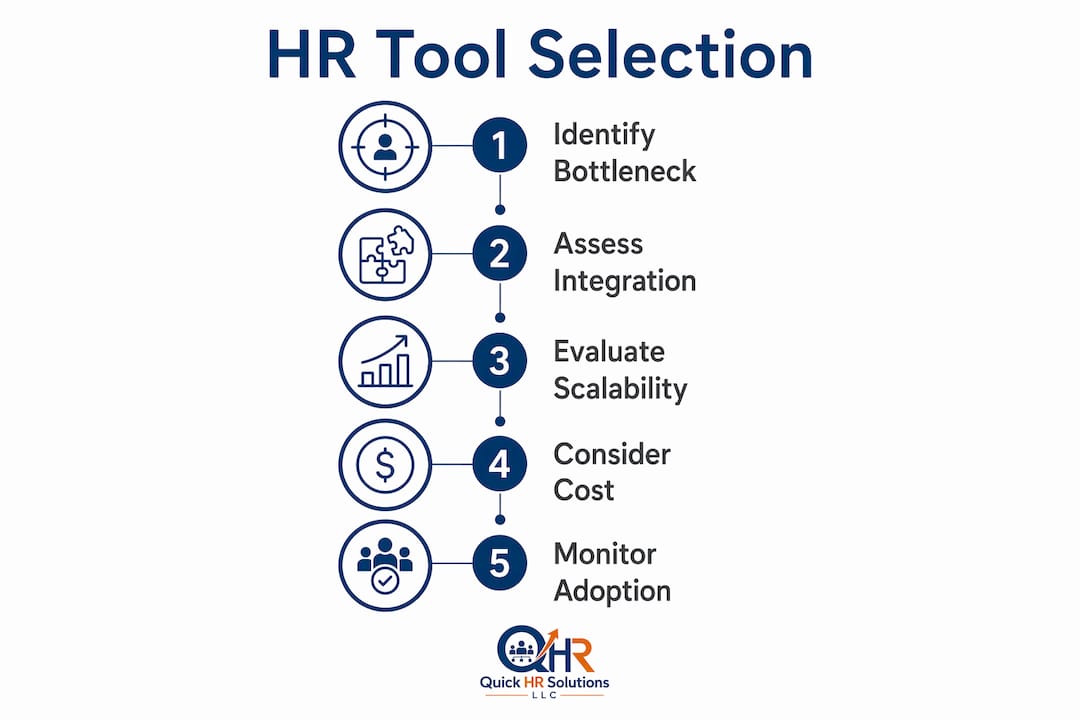
Add HR tech layers only when the pain of not having them clearly exceeds the cost and complexity of adding them. That principle prevents premature tool sprawl and keeps your stack lean through the early stages.
Pro Tip: Run a 30-day audit of where your HR team spends time before evaluating any new tool. The category consuming the most hours is where your next software investment belongs.
What are the critical integration and scalability considerations?
Integration is where most startup HR stacks break down. You can buy five excellent tools and still end up with five disconnected data silos if they do not talk to each other.
The three integration types you will encounter are:
- Native connectors: Pre-built, maintained by the vendor, and the lowest-friction option. Prioritize these when available.
- API integrations: More flexible but require developer time to set up and maintain. Appropriate for Series A and beyond when you have engineering resources.
- Batch syncing: Data transfers on a schedule, typically nightly. Acceptable for low-urgency data like headcount reports, but not for payroll or compliance records.
Most HR platforms offer integration with major HRIS systems through native connectors or APIs, ranging from batch syncing to real-time bidirectional workflows. Real-time sync matters most for payroll and benefits, where a one-day lag can cause errors that affect employee paychecks.
Scalability means your tools grow with you without forcing a full migration. Look for platforms with modular feature sets, transparent per-seat pricing, and a vendor support track record with companies at your next growth stage. A tool that works perfectly at 20 employees but requires a full data migration at 75 is not scalable. It is a time bomb.
The most common integration pitfall is buying a specialized tool before confirming it connects to your HRIS. You can learn more about HR scalability planning before committing to any platform that sits outside your core stack.
How to implement a new HR tech stack successfully
Implementation is where good tool decisions fail. The software can be perfect and still deliver poor results if the rollout is rushed or training is skipped.
A reliable implementation sequence follows four steps:
- Needs assessment: Document your current HR processes, pain points, and compliance gaps before you evaluate any vendor. You cannot measure improvement without a baseline.
- Vendor demo and pilot: Run a structured 2-week pilot with a small group of employees before a full rollout. Collect feedback on usability and missing features.
- Data migration: Map your existing employee data to the new system's fields before import. Clean the data first. Migrating dirty data into a new system just moves the problem.
- Phased rollout and training: Launch by department or function, not all at once. Train managers before employees. Document every process in writing so the knowledge does not live only in one person's head.
Phased rollouts, data migration planning, and staff training are the three factors most responsible for implementation success. Skipping any one of them significantly increases the chance of low adoption and wasted spend.
The most common mistake is overbuying. Startups that choose enterprise tools too early often find that the complexity of those platforms slows down HR operations rather than simplifying them. A tool with 200 features you do not need yet is not a bargain. It is a distraction.
"The goal of your first HR tech stack is not to be impressive. It is to be accurate, compliant, and easy enough that your team actually uses it every day."
Measure adoption rates and time-to-complete for key HR tasks at 30, 60, and 90 days post-launch. If adoption is below 80% at 60 days, the problem is almost always training, not the tool itself.
Key Takeaways
Selecting the right HR tech stack for your startup requires matching tools to your growth stage, starting with a consolidated HRIS, and adding layers only when the operational pain justifies the cost.
| Point | Details |
|---|---|
| Start consolidated | Use one HRIS for payroll, onboarding, and records until you exceed 50 employees. |
| Match budget to stage | Seed-stage stacks cost $200–$400/month; Series A budgets reach $1,500–$3,000/month. |
| Prioritize your bottleneck | Identify your biggest time drain before selecting any new HR tool. |
| Validate integration first | Confirm native connectors or API availability before signing any software contract. |
| Implement in phases | Phased rollouts with structured training consistently outperform full-company launches. |
What I have learned from watching startups build their HR stacks
Founders consistently underestimate how much the wrong tool order costs them. The pattern I see most often is a 20-person startup buying a sophisticated performance management platform before they have a reliable payroll process. The result is a team that cannot run a clean payroll but can generate beautifully formatted performance reviews nobody trusts.
The tools that matter most in the first two years are boring: HRIS, payroll, onboarding, and e-signature. They are not exciting to demo. They do not generate buzz in a board meeting. But they are the reason your employee records are clean when your Series A investors ask for a data room.
I also see founders treat HR software selection as a one-time decision. It is not. Your stack should be reviewed every 12 months against your current headcount, compliance requirements, and team structure. A tool that was right at 15 employees may be the wrong tool at 60.
The startups that build the best HR foundations are the ones that document everything from day one. Policy acknowledgments, job descriptions, compensation decisions, and performance conversations all belong in writing. When a compliance question arises, and it will, documentation is the only thing that protects you.
— John
How Quickhrtx supports your HR tech stack decisions
Building an HR tech stack without dedicated HR expertise is one of the most common and costly mistakes early-stage startups make.
Quickhrtx provides fractional HR consulting for small and mid-sized businesses across Texas, including Dallas-Fort Worth, that need expert HR guidance without the overhead of a full-time HR department. The team holds SHRM-CP and SHRM-CPC certifications and works directly with founders and HR managers to assess current HR operations, identify the right tools for their growth stage, and guide implementation from start to finish. If you are building your HR stack in Dallas or anywhere in Texas and want a structured plan rather than a trial-and-error approach, Quickhrtx offers a free consultation to get you started.
FAQ
What is an HR tech stack for a startup?
An HR tech stack is the collection of software tools a startup uses to manage employee data, payroll, hiring, onboarding, and compliance. Most early-stage startups need four core components: HRIS, payroll, onboarding, and e-signature.
How much should a startup spend on HR technology?
Pre-seed and seed-stage startups typically spend $200–$400 per month on HR tech. That budget covers a consolidated HRIS with payroll and onboarding for teams under 30 employees.
When should a startup add more HR tools?
Add a new HR tool when the operational pain of not having it clearly exceeds the cost and complexity of adding it. Premature tool layering creates overhead without proportional benefit.
What is the biggest mistake startups make when selecting HR software?
The most common mistake is choosing enterprise-grade platforms too early. Complex tools built for 500-person companies slow down HR operations at a 20-person startup and rarely get fully adopted.
How do I know if my HR tools integrate properly?
Confirm that your tools offer native connectors or documented API support before you sign a contract. Real-time bidirectional sync matters most for payroll and benefits data, where delays can cause compliance errors.