

A startup hiring process checklist is a structured, repeatable sequence of steps that helps founders and HR managers identify, evaluate, and secure the right talent quickly and legally. Most early-stage teams skip this structure and pay for it with bad hires, compliance gaps, and wasted runway. The standard industry term for this discipline is talent acquisition, and it covers everything from role definition to day-one onboarding. An efficient hiring process runs 2–4 weeks with no more than 3 interview rounds to keep candidates engaged. That timeline is achievable only when each step is planned before recruiting starts.
1. Define the role before you post anything
Most hiring mistakes happen before a single interview. They happen in the role definition phase, when founders write vague job descriptions based on gut feel rather than outcomes. A calibration brief fixes this. It defines the role's mission, the 3–5 core competencies required, and the results you expect at 30, 60, and 90 days.
Defining 30/60/90-day success metrics before posting a job description is critical to avoiding bad hires. A 90-day outcome for a first sales hire might be "close 3 pilot deals at $5,000 each," not "be a great communicator." That specificity filters candidates before you spend a minute interviewing them.

Separate must-have skills from nice-to-have skills in writing. Must-haves belong in the job post. Nice-to-haves belong in your internal notes. Mixing the two inflates your candidate requirements and shrinks your qualified pool.
Pro Tip: Write the calibration brief before the job description. If you cannot describe what success looks like at 90 days, you are not ready to hire for the role.
2. Build your interview scorecard
Structured scorecards with 4–6 competencies per role are the single most reliable tool for objective hiring decisions. Each interviewer scores candidates independently on a 1–4 scale before any group debrief. This prevents one dominant voice from steering the entire decision.
Scorecards with independent scoring per interviewer force evidence-based ratings and remove impression-based bias from the process. A scorecard for a product manager role might include competencies like prioritization, stakeholder communication, data fluency, and cross-functional leadership. Each one gets a score, not a vibe.
Assign each interviewer a specific competency to probe. Do not let everyone ask the same questions. One person covers culture fit, another covers technical depth, a third covers past performance. This division gives you a complete picture without redundancy.
- Write 4–6 competencies per role before interviews begin
- Assign each competency to one interviewer
- Score independently on a 1–4 scale before the debrief
- Aggregate scores to guide the final decision, not override it
Pro Tip: Send scorecards to interviewers 24 hours before the interview. Reviewers who read the role brief in advance ask sharper, more targeted questions.
3. Source candidates from the right channels
Sourcing quality candidates quickly requires a channel strategy, not a spray-and-pray job post. For early-stage startups, the highest-yield sources are founder networks, warm referrals, and targeted job boards. Posting on AngelList and using an applicant tracking system (ATS) improves pipeline visibility and candidate tracking from day one.
A structured sourcing approach for startups looks like this:
- Tap your network first. Send a direct message to 20 people who know your space. Ask for one referral each. Referrals close faster and retain longer than cold applicants.
- Post on targeted boards. AngelList, LinkedIn, and niche job boards for your industry reach candidates who already understand startup environments.
- Use a short application form. Ask 2–3 screening questions that reveal thinking, not just credentials. "Describe how you would approach your first 30 days in this role" tells you more than a resume.
- Run a phone screen within 48 hours. Speed signals seriousness. Candidates who pass your application screen should hear from you within two business days.
- Use async tasks for technical roles. A short take-home assignment (under 2 hours) filters for real skill without consuming interview time.
Balancing volume with depth is the core sourcing challenge. An ATS keeps your pipeline organized so you never lose a strong candidate to a missed follow-up.
4. Run a structured interview process
A structured interview process means every candidate for the same role answers the same core questions, evaluated against the same scorecard. This is not about being robotic. It is about being fair and consistent. Limiting interviews to 2–3 rounds reduces candidate drop-off and keeps your hiring timeline inside the 2–4 week target.
A three-round structure works well for most startup roles. Round one is a 30-minute phone or video screen with the hiring manager. Round two is a 60-minute deep-dive interview covering competencies. Round three is a 45-minute culture and leadership conversation with a founder or senior team member.
Effective interview questions are behavioral and specific. "Tell me about a time you had to ship a product with incomplete information" is better than "Are you comfortable with ambiguity?" The first question requires evidence. The second invites a yes.
Debrief within 24 hours of the final interview. Memory fades fast. Scorecards submitted before the debrief keep the conversation grounded in evidence rather than recency bias.
5. Check references before making an offer
Reference checks belong before the verbal offer, not after. Pre-offer reference checks reveal environment fit and surface red flags while you still have the freedom to change course without legal or relational complications. Most founders skip this step or do it as a formality after the decision is made. That is a costly habit.
Ask references three targeted questions. First: "How did this person handle a situation where they disagreed with leadership?" Second: "What environment does this person thrive in?" Third: "Would you hire them again, and for what type of role?" These questions reveal patterns that interviews rarely expose.
A strong reference check takes 15 minutes and can save you months of a bad hire. Treat it as a final interview, not a checkbox.
- Contact at least two professional references per finalist
- Ask open-ended, behavior-based questions
- Listen for hesitation as carefully as you listen for praise
- Complete all checks before issuing any verbal offer
6. Make the offer clearly and close quickly
A verbal offer should include five elements: title, base salary, equity, start date, and at-will employment status. Leaving any of these out creates confusion and slows the close. Startups should budget 3–5% total equity for the first five hires, with founding engineers typically receiving 0.5–1.5% and early specialists receiving 0.1–0.2%.
Set a 48–72 hour decision window on every offer. This is not pressure. It is a signal that you run a focused organization. Candidates who need three weeks to decide on a startup role are often not the right fit for a startup environment.
Follow the verbal offer with a written offer letter within 24 hours. The letter should match the verbal terms exactly. Discrepancies between verbal and written offers destroy trust before the hire even starts.
Start onboarding planning the moment the candidate accepts. Assign a buddy, schedule week-one meetings, and prepare equipment before day one. Early onboarding investment directly reduces first-year turnover.
7. Complete compliance and onboarding before day one
Compliance is not optional, and it is not something to figure out after your first hire. Core compliance tasks before a first hire include obtaining an EIN, registering with state labor agencies, securing workers' compensation insurance, and collecting I-9 and W-4 forms from every new employee. Texas startups should also confirm state-specific payroll tax registration requirements.
The HR documentation requirements for a new hire go beyond tax forms. You need a signed offer letter, a confidentiality agreement, and a direct deposit authorization at minimum.
| Compliance task | When to complete |
|---|---|
| Obtain EIN from IRS | Before first hire |
| Register with state labor agency | Before first payroll |
| Secure workers' comp insurance | Before first day |
| Collect I-9 and W-4 | Day one or before |
| Set up payroll system | Before first pay period |
A 30/60/90-day onboarding plan keeps new hires on track after they start. Day one covers logistics and introductions. Week two covers role-specific training. By day 30, the new hire should have a clear picture of their first deliverable. Manager check-ins at 30, 60, and 90 days catch problems before they become turnover.
Pro Tip: Use e-signature tools for all onboarding paperwork. Remote or hybrid hires should complete all forms digitally before their first day, not during it.
Key takeaways
A complete startup hiring process checklist covers role definition, structured interviews, pre-offer reference checks, clear offers, and compliance tasks before day one.
| Point | Details |
|---|---|
| Define roles with outcomes | Write 30/60/90-day success metrics before posting any job description. |
| Use scorecards consistently | Score 4–6 competencies independently per interviewer to remove bias. |
| Check references before offering | Pre-offer checks reveal fit and flag red flags while you can still act. |
| Close offers in 48–72 hours | Fast offer windows signal organizational focus and reduce candidate drop-off. |
| Complete compliance before day one | EIN, I-9, W-4, and workers' comp must be in place before the first hire starts. |
What I have learned from watching founders hire
Founders who own their hiring funnel early build something most startups never get: a repeatable system. Founders should own recruitment until at least 40–50 employees before delegating to a recruiter or agency. That is not a burden. It is a competitive advantage.
The mistake I see most often is skipping the calibration brief. A founder posts a job, gets 80 applications, and then realizes they do not know what they are actually looking for. They interview based on instinct, hire based on chemistry, and wonder why the person does not perform. The brief takes 45 minutes to write. The bad hire costs 6–12 months of salary and momentum.
The second mistake is treating compliance as an afterthought. Texas founders especially underestimate state-specific registration requirements. A missed workers' comp filing or an I-9 error can result in fines that dwarf the cost of getting it right the first time. The founder HR responsibilities checklist for startups is a practical place to start if you are not sure where your gaps are.
Workforce planning anchored to funding milestones rather than calendar dates keeps runway sustainable. Hire when a role unlocks a specific revenue or product outcome, not because it feels like the right time. That discipline separates startups that scale from startups that stall.
— John
Quickhrtx supports startup hiring from day one
Building a hiring process from scratch while running a startup is a real time drain. Quickhrtx provides fractional HR consulting in Dallas specifically for startups and growing businesses that need structured hiring, compliance support, and onboarding frameworks without the cost of a full-time HR department.
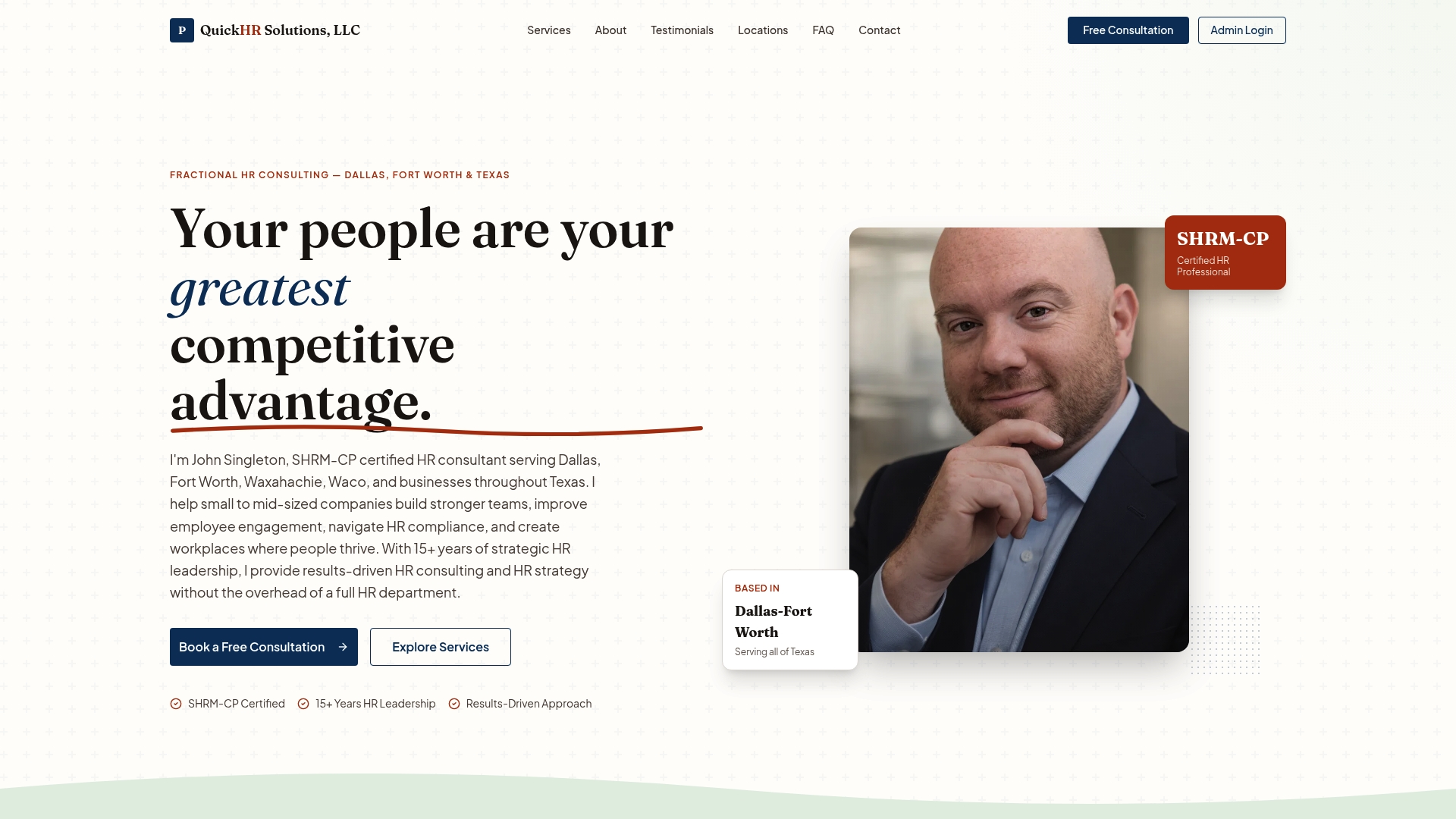
Quickhrtx holds SHRM-CP and SHRM-SCP certifications and works with founders across the Dallas-Fort Worth area to build hiring infrastructure that scales. From writing calibration briefs to setting up compliant onboarding workflows, the team handles the process so you can focus on building your product. Book a free consultation at quickhrtx.com to see where your current hiring process has gaps.
FAQ
What is a startup hiring process checklist?
A startup hiring process checklist is a step-by-step guide covering role definition, sourcing, interviews, offers, compliance, and onboarding. It gives founders a repeatable system that reduces bad hires and keeps hiring timelines under four weeks.
How many interview rounds should a startup use?
Startups should use 2–3 interview rounds. More than three rounds increases candidate drop-off without meaningfully improving hire quality.
When should reference checks happen in the hiring process?
Reference checks should happen before the verbal offer. Pre-offer checks give you the freedom to change course if a reference reveals a significant concern.
What compliance tasks must a startup complete before the first hire?
Startups must obtain an EIN, register with state labor agencies, secure workers' compensation insurance, and collect I-9 and W-4 forms before or on the employee's first day.
How much equity should early startup hires receive?
Early-stage startups should budget 3–5% total equity for the first five hires. Founding engineers typically receive 0.5–1.5%, while early specialists receive 0.1–0.2%.