

HR benchmarking is the systematic comparison of your organization's HR metrics, processes, and practices against external peer standards or internal reference points to measure effectiveness and identify performance gaps. Every HR team collects data, but without context, a 15% voluntary turnover rate is just a number. Compared to an industry median of 12%, that same number signals a retention problem worth addressing. Organizations like SHRM, Mercer, and LinkedIn publish benchmarking data that transforms raw HR metrics into strategic intelligence. The practice traces its roots to manufacturing, where Xerox pioneered benchmarking in the 1980s before the Saratoga Institute standardized HR metrics collection in the 1990s.
What is HR benchmarking and why does it matter?
HR benchmarking, also called HR performance benchmarking in strategic contexts, is the disciplined process of measuring your HR function against defined reference points to determine where you stand and where you need to improve. It converts HR data from a reporting exercise into a decision-making tool. Without benchmarking, HR leaders present metrics to executives without the context needed to justify investments or prioritize change.
The importance of HR benchmarking becomes clear when you consider that just over 50% of companies actively track key HR metrics. That means roughly half of all organizations are making workforce decisions without the comparative data needed to validate their choices. For HR professionals in small to mid-sized businesses, this gap represents both a risk and an opportunity to lead with evidence rather than intuition.
Benchmarking also builds credibility with leadership. When an HR director walks into a budget meeting with data showing the company's cost-per-hire is 30% above the industry median, the conversation shifts from "we need more resources" to "here is exactly why and what it will cost us to fix it." That shift from opinion to objective, comparative evidence is the core value of the practice.

What types of HR benchmarking exist and how do they differ?
Understanding the benchmarking landscape helps you choose the right method for your specific question. Two primary methods exist at the broadest level: quantitative and qualitative.
Quantitative benchmarking uses numerical metrics like cost-per-hire, turnover rate, and time-to-hire. It produces clear, comparable data points that work well for executive reporting and budget justification. Qualitative benchmarking gathers insights through interviews, surveys, and case studies to understand how high-performing organizations structure their HR processes, not just what their numbers look like.
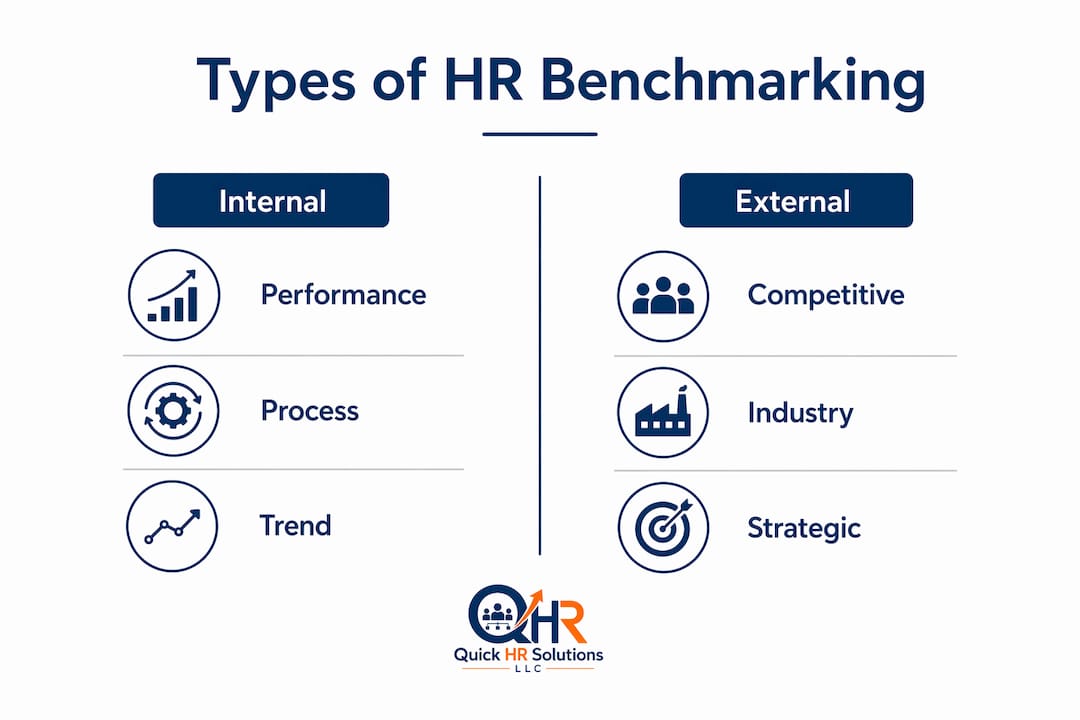
Beyond that split, six benchmarking types serve different strategic purposes:
- Internal benchmarking compares performance across departments, business units, or time periods within your own organization. A Texas manufacturer might compare turnover rates across its Dallas and Houston facilities to identify location-specific issues.
- External benchmarking measures your metrics against industry peers or published data from sources like SHRM's annual benchmarking reports or Mercer's workforce surveys.
- Competitive benchmarking focuses specifically on direct competitors. This is harder to execute because competitor data is rarely public, but industry associations and third-party surveys often provide aggregated data.
- Functional benchmarking compares your HR practices against best-in-class organizations outside your industry. A healthcare company might study how a top-tier technology firm runs its onboarding program.
- Strategic benchmarking examines long-term workforce strategies, organizational design, and HR operating models rather than individual metrics.
- Process benchmarking drills into specific HR workflows, such as the steps and cycle time involved in a performance review process, to identify inefficiencies.
Each type answers a different question. Internal benchmarking tells you where you are improving over time. External benchmarking tells you where you stand relative to the market. Functional benchmarking tells you what is possible.
Key HR metrics commonly used in benchmarking
The core metrics for HR benchmarking include time-to-hire, turnover rate, cost-per-hire, HR-to-employee ratio, and employee relations case volume. These fall into three categories that serve distinct analytical purposes.
| Metric Category | Examples | What It Measures |
|---|---|---|
| Efficiency metrics | Cost-per-hire, time-to-hire, HR-to-employee ratio | How well HR operates with available resources |
| Effectiveness metrics | Voluntary turnover rate, engagement scores, retention rate | Whether HR programs produce the intended outcomes |
| Practice adoption metrics | Training completion rate, performance review participation | How consistently HR processes are being executed |
Efficiency metrics answer the question of whether HR is operating lean. An HR-to-employee ratio of 1:100 is common in mid-sized companies, but organizations with strong HR technology often operate at 1:150 without sacrificing service quality. Effectiveness metrics reveal whether HR programs are actually working. A high training completion rate paired with flat engagement scores tells you the training content may need revision. Practice adoption metrics expose execution gaps, which are situations where a policy exists on paper but is not consistently applied across the organization.
Data sources matter as much as the metrics themselves. SHRM's benchmarking surveys, Mercer's workforce analytics reports, and LinkedIn's Talent Trends data are among the most widely cited. For HR metrics context, peer group selection is critical. A 10-person startup should not benchmark its HR-to-employee ratio against a Fortune 500 company.
Pro Tip: Before pulling external benchmarks, audit your internal data first. If your HRIS is inconsistently updated or your turnover calculation methodology differs from the benchmark source, you are comparing apples to oranges. Clean internal data is the foundation of credible benchmarking.
Benefits and importance of HR benchmarking for decision-making
HR benchmarking converts the HR function from a cost center narrative into a performance-driven business partner. The strategic advantages are concrete and measurable when the process is executed correctly.
- Data-driven strategy: Benchmarking replaces gut-feel decisions with comparative evidence. When your time-to-hire is 45 days against an industry median of 28 days, you have a specific, defensible case for investing in recruiting technology or additional talent acquisition staff.
- Investment prioritization: Not every HR gap deserves equal attention. Benchmarking reveals which gaps are most costly and most addressable, helping HR leaders focus limited budgets where they will generate the highest return.
- Leadership credibility: External validation from recognized sources like SHRM or Mercer carries weight in executive conversations. Benchmarking gives HR leaders the language of business performance rather than HR process.
- Continuous improvement: Benchmarking integrated into improvement cycles produces faster progress than one-time assessments. Organizations that track benchmarks quarterly can course-correct before small gaps become expensive problems.
- Accountability: Published benchmarks create shared performance standards across HR teams and business units, reducing the tendency to accept underperformance as normal.
"Benchmarking should not be about chasing the average but focused on advancing organizational competitiveness and maturity." — HRM Guide
That distinction matters. Hitting the industry average on turnover does not mean your retention strategy is working. It means you are keeping pace. The organizations that use benchmarking most effectively treat the median as a floor, not a ceiling.
Common pitfalls and HR benchmarking best practices
Most benchmarking failures trace back to three root causes: poor peer group selection, low data maturity, and treating benchmarks as destinations rather than reference points.
| Common Pitfall | Best Practice Alternative |
|---|---|
| Benchmarking bias: selecting favorable or irrelevant peers | Define peer group criteria before pulling data, based on industry, size, and geography |
| One-time benchmarking exercise | Build benchmarking into quarterly or annual HR planning cycles |
| Low internal data quality | Establish data governance standards in your HRIS before external comparisons |
| Treating the benchmark as the goal | Use benchmarks to identify gaps, then set targets beyond the median |
| Ignoring context behind the numbers | Pair quantitative data with qualitative research to understand the "why" |
Benchmarking bias is the most common and least discussed problem. It occurs when organizations select peer groups or data sources that confirm what they already believe rather than challenge it. An HR leader who wants to justify a low training budget might compare against peers in a cost-constrained industry rather than against best-in-class performers. The result is a benchmark that validates underperformance.
Low data maturity is equally damaging. When internal metrics are unreliable, external benchmarks lose their credibility with leadership. Before conducting external benchmarking, HR teams should confirm that their HRIS data is clean, consistently defined, and regularly updated. An HR audit is often the right first step before launching a benchmarking program.
Pro Tip: When presenting benchmarking results to leadership, always include the source, the peer group definition, and the date of the data. Executives who trust the methodology are far more likely to act on the findings.
The most effective benchmarking programs treat benchmarks as reference points, not endpoints. A benchmark tells you where the market is. Your strategy determines where you want to be relative to that market.
How to implement HR benchmarking in your organization
A structured approach prevents the most common implementation failures. Follow these steps to build a benchmarking program that produces results rather than reports.
- Define your objectives. Identify the specific business questions you want benchmarking to answer. Are you trying to justify a headcount request? Diagnose a retention problem? Evaluate your HR operating model? The objective determines which metrics and benchmarking types you need.
- Audit your internal data. Confirm that your HRIS data is accurate, consistently defined, and complete before pulling external comparisons. This step is non-negotiable for credible results.
- Select your peer group. Define criteria for relevant comparisons: industry, company size, geography, and business model. For Texas-based mid-sized companies, SHRM's regional data and Texas Workforce Commission reports are useful starting points.
- Choose your data sources. Reliable external sources include SHRM benchmarking surveys, Mercer workforce analytics, LinkedIn Talent Insights, and industry-specific association reports. Match the source to your peer group criteria.
- Collect and compare. Map your internal metrics against the external benchmarks. Document gaps, note the direction of each gap (above or below median), and flag the metrics with the largest deviations for priority attention.
- Translate findings into action. Benchmarking insight into action requires connecting each gap to a specific initiative, owner, and timeline. A gap without an action plan is just a data point.
- Build in continuous tracking. Schedule benchmarking reviews at least annually, with quarterly check-ins on priority metrics. Continuous benchmarking produces faster improvement and stronger justification for HR investments over time.
For organizations without a dedicated HR analytics function, HR technology tools like Workday, BambooHR, and Rippling include built-in benchmarking dashboards that simplify data collection and comparison.
Key takeaways
Effective HR benchmarking requires clean internal data, disciplined peer group selection, and a commitment to continuous improvement rather than one-time comparison.
| Point | Details |
|---|---|
| Start with a clear definition | HR benchmarking compares your HR metrics and practices against peer standards to identify performance gaps. |
| Choose the right benchmarking type | Internal, external, competitive, and functional benchmarking each answer different strategic questions. |
| Prioritize data quality first | Unreliable internal data invalidates external comparisons and undermines leadership credibility. |
| Avoid benchmarking bias | Define peer group criteria before pulling data to prevent cherry-picking favorable comparisons. |
| Make benchmarking continuous | Quarterly tracking produces faster improvement than annual one-time exercises. |
Why HR benchmarking is more urgent than most leaders realize
I have worked with enough small and mid-sized businesses in Texas to know that benchmarking is one of the most consistently underused tools in HR. Most teams treat it as a once-a-year exercise, pull a few numbers from a SHRM report, and call it done. That approach produces a slide deck, not a strategy.
What I have seen work is treating benchmarking as an ongoing diagnostic, not a report card. The organizations that get real value from it are the ones that connect every benchmark gap to a specific business cost. When you can tell a CEO that your 60-day time-to-hire is costing the company an estimated $15,000 per open role in lost productivity, the conversation about investing in recruiting resources becomes very short.
The other thing most articles will not tell you is that benchmarking exposes organizational politics as much as performance gaps. Sometimes the data shows that one department has significantly higher turnover than others, and the benchmark is just the tool that makes that visible. Having the courage to act on what the data reveals is where the real work begins.
My advice for 2026: stop waiting until you have a "perfect" HR analytics setup to start benchmarking. Start with two or three metrics, use SHRM or Mercer data as your baseline, and build from there. Imperfect benchmarking done consistently beats perfect benchmarking done never.
— John
How Quickhrtx helps you put benchmarking to work
Knowing what HR benchmarking is and actually using it to drive decisions are two very different things. For small and mid-sized businesses in the Dallas-Fort Worth area, building an internal benchmarking capability from scratch is a significant investment of time and expertise that most teams do not have.
Quickhrtx provides fractional HR consulting in Dallas that includes benchmarking as a core component of HR strategy development. The team uses SHRM, Mercer, and industry-specific data to identify your most critical performance gaps, build the business case for HR investments, and implement improvement plans tied to measurable outcomes. You get the analytical depth of a senior HR function without the overhead of a full-time hire. Book a free consultation to see where your HR metrics stand against your peers.
FAQ
What is the HR benchmarking definition in simple terms?
HR benchmarking is the process of comparing your organization's HR metrics, processes, and practices against industry peers or internal standards to identify performance gaps and improvement opportunities. It gives raw HR data the context needed to drive decisions.
What are the most important HR metrics to benchmark?
The most commonly benchmarked HR metrics include time-to-hire, cost-per-hire, voluntary turnover rate, HR-to-employee ratio, and employee relations case volume. These cover efficiency, effectiveness, and practice adoption across the HR function.
How often should HR benchmarking be conducted?
Benchmarking is most effective when integrated into continuous improvement cycles rather than treated as a one-time exercise. Annual benchmarking with quarterly tracking of priority metrics produces the fastest and most defensible results.
What is benchmarking bias and how do you avoid it?
Benchmarking bias occurs when organizations select peer groups or data sources that confirm existing assumptions rather than challenge them. Avoid it by defining peer group criteria, such as industry, size, and geography, before pulling any data.
How does HR benchmarking support HR strategy?
Benchmarking converts HR performance data into comparative evidence that justifies investments, prioritizes initiatives, and builds credibility with executive leadership. It moves HR from reactive reporting to proactive, data-driven strategy.