

Many business owners assume that HR outsourcing means handing over control of their workforce to a vendor and hoping for the best. That assumption stops a lot of smart leaders from exploring options that could genuinely help them. What does HR outsourcing mean in practice? At its core, it means delegating specific HR functions to an external provider while you keep running your business. The HR outsourcing definition is broader than most people realize, covering everything from payroll to compliance to full strategic support. This guide breaks down the models, the benefits, the operational realities, and what you need to know before making a decision.
Table of Contents
- Key Takeaways
- What HR outsourcing means and what it actually covers
- Types of HR outsourcing models
- Benefits of HR outsourcing that actually move the needle
- How HR outsourcing actually works day to day
- How to select and implement an HR outsourcing provider
- My honest take on HR outsourcing after years of seeing it done right and wrong
- Ready to see what fractional HR support looks like for your team?
- FAQ
Key Takeaways
| Point | Details |
|---|---|
| HR outsourcing keeps you in control | You retain employer-of-record status and all strategic people decisions under standard outsourcing models. |
| Multiple models exist | PEO, standard outsourcing, and ASO arrangements serve different needs based on size, control, and liability preferences. |
| Cost savings are real and significant | HR outsourcing can reduce HR-related costs by 27% to 40% compared to maintaining internal capabilities. |
| Compliance risk drops considerably | Providers monitor federal, state, and local employment law changes so you do not have to. |
| Provider fit matters as much as price | Culture alignment, contract clarity, and communication structure determine whether outsourcing actually works for your team. |
What HR outsourcing means and what it actually covers
HR outsourcing is the practice of contracting an external organization to manage specific human resources functions on your behalf. The scope can be narrow, covering just payroll processing, or it can be broad, encompassing recruitment, benefits administration, compliance, employee relations, and performance management. The key distinction is that standard HR outsourcing allows businesses to retain employer-of-record status and full legal liability. Your employees work for you. The provider handles execution, not ownership.
This matters because HR outsourcing explained correctly is not the same as hiring a staffing agency or fragmenting your HR across three different software tools. A true HR outsourcing arrangement puts a professional provider in charge of specific, defined HR processes while keeping you accountable for the outcomes that affect your people and your culture.
Common functions included in HR outsourcing arrangements:
- Payroll processing and tax filings covering federal, state, and local requirements
- Benefits administration including plan enrollment, renewals, and employee inquiries
- HR compliance monitoring changes to employment law and updating policies accordingly
- Recruitment support from job posting through offer letter
- Employee relations including conflict resolution, disciplinary guidance, and termination support
- Onboarding and offboarding procedures and documentation
- Performance management frameworks and manager coaching
Pro Tip: Do not confuse a payroll software subscription with HR outsourcing. One automates a task. The other gives you access to HR expertise, judgment, and accountability that software cannot provide.
The distinction between HR outsourcing and basic payroll solutions is worth holding onto as you evaluate your options. Payroll tools process numbers. HR outsourcing partners interpret situations, advise on risk, and help you make better decisions about your workforce.
Types of HR outsourcing models
Understanding the different models is where most business owners get tripped up. The three most common arrangements are standard HR outsourcing, Professional Employer Organization (PEO) arrangements, and Administrative Services Only (ASO) agreements. Each comes with a different risk and control profile.
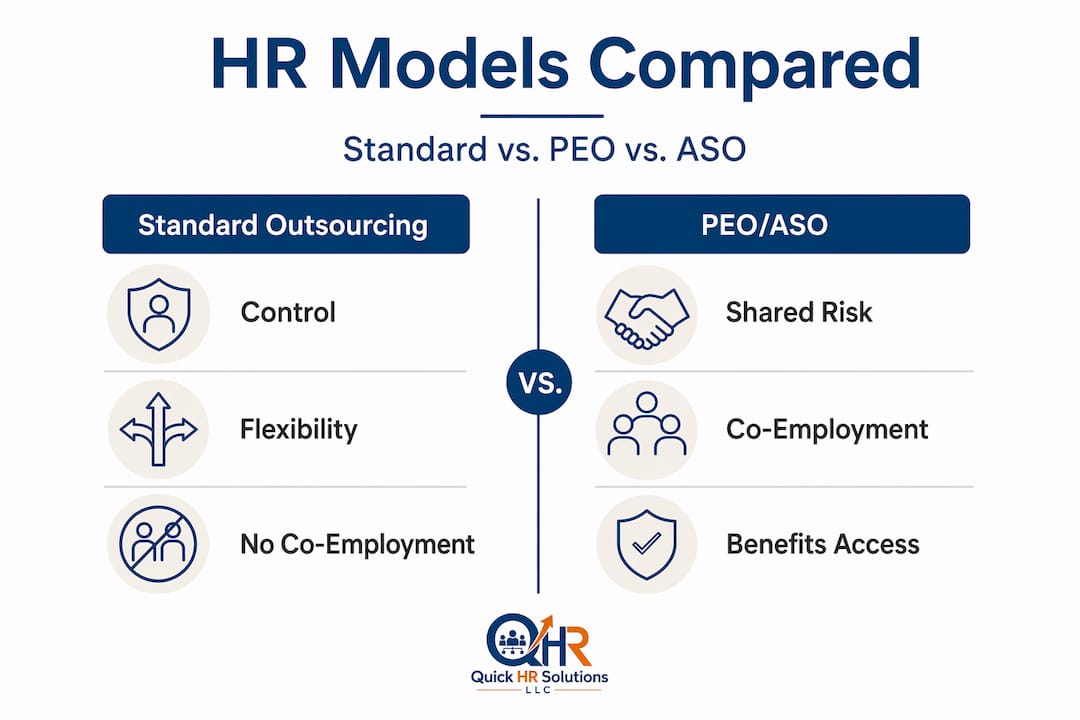
Standard HR outsourcing is the most flexible model. You hire an external provider to manage defined HR functions, they operate as your contractor, and you keep all employer relationships intact. No shared liability. No co-employment. Full control over how your benefits are structured and who manages your workers' compensation accounts.
PEO arrangements work differently. When you enter a co-employment relationship, the PEO becomes employer of record for tax and benefits purposes. Your employees technically work for both you and the PEO simultaneously. This can unlock better benefits pricing and reduce certain compliance burdens, but it also means relinquishing control over some administrative accounts and benefit plan design.
ASO (Administrative Services Only) is essentially a middle ground. The provider handles HR administration tasks but does not assume any employer-of-record status. You get the efficiency benefits without the co-employment component. It is a good fit for companies that want cleaner administrative support without changing their legal employer structure.
| Model | Employer of record | Co-employment | Best for |
|---|---|---|---|
| Standard outsourcing | Client company | No | Companies needing expert HR support with full control |
| PEO | Shared (PEO + client) | Yes | Small companies seeking lower-cost benefits pools |
| ASO | Client company | No | Mid-sized firms wanting admin help without shared liability |
Choosing standard HR outsourcing over a PEO often comes down to how much control you want over your workers' compensation accounts and benefit plan design. If those matter to your business model, standard outsourcing or ASO is usually the right call.
Pro Tip: Before signing any PEO agreement, get clarity on what happens to your benefit plans and workers' comp history if you leave the arrangement. Transitions out of PEOs can be operationally disruptive if exit terms are not explicit.
Benefits of HR outsourcing that actually move the needle
The benefits of HR outsourcing go well beyond the frequently cited cost savings. Those savings are real. HR outsourcing can reduce HR-related costs by 27% to 40% compared to maintaining an equivalent internal function, factoring in salaries, benefits, HR technology, and overhead. For a 30-person company in Dallas paying a full-time HR manager, benefits administrator, and HRIS software subscription, the math shifts quickly in favor of outsourcing.

But the time savings are arguably more significant for the leaders reading this. 34% of business leaders spend more than 10 hours per week on HR-related tasks. That is a quarter of a standard work week consumed by recruiting coordination, compliance questions, employee disputes, and paperwork that has nothing to do with growing the business.
Beyond time and cost, here is what moves the needle for small to mid-sized companies specifically:
- Compliance protection. HR outsourcing providers monitor complex employment law changes at federal, state, and local levels continuously. Texas employers face a particular mix of at-will employment nuances, evolving local ordinances, and federal FLSA and ADA requirements. An experienced provider keeps your handbook, policies, and practices current.
- Access to expertise you cannot afford to hire full-time. A fractional or outsourced HR partner often brings SHRM credentials, employment law knowledge, and benefits expertise that would cost $90,000 to $120,000 a year to replicate internally.
- Improved employee relations. When employees have a knowledgeable, responsive HR resource available to them, grievances get addressed faster and more consistently. That reduces legal exposure and turnover.
- Scalability. You can adjust the scope of services as your headcount grows without the lag of hiring, onboarding, and training internal staff.
Pricing for small businesses typically ranges from $50 to $200 per employee monthly depending on services. That range makes HR outsourcing accessible at 10 employees and still cost-effective at 150.
Understanding HR risk management is closely tied to the compliance benefit. Outsourcing gives you a partner who treats compliance as a continuous responsibility, not an annual checklist.
How HR outsourcing actually works day to day
One of the biggest misconceptions about HR outsourcing is that it operates like a vending machine. You sign a contract, a provider appears, and your HR problems disappear. That is not how it works and not how it should work.
Effective HR outsourcing requires active involvement from business owners in culture and people decisions. Your provider should integrate with your leadership team, not operate in a silo. The practical mechanics of a well-structured outsourcing arrangement typically look like this:
- Defined service scope. A clear service agreement outlines exactly which functions the provider owns, which they support, and which remain entirely yours.
- Regular communication. Most providers establish weekly or biweekly check-ins with leadership, plus an open line for urgent HR matters.
- Shared technology. Many providers work within your existing HRIS or help you select one. If you are evaluating platforms, understanding what an HRIS system does for Texas SMBs helps you set up the right infrastructure from the start.
- Leadership retains cultural decisions. Your provider advises on hiring decisions, performance improvement plans, and disciplinary actions. You make the final call. Always.
The most important operational pitfall to watch for involves data ownership. Clear exit terms regarding employee data ownership and portability are critical to avoiding operational disruption if you ever switch providers. Verify that your contract explicitly covers who owns employee records, how data is transferred on exit, and which privacy regulations govern the arrangement.
Pro Tip: Ask any prospective HR outsourcing provider directly: "If we end this relationship, how do we get our employee data back, and in what format?" The quality of their answer tells you a lot about how they operate.
How to select and implement an HR outsourcing provider
Getting the model right is half the battle. Selecting the right provider is the other half. Here is a structured approach to evaluating your options.
- Define what you actually need. List the HR functions consuming the most time or creating the most compliance risk in your organization. That list becomes your minimum requirement for any provider.
- Verify credentials and compliance expertise. Look for SHRM-CP or SHRM-SCP certified professionals. Ask specifically about their knowledge of Texas employment law, not just federal standards.
- Evaluate service scope and flexibility. A provider who only offers fixed packages may not adapt well as your business changes. Flexibility in service scope is a sign of a mature operation.
- Scrutinize the contract. Pay close attention to data ownership clauses, exit notice periods, fee structures for scope changes, and liability provisions. Do not assume standard terms are favorable.
- Start with core functions. Rather than outsourcing everything simultaneously, begin with your highest-pain area, whether that is payroll, compliance, or recruitment. Build trust before expanding scope.
- Assess cultural fit. Your HR partner will be communicating with your employees, advising on sensitive situations, and representing your company's values in how people issues get handled. They need to understand your culture, not just your org chart.
For recruitment specifically, combining a strategic HR outsourcing arrangement with tools like AI-powered recruitment technology can accelerate hiring without inflating headcount in your HR function.
Best practices for selecting an HR provider in Dallas include evaluating local knowledge of Texas employment law, understanding whether the provider has experience in your industry, and confirming that their compliance approach covers both state and municipal requirements.
My honest take on HR outsourcing after years of seeing it done right and wrong
I have seen HR outsourcing arrangements that transformed small businesses, and I have seen others that created more problems than they solved. The difference almost never comes down to the provider's credentials. It comes down to the client's mindset.
Business owners who treat HR outsourcing as a way to stop thinking about HR end up disappointed. The ones who treat it as a way to think about HR better, because they now have an expert partner, get exactly what they hoped for. That distinction matters enormously.
What I have learned is that outsourcing HR administration is not the same as delegating strategic people decisions. You should never outsource the question of what kind of company you want to build or what culture you want to sustain. Those answers have to come from you. Effective outsourcing is about delegation of administrative functions, not relinquishing your identity as an employer.
The mistake I see most often is signing a contract before defining what success looks like. If you cannot articulate what problems you are solving or what outcomes you expect in the first 90 days, you have no basis for evaluating whether the relationship is working. Define the outcomes first. Then find the provider who can deliver them.
Long-term value in HR outsourcing comes from enterprise-grade expertise and risk mitigation, not just reduced overhead. When you get that right, HR becomes a competitive advantage rather than an administrative cost center.
— John
Ready to see what fractional HR support looks like for your team?
At Quickhrtx, we work with small to mid-sized businesses across Dallas-Fort Worth who want experienced, SHRM-certified HR support without the cost of a full internal department. Our fractional HR services in Dallas are designed to fit your specific stage of growth, whether you need compliance-first support, help building your people infrastructure, or a strategic HR partner for ongoing leadership decisions.
We handle the complexity of HR administration, employment law compliance, employee relations, and workforce planning so you can focus on running the business. Every engagement starts with a free consultation where we assess your current HR setup and identify the highest-impact areas to address first. If you are a Texas business owner asking whether is HR outsourcing right for my business, that conversation is the right place to start. Book your free consultation at quickhrtx.com today.
FAQ
What does HR outsourcing mean exactly?
HR outsourcing means contracting an external provider to manage specific HR functions such as payroll, compliance, benefits administration, or recruitment on your behalf. You retain employer-of-record status and continue making all strategic decisions about your workforce.
What is the difference between HR outsourcing and a PEO?
Standard HR outsourcing keeps you as the sole employer of record with no co-employment, while a PEO arrangement creates a shared employer relationship where the PEO assumes employer-of-record status for tax and benefits purposes. The PEO model can offer lower benefits costs but requires giving up control over certain administrative accounts.
How much does HR outsourcing cost for a small business?
Pricing for small businesses typically ranges from $50 to $200 per employee monthly depending on the scope of services. Some providers charge a flat monthly minimum, which can range from $45 to $1,500 per month for basic packages.
What HR functions can be outsourced?
Most HR functions can be outsourced, including payroll, benefits administration, HR compliance, recruitment, employee relations, onboarding, offboarding, and performance management. The scope depends on your provider's capabilities and the terms of your service agreement.
Is HR outsourcing right for small businesses in Texas?
Yes, particularly for Texas businesses with 10 to 150 employees that lack a dedicated HR department. Outsourcing gives you access to SHRM-certified HR expertise, Texas-specific employment law compliance, and consistent HR processes without the overhead of full-time HR staff.