

When a deal closes and the celebrations fade, the real work begins. Understanding what does HR due diligence mean is not a technicality reserved for corporate lawyers. It is the difference between an acquisition that thrives and one that quietly bleeds value for years. 70% of M&A deals fail to deliver expected returns because of people-related challenges. Culture clashes, talent loss, compliance gaps, and disengaged workforces do not show up on a balance sheet until it is too late. This article breaks down what HR due diligence actually covers, what red flags to watch for, and how to run the process well.
Table of Contents
- Key Takeaways
- What HR due diligence means and what it actually covers
- Common red flags and the risks they signal
- The HR due diligence process from start to finish
- How strategic HR due diligence protects value after the deal
- My take on where most teams get this wrong
- How Quickhrtx supports your HR due diligence needs
- FAQ
Key Takeaways
| Point | Details |
|---|---|
| HR due diligence goes beyond checklists | It requires a strategic review of workforce, culture, contracts, and compliance to protect deal value. |
| People risk is the top deal killer | Human capital factors cause the majority of M&A failures, making early HR assessment non-negotiable. |
| The process is phased and time-bound | Expect a 4 to 8 week HR review embedded within a broader deal timeline that can span months to years. |
| Hidden liabilities are common | Accrued leave, underfunded benefits, and contract irregularities can carry significant financial exposure. |
| Culture assessment is not optional | Evaluating organizational culture during due diligence directly influences retention and integration outcomes. |
What HR due diligence means and what it actually covers
At its core, what is HR due diligence comes down to a structured, evidence-based evaluation of every significant people-related factor in a target organization. Where financial due diligence reviews assets and liabilities on paper, HR due diligence focuses on the workforce itself. That means the people, the policies governing them, the contracts binding them, and the culture holding them together or pulling them apart.
The scope is broader than most business owners expect. Here is what a thorough review examines:
- Organizational structure: Reporting lines, headcount by department, role redundancies, and leadership gaps that could create dysfunction post-close
- Employment contracts: Terms, severance obligations, non-compete clauses, and any agreements that create financial or operational risk
- Payroll and compensation: Salary data, incentive structures, equity arrangements, and whether compensation benchmarks are competitive
- Benefits and retirement plans: Health coverage, pension funding status, and any deferred compensation liabilities
- Regulatory compliance: Wage and hour adherence, classification of employees versus contractors, immigration and work authorization status, and EEOC compliance
- HR systems and technology: The quality and integration of HRIS platforms, payroll software, and performance management tools that will need to align post-merger
- Workforce culture and engagement: Survey data, turnover trends, and qualitative signals about morale and leadership trust
The distinction from general due diligence matters. Legal review catches contract exposure. Financial review models cash flow. HR due diligence reveals whether the organization can actually perform the way the deal model assumes. Human capital must be managed from the start of the deal lifecycle to identify risks and protect value throughout execution.
Common red flags and the risks they signal
Knowing what to look for separates a credible HR review from a superficial scan. The importance of HR due diligence becomes vivid when you see what gets missed by teams that rush or under-resource this phase.
- Cultural misalignment: Two organizations with fundamentally different values, management styles, or communication norms will collide after closing. Organizational culture assessments are a critical part of HR due diligence precisely because culture clashes drive attrition and erode productivity fast.
- Key talent dependency: If a handful of individuals carry disproportionate client relationships or technical knowledge, their departure post-deal can materially change the value of what was acquired. Look for retention agreements or lack thereof.
- Regulatory non-compliance: Misclassified contractors, unpaid overtime, expired work authorizations, or missing required policy documentation create immediate legal exposure the acquirer will inherit.
- Hidden financial liabilities: Accrued but untaken leave, underfunded end-of-service benefits, and unresolved employment disputes are frequently underestimated but can carry significant deal impact once surfaced.
- Disengaged leadership: Senior leaders who are disengaged, aligned to the prior ownership structure, or likely to exit create instability during integration. Workforce engagement data and leadership assessments matter here.
Pro Tip: Do not wait until the formal due diligence phase to start watching for these signals. Preliminary conversations with the target organization's HR leadership during early negotiations often reveal red flags before a single document is shared.
One pattern that shows up repeatedly in troubled integrations: the acquirer underestimates accrued leave balances. In organizations where time off was informally managed or under-reported, the liability can represent millions in cash obligations that never appeared in financial projections.

The HR due diligence process from start to finish
A well-run HR due diligence process follows a phased structure, and understanding that structure helps you allocate time, resources, and attention appropriately. Phased HR due diligence improves focus by splitting work into team setup, high-level review, detailed analysis, and integration planning stages.
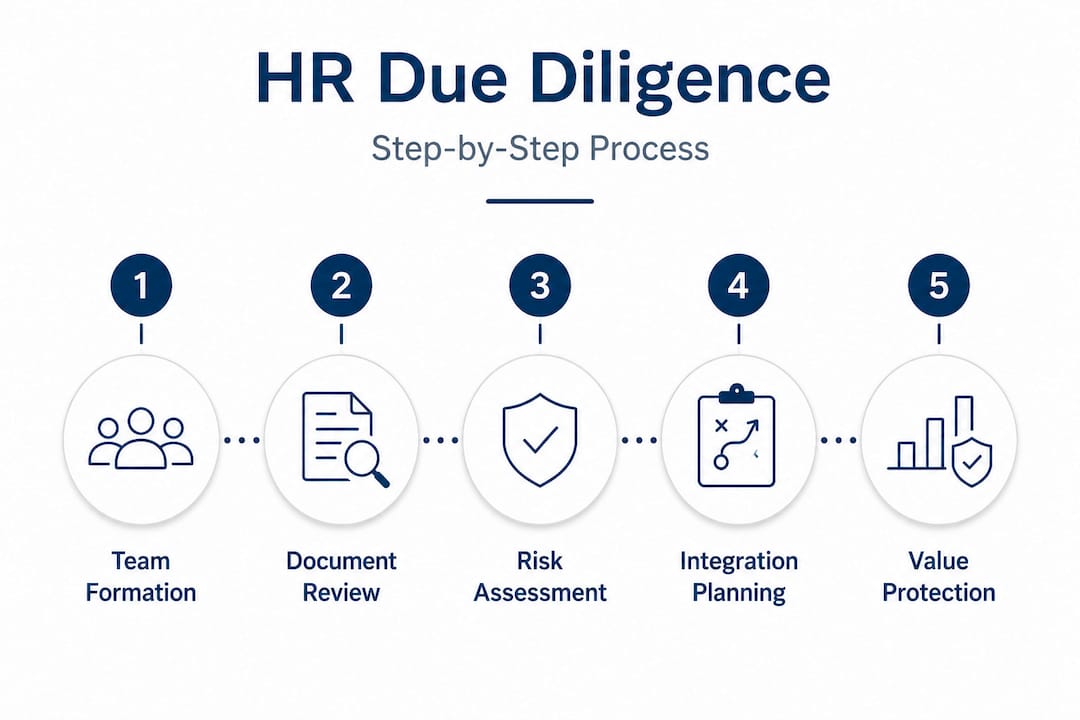
The full HR review typically spans 4 to 8 weeks within a broader deal timeline that ranges from six months to two years depending on transaction complexity. Here is how that breaks down in practice:
| Phase | Activities | Typical Timing |
|---|---|---|
| Team formation | Assign HR, legal, and finance reviewers; define scope and data requests | Week 1 |
| Data collection and high-level review | Gather employment contracts, org charts, payroll summaries, and policy documents | Weeks 2 to 3 |
| Detailed analysis | Review 24 to 36 months of payroll data, benefits obligations, compliance records, and culture indicators | Weeks 3 to 6 |
| Reporting | Compile risk register, financial exposure summary, and compliance gap report | Week 7 |
| Integration planning | Use findings to design retention programs, compliance remediation, and culture alignment strategy | Week 8 and beyond |
The documentation requests in phase two are substantial. A thorough HR due diligence checklist includes employment contracts, payroll data covering 24 to 36 months, visa and work permit verification, benefit plan documents, and org charts by department. Skipping any of these creates blind spots that tend to resurface as post-close surprises.
Technology is changing how this work gets done. AI tools can review large volumes of contracts to flag HR risks and non-standard terms with speed that humans cannot match manually. However, experienced HR professionals are still required to interpret what those flags actually mean for a specific transaction. AI accelerates the process. It does not replace judgment.
Pro Tip: Request payroll data in raw export format rather than summary reports. Summary reports often mask irregular pay patterns, off-cycle bonuses, or classification inconsistencies that only appear when you look at transaction-level data.
Thinking about HR reporting structures early in the process also helps you model what the combined organization will look like post-close, which makes integration planning far less reactive.
How strategic HR due diligence protects value after the deal
Running a thorough HR review is not just about uncovering problems. When done well, the HR due diligence process becomes a blueprint for post-merger success. This is where the importance of HR due diligence shifts from defensive to strategic.
Here is how findings translate into outcomes:
- Compliance gap remediation: When you know exactly where the target organization falls short on wage and hour compliance, contractor classification, or policy documentation, you can build remediation into the integration plan and budget for it. Surprises become line items. A practical HR compliance checklist can anchor this work during the post-close phase.
- Retention strategy design: Due diligence data tells you who the critical employees are, what motivates them, and whether current compensation structures will retain them through a transition. You can design targeted retention bonuses or equity arrangements before close rather than scrambling after talent starts walking.
- Culture integration planning: Effective HR due diligence should go beyond checklists to evaluate culture, leadership, and how teams will experience post-deal changes. When you understand both cultures in detail, you can design an integration approach that preserves what works in each rather than defaulting to "our way is the right way." Understanding why cultural alignment matters is foundational to making this work in practice.
- Benefits harmonization: Mismatched benefits packages create immediate resentment among acquired employees. Due diligence data lets you model the cost of harmonizing plans before close, so the decision is informed rather than reactive.
- HR technology integration: Knowing the target's HR systems before close lets you plan the data migration, avoid duplicate systems, and build a realistic timeline for getting everyone onto a unified platform. A clear HR software implementation plan prevents weeks of operational disruption post-close.
The organizations that get this right treat HR due diligence findings as inputs to a people strategy, not just a risk report to file away.
My take on where most teams get this wrong
In my experience working with business owners and HR teams through transactions, the most consistent failure is not missing a document. It is treating HR due diligence as a compliance exercise rather than a strategic one. Teams produce a checklist, tick the boxes, and declare it done. Then they close the deal and wonder why the acquired team is disengaged six months later.
Many organizations mistakenly treat HR due diligence as a checklist rather than a strategic evaluation of workforce and culture dynamics. I have seen this firsthand in situations where the numbers looked clean but the culture was deeply misaligned. No checklist catches the fact that the acquired leadership team only stayed because the deal included earnout provisions, and the moment those provisions expired, they left. The workforce followed.
What I have found actually works is bringing HR expertise into the deal team before the formal due diligence phase begins. The preliminary conversations, the informal observations, the questions asked during management meetings, all of these surface information that no data room document will ever reveal. Edward Breen said it plainly: the human capital side of megamergers is the most important, because people drive business performance beyond numbers and contracts.
If you are a business owner in Texas approaching an acquisition and HR is not at the table from day one, you are already behind. The signs that you need an HR consultant do not get more obvious than when a multimillion-dollar transaction is on the line.
— John
How Quickhrtx supports your HR due diligence needs
Quickhrtx provides fractional HR consulting to small and mid-sized businesses across Dallas-Fort Worth, including strategic support for M&A transactions. Whether you are preparing for an acquisition, integrating a newly acquired workforce, or navigating compliance gaps surfaced during a review, Quickhrtx brings SHRM-certified expertise without the overhead of a full-time HR department. The team understands Texas employment law and the real-world complexity of workforce integration. If you are ready to approach your next transaction with a people strategy that actually protects deal value, explore fractional HR consulting in Dallas or visit Quickhrtx to book a free consultation today.
FAQ
What does HR due diligence mean in an M&A deal?
HR due diligence is a structured evaluation of a target company's workforce, employment contracts, HR compliance, compensation, benefits, and culture. It identifies people-related risks that could affect deal value or post-close integration.
How long does the HR due diligence process take?
The HR due diligence process typically takes 4 to 8 weeks and is conducted within a broader M&A timeline that can range from six months to two years depending on the complexity of the transaction.
What is included in an HR due diligence checklist?
A thorough HR due diligence checklist covers employment contracts, 24 to 36 months of payroll data, benefits and pension plans, work authorization verification, compliance records, organizational charts, and culture assessment data.
Why does HR due diligence matter beyond legal and financial review?
Financial and legal reviews do not capture how a workforce will actually perform post-close. HR due diligence identifies retention risks, cultural misalignment, and compliance gaps that directly determine whether an acquisition delivers its projected value.
Can small businesses benefit from HR due diligence?
Yes. Any business involved in an acquisition, whether as buyer or seller, benefits from a thorough HR review. Small and mid-sized businesses often carry the highest concentration of undocumented HR risk precisely because formal HR functions are underdeveloped.