

An HR Business Partner (HRBP) is defined as a strategic advisor who aligns people practices directly with business objectives to drive organizational performance. Unlike a traditional HR manager focused on payroll, compliance, and administrative tasks, the HRBP sits inside the business and shapes how talent strategy connects to revenue goals. For small to mid-sized companies in Texas and beyond, this distinction is not academic. It determines whether HR becomes a growth engine or stays a back-office function. HRBPs typically require 6 to 10 years of progressive experience and embed within business units to deliver tailored strategic advice. That depth of expertise is exactly what growing organizations need before problems become expensive.
How does the role of an HR business partner differ from traditional HR managers?
The clearest way to understand the HRBP role is through contrast. A traditional HR manager handles the operational infrastructure of employment: onboarding paperwork, benefits administration, payroll accuracy, and regulatory compliance. An HRBP handles the strategic questions that determine whether your workforce is built to support where the business is going next year.
HRBPs drive business outcomes through people rather than simply executing HR processes. That means workforce planning, organizational design, leadership coaching, and succession strategy. It also means sitting in leadership meetings, not just responding to tickets from department heads.

The table below captures the core differences:
| Dimension | Traditional HR manager | HR Business Partner |
|---|---|---|
| Primary focus | Operational and compliance tasks | Strategic people and business alignment |
| Organizational position | Centralized HR department | Embedded within specific business units |
| Key responsibilities | Payroll, benefits, I-9 compliance | Workforce planning, leadership coaching, talent strategy |
| Skills emphasis | Process management, employment law | Business acumen, data analysis, strategic consultation |
| Success metric | Policy adherence, error reduction | Business unit performance, retention, engagement |
The skills gap between the two roles is significant. Transitioning an HR Generalist to HRBP without strong business acumen fails to capture the HRBP's strategic value. Understanding unit operations and revenue drivers is not optional. It is the entire point.
- HRBPs develop deep organizational context by embedding within specific teams
- They advise senior leaders on talent decisions with measurable business consequences
- They use workforce data to identify patterns, not just report headcount numbers
- They connect individual employee issues to broader organizational health signals
Pro Tip: If your HR function spends more than 60% of its time on administrative tasks, you likely have an HR Generalist doing an HRBP's job title. Audit the actual work before hiring.
What are the core functions of HR business partners in organizational development?
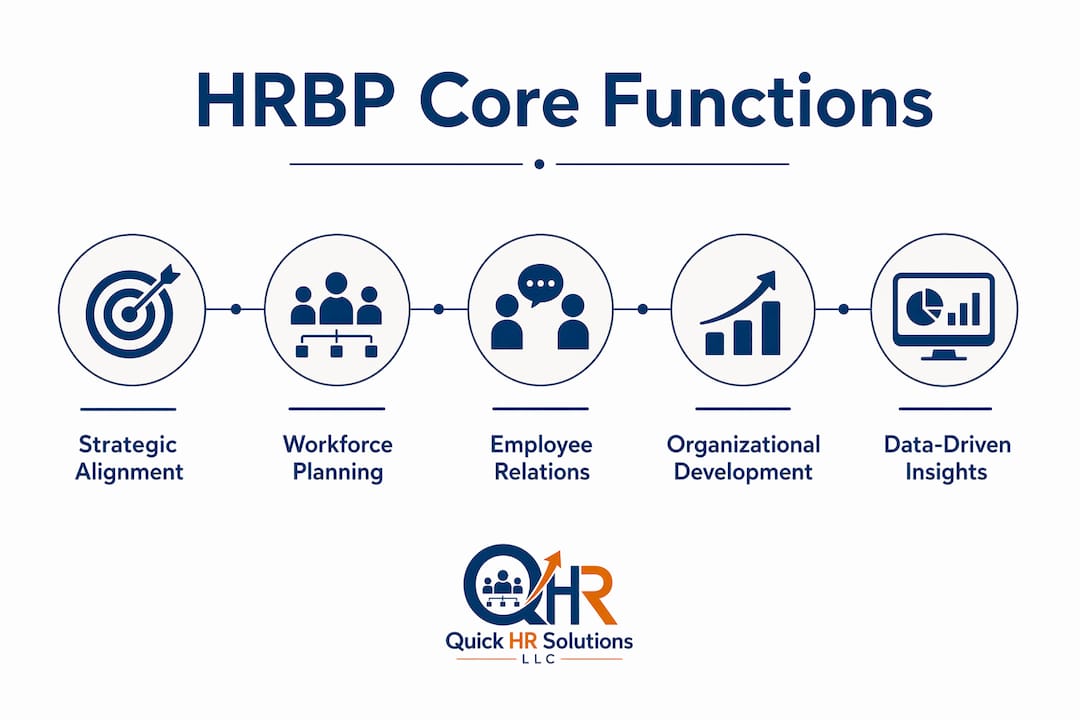
The functions of an HR Business Partner span a wider range than most business leaders expect. The role blends strategic foresight with hands-on problem-solving, and the best HRBPs move between both without losing altitude.
Here are the primary responsibilities that define the position:
-
Strategic workforce planning. HRBPs analyze current talent against future business needs and identify gaps before they become hiring crises. This includes succession planning for key roles and building talent pipelines.
-
Organizational diagnosis. When a business unit underperforms, the HRBP investigates whether the cause is structural, cultural, or talent-related. They recommend redesigns, not just training programs.
-
Complex employee relations. HRBPs handle sensitive investigations and restructuring planning with strategic foresight, connecting individual cases to organizational patterns. A harassment investigation is not just a compliance event. It is a signal about management culture.
-
Leadership coaching. HRBPs coach senior managers on topics like communication style, retention risk, and team dynamics. This requires credibility earned through business understanding, not just HR credentials.
-
Data-driven talent insights. Data fluency distinguishes strategic HRBPs from process-focused HR staff. Reading attrition trends, engagement scores, and performance distributions allows HRBPs to make recommendations that hold up in a boardroom.
-
Culture and engagement strategy. HRBPs design and monitor programs that keep employees connected to the organization's mission. This is especially critical in small businesses where culture shifts quickly when even one or two key people leave.
-
Talent acquisition strategy. Beyond posting jobs, HRBPs define what profiles the business actually needs, build employer brand positioning, and align hiring with long-term workforce plans.
Pro Tip: The best HRBPs set a clear boundary between strategic work and transactional HR. If your HRBP is spending significant time processing paperwork, pair them with an HR coordinator or invest in HR technology tools to free their capacity for higher-value work.
When should small to mid-sized businesses consider hiring an HR business partner?
Timing matters more than most owners realize. Hiring an HRBP too early wastes budget on strategic capacity the organization is not ready to use. Waiting too long means compliance failures, cultural drift, and turnover costs that compound quietly.
Replacing a salaried employee can cost 50% to 200% of their annual salary. That figure reframes the cost of an HRBP from an overhead expense to a retention investment. Most small business owners do not run that math until after a costly departure.
Businesses typically justify a full-time HRBP at 40 to 50 employees with consistent HR needs, after first implementing HR software and fractional or outsourced HR support. Before that threshold, the economics favor a lighter model. After it, the risks of operating without strategic HR guidance outweigh the cost.
Signs your business is ready for an HRBP or equivalent strategic HR support:
- Employee count is approaching or has passed 40 people
- You are spending more than 10 hours per week on HR-related decisions as an owner or manager
- Turnover has increased without a clear explanation
- You have had two or more employee relations incidents in the past 12 months
- You are planning a significant expansion, acquisition, or restructuring
- Managers are making inconsistent people decisions across departments
- You cannot clearly articulate your talent strategy for the next 18 months
Owners who overestimate their ability to manage HR increase compliance risk and administrative burden simultaneously. Strategic HR frees leadership time by handling complex employee issues while aligning people strategy with business goals. That is not a soft benefit. It is a direct contribution to capacity and focus.
For businesses not yet at the 40-employee mark, outsourcing HR functions or engaging a fractional HRBP provides strategic guidance without the full-time cost. This model works especially well for companies in rapid growth phases where HR needs are real but unpredictable.
How can businesses effectively integrate an HR business partner to maximize impact?
Hiring an HRBP and integrating one are two different achievements. Many organizations bring in strong HR talent and then underutilize it by keeping the HRBP at arm's length from real business decisions.
HRBPs embed directly within business units to develop deep organizational context and tailor HR solutions to specific operational realities. This means the HRBP needs a seat at leadership team meetings, access to business performance data, and a direct reporting relationship with the business unit leader, not just the HR director.
Credibility with senior management is built through demonstrated business understanding. An HRBP who speaks the language of revenue, margin, and customer retention earns trust faster than one who leads with HR frameworks. Successful HRBPs maintain strategic altitude while retaining operational credibility, acting as a communication link between management and employees. That balance is what makes the role work in practice.
Technology also matters. HR analytics platforms like Workday, BambooHR, and Rippling give HRBPs the data infrastructure to move from intuition to evidence. When an HRBP walks into a leadership meeting with attrition trend data segmented by manager, tenure, and department, the conversation changes. HRBPs skilled at reading workforce data identify trends and provide recommendations that directly impact talent strategy and organizational effectiveness.
Continuous skill development keeps HRBPs current. SHRM-CP and SHRM-SCP certifications provide a recognized framework for HR competency. Pairing those credentials with business education, whether through formal programs or structured exposure to financial and operational decision-making, produces the business acumen that separates good HRBPs from great ones.
Pro Tip: Avoid the common mistake of assigning your HRBP to a single large project at onboarding. Instead, give them a 90-day listening tour across all business units before asking for strategic recommendations. The insights they surface will be far more accurate and trusted.
Key takeaways
The role of an HR Business Partner creates measurable organizational value only when the HRBP has genuine access to business strategy, workforce data, and leadership decision-making.
| Point | Details |
|---|---|
| HRBP vs. HR manager | HRBPs focus on strategic alignment; HR managers handle operational and compliance tasks. |
| Hiring threshold | Most small businesses justify a full-time HRBP at 40 to 50 employees with consistent HR needs. |
| Core functions | Workforce planning, leadership coaching, employee relations, and data-driven talent strategy define the role. |
| Integration success | Embed HRBPs within business units and give them access to performance data and leadership meetings. |
| Cost of inaction | Replacing one salaried employee costs 50% to 200% of their annual salary, making HR investment a financial decision. |
Why the HRBP conversation is changing for small businesses
I have worked with enough small business owners in the Dallas-Fort Worth area to recognize a consistent pattern. They hire their first HR person when something goes wrong, not when the business is ready to grow. A termination goes sideways, a complaint surfaces, or a key manager quits and takes half the team. That reactive posture is expensive, and it is entirely avoidable.
The HRBP role is not a luxury for enterprise companies. It is a growth tool that small businesses chronically underinvest in. What I have seen work is bringing in fractional HRBP support at the 20 to 30 employee mark, well before the 40-employee threshold that most guidelines cite. At that stage, the cost is manageable and the strategic value is immediate. You get someone who can build the people infrastructure before the cracks appear, not after.
The other shift I keep observing is how much the role depends on business acumen rather than HR credentials alone. The HRBPs who make the biggest difference in growing organizations are the ones who understand how the business makes money. They do not just know employment law. They know why the sales team is underperforming and what the hiring profile needs to look like to fix it. That combination is rare and worth investing in.
The HRBP role continues to evolve as organizations face talent shortages and workplace changes, with technology and analytics becoming central to the work. The businesses that treat HR as a strategic function now will have a structural advantage in talent markets that are only getting more competitive.
— John
How Quickhrtx supports your HR business partner needs
Quickhrtx provides fractional HR consulting in Dallas designed specifically for small to mid-sized businesses that need strategic HR expertise without the overhead of a full-time hire. Whether you are approaching the 40-employee threshold, managing a growth phase, or dealing with complex employee relations issues, Quickhrtx delivers SHRM-certified HR Business Partner support tailored to your stage and industry. You get the strategic depth of an experienced HRBP, the compliance knowledge to protect your business, and a partner who understands the Texas market. Book a free consultation to find out exactly where your HR strategy has gaps and how to close them.
FAQ
What is the primary role of an HR business partner?
An HR Business Partner serves as a strategic advisor who aligns people practices with business objectives to improve organizational performance. Unlike traditional HR managers, HRBPs embed within business units and focus on workforce planning, leadership coaching, and talent strategy.
How many employees do you need before hiring an HR business partner?
Most businesses justify a full-time HRBP at 40 to 50 employees with consistent HR needs. Before that threshold, fractional HR support or HR software typically provides a better return on investment.
What skills does an effective HR business partner need?
Strong HRBPs combine business acumen with HR expertise, including data analysis, strategic consultation, and leadership coaching. SHRM-CP or SHRM-SCP certification signals a recognized level of HR competency, but understanding how the business unit generates revenue is equally critical.
How does an HR business partner add value to a small business?
HRBPs reduce costly turnover, manage complex employee relations before they become legal issues, and free leadership time from HR administration. Given that replacing one salaried employee can cost up to 200% of their annual salary, the financial case for strategic HR support is direct.
What is the difference between an HR business partner and an HR generalist?
An HR Generalist handles a broad range of operational HR tasks across the organization. An HRBP focuses on strategic alignment within a specific business unit, requiring deeper business acumen and a more consultative relationship with senior leadership.