

A SHRM certification study plan is a structured timeline, resource set, and method framework that prepares HR professionals to pass the SHRM-CP exam with confidence. The SHRM-CP exam contains 134 questions (110 scored) to be completed in 4 hours, with a global pass rate around 68%. That pass rate means roughly one in three candidates fails without adequate preparation. A well-built plan built around the SHRM BASK framework and Situational Judgment Items (SJIs) closes that gap significantly. This guide walks you through exactly how to build one, week by week.
How many hours does a SHRM certification study plan require?
The standard recommendation is 8–12 weeks of study at 8–12 hours per week, totaling roughly 100–120 hours. That range is not arbitrary. It reflects the breadth of the SHRM BASK framework, which covers behavioral competencies and HR knowledge domains across People, Organization, and Workplace categories.
Your experience level determines where you land in that range. HR professionals with five or more years of generalist experience can often work through a focused 8-week plan. Candidates newer to the field, or those who specialize in a narrow HR function, benefit from extending to 12 or even 16 weeks. Rushing a 16-week plan into 6 weeks produces surface-level knowledge that collapses under SJI pressure.
Consistency beats intensity every time. Candidates who study in regular, manageable blocks retain more than those who cram over a long weekend. A daily 90-minute session on weekdays, combined with a 2–3 hour block on weekends, builds the kind of durable knowledge the exam actually tests.
- 8-week plan: Best for experienced HR generalists with broad domain exposure
- 10-week plan: Solid fit for mid-level HR professionals with some knowledge gaps
- 12-week plan: Recommended for most candidates balancing full-time work
- 16-week plan: Right for newer HR professionals or those with limited study time per week
Pro Tip: Block your study sessions in your calendar the same way you block meetings. Treat them as non-negotiable. Candidates who schedule study time in advance are far less likely to skip sessions when work gets busy.
What tools and resources does an effective study plan need?
The SHRM BASK document is the single most important resource you can use. It maps every competency and knowledge domain tested on the exam. Without it, you are studying blindly. Download it before you open any other material and use it as your content checklist throughout your preparation.
Practice question banks focused on SJIs are your second priority. SJIs represent 35–40% of exam questions and are the primary reason candidates fail. These questions do not test memorized facts. They test your judgment in realistic HR scenarios, which requires a different kind of preparation than reading a textbook.
The official SHRM Learning System is worth considering for candidates who want a single, integrated resource. It correlates with improved pass rates and costs $800–$1,200 depending on membership status. That price point is not trivial, but it bundles content review, practice questions, and progress tracking in one place.
| Resource | Primary Use | Best For |
|---|---|---|
| SHRM BASK document | Content roadmap and domain mapping | All candidates |
| Diagnostic practice exam | Baseline assessment and gap identification | Week 1 |
| SJI question bank | Situational judgment skill building | Weeks 7–9 |
| SHRM Learning System | Integrated content and practice | Candidates wanting one resource |
| Study group or peer network | Accountability and scenario discussion | Throughout |
A quiet, dedicated study space matters more than most candidates expect. Studying in fragmented environments, like a noisy break room or while half-watching TV, reduces retention. Treat your study space like a work environment. Close the browser tabs, silence the phone, and commit to the session.
How to structure your study schedule week by week
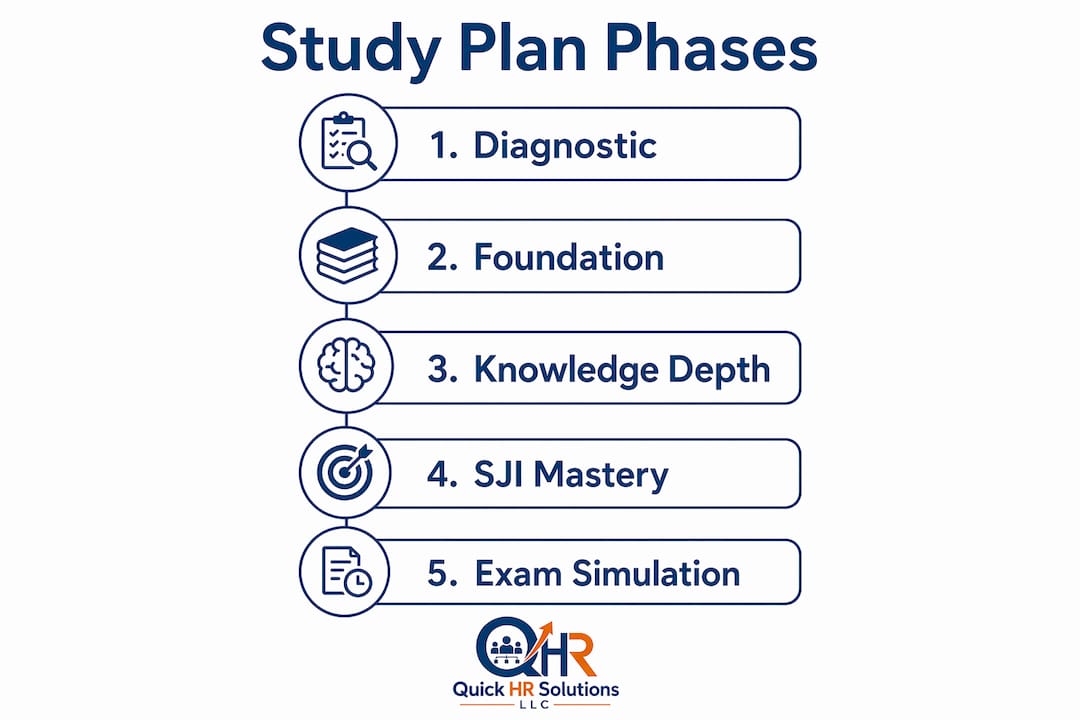
A phased approach works better than reading straight through the BASK from page one to the end. Each phase builds on the last, moving from diagnosis to depth to application to simulation.

Phase 1: Diagnostic and foundation (weeks 1–3)
Start week one with a full diagnostic practice exam. Do not study first. Take the exam cold to get an honest baseline. Your results will show you exactly which BASK domains need the most attention. Candidates who skip this step waste weeks reviewing content they already know.
Weeks two and three focus on the People domain, which covers talent acquisition, employee engagement, and total rewards. This domain tends to be more familiar to most HR professionals, making it a good place to build momentum before tackling harder material.
Phase 2: Knowledge depth (weeks 4–6)
Weeks four through six shift to the Organization and Workplace domains. The Organization domain includes structure, technology, and HR in the global context. The Workplace domain covers risk management, employee relations, and U.S. employment law.
The Business Acumen competency deserves extra attention here. It requires you to evaluate financial impacts like cost-per-hire and ROI, not just describe HR programs. Many candidates underestimate this shift from technical HR knowledge to financial thinking. Spend at least two sessions in this phase working through financial metric scenarios.
Phase 3: SJI mastery (weeks 7–9)
This phase is where most candidates either separate themselves from the pack or fall behind. Practice 20–30 SJI questions daily. Do not just check whether you got the answer right. Read every rationale, for both correct and incorrect choices. Understanding the rationale tells you which competency the question is testing, which is the actual skill the exam measures.
SJI practice also builds the mental pattern recognition you need to work quickly under timed conditions. The exam gives you roughly 1.8 minutes per question. Candidates who have seen hundreds of SJI scenarios in practice move through them with far more confidence on exam day.
Phase 4: Exam simulation (weeks 10–12)
Take at least two full-length timed practice exams in the final phase. Simulate real conditions: no phone, no breaks beyond what the actual exam allows, and a quiet room. After each exam, spend as much time reviewing your results as you spent taking the test. Target your weakest domains with focused remediation sessions before the next simulation.
- Take a full timed practice exam under real conditions
- Score your results by domain, not just overall percentage
- Identify the two or three weakest domains
- Spend two to three focused sessions on those domains
- Repeat with a second full practice exam before your scheduled test date
Pro Tip: If your practice exam scores plateau, switch your SJI source. Seeing the same question formats repeatedly creates false confidence. A fresh question bank forces you to apply judgment rather than recognize patterns.
Weekday sessions work best for content review and short SJI sets. Weekend blocks are the right time for longer practice exams and domain deep dives. Candidates who balance weekday and weekend sessions consistently report less burnout and better retention heading into the final weeks.
What are the most common SHRM exam preparation mistakes?
Most candidates who fail the SHRM-CP make the same handful of mistakes. Recognizing them early keeps your study plan on track.
- Memorizing instead of understanding. The SHRM-CP tests applied judgment, not recall. Memorizing definitions does not prepare you for SJIs. Focus on understanding why a competency matters in a real HR situation.
- Skipping SJI rationale review. Tallying correct answers without reading the rationale is the single biggest study mistake. The rationale explains the competency being tested, which is the knowledge you actually need.
- Ignoring your diagnostic results. Candidates who skip the baseline exam or ignore weak domains spend too much time on content they already know. Your diagnostic is a map. Use it.
- Studying without timed conditions. Reading through practice questions without a clock creates a false sense of readiness. The 4-hour exam window is tighter than it sounds. Practice under time pressure from week seven onward.
- Setting an unrealistic schedule. A plan that requires three hours of study every weeknight is not sustainable for a working HR professional. Burnout in week four means no preparation in weeks ten through twelve. Build a schedule you can actually keep.
The SHRM certification benefits extend well beyond the credential itself, but only if you pass. A realistic, consistent plan protects that investment.
Key Takeaways
A structured SHRM certification study plan built around the BASK framework, diagnostic assessment, and daily SJI practice is the most reliable path to passing the SHRM-CP on the first attempt.
| Point | Details |
|---|---|
| Study duration | Plan for 100–120 total hours across 8–12 weeks based on your experience level. |
| Start with a diagnostic | Take a full practice exam on day one to identify weak domains before studying. |
| SJI practice is non-negotiable | Situational Judgment Items make up 35–40% of the exam; practice daily in weeks 7–9. |
| Read every rationale | Understanding why an answer is correct or wrong builds the competency the exam measures. |
| Simulate real conditions | Take at least two timed full-length practice exams before your scheduled test date. |
What I've learned from helping HR professionals prepare for SHRM certification
The candidates I've seen succeed share one trait: they treat the SHRM-CP like a professional project, not a personal test. They set a deadline, build a plan, and track their progress the same way they would manage an HR initiative at work.
The biggest mistake I see is skipping the diagnostic exam because it feels uncomfortable to see your gaps laid out in a score report. That discomfort is exactly the point. You cannot fix what you have not measured. The diagnostic is not a judgment. It is a starting point.
SJI practice is the differentiator that most study guides underemphasize. Candidates who spend weeks reading content and then encounter 50 SJI questions on exam day are often caught off guard. The judgment-based format feels different from anything in a textbook. The only way to get comfortable with it is repetition, and the only way repetition pays off is if you read the rationale every single time.
Balancing study with a full-time HR role is genuinely hard. The candidates who manage it best protect their weekend study blocks fiercely and keep weekday sessions short and focused. They also lean on peer groups and study partners for accountability. Talking through a scenario with a colleague who is also preparing often surfaces an insight that solo study misses entirely.
The HR risk management strategies you build through SHRM preparation also translate directly into stronger on-the-job performance. The credential and the competency grow together.
— John
How Quickhrtx supports HR professionals on the path to certification
HR professionals preparing for the SHRM-CP often find that studying for the exam surfaces real gaps in their organization's HR practices. That is where Quickhrtx comes in.
Quickhrtx provides fractional HR consulting to small and mid-sized businesses across the Dallas-Fort Worth area. The team holds SHRM-CP and SHRM-SCP certifications, which means the guidance you receive is grounded in the same competency framework you are studying. Whether you need help building compliant HR processes, managing employee relations, or preparing your organization for growth, Quickhrtx offers the kind of practical, hands-on support that complements your certification journey. Book a free consultation to see how professional HR expertise can work alongside your own development.
FAQ
How long should I study for the SHRM-CP exam?
Most candidates need 100–120 total hours spread across 8–12 weeks. Candidates with less HR experience should extend to 16 weeks to avoid burnout and improve retention.
What is the SHRM BASK and why does it matter?
The SHRM BASK (Body of Applied Skills and Knowledge) is the official framework that defines every competency and knowledge domain tested on the exam. Using it as your study roadmap is the most direct way to align your preparation with what the exam actually measures.
How much does the SHRM-CP exam cost?
Exam fees range from $350 to $499 depending on SHRM membership status and registration timing. The official SHRM Learning System, a separate study resource, costs an additional $800–$1,200.
What are Situational Judgment Items and how do I prepare for them?
SJIs are scenario-based questions that test how you would respond in real HR situations. They make up 35–40% of the exam. The best preparation is daily practice with a dedicated SJI question bank, combined with reading the rationale for every answer, correct or not.
Can I pass the SHRM-CP while working full time?
Yes. Most successful candidates are working HR professionals. The key is a realistic schedule of 90-minute weekday sessions and 2–3 hour weekend blocks, maintained consistently across the full study period.