

HR recordkeeping requirements define the mandatory documentation and retention practices every Texas employer must follow to stay compliant and prepared for audits. Federal agencies including the EEOC, the Department of Labor, and the IRS each set minimum standards. Texas adds its own layer through the Texas Workforce Commission, which conducts audits that directly test the quality of your records. This guide covers what to keep, how long to keep it, and how to build a system that holds up under scrutiny.
What are HR recordkeeping requirements for Texas employers?
HR recordkeeping requirements, also called employee record retention obligations, are the legally mandated rules governing which employment documents you must create, how long you must store them, and how you must protect them. Every Texas employer faces obligations under both federal and state law simultaneously. The EEOC, DOL, IRS, and Texas Workforce Commission each enforce different pieces of this puzzle. Ignoring any one of them creates real audit exposure.
Texas employers also face growing complexity because state mandates increasingly diverge from federal standards, particularly around data privacy, paid leave, and wage transparency. That divergence means a federal compliance checklist alone is no longer enough. You need a Texas-specific lens on every retention decision you make.

What HR documents must Texas employers create and maintain?
A complete personnel file is the foundation of any HR documentation system. Personnel files should contain hiring documents, exempt status designations, pay and salary history, training records, job descriptions, handbook acknowledgments, performance reviews, and disciplinary actions. Each of these categories carries its own retention timeline and audit risk.
The core documents every Texas employer must maintain include:
- Hiring records: Resumes, applications, offer letters, background check authorizations, and signed job descriptions
- Payroll records: Wage rates, hours worked, overtime calculations, and pay stub history
- Tax and benefits records: W-4s, benefit elections, health plan enrollment forms, and COBRA notices
- I-9 forms: Completed for every new hire, stored separately from the main personnel file
- Training records: Completion logs, signed acknowledgments of the employee handbook, and safety training certificates
- Performance and discipline records: Written reviews, performance improvement plans, written warnings, and termination documentation
Keeping these categories physically or digitally separate matters. I-9 forms, for example, must be stored apart from personnel files to prevent immigration status information from influencing employment decisions.
Pro Tip: Create a new hire documentation checklist that triggers automatically on day one. Missing a single form at onboarding is far harder to fix six months later than it is to catch in the first week.
How long should you keep HR records under Texas and federal law?
Retention timelines vary widely by document type, and federal retention periods range from 1 to 30 years depending on the category. The table below shows the most common document types and their required retention windows.
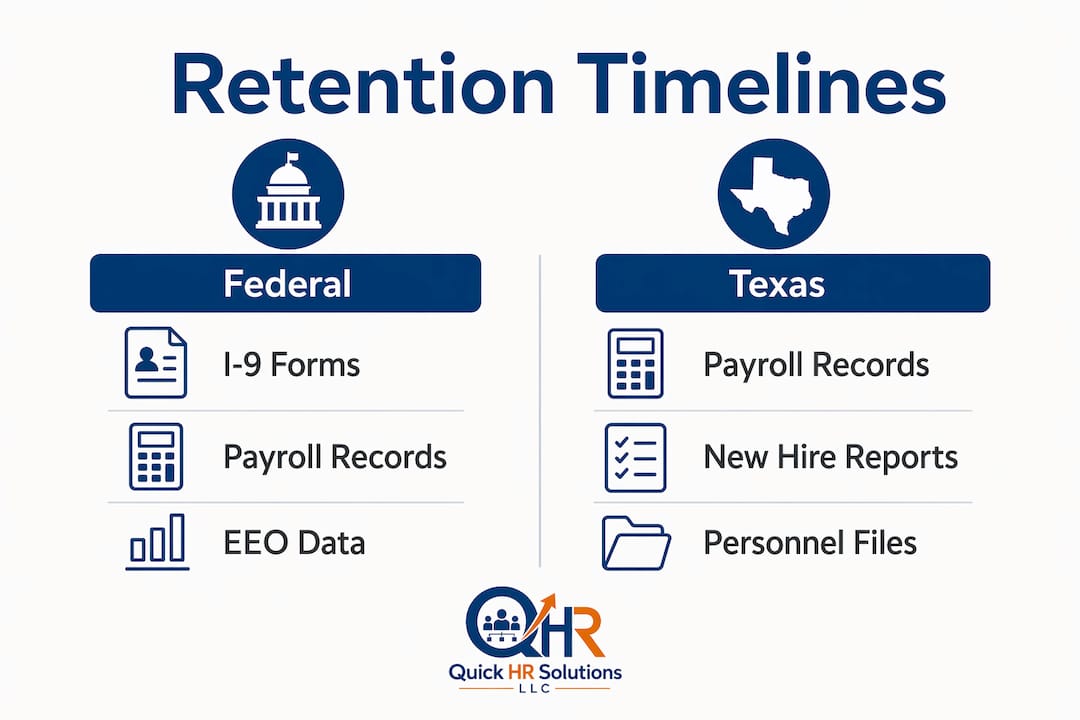
| Document Type | Federal Requirement | Texas Requirement |
|---|---|---|
| I-9 forms | 3 years from hire or 1 year after termination, whichever is later | Same as federal |
| Payroll records | At least 3 years | 3–4 years minimum |
| Tax records | 4 years | Same as federal |
| Benefits records | 6 years | Same as federal |
| OSHA records | 5 years | Same as federal |
| New hire reports | N/A | Submit within 20 calendar days to the Office of the Attorney General |
Texas employers must retain payroll records for at least 3–4 years and submit new hire reports within 20 calendar days. Missing that new hire reporting window is a common compliance gap that surfaces quickly during Texas Workforce Commission audits.
The practical standard most compliance professionals use is the seven-year rule: retain all employment records for a minimum of seven years after an employee's separation. This single threshold covers the majority of federal and Texas requirements without requiring you to track separate timelines for every document category. It is a conservative but defensible approach.
Pro Tip: Set your document destruction schedule to trigger only after a legal hold review. One pending wage claim or EEOC charge can make destroying a record a serious legal problem, even if the standard retention period has passed.
Best practices for organizing and maintaining HR documentation
A well-organized recordkeeping system does not happen by accident. It requires defined ownership, written policies, and scheduled reviews. Follow these steps to build a system that stays compliant year-round.
-
Assign document ownership. Every record category needs a named owner and a backup. Payroll records belong to payroll. Personnel files belong to HR. No owner means no accountability when an audit request arrives.
-
Write a formal retention policy. A written retention policy should define which records you keep, how you store them, who the custodians are, and when destruction is permitted. Without a written policy, your practices are informal and indefensible.
-
Document every workflow decision. Maintain clear audit trails for every documentation decision, and manage exceptions regularly. One-off deviations from policy become informal norms if you do not track and review them.
-
Use digital tools for storage and access control. HR software supports automated retention scheduling, audit trails, and access tracking. A digital system also makes responding to audit requests dramatically faster than searching through paper files.
-
Build a compliance calendar. Schedule quarterly document reviews and an annual full audit. Put them on the calendar at the start of each year so they do not get displaced by other priorities.
-
Prioritize your highest-risk workflows first. Rank document workflows by frequency, impact, and auditability and fix the top three before moving to lower-risk categories. Trying to fix everything at once usually means fixing nothing well.
This structured approach to HR documentation rules gives you a defensible system rather than a reactive one.
What are the most common HR recordkeeping mistakes?
Most recordkeeping failures come from predictable, avoidable gaps. Knowing them in advance is the fastest way to close them.
- Keeping records for too short a time. Many employers default to the federal minimum without checking Texas-specific requirements. The result is premature destruction of records that a state audit still needs.
- No clear ownership or accountability. When everyone is responsible for a record, no one is. Missing documents during an audit almost always trace back to unclear ownership.
- Skipping scheduled audits. Annual audits reveal missing documentation and outdated policies before regulators do. Skipping them means problems compound silently.
- Losing data during system migrations. Migrating payroll or HR systems risks losing historical payroll calculation data that is critical for defending wage claims. Any migration plan must include a complete data preservation requirement.
- Ignoring Texas-specific nuances. Texas employers who rely only on federal guidance miss state-level obligations around new hire reporting, payroll retention, and Texas Workforce Commission audit standards.
The HR compliance checklist approach works only when you treat it as a living document, not a one-time exercise.
How do you stay audit-ready and compliant year-round?
Compliance is not a fixed state. It requires ongoing attention, regular updates, and adjustments as laws change. These practices keep Texas employers prepared at all times.
- Conduct an annual HR compliance self-audit. Review all active personnel files, confirm retention schedules are current, and verify that no records have been destroyed prematurely. An annual compliance review catches gaps before they become penalties.
- Update employee handbooks and policy documents regularly. Texas and federal law change. A handbook that was accurate two years ago may now create liability. Review it at least once per year.
- Train managers on documentation standards. Managers create disciplinary records, performance reviews, and termination documentation. If they do not know the standard, the records they create will not hold up under scrutiny.
- Use your HRIS for workflow automation and alerts. Set automated reminders for retention deadlines, new hire reporting windows, and annual review dates. Manual tracking fails under volume.
- Monitor Texas Workforce Commission guidance. The TWC updates its audit standards and reporting requirements periodically. Staying current with TWC guidance is a direct line to avoiding audit exposure.
Pro Tip: Treat every manager as a compliance participant, not just an HR consumer. When managers understand why documentation standards exist, they produce better records without being reminded.
Key Takeaways
Texas employers who follow structured HR documentation and retention practices reduce their audit exposure and build a defensible compliance record across both federal and state requirements.
| Point | Details |
|---|---|
| Define retention timelines clearly | Use the seven-year rule as a baseline; verify Texas-specific requirements for payroll and new hire reports. |
| Assign document ownership | Every record category needs a named custodian and a backup to prevent gaps during audits. |
| Write a formal retention policy | A written policy covering storage, custodians, and destruction schedules makes compliance defensible. |
| Prioritize high-risk workflows first | Rank workflows by impact and auditability; fix the top three before addressing lower-risk categories. |
| Schedule annual audits | Regular self-audits catch missing documentation and outdated policies before regulators do. |
What I have learned from Texas HR recordkeeping in the field
The most common mistake I see Texas employers make is treating recordkeeping as a filing problem rather than a risk management problem. They focus on where documents live instead of whether the right documents exist at all. That mindset shift matters more than any software purchase.
The second lesson is harder to sell: ownership without accountability is worthless. I have worked with companies that had beautiful HRIS systems and still failed audits because no one could confirm who was responsible for updating a specific record category. The system was there. The person was not.
System migrations deserve far more attention than they get. When a company switches payroll platforms, the historical wage calculation data from the old system often gets archived in a format that is practically inaccessible. That data is exactly what you need to defend a wage claim. I now treat data migration planning as a compliance event, not just an IT project.
The practical framework that works: start with your three highest-risk documentation workflows, assign an owner to each, build a written policy around them, and schedule a review date. Do that before you try to fix everything else. Compliance built in layers holds up far better than compliance built all at once.
— John
How Quickhrtx supports Texas employers with recordkeeping compliance
Texas employers navigating federal and state documentation requirements do not have to build their compliance systems alone. Quickhrtx provides fractional HR consulting built specifically for small and mid-sized businesses in the Dallas-Fort Worth area and across Texas.

Quickhrtx helps you develop written retention policies, assign documentation ownership, and prepare for Texas Workforce Commission audits. The team holds SHRM-CP and SHRM-CPC certifications and brings direct experience with Texas labor law compliance. Whether you need a full HR documentation audit or ongoing support for your Dallas-area HR operations, Quickhrtx offers a free consultation to identify your highest-risk gaps and build a plan to close them.
FAQ
What records must Texas employers keep?
Texas employers must maintain personnel files, payroll records, I-9 forms, tax records, benefits documentation, training records, and disciplinary files. Each category carries its own federal and Texas-specific retention requirement.
How long do Texas employers need to keep payroll records?
Federal law requires payroll records for at least three years, but Texas mandates a minimum of 3–4 years for payroll documentation. Using a seven-year retention standard covers both requirements safely.
What happens if a Texas employer fails to maintain HR records?
Failure to maintain proper records increases audit exposure during Texas Workforce Commission reviews and creates liability in wage claims, EEOC investigations, and DOL audits. Missing records are treated as evidence against the employer in most dispute scenarios.
What is the best way to organize HR records for an audit?
Assign a named custodian to each record category, store I-9 forms separately from personnel files, use digital tools with audit trails, and conduct an annual self-audit to confirm all records are current and complete.
Do Texas employers need to submit new hire reports?
Yes. Texas employers must submit new hire reports to the Office of the Attorney General within 20 calendar days of a new employee's start date. Missing this window is a direct compliance violation.