

Running a business in Texas with under 200 employees means you carry real HR risk every single day you operate without dedicated expertise. The benefits of fractional HR go far beyond cutting costs: they include avoiding five-figure compliance penalties, building a workplace people actually want to stay in, and getting expert-level HR strategy without the salary, benefits, and overhead of a full-time hire. If you've been managing HR yourself or delegating it to an office manager who's already stretched thin, this guide will change how you think about what's possible.
Table of Contents
- Understanding fractional HR: What it is and why it matters for Texas SMBs
- Navigating Texas HR compliance: How fractional HR minimizes costly legal risks
- Boosting employee engagement and culture with expert fractional HR support
- Fractional HR vs full-time HR and PEOs: A practical comparison for Texas SMBs
- Implementing fractional HR in your Texas SMB: Practical steps and expert advice
- Why fractional HR is the future of strategic HR management for Texas SMBs
- How Quick HR Solutions supports Texas SMBs with expert fractional HR services
- Frequently asked questions
Key Takeaways
| Point | Details |
|---|---|
| Cost-effective HR | Fractional HR provides expert-level HR services to Texas SMBs at a fraction of full-time employee costs. |
| Compliance assurance | Fractional HR helps Texas businesses avoid costly penalties by ensuring adherence to complex state laws like SB 45. |
| Enhanced engagement | Fractional HR leaders leverage diverse experience to build stronger workplace culture and improve employee engagement. |
| Flexible support | Fractional HR scales with your business needs, from part-time foundational help to smooth transition toward full-time HR. |
| Faster onboarding | Fractional HR onboarding for Texas SMBs typically takes weeks, enabling quicker response to compliance and operational needs. |
Understanding fractional HR: What it is and why it matters for Texas SMBs
Fractional HR is exactly what it sounds like: you get a seasoned HR professional working for your business on a part-time or project basis, typically through a subscription or retainer model. You're not hiring a temp. You're not outsourcing to a faceless call center. You're bringing in someone with deep HR expertise who works inside your business, knows your people, and builds your HR infrastructure over time.
This model is specifically built for the 10 to 200 employee range. At that size, you're too big to wing it, and too small to justify a $90,000 to $120,000 full-time HR director. Fractional HR is a managed service offering expert support at affordable subscription prices, making it genuinely accessible for Texas SMBs that need real HR without the full-time price tag.
It's also worth separating fractional HR from two common alternatives Texas business owners often consider. A PEO (Professional Employer Organization) co-employs your workforce, which means they take on legal employer responsibilities but also take control away from you. DIY HR means you or your office manager handles everything, which works fine until it doesn't. Here's how the models compare at a glance:
- Fractional HR: Part-time expert embedded in your business, handles compliance, culture, payroll oversight, and employee relations on your behalf
- Full-time HR hire: Dedicated internal employee, high fixed cost, limited cross-industry experience
- PEO: Co-employment model with bundled services, less flexibility, potential loss of employer control
- DIY: Low cost upfront, high risk of compliance gaps, no strategic HR thinking
For a deeper look at how to find the right fit, our fractional HR consultant guide walks through what to look for in a provider.
Navigating Texas HR compliance: How fractional HR minimizes costly legal risks
Texas has a reputation as a business-friendly state, but that reputation can lull SMB owners into a false sense of security. The state has its own specific labor laws that carry real financial consequences when ignored.
Take Texas SB 45 as an example. SB 45 covers all employers with one or more employees and imposes personal liability on managers for sexual harassment, meaning your supervisors can be held individually responsible. Most small business owners have no idea that liability extends to individuals, not just the company. A fractional HR professional ensures your policies, complaint procedures, and manager training all meet this standard before a claim ever surfaces.
Here are the key compliance tasks a fractional HR provider handles to protect your Texas business:
- Employee handbook audits to align policies with current Texas and federal law
- Workers' comp notice posting and documentation to meet Texas Labor Code requirements
- Payday law compliance including proper pay frequency, final paycheck timing, and wage deduction rules
- SB 45 training and policy implementation for all supervisors and managers
- I-9 and E-Verify management for businesses with federal contracts or multi-state employees
- FMLA and ADA guidance for businesses approaching the 50-employee threshold
"Non-compliance fines in Texas can reach tens of thousands of dollars per violation. Fractional HR pays for itself the moment it prevents a single wage claim, harassment lawsuit, or DOL audit finding."
Pro Tip: Before your first fractional HR intake meeting, gather your current employee handbook, the last 12 months of payroll records, a list of any remote or multi-state workers, and any active or resolved employee complaints. This cuts onboarding time significantly and lets your fractional HR professional start identifying gaps immediately.
Our HR compliance checklist for Texas gives you a head start on what to expect.
Boosting employee engagement and culture with expert fractional HR support
Compliance keeps you out of trouble. Culture keeps your people. These two things are not separate problems, and fractional HR addresses both.

One of the most underrated fractional HR advantages is the cross-industry experience these professionals bring. Someone who has worked in manufacturing, healthcare, and professional services has seen what actually works to improve retention, not just what sounds good in a leadership book. Fractional HR leaders bring diverse experience and pattern recognition to solve engagement and culture challenges practically for SMBs. That's a different kind of value than an in-house hire who has only ever worked in your industry.
Here's what a fractional HR professional can deliver on the culture side, even working remotely or part-time:
- Onboarding program design that reduces 90-day turnover, which is where most SMBs lose new hires
- Manager coaching and feedback frameworks that improve team communication without expensive training programs
- Employee surveys and pulse checks with actual analysis and action plans, not just data collection
- Recognition programs tailored to your team size and budget
- Exit interview processes that surface real reasons people leave so you can fix them
These aren't abstract initiatives. They're the kind of employee engagement consulting work that directly impacts your retention rate and your ability to hire. In a tight Texas labor market, that matters.
Pro Tip: Bring your fractional HR professional into leadership meetings early, not just when there's a problem. The more context they have about your business direction, the more targeted their culture recommendations will be.
For a practical framework on building the kind of workplace that retains people, the building company culture guide is worth your time.
Fractional HR vs full-time HR and PEOs: A practical comparison for Texas SMBs
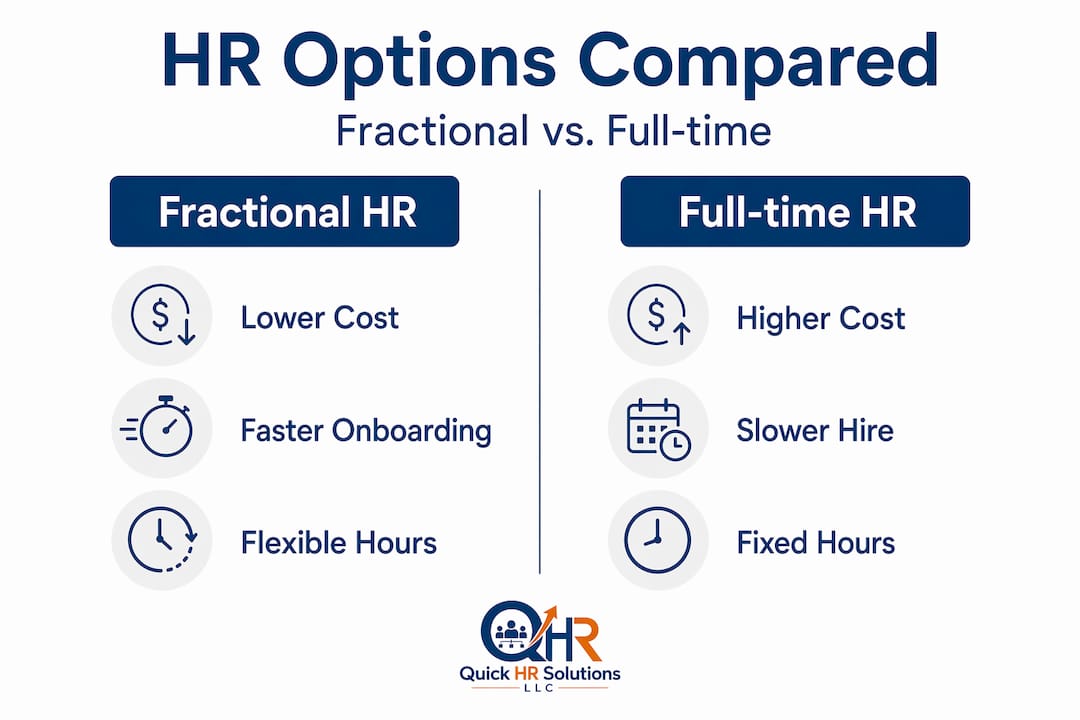
Before committing to any HR model, you need to see the real trade-offs side by side. The table below reflects what Texas SMBs actually experience, not theoretical scenarios.
| Feature | Fractional HR | Full-time HR hire | PEO | DIY |
|---|---|---|---|---|
| Monthly cost | $1,500–$5,000 | $7,500–$12,000+ | $100–$200/employee | Near zero |
| Onboarding speed | 2–4 weeks | 60–90 days | 30–60 days | Immediate |
| Compliance coverage | High | High | Moderate | Low |
| Flexibility | High | Low | Low | High |
| Culture impact | High | High | Low | Low |
| Co-employment risk | None | None | Yes | None |
| Cross-industry insight | High | Low | None | None |
Fractional HR offers lower total cost and faster onboarding compared to hiring full-time HR, while avoiding the co-employment complications that come with PEOs. And state agencies heavily penalize SMBs for non-compliance, making fractional HR's proactive coverage genuinely cost-effective when you factor in risk.
A few honest pros and cons worth knowing:
- Fractional HR pros: Affordable, fast to deploy, expert-level knowledge, no benefits or PTO costs, scales with you
- Fractional HR cons: Not available 40 hours a week, requires clear communication to stay aligned
- Full-time HR pros: Always available, deeply embedded in your culture
- Full-time HR cons: High fixed cost, limited perspective, slow to hire
- PEO pros: Bundled services, employer liability reduction
- PEO cons: Loss of control, co-employment complications, less cultural fit
- DIY pros: Zero cost
- DIY cons: High risk, no expertise, reactive rather than proactive
If you're in the Dallas-Fort Worth area and weighing these options, our HR consulting guide for Dallas small businesses covers local market context.
Implementing fractional HR in your Texas SMB: Practical steps and expert advice
Knowing the benefits of fractional HR is one thing. Getting it set up correctly is another. Here's how to do it right from day one.
- Conduct a needs assessment. Identify your three biggest HR pain points: compliance gaps, turnover, manager effectiveness, or something else. This shapes the scope of your engagement.
- Gather your documentation. Pull together your employee handbook, payroll records, job descriptions, and any active performance improvement plans or complaints.
- Complete a compliance audit in week one. Your fractional HR professional should immediately review your policies against current Texas law and flag critical gaps.
- Align stakeholders. Brief your leadership team on what fractional HR is and is not. Set expectations about response times, communication channels, and decision-making authority.
- Implement priority policies first. Start with the highest-risk areas: harassment, termination procedures, and pay practices.
- Schedule regular check-ins. Weekly or biweekly touchpoints keep your fractional HR professional current on what's happening in your business.
Fractional HR onboarding typically takes 2 to 4 weeks, which is significantly faster than hiring full-time. That speed matters most during compliance-sensitive periods like open enrollment, policy rollouts, or rapid headcount growth.
Pro Tip: Don't treat your fractional HR professional like a vendor you call when something breaks. The businesses that get the most value schedule proactive monthly reviews to assess what's coming, not just what's already happened.
Ready to take the first step? Our fractional HR services in Dallas are built specifically for Texas SMBs at exactly this stage.
Why fractional HR is the future of strategic HR management for Texas SMBs
Here's the perspective most HR articles won't give you: fractional HR isn't a budget compromise. It's often a better strategic choice than hiring full-time, even for companies that could afford a full-time HR director.
When you hire a full-time HR leader, you get one person's experience. That person has likely worked in two or three industries, maybe four. A fractional HR professional who has served 20 clients across manufacturing, retail, healthcare, and professional services has seen 20 different ways the same problem plays out. That pattern recognition is worth more than availability.
Texas SMBs also face a specific challenge: the regulatory environment shifts, and businesses need to respond quickly. When the Texas legislature passes a new employment law, or when a federal rule change affects your workforce, a fractional HR professional who stays current across multiple clients is already ahead of it. An in-house hire who's been heads-down in your business for three years may not be.
"The best fractional HR professionals don't just execute tasks. They bring a strategic perspective shaped by seeing what works and what fails across dozens of organizations. That's a different kind of partner than a vendor."
There's also an overlooked timing advantage. Open enrollment, policy updates, and rapid hiring phases are exactly when compliance risk spikes. A fractional HR professional can surge hours during those windows and scale back when things stabilize. A full-time hire costs the same whether you need them at full capacity or not.
The pattern recognition fractional HR leaders bring helps avoid pitfalls and implement solutions proven across industries, making them invaluable beyond just compliance. If you're serious about building a business that scales, this is the model worth understanding fully. Our fractional HR consultant guide goes deeper on how to evaluate providers.
How Quick HR Solutions supports Texas SMBs with expert fractional HR services
At Quick HR Solutions, we work specifically with Texas SMBs in the Dallas-Fort Worth area and beyond, providing fractional HR specialists who understand the local labor market, Texas-specific compliance requirements, and the real-world challenges of growing a business without a full HR department.
Our fractional HR services cover what you actually need:
- Compliance management: Texas labor law, SB 45 training, handbook audits, and ongoing regulatory monitoring
- Payroll oversight: Review and management through your existing platforms to catch errors before they become violations
- Employee engagement: Onboarding design, manager coaching, and retention-focused culture initiatives
- Culture building: Recognition programs, feedback systems, and leadership alignment
Our team holds SHRM-CP and SHRM-SCP certifications, which means you're working with credentialed professionals, not generalists. Book a free consultation through Quick HR Solutions and we'll assess your current HR gaps and outline exactly what fractional HR would look like for your business. Or explore our fractional HR services in Dallas to see what a typical engagement includes.
Frequently asked questions
What size Texas businesses benefit most from fractional HR?
Fractional HR is ideal for Texas SMBs with 10 to 200 employees who need expert HR support without full-time hire costs. Businesses at this stage get the highest return because they face real compliance exposure but can't justify a six-figure HR salary.
How does fractional HR help with Texas-specific compliance like SB 45?
Fractional HR ensures your policies, manager training, and complaint procedures meet Texas's strict harassment standards before a claim occurs. SB 45 requires immediate corrective action from all Texas employers, regardless of size, making proactive compliance non-negotiable.
Can fractional HR scale as my Texas business grows?
Yes. Fractional HR hours flex with your needs and can increase during high-demand periods like open enrollment or rapid hiring. Many companies use fractional HR to build their HR foundation and then transition to a full-time hire once they reach the scale that justifies it.
What documents should I prepare for fractional HR onboarding in Texas?
Bring your employee handbook, payroll records, job descriptions, and any active employee complaints or performance documentation. Texas-specific onboarding also requires your multi-state worker list and any existing compliance notices to get your audit started immediately.
Does fractional HR handle payroll and benefits administration?
Yes. Fractional HR specialists manage payroll and benefits administration either directly or through your existing platforms, ensuring both accuracy and compliance without requiring you to switch systems.