

Most business owners discover fractional HR the same way: they're drowning in compliance questions, employee relations issues, and onboarding gaps, but can't justify a six-figure HR executive salary. Fractional HR fills exactly that space. It's not a watered-down consulting engagement, and it's not the same as outsourcing your payroll to a vendor. Understanding what is fractional HR, how it differs from a PEO, and whether it actually fits your organization is what separates leaders who get real HR value from those who keep paying for the wrong solution.
Table of Contents
- Key takeaways
- What is fractional HR and how does it work
- PEO vs fractional HR: knowing the difference
- Benefits and honest limitations of fractional HR
- How to select and implement a fractional HR solution
- My take on fractional HR after years in the field
- How Quickhrtx supports mid-sized companies in Dallas
- FAQ
Key takeaways
| Point | Details |
|---|---|
| Fractional HR is not outsourcing | A fractional HR professional works as part of your leadership team, not as an external vendor executing transactions. |
| Cost savings are significant | Fractional HR costs 40-60% less than hiring a full-time HR leader while delivering comparable strategic expertise. |
| No co-employment risk | Unlike a PEO, fractional HR keeps you as the sole employer, which matters for equity structures and company culture control. |
| Scope clarity is non-negotiable | Vague engagements lead to diluted results. Define measurable goals before the first meeting. |
| Best fit for 10-200 employee companies | Multi-state teams in this range gain the most from fractional HR's compliance coverage without PEO constraints. |
What is fractional HR and how does it work
Fractional HR is exactly what it sounds like: you get a senior HR professional, but only the fraction of their time your company actually needs. That might be 10 hours a week, 20 hours a month, or a defined scope of services spread across the year. The professional works inside your organization, attends your leadership meetings, learns your culture, and builds HR systems specific to your business.
Fractional HR professionals work part-time across multiple clients while delivering the depth of a senior hire. They are not there to execute administrative tasks. Their job is to guide your managers and internal team on how to execute, while they focus on strategy, systems design, and judgment calls that require real expertise.
Here is what fractional HR typically covers:
- Compliance and risk management: Keeping your policies, handbooks, and employment practices current with federal, state, and local law
- Recruitment strategy: Building hiring processes, defining job frameworks, and supporting offer decisions
- Employee relations: Advising on performance issues, disciplinary processes, and conflict resolution
- Onboarding and offboarding: Designing experiences that reduce turnover and protect the company legally
- Culture and engagement: Diagnosing what is driving attrition or disengagement and recommending specific fixes
- Organizational design: Helping leaders build HR reporting structures that scale with the business
What separates fractional HR from traditional HR consulting is continuity. A consultant parachutes in, delivers a report, and leaves. A fractional HR professional builds an ongoing relationship with your company, developing genuine context about your people, your culture, and your business model. That continuity produces better decisions over time.
PEO vs fractional HR: knowing the difference
This is where most business owners get stuck, so let's be direct about the distinction. A PEO, or Professional Employer Organization, enters a co-employment arrangement with your company. Your employees technically work for both you and the PEO. That structure gives the PEO leverage to offer pooled benefits, standardized compliance infrastructure, and payroll processing at scale. The tradeoff is real: you give up a degree of control over HR policy and, in some cases, your ability to structure equity arrangements freely.
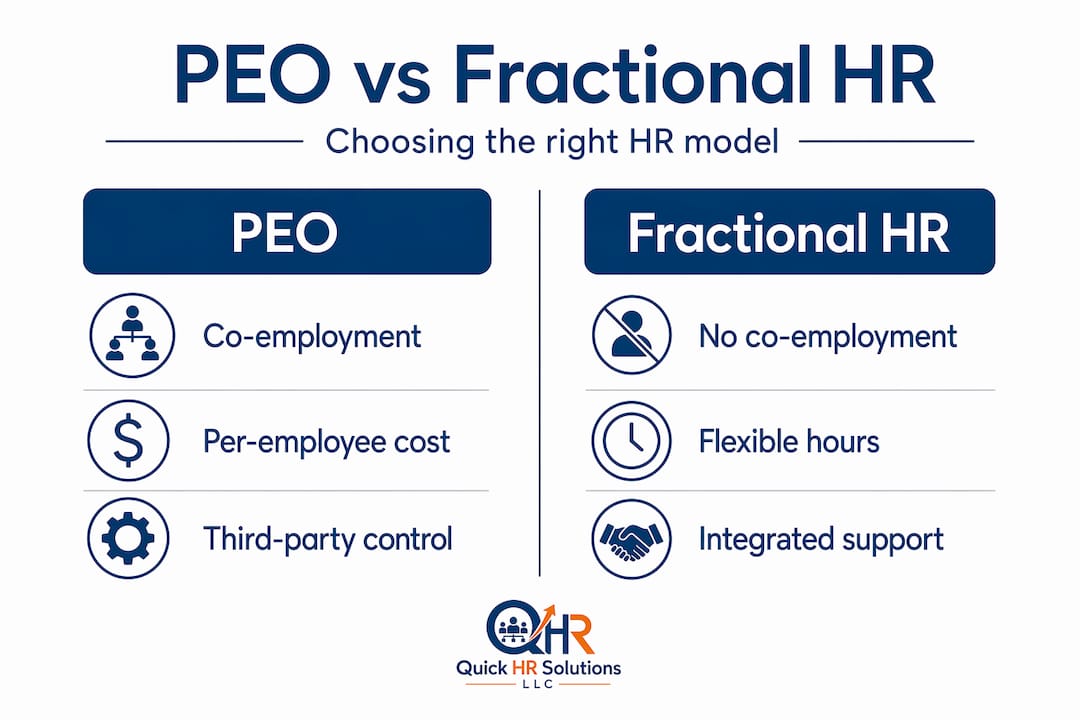
PEO co-employment can create structural complications for companies with equity-bearing employees or those operating in niche industries with specific HR requirements. Fractional HR avoids that entirely. You remain the sole employer. Your HR professional works for you, not alongside a third-party employer entity.
Here is a direct peo vs fractional hr comparison:
| Feature | PEO | Fractional HR |
|---|---|---|
| Co-employment | Yes | No |
| Typical cost | Per-employee monthly fees | $99–$600/month or hourly |
| Compliance coverage | Broad, standardized | Customized to your needs |
| Cultural integration | Limited | Deep and ongoing |
| Flexibility | Low to moderate | High |
| Best for | 25+ employees, standard structures | 10-200 employees, custom needs |
| Control over HR policy | Shared with PEO | Fully retained by company |
Outsourced HR, another common model, generally means you hand off specific HR functions to a third party that handles execution. Think payroll processing, benefits administration, or recruiting. It is transactional by design. Fractional HR, in contrast, sits at the strategic level. The real advantages of human resource outsourcing are operational efficiency and cost reduction on defined tasks. Fractional HR offers something different: embedded leadership and judgment that shapes how your entire people strategy operates.
Pro Tip: If your company has fewer than 25 employees and straightforward HR needs in a single state, a payroll service may cover you adequately. If you have multi-state complexity, equity-bearing employees, or a culture-sensitive environment, fractional HR is almost always the smarter move over a PEO.
Fractional HR pricing runs $99 to $600 per month depending on scope, which is compliance coverage comparable to a PEO at 60 to 70% lower total cost. That is a number worth sitting with.
Benefits and honest limitations of fractional HR
The benefits case is strong, but it is not unconditional. Here is a transparent look at both sides.
Where fractional HR delivers:
- Access to senior expertise without a $200,000 annual salary. Full-time HR executives routinely exceed that threshold, while fractional HR delivers comparable strategic thinking at a fraction of the investment.
- You scale up or down as your needs change. Launching a new office? Increase hours. Steady state operations? Pull back.
- No co-employment means your HR professional is genuinely your advocate, not a shared resource managing standardized protocols across hundreds of clients.
- Fractional HR professionals bring cross-industry experience from working with multiple organizations. That breadth often produces solutions your full-time hire would never have encountered.
- You maintain control over your culture, your policies, and your employer brand.
Where things go wrong:
- Scope creep is the biggest risk. Without clear boundaries, a fractional HR professional can become a generalist catch-all, answering every random HR question instead of delivering on the strategic priorities you hired them for.
- Integration takes intentional effort. If your leadership team treats the fractional HR professional as an outsider rather than a peer, you lose most of the value.
- For very large organizations with complex, high-volume HR operations, fractional HR may not provide enough bandwidth. This model works best for companies in the 10 to 200 employee range.
Pro Tip: Before signing any fractional HR agreement, write down three to five specific HR outcomes you want to achieve in the first six months. Share those with your provider and build them into the contract. Clear scope and measurable goals are what separate engagements that transform a company's people operations from ones that drift into noise.
You can explore specific benefits for Texas SMBs if you want to go deeper on how this plays out in a regional business context.
How to select and implement a fractional HR solution
Getting the engagement right from the start is what determines whether you look back on fractional HR as one of the best decisions you made or a frustrating experiment. Follow these steps.
-
Audit your current HR gaps. List every HR function your business touches: hiring, onboarding, performance management, compliance, benefits, and culture. Rate your current state on each. Where are the legal risks? Where are you losing time or people? This audit tells you exactly what to ask for.
-
Define your scope in writing before any conversations begin. Know whether you need 10 hours a month of strategic support or 25 hours a week of active engagement. Vague scope is the most common reason fractional HR engagements underdeliver.
-
Evaluate providers on culture fit, not just credentials. Certifications like SHRM-CP matter. But the fractional HR professional who will join your leadership calls needs to communicate in your company's style and earn trust from your managers. Ask for references from clients with similar company size and industry.
-
Treat onboarding seriously. Your fractional HR professional should spend the first two to four weeks meeting key stakeholders, reviewing existing policies, and understanding your workforce before recommending anything. Rushing to solutions before understanding context is a red flag. Read through this fractional HR consultant guide to know what good onboarding looks like.
-
Establish a monthly review cadence. Track progress against the outcomes you defined in step two. Review what got done, what did not, and whether the scope needs adjustment. Use HR metrics like time-to-fill, turnover rate, and policy compliance to measure real impact.
-
Avoid the "just handle it" trap. If you find yourself routing every employee issue to your fractional HR professional without involving your own managers, you are building dependency rather than capability. The goal is to develop your internal team's HR judgment over time.
My take on fractional HR after years in the field
I've watched companies cycle through PEOs, HR outsourcing vendors, and internal hires trying to solve what is fundamentally a judgment problem. HR is not a transaction. It is a series of nuanced calls that require someone who understands your specific business, your people, and your risk tolerance.

What I've found in practice is that fractional HR is one of the most underutilized tools available to mid-sized companies, particularly in markets like Dallas-Fort Worth where competition for experienced HR talent is brutal. Most leaders default to "we'll hire someone eventually" and operate in a compliance gray zone for years. The cost of that delay, in regulatory exposure, turnover, and lost productivity, almost always exceeds what fractional HR would have cost.
The theory of fractional HR is elegant. The practice requires discipline. I've seen engagements fail not because the HR professional was incompetent, but because the business owner kept adding scope without adjusting the time commitment or the fee. Then frustration builds on both sides. The fix is simple but requires honesty upfront: treat the fractional engagement like a leadership hire, not a service subscription. Set goals. Hold reviews. Adjust deliberately.
The remote and embedded fractional models are both viable now, and the market has matured enough that you can find genuine senior expertise at price points that would have been impossible a decade ago. My advice: stop waiting for the right time to build your HR infrastructure. There is no right time. There is only the cost of waiting.
— John
How Quickhrtx supports mid-sized companies in Dallas
If you've been managing HR reactively, putting out fires instead of building systems, Quickhrtx was built for exactly where you are right now.
Quickhrtx delivers fractional HR services in Dallas to mid-sized companies that need senior HR expertise without the overhead of a full-time hire. Every engagement is scoped to your actual needs, whether that's compliance infrastructure, employee relations support, or building out a full people strategy from scratch. There's no long-term lock-in and no co-employment. You stay in control of your workforce while gaining access to SHRM-certified HR leadership that scales with your growth. If you're ready to find out what a properly scoped fractional HR engagement looks like for your company, book a free consultation with the Quickhrtx team today.
FAQ
What is fractional HR in simple terms?
Fractional HR means hiring a senior HR professional on a part-time or contract basis to handle your company's HR strategy, compliance, and employee relations without bringing someone on full-time. You get senior expertise at a fraction of the cost.
How does fractional HR work day to day?
A fractional HR professional typically attends leadership meetings, advises managers on HR decisions, builds or updates policies, and manages specific HR initiatives based on a defined scope and time commitment agreed upon at the start of the engagement.
What is the difference between PEO vs fractional HR?
A PEO uses co-employment, meaning your employees technically work for both your company and the PEO. Fractional HR keeps you as the sole employer, giving you more control over HR policy, culture, and equity arrangements.
Is fractional HR a good fit for startups and mid-sized companies?
Yes. Fractional HR is particularly well-suited for companies with 10 to 200 employees, especially those operating across multiple states or with complex compliance needs, where full-time HR leadership would be costly but HR gaps carry real legal and operational risk.
How much does fractional HR cost compared to a full-time hire?
Fractional HR typically costs 40 to 60% less than hiring a full-time HR executive. Monthly pricing generally ranges from $99 to $600 depending on scope, compared to full-time HR leaders who often exceed $200,000 annually in total compensation.